
Disclaimer: This article is for educational and informational purposes only and does not constitute financial, legal or tax advice.
Carrying high-interest debt can feel like running on a treadmill that keeps speeding up. No matter how much you pay each month, the total balance barely moves.
When trying to tackle your debts, you’ll encounter three common strategies: debt consolidation, balance transfers and debt relief.
The right strategy for your situation depends heavily on your credit score, total debt load, monthly income and long-term financial goals. However, choosing the wrong path can result in additional fees, mounting interest and severe long-term damage to your credit score.
This guide breaks down how each strategy works, examines the costs and risks involved, and provides an honest decision tree to help you determine which path makes sense for your specific situation.
Debt Consolidation
Debt consolidation combines all your debt into a single payment, ideally at a lower interest rate than you’re currently paying.
This makes it both easier and quicker to get out of debt, as a greater proportion of your payment goes toward the principal amount.
If you want to consolidate your debt, you have two options:
- Transfer your existing debt to a balance transfer card
- Take out a debt consolidation loan
Which option is better suited to you depends on your credit score, the type of debt you have and your debt-to-income ratio.
1. Transfer Debt to a Balance Transfer Card
A balance transfer card allows you to move existing debt onto a single new credit card. These cards are typically used to consolidate credit card debt, although some issuers may let you transfer other debt types.
Here’s how balance transfer cards work:
- Eligibility and credit score: Usually requires a good to excellent credit score (670+).1 Best for smaller total balances as you’ll be limited by your approved credit limit.
- 0% APR promotional window: Cards offer introductory periods lasting six to 21 months with 0% APR.2 Paying off your total balance during this window eliminates interest entirely.
- Fees and fine print: Balance transfers carry a 3% to 5% fee.3 Ensure the 0% rate applies to balance transfers, not just new purchases. If you don’t clear the balance before the promotional period ends, standard APRs apply to the remainder.
A 0% APR balance transfer card gives you breathing space, allowing you to catch up on your debt payments without accumulating additional interest on top. You can use the money you would’ve paid in additional interest payments to pay off your debt faster, condensing the repayment period.
However, it’s crucial that you’re able to pay off your existing debt before the promotional period ends; otherwise you’ll be hit with standard interest rates thereafter.
Keep in mind that while many cards offer a promotional period of 0% APR on both balance transfers and ongoing purchases, some cards restrict the 0% rate to balance transfers or purchases only. That means if you charge additional purchases to a card with 0% APR on balance transfers only, you’ll continue to rack up interest on purchases even within the promotional period. So make sure to read the fine print.
2. Debt Consolidation Loan
If you owe larger balances across various debt types and need several years to repay, a debt consolidation loan may be better. They can be used to pay off medical debt, credit card debt, payday loans and various other types of debt.
Here’s an overview of how debt consolidation loans work:
- Structure and terms: Personal loans offer fixed interest rates and fixed terms ranging from two to seven years.4 You use the loan to pay off creditors, leaving you with one predictable monthly installment.
- Rates and origination fees: Borrowers with good to excellent credit qualify for lower interest rates. Many lenders charge an origination fee between 1% and 10%, which is deducted from your loan payout before disbursement.5
Debt consolidation loans can be a strong option if your debt payments account for less than 50% of your gross monthly income and if you have a larger outstanding balance that may require several years to pay off in full.6
Debt consolidation loans are also best for those with good to excellent credit scores as you’ll be able to negotiate lower interest rates and origination fees, making it a more cost-effective option.
Debt Relief
If your total monthly debt payments account for more than 50% of your gross monthly income and you're struggling to make payments, you might want to consider a debt relief strategy.
Debt relief refers to any strategy, legal process or program that seeks to restructure, reduce and eliminate unsustainable unsecured debt. That can include:
- Debt management planning with a certified credit counselor
- Debt settlement
- Filing for Chapter 7 or Chapter 13 bankruptcy
Depending on the severity of your financial situation, one option may suit you better than the other.
Debt Management Plan (DMP)
The most favorable of these options is a debt management plan, as it will do the least damage to your credit score.
Offered by nonprofit credit counseling agencies such as the National Foundation for Credit Counseling (NFCC) or the Financial Counseling Association of America (FCAA), a DMP consolidates your payments without reducing your principal debt.
- How it works: A counselor negotiates with creditors to lower interest rates, waive late fees and pause collections. You make one monthly payment to the agency, which distributes funds to your creditors. Credit counseling agencies typically charge a setup fee plus a monthly maintenance fee.
- Credit impact: DMPs cause minimal credit damage compared to other relief options. Accounts enrolled are typically closed, preventing new debt build-up.
It’s crucial to work with a counselor certified by a reputable organization, such as the NFCC or FCAA. Keep in mind that while counselors can negotiate lower interest rates and fee waivers, they cannot reduce the total amount of debt you owe.
Debt Settlement
Debt settlement companies are for-profit organizations that attempt to negotiate lump-sum payouts for less than what you owe.
- The process and costs: Settlement companies charge between 15% and 25% of your enrolled or settled debt.7 Programs typically require you to stop paying creditors, accumulating savings in a dedicated account to use as settlement leverage.
- Severe risks: Stopping payments damages your credit score, triggers late fees and penalty interest, and exposes you to creditor lawsuits. Results are never guaranteed, as creditors are not obligated to negotiate.
- Tax liabilities: Forgiven debt of $600 or more is reported to the IRS on Form 1099-C and is taxable as income unless you qualify for an insolvency exclusion.8
It’s important to understand the risk of working with debt settlement companies. If the company fails to negotiate a lower rate or forgiveness, the built-up penalty fees and additional debts could easily wipe out any short-term savings you’ve made.
Under the Federal Trade Commission's Telemarketing Sales Rule, for-profit debt settlement companies are prohibited from collecting any fees before they have settled or renegotiated at least one of your enrolled debts. The CFPB echoes this warning, so treat any company that demands payment upfront as a clear red flag.9
Unfortunately, fraudulent and deceptive practices are common in the debt settlement industry, so be sure to verify any prospective debt settlement companies using your local consumer protection agency or your state’s attorney general.
File for Bankruptcy
The last option for debt relief is filing for bankruptcy. Bankruptcy provides legal protection under federal court authority via an Automatic Stay, immediately stopping collection efforts and lawsuits.
You have two options when filing for bankruptcy:
- Chapter 7 Bankruptcy: Liquidates your non-exempt assets to pay your creditors and eliminate most unsecured debt in about six months. Chapter 7 bankruptcy remains on your credit report for up to 10 years.10
- Chapter 13 Bankruptcy: Establishes a court-approved three- to five-year repayment plan allowing you to retain your assets. Debt limits apply, including a maximum of $526,700 for unsecured debt and $1,580,125 for secured debt. You’ll also need proof of regular income. Chapter 13 bankruptcy remains on credit reports for seven years.11
While filing for bankruptcy may sound extreme, it offers a more secure path to repaying your debts than debt settlement.
Whereas filing for bankruptcy is legally protected through an Automatic Stay issued by the courts, debt settlement offers no such legal protection. Filing for bankruptcy often results in your debts being wiped out quicker, allowing you to rebuild your credit sooner.
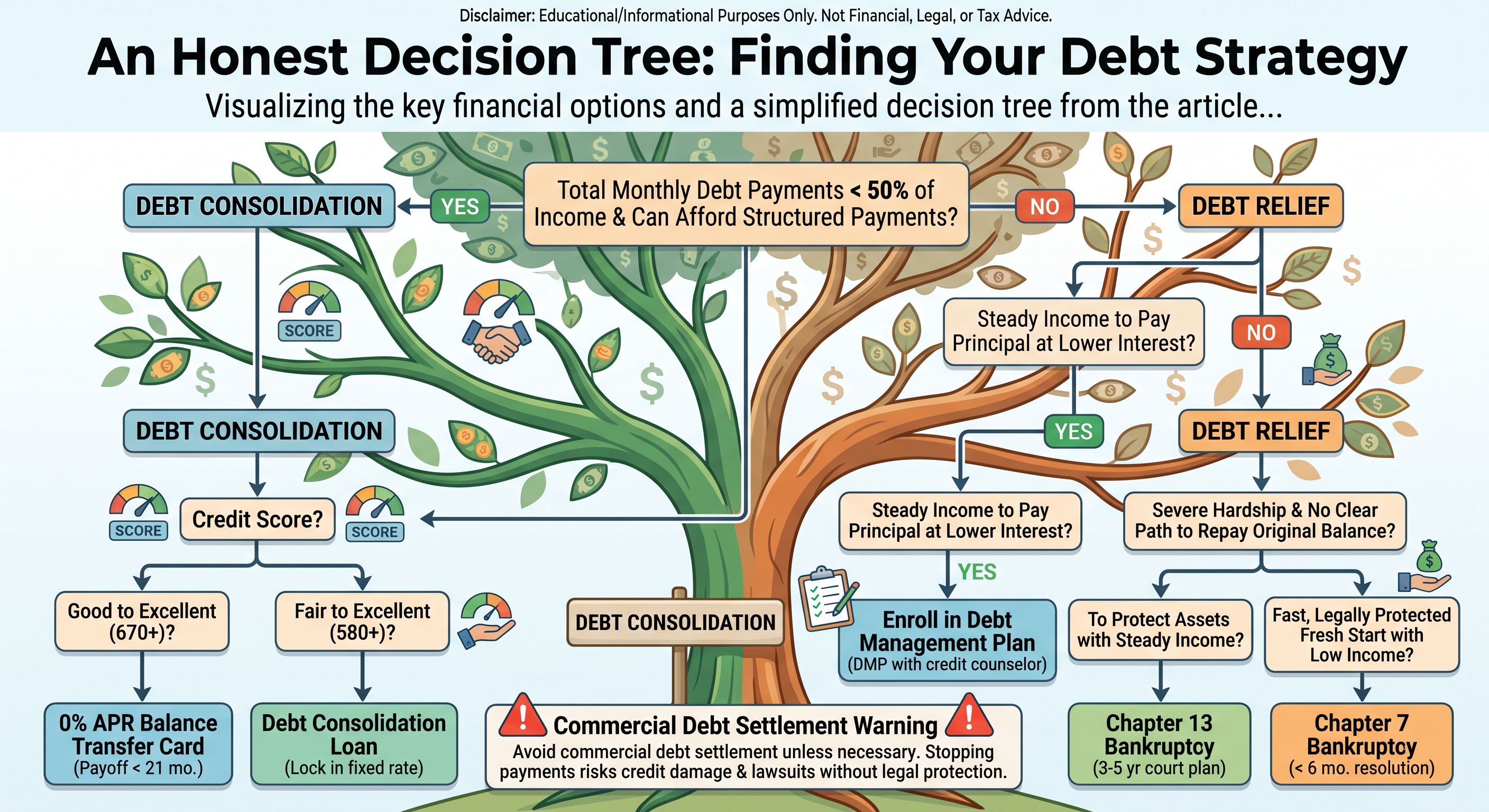
An Honest Decision Tree: Finding the Right Debt Strategy
To help you find the best path forward, here are four simple questions to direct your strategy.
1. Are your total monthly debt payments less than 50% of your gross monthly income, and can you afford structured monthly payments?
- Yes: You are a strong candidate for debt consolidation. Move to Question 2.
- No: Your debt is unsustainable. Skip to Question 3.
2. What does your credit score look like, and how fast can you pay off your balance?
- Good to Excellent credit (670+) and payoff in under 21 months: A 0% APR balance transfer card would be ideal. Factor in the 3%–5% transfer fee and clear the balance before standard rates kick in.
- Fair to Excellent Credit (580+) and need two to seven years to pay off: A debt consolidation loan may be your best fit. Lock in a fixed interest rate and watch out for origination fees (1%–10%). One caveat at the lower end of this range: loan APRs for fair credit can run high enough to match or exceed what you already pay, so this only makes sense if the rate you are offered is genuinely lower than your current debt.
3. Do you have a steady income that would allow you to pay back your principal debt if high interest rates were reduced or paused?
- Yes: Enroll in a debt management plan with a certified credit counselor. You’ll repay 100% of your principal at lower rates without defaulting.
- No: Move to Question 4.
4. Are you experiencing severe hardship with no clear path to repaying the original balance?
- To protect assets with steady income: File Chapter 13 Bankruptcy for a court-monitored three- to five-year plan.
- For a fast, legally protected fresh start with low income: File Chapter 7 Bankruptcy to resolve debt in under six months.
- Commercial debt settlement warning: Avoid commercial debt settlement unless necessary. Stopping payments carries severe credit damage, lawsuit risks and tax burdens without legal court protections.
When None of These Options Are Right for You (and What to Do Instead)
There are situations where taking out new credit products, entering a debt relief program or filing for court protection doesn’t make sense.
These include the following situations:
- Your debt burden is small: If you owe a small amount relative to your income, the fees associated with balance transfers (3%–5%) or consolidation loan origination fees (1%–10%) may cost you more than the potential interest savings.
- The root cause of spending isn't addressed: Using a balance transfer card or personal loan to pay off credit cards frees up your available credit lines. If your underlying spending habits haven't changed, you run the risk of running those credit balances back up while simultaneously owing a loan payment.
- You have unstable or zero income: If you lack a predictable stream of income, you will likely not qualify for affordable consolidation loans or balance transfer cards, nor will you be able to maintain a debt management plan or file Chapter 13 bankruptcy.
If one of these situations aligns with your own, here are some alternative strategies to consider:
- Self-directed payoff strategies: If you can make more than the minimum payments, choose between paying off the highest-interest debt first (Debt Avalanche method) or paying off the smallest balance first (Debt Snowball method).
- Hardship programs directly with creditors: Many lenders offer temporary relief programs that lower interest rates or waive fees for 6 to 12 months due to job loss, illness or major life changes.
- Nonprofit credit counseling sessions: Speaking with a certified nonprofit credit counselor (via NFCC or FCAA) for an initial consultation is typically free or low-cost and doesn’t require enrolling in a formal plan. They can help you audit your budget, reorganize expenses and evaluate your situation without affecting your credit score.
Frequently Asked Questions (FAQ)
1. Will consolidating my debt lower my credit score?
Applying for new credit causes a minor, temporary dip from hard inquiries. Shuttering old accounts and opening new credit lines also lowers the overall age of your accounts, which can temporarily hurt your credit score. However, replacing maxed-out revolving credit with a structured loan lowers your credit utilization ratio and builds positive payment history, improving your score — provided you make timely payments.
2. How long does commercial debt settlement take?
Settlement programs generally take 24 to 48 months. The timeline depends on how quickly you accumulate funds and whether creditors agree to negotiate.
3. Can a debt settlement company guarantee debt reduction?
No. CFPB and FTC guidelines prohibit companies from guaranteeing outcomes because creditors are not obligated to negotiate. Avoid companies claiming guaranteed savings or demanding upfront fees.
Bottom Line
Finding the right strategy to manage or eliminate debt is rarely a one-size-fits-all process. What works for someone with strong credit and a small, short-term deficit looks entirely different from what works for someone facing severe financial hardship and struggling to cover basic living expenses.
Take time to review your budget and consider speaking with a certified nonprofit credit counselor before making a commitment. With a clear understanding of the options and a plan tailored to your reality, you can take meaningful steps toward lasting financial freedom.
References
1. Experian. “What Are Balance Transfer Credit Cards?” https://www.experian.com/blogs/ask-experian/credit-education/balance-transfer-credit-cards
2. Forbes Advisor. “Longest 0% APR Cards For Balance Transfers Of September 2026”. https://www.forbes.com/advisor/credit-cards/best/longest-0-apr-cards-for-balance-transfer
3. NFCC. “Should You Use a Personal Loan or Balance Transfer to Pay off Credit Card Debt?” https://www.nfcc.org/blog/ask-expert-good-idea-seek-personal-loan-balance-transfer-take-pay-off-substantial-balance-credit-card/
4. Experian. “What Are the Different Types of Personal Loans?” https://www.experian.com/blogs/ask-experian/types-of-personal-loans
5. LendingTree. “Origination Fees on Personal Loans: What To Know Before You Pay” https://www.lendingtree.com/personal/understanding-origination-fees
6. Experian. “7 Things Lenders Look at Besides Your Credit Score” https://www.experian.com/blogs/ask-experian/7-things-lenders-look-at-besides-your-credit-score
7. CNBC Select. “How much does debt settlement cost?” https://www.cnbc.com/select/how-much-does-debt-settlement-cost/
8. Internal Revenue Service. “Topic no. 431, Canceled debt – Is it taxable or not?” https://www.irs.gov/taxtopics/tc431
9. Federal Trade Commission. “Debt Relief Services & the Telemarketing Sales Rule: What People Are Asking.” https://www.ftc.gov/business-guidance/resources/debt-relief-services-telemarketing-sales-rule-what-people-are-asking and CFPB. “How to get a handle on debt” https://www.consumerfinance.gov/archive/blog/how-get-handle-debt/
10. United States Courts. “Chapter 7 - Bankruptcy Basics” https://www.uscourts.gov/court-programs/bankruptcy/bankruptcy-basics/chapter-7-bankruptcy-basics
11. United States Courts. “Chapter 13 - Bankruptcy Basics” https://www.uscourts.gov/court-programs/bankruptcy/bankruptcy-basics/chapter-13-bankruptcy-basics