

Key takeaways
- Claiming Social Security at 62 pays 70% of your full benefit for life if your full retirement age is 67, while each year you delay past it, up to 70, adds 8%.
- COBRA and retiree coverage don't extend Medicare's eight-month enrollment window, and missing it can mean a Part B penalty of 10% for each full year you went without coverage.
- Your Medicare premiums are based on income from two years earlier, and Form SSA-44 lets you ask for a reduction after you stop working.
- Rolling a 401(k) into an IRA can forfeit the age-55 exception to the 10% additional tax, and an indirect rollover triggers 20% mandatory withholding.
- A cash and short-term bond reserve can help you avoid selling investments during a downturn in your first years of retirement.
You spend years looking forward to the day you stop working. What many people don't know is there is a stack of decisions that shows up right alongside it, from a Social Security application and Medicare enrollment forms to a letter asking what you'd like to do with the 401(k) you've spent decades contributing to.
And then there's the first month when no paycheck lands in your account, which changes how every dollar you spend feels.
Each of those decisions looks administrative, which is exactly why they're easy to rush. But several of them can't be undone once a window closes, and a few carry costs that follow you for the rest of your life. The first year of retirement is when the largest number of these choices arrive at once, and it's also the year when you have the least experience making them.
This guide walks through five first-year mistakes that can cost new retirees real money, why each one happens, and what you can do before or shortly after your last day of work to avoid it. Avoiding them doesn't require a perfect plan. What it does require is knowing where the deadlines and the surprise costs are before you reach them.
Why does the first year carry so much weight?
For a variety of reasons, retirement doesn’t always unfold on the schedule people set for it. In the 2026 Retirement Confidence Survey, nearly half of retirees said they stopped working earlier than they had planned, and the median retirement age among retirees was 62(1). That's three years before your Medicare enrollment window opens around your 65th birthday(6), and it's five years before full retirement age for Social Security if you were born in 1960 or later(2). An exit that comes earlier than expected takes decisions you thought you'd have years to research and compresses them into a few weeks.
The same survey found that two in five retirees said their overall expenses in retirement have been higher than they expected, and two in five said the same about their health care costs. Fewer than half of workers and retirees said they had calculated how much they'll need for health care in retirement(1).
Even carefully laid plans can miss a few moving parts.
What makes the first year different is that it's the only time several one-way doors open together. Your Social Security claiming age sets a monthly benefit that, apart from a narrow correction window, stays with you for life. Your Medicare enrollment timing determines whether you pay a standard premium or a permanently higher one. The way you move money out of an employer retirement plan decides which tax rules apply to it afterward. And the withdrawals you take while your portfolio is at its largest have an outsized effect on how long it lasts.
The five mistakes below follow those decisions, roughly in the order you're likely to face them. Some will apply to you and some won't, depending on your age, your health coverage, and how your savings are set up, so read each one with your own timeline in mind.
Mistake 1: Claiming Social Security on autopilot
For many new retirees, filing for Social Security feels like the natural first step of retirement, the moment the system starts paying back what you put in over your career. The trouble is that the age you file at sets the size of every check that follows, and the difference between filing early and waiting is larger than many people expect.
Full retirement age (FRA) is the age at which you're entitled to your full, unreduced benefit, and it's 67 for anyone born in 1960 or later. You can start as early as 62, but your benefit is permanently reduced for each month you claim before FRA. Claiming at 62 pays 70% of your full benefit, claiming at 64 pays 80%, and claiming at 65 pays about 86.7%(2). Waiting works in the other direction.
For each month you delay past full retirement age, up to age 70, your benefit grows by two-thirds of 1%, which adds up to 8% per year for anyone born in 1943 or later(3).
To put that in dollars, take a hypothetical retiree whose full benefit at 67 would be $2,000 a month. Claiming at 62 would lock in $1,400 a month, while waiting until 70 would raise it to $2,480, which is a difference of $1,080 every month for the rest of that person's life. Those figures are illustrative only, and your own numbers will depend on your earnings record.
None of this means waiting is always the right call. It’s a highly personal decision each person has to make for themselves.
If your health is poor, if you have no other way to cover expenses until a later claiming age, or if the benefit is what keeps you from selling investments during a downturn, claiming earlier can be a reasonable choice. The mistake is filing by default, simply because the paycheck stopped, without comparing what each claiming age means for your household over a retirement that could span decades.
Married couples have an added layer to consider, because spousal benefits follow their own reduction schedule. A spouse who claims on the other's record at 62 receives 32.5% of the worker's full benefit, compared with 50% at full retirement age(2). That's one more reason to compare claiming ages as a household decision rather than two separate ones.
What if you've already filed and want to cancel?
Social Security offers a narrow do-over. You can cancel your application up to 12 months after your benefits are approved, but you can only do it once, and you'll have to repay everything you and your family received, including amounts withheld for Medicare premiums and taxes. If any medical expenses were paid by Medicare Part A during that period, those have to be repaid as well(4).
For someone who filed in a hurry after an unexpected layoff and then found other income a few months later, that withdrawal can reset the clock and allow a larger benefit down the road.
Once the 12-month window has passed, a second option opens only at full retirement age. At that point, you can pause your payments, which increases your future benefit by up to 8% per year, and payments restart automatically at 70 if you don't restart them sooner. While your benefit is paused, anyone collecting on your record stops receiving payments too, and you'll need to keep paying your Medicare premiums to hold onto that coverage(5).
Mistake 2: Letting COBRA run past your Medicare deadline
Health coverage is one of the first things people think about when they leave a job. Continuing an employer plan through COBRA, the federal law that lets you temporarily keep your former employer's health plan after you leave, can feel like the safest bridge. For anyone 65 or older, that bridge has a crack in it that often doesn't show up until years later.
Medicare gives you an Initial Enrollment Period (IEP), which is a seven-month window that starts three months before the month you turn 65 and ends three months after it. If you were still working at 65 and covered by a health plan through your job or your spouse's job, you get a separate Special Enrollment Period (SEP) that ends eight months after that employment or coverage ends, whichever happens first(6).
That eight-month clock is where new retirees can get caught, because Medicare is explicit that COBRA isn't considered group health plan coverage, and choosing COBRA doesn't change when the window ends. Medicare also lists the end of COBRA or the end of retiree coverage among the situations that don't qualify you for a new Special Enrollment Period(6). For example, a hypothetical retiree who leaves work at 66, stays on COBRA for 18 months, and then tries to sign up for Part B when COBRA ends has already missed the window by roughly 10 months.
If you miss it, you'll have to wait for the General Enrollment Period, which runs from January 1 through March 31 each year, with coverage starting the month after you sign up(6). You may also owe a late enrollment penalty, which adds 10% to your Part B premium for each full 12-month period you could have signed up but didn't, and for many people that penalty lasts as long as they have Part B(7).
What does that penalty cost in real dollars?
Medicare's own example shows how quickly it adds up. Someone who waited two full years without qualifying for a Special Enrollment Period would pay a 20% penalty on top of the 2026 standard Part B premium of $202.90, which brings their monthly premium to $243.50(7).
Because the penalty is a percentage of the standard premium, it rises whenever the standard premium rises, and it doesn't fall away at 70 or 80.
A similar penalty applies to Medicare drug coverage, known as Part D, if you go 63 days or more without creditable drug coverage, which Medicare describes as coverage similar in value to Part D. That penalty adds 1% of a national base premium for each month you went without coverage, and it stays attached to your drug plan premium even if you switch plans(7).
If you're leaving a job at or after 65, the safer sequence is to confirm your Medicare start date before your employer coverage ends, and then decide whether COBRA still makes sense alongside Medicare rather than in place of it. If you're retiring before 65, mark the start of your Initial Enrollment Period on your calendar now, because it arrives on the same schedule whether or not you're still thinking about work.
Mistake 3: Overpaying Medicare because of your old income
Once you're enrolled, you'd reasonably expect to pay the standard Part B premium. Some new retirees open their first premium notice and find a much larger number, along with a letter referencing an income-related monthly adjustment amount, or IRMAA. It's a surcharge on Part B and Part D premiums for people with higher incomes, and it catches retirees off guard because of which year's income it uses.
To set your IRMAA, Social Security looks at your modified adjusted gross income (MAGI), which is your adjusted gross income plus certain tax-exempt income, from the federal tax return you filed two years earlier. For 2026 premiums, that means your 2024 tax return, or your 2023 return if the 2024 one wasn't available(8).
If 2024 was your last full year of work, your premium is being set by a salary you've already stopped earning.
For 2026, no surcharge applies if that MAGI was $109,000 or less for individual filers, or $218,000 or less for joint filers. Above those levels, the surcharge rises in tiers, and because each tier covers a fixed income range, crossing a threshold by even a small amount moves you into the next bracket(9).
2026 Medicare premiums for joint filers, based on 2024 income:
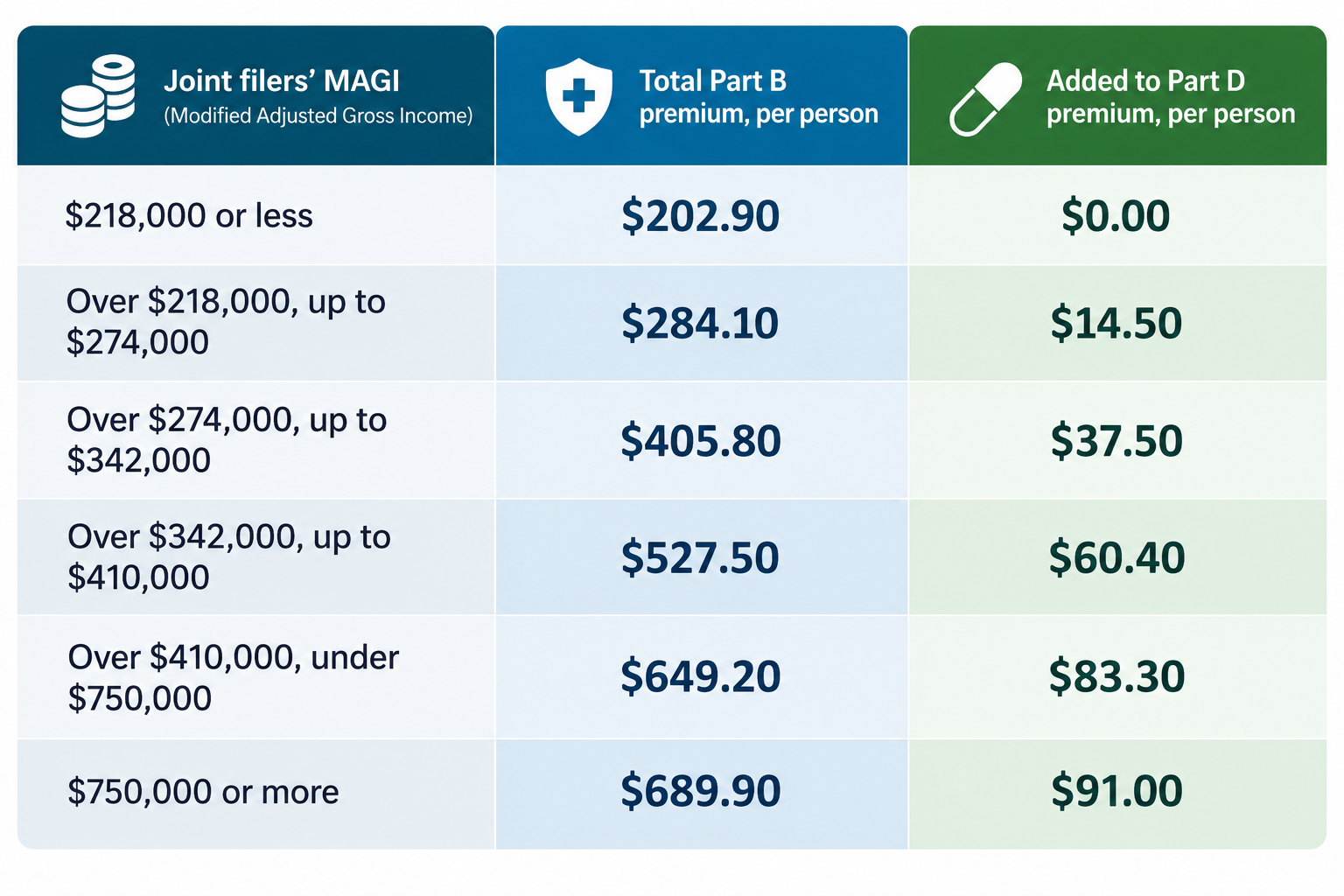
Consider a hypothetical married couple who both turn 65 in 2026, retire that spring, and reported a joint MAGI of $300,000 on their 2024 return. Each spouse would pay $405.80 a month for Part B instead of $202.90, plus an extra $37.50 a month on top of their Part D plan premium(9). Across both spouses, that comes to $480.80 a month, or $5,769.60 for the year, in surcharges tied to income they no longer have.
The same two-year lookback also works in reverse, which is easy to forget in a busy first year. A large retirement account withdrawal, a Roth conversion, or a one-time gain from selling a property or investment raises your MAGI for that year, which is the year Social Security will look at when it sets your premiums two years later(8).
Can you get the surcharge reduced?
Yes, if your income dropped because of what Social Security calls a life-changing event. Stopping work or reducing your hours qualifies, alongside marriage, divorce, the death of a spouse, and the loss of pension income. You make the request with Form SSA-44, and you can ask Social Security to use a more recent year's income, including an estimate of your income for the current premium year if that's the year your earnings fell(8).
You'll need evidence of the work stoppage, such as a signed statement from your employer or copies of pay stubs, and Social Security will later check any estimate you provide against your actual tax return(8). The form can be submitted online, or you can fax or mail it to a local Social Security office(10). The mistake isn't having a high income in your final working years. It's paying the higher premium for a year or more without knowing that a correction exists.
Mistake 4: Moving your 401(k) before checking what you'd give up.
After you leave a job, you'll need to decide what to do with the money in your former employer's 401(k), the workplace retirement account many people contribute to through payroll. Rolling it into an individual retirement account (IRA) is a common answer, and for many people it's a sensible one. But the timing and the method of that move carry two traps that tend to surface in the first year.
What happens to the age-55 exception when you roll over?
Withdrawals from retirement accounts before age 59½ generally carry a 10% additional tax on top of regular income tax. One exception, often called the rule of 55, applies to employer plans like a 401(k) when you leave your job during or after the calendar year you turn 55. If you qualify, you can take money from that employer's plan before 59½ without the 10% additional tax, although ordinary income tax still applies(11).
That exception doesn't carry over to IRAs.
If you retire at 57, roll your entire 401(k) into an IRA, and then need money at 58, those IRA withdrawals would generally face the 10% additional tax unless a different exception applies. Leaving at least part of the balance in the employer plan until you reach 59½, or until you're confident you won't need it, can preserve an option you would otherwise give up with a single transfer. Before you decide, ask your plan administrator how withdrawals work once you've left the company.
Why does the way you move the money make a difference?
There are two ways to roll over an employer plan. In a direct rollover, the plan sends the money straight to your new IRA or plan. In an indirect rollover, the plan pays you, and you have 60 days to deposit it into another eligible retirement account. The indirect route comes with mandatory federal income tax withholding, generally at 20%, even if you fully intend to roll the money over(12).
Here's how that plays out with a hypothetical $100,000 balance. With an indirect rollover, you'd receive a check for $80,000, with $20,000 withheld for taxes. To roll over the full $100,000 and keep the entire amount tax-deferred, you'd have to deposit $100,000 within 60 days, which means covering the missing $20,000 from other savings. Any portion you don't roll over counts as taxable income for that year, and if you're under 59½ it may also face the 10% additional tax unless an exception applies. A direct rollover avoids the mandatory withholding entirely(12).
Withholding is also a reminder that your tax picture changes once payroll stops. For decades, an employer calculated and withheld your taxes for you. In retirement, that job shifts to you, and the default withholding rate on a retirement plan distribution may be too low for your situation, which is why the IRS offers Form W-4R to let you choose to withhold a higher rate(12).
Mistake 5: Spending without a withdrawal plan
After decades of saving, the first year of retirement can bring spending you'd put off for years, whether that's travel, a home project, or helping family. None of that is a mistake on its own. The risk comes from pulling larger amounts from your investments without a plan for what happens if the market falls at the same time.
This is known as sequence-of-returns risk, which describes how the order of investment returns, and not just their average, affects how long your savings last. When you sell investments during a decline to cover expenses, you have to sell more shares to raise the same amount of cash, and that leaves fewer shares in place to recover when prices rebound(13).
A Schwab Center for Financial Research hypothetical illustration compares two retirees who each start with $1 million, withdraw $50,000 in the first year, and raise withdrawals 2% a year for inflation. The first loses 15% in each of the first two years of retirement and earns 6% a year afterward, and that portfolio runs out in roughly 18 years. The second earns 6% a year but takes the same 15% losses in years 10 and 11, and after 18 years still has nearly $400,000(13). Both retirees experience the same returns over those 18 years, only in a different order.
How do retirees protect against a bad start?
One approach is to keep a reserve that lets you avoid selling stocks during a downturn. A common framework holds one year of expenses, after accounting for Social Security and other income, in cash investments, along with another two to four years of expenses in high-quality short-term bonds or short-term bond funds(13).
With that cushion in place, a market decline in your first few years doesn't force you to sell investments at depressed prices just to pay the bills.
If you don't have that cushion, scaling back withdrawals, skipping an inflation increase for a year, or postponing a large purchase can help you avoid locking in losses. In the same hypothetical, a retiree who cut withdrawals to 2% of the portfolio after two down years recovered to the starting balance after about 11.5 years of 6% gains, while one who kept withdrawing 4% needed 28 years(13).
A written withdrawal plan doesn't need to be elaborate. It should settle which accounts you'll draw from first and how much you'll take each month, and it should spell out what you'll change if the market drops sharply during your first two years. Deciding those things in advance is far easier than deciding them while watching your balance fall.
Which assumptions tend to trip up new retirees?
Beyond the five decisions above, a few common beliefs about retirement lead people toward those mistakes without their noticing.
Expecting expenses to fall right away. It's natural to assume that spending drops once commuting, work clothes, and payroll deductions disappear. Yet two in five retirees in the 2026 Retirement Confidence Survey said their overall expenses have been higher than they expected(1). Basing your first-year budget on your actual recent spending, rather than a rule of thumb, gives you a more reliable starting point.
Assuming Medicare will cover the bills. Medicare pays for a great deal, but it isn't free and it isn't comprehensive. In 2026, the Part B deductible is $283, and a hospital stay carries a Part A deductible of $1,736 per benefit period before Medicare pays its share(9). Two in five retirees said their health care costs in retirement have been higher than they expected(1).
Believing any job will cost you your Social Security. If you claim before full retirement age and keep working, Social Security withholds $1 for every $2 you earn above an annual limit, which is $24,480 in 2026(14). That money isn't lost, though. Once you reach full retirement age, your benefit is recalculated to credit you for the months that were withheld, and only wages and self-employment income count toward the limit, not pensions, annuities, or investment income(14). In the year you first retire, a special rule lets you receive a full check for any month your earnings stay at or below $2,040, provided you're under full retirement age all year and not performing substantial self-employment work, even if you earned far more earlier in the year(15).
Who can help you check your first-year plan?
If your last day of work is on the calendar, or already behind you, and you're not sure whether your claiming age, your Medicare timing, your rollover, and your withdrawal plan fit together, you don't have to work through them one form at a time. A financial advisor can look at these decisions as a single plan and help you spot the deadlines that apply to you before they pass.
Answer a few questions to get matched with a financial advisor.
References
1. Employee Benefit Research Institute and Greenwald Research. "2026 Retirement Confidence Survey Finds Americans Less Confident About Retirement as Worries Grow Over Social Security, Medicare and Rising Costs." April 21, 2026. https://www.ebri.org/content/2026-retirement-confidence-survey-finds-americans-less-confident-about-retirement-as-worries-grow-over-social-security--medicare-and-rising-costs
2. Social Security Administration. "If you were born in 1960 or later, your full retirement age is 67." https://www.ssa.gov/benefits/retirement/planner/1960.html
3. Social Security Administration. "Delayed Retirement Credits." https://www.ssa.gov/benefits/retirement/planner/delayret.html
4. Social Security Administration. "Cancel your benefits application." https://www.ssa.gov/manage-benefits/cancel-your-benefits-application
5. Social Security Administration. "Pause your Retirement benefit." https://www.ssa.gov/manage-benefits/pause-retirement
6. Medicare.gov. "When does Medicare coverage start?" https://www.medicare.gov/basics/get-started-with-medicare/sign-up/when-does-medicare-coverage-start
7. Medicare.gov. "Avoid late enrollment penalties." https://www.medicare.gov/basics/costs/medicare-costs/avoid-penalties
8. Social Security Administration. "Medicare Income-Related Monthly Adjustment Amount - Life-Changing Event" (Form SSA-44, 12-2025). https://www.ssa.gov/forms/ssa-44.pdf
9. Centers for Medicare & Medicaid Services. "2026 Medicare Parts A & B Premiums and Deductibles." November 14, 2025. https://www.cms.gov/newsroom/fact-sheets/2026-medicare-parts-b-premiums-deductibles
10. Social Security Administration. "Request to lower an Income-Related Monthly Adjustment Amount (IRMAA)." https://www.ssa.gov/medicare/lower-irmaa
11. Internal Revenue Service. "Retirement topics - Exceptions to tax on early distributions." https://www.irs.gov/retirement-plans/plan-participant-employee/retirement-topics-exceptions-to-tax-on-early-distributions
12. Internal Revenue Service. "Topic no. 413, Rollovers from retirement plans." https://www.irs.gov/taxtopics/tc413
13. Charles Schwab. "What Is Sequence-of-Returns Risk?" January 30, 2026. https://www.schwab.com/learn/story/timing-matters-understanding-sequence-returns-risk
14. Social Security Administration. "Receiving Benefits While Working." https://www.ssa.gov/benefits/retirement/planner/whileworking.html
15. Social Security Administration. "Special Earnings Limit Rule." https://www.ssa.gov/benefits/retirement/planner/rule.html
Medicare premiums, deductibles, IRMAA thresholds, and Social Security earnings limits reflect 2026 figures and adjust annually; confirm the current year's amounts before relying on them. Social Security reduction percentages and delayed retirement credits reflect rules for people born in 1960 or later. Survey figures reflect the 2026 Retirement Confidence Survey, conducted January 2026. All illustrative examples are hypothetical.