

Key takeaways
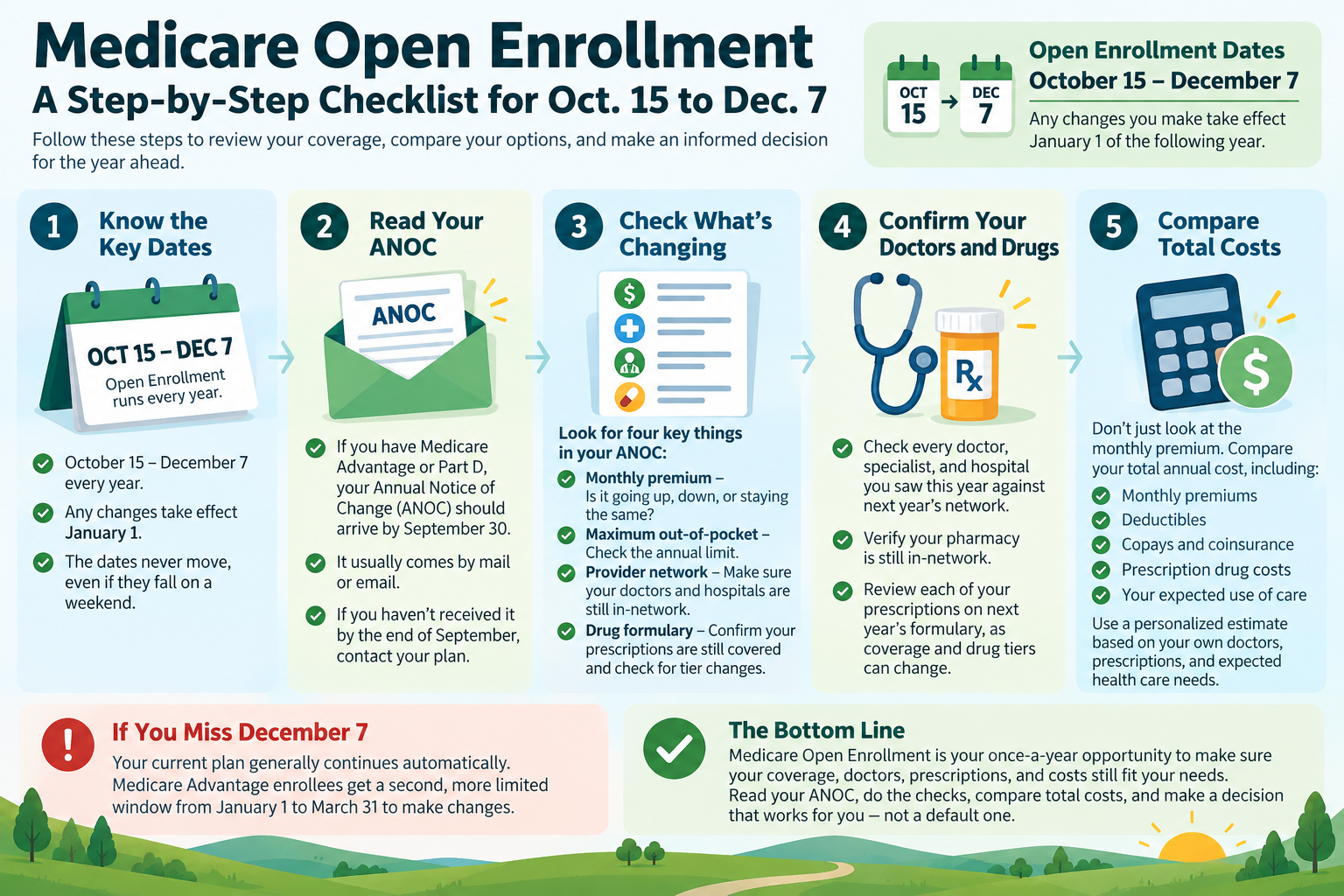
- Medicare Open Enrollment runs October 15 through December 7 every year, with any changes taking effect January 1.
- Your ANOC should arrive by September 30 if you have Medicare Advantage or Part D coverage. Read it before comparing anything else.
- Check your specific doctors, specialists, and prescriptions against next year's network and formulary, not just this year's.
- Compare total annual cost, not just the monthly premium, using a personalized estimate rather than a generic one.
- If you miss December 7, your current plan generally continues automatically, and Medicare Advantage enrollees get a second, more limited window from January 1 to March 31.
Every fall, a thick envelope or a series of emails shows up from your Medicare plan, and every fall it is easy to set them aside for ‘later’. Then December hits, the window closes, and whatever you had stays in place for another year, changes and all. We wrote this checklist to help prevent that. It walks through exactly what to do, in order, during the one window each year when you can change your coverage.
This is not a guide to which type of plan is right for you. It will not tell you to pick Original Medicare over Medicare Advantage or one drug plan over another. It's the procedure, covering what arrives, what to read, what to check, and what to click, so that whatever decision you make is an informed one.
When does the window open and close?
Medicare's Open Enrollment Period, also called the Annual Enrollment Period, runs from October 15 through December 7 every year(1). Any change you make during that window takes effect January 1 of the following year(2). The dates themselves never move, even when October 15 or December 7 lands on a weekend.
During this window, you can switch from Original Medicare to a Medicare Advantage plan or back again, move from one Medicare Advantage plan to another, and join, drop, or switch a Part D prescription drug plan(2).
What you're allowed to change depends on what you currently have, so the first useful step is simply confirming your current coverage type before you look at anything else.
Did your Annual Notice of Change arrive?
If you're enrolled in a Medicare Advantage plan or a standalone Part D drug plan, your insurer is required to send you an Annual Notice of Change, usually shortened to ANOC, no later than September 30(3). It typically arrives by mail or email, depending on which one you selected when you enrolled. If you haven't received it by the end of September, contact your plan directly and ask for it. Original Medicare and Medigap enrollees do not receive an ANOC, since those don't change plan to plan the way Medicare Advantage and Part D do.
The ANOC is usually 15 to 30 pages, and it compares your plan's current benefits against what changes on January 1. Don't confuse it with the Evidence of Coverage, a longer document, often over 100 pages, that spells out the full legal detail of what your plan covers. The ANOC is the summary worth reading closely. The Evidence of Coverage is the reference to pull out if a specific question comes up later.
What should you look for inside it?
Four things determine whether your current plan still fits, and all four show up in the ANOC.
- Monthly premium. Check whether it's going up, staying flat, or dropping, and by how much.
- Maximum out-of-pocket amount. This is the ceiling on what you'd pay for covered services in a plan year, and insurers can and do adjust it annually.
- Provider network. Confirm the doctors, specialists, and hospitals you use are still listed as in-network for next year, not just this year.
- Drug coverage. If you take prescriptions, check whether they're still covered, and at what tier, since tier placement affects your copay directly.
A plan that looks unchanged on the surface can still cost you real money if your specific doctor drops out of network or your specific medication moves to a higher tier. General plan ratings don't catch that. Only checking your own list against the ANOC does.
Are your doctors and pharmacy still covered?
This step gets skipped more than any other, mostly because it takes the most legwork. Pull up your plan's current provider directory (available on the insurer's website or by phone) and check every doctor, specialist, and hospital you saw in the past year. Do the same for your pharmacy. Networks shift for reasons that have nothing to do with your plan's overall quality, and a doctor dropping out of network is often the single biggest cost surprise people run into come January.
If you take regular prescriptions, cross-reference each one against next year's formulary, not just this year's. A drug that was covered at a low copay this year can move to a specialty tier next year with no warning beyond the ANOC itself.
How do the total costs compare?
The premium is the number insurers advertise, but it's rarely the number that determines what you'll spend over a full year. Add up the premium, deductible, copays for the visits and prescriptions you use, and the maximum out-of-pocket limit, then compare that total across your current plan and any alternative you're considering. Medicare's Plan Finder tool at Medicare.gov lets you enter your specific medications and preferred pharmacy to generate a personalized cost estimate.
If you take prescription drugs, one structural change is worth knowing about regardless of which plan you're comparing. Starting in 2026, every Part D plan, including the drug coverage packaged with Medicare Advantage plans, caps your out-of-pocket prescription costs at $2,100 for the year(4). Once you hit that cap, your plan covers the full cost of your covered drugs for the rest of the calendar year. That figure adjusts annually, so confirm the number that applies to the coverage year you're shopping for rather than assuming it’s going to remain the same.
What does the plan's star rating tell you, and what doesn't it tell you?
Medicare assigns a star rating (1 to 5) to every Medicare Advantage and Part D plan, based on member experience, customer service, and clinical quality measures. It's a useful sanity check, but it's an average across a large pool of enrollees rather than a measure of how the plan performs for your specific doctors, prescriptions, or health needs. Use it as one data point alongside the network and formulary checks above, not as a replacement for them.
How do you make a change?
Once you've decided a change makes sense, you have three ways to do it. You can make the change online through your Medicare.gov account, by phone through 1-800-MEDICARE, or directly through the new plan's enrollment process if you're moving to a different Medicare Advantage or Part D plan. If you're switching plans, you generally don't need to cancel the old one. Enrolling in a new Medicare Advantage or Part D plan automatically disenrolls you from the old one once the new plan takes effect.
If you're moving from Medicare Advantage back to Original Medicare and you want a Medigap supplement to go with it, check your state's specific rules first. Federal guaranteed-issue protections for Medigap are narrower outside your initial enrollment window, and some states offer broader protections than federal law requires.
Keep a copy of your confirmation number or confirmation email from whichever channel you used to make the change.
How do you confirm the change went through?
Don't submit the request and assume it's done. Within a few weeks, you should receive a confirmation from your new plan along with a new member ID card. If you don't see it by mid-December, call the plan directly to confirm your enrollment was processed before January 1. Having your confirmation number ready will make this process easier if you need to contact them directly.
What happens if you miss December 7?
If you don't make any changes by the deadline, your current coverage generally rolls over automatically into the new year, provided your current plan is still offered in your area(5). That means whatever changes were listed in your ANOC, higher premium, narrower network, reshuffled formulary, take effect whether or not you reviewed them.
Missing the window doesn't mean you're locked in with zero options for a full year. If you have a Medicare Advantage plan, a separate Medicare Advantage Open Enrollment Period runs from January 1 through March 31 and lets you make one additional switch, either to a different Medicare Advantage plan or back to Original Medicare(5). Outside of that, Special Enrollment Periods exist for specific circumstances, such as moving to a new address or losing other health coverage, but they don't offer the same open flexibility as the fall window.
Common mistakes to watch for
Assuming no letter means no changes. Some people read a missing or unopened ANOC as a sign their plan is staying the same. Insurers make changes to premiums, formularies, and networks most years, letter or no letter, so the safest assumption is that something changed until you've confirmed otherwise.
Comparing plans on premium alone. A lower premium with a higher deductible, a narrower network, or a reshuffled formulary can cost more over a full year than a plan with a higher sticker price. The total cost comparison above exists specifically to catch this.
Waiting until the first week of December. Enrollment requests take time to process, and issues, such as a plan not recognizing your Medicare number or a doctor's network status showing differently on two different tools, take even longer to sort out. Starting the review process in October, as soon as the window opens, leaves room to fix problems before the deadline instead of racing it.
Once you've reviewed your ANOC and confirmed your specific doctors and prescriptions are covered, comparing your options side by side is the next step.
Medicare disclaimer: Medicare plan availability and costs vary by location. Contact a licensed Medicare advisor or visit Medicare.gov to compare plans available in your area.
References
1. Centers for Medicare & Medicaid Services. "Medicare Open Enrollment." https://www.cms.gov/priorities/key-initiatives/medicare-open-enrollment-partner-resources
2. Medicare.gov. "Open Enrollment." https://www.medicare.gov/health-drug-plans/open-enrollment
3. National Council on Aging. "What Is a Medicare Annual Notice of Change (ANOC)?" https://www.ncoa.org/article/what-is-a-medicare-annual-notice-of-change-anoc/
4. AARP. "Medicare Drug Payment Changes for 2026." https://www.aarp.org/medicare/future-medicare-drug-payment-changes-2026/
5. Kiplinger. "Missed Medicare Open Enrollment? Here Are Your Options." https://www.kiplinger.com/retirement/medicare/missed-medicare-open-enrollment-now-what
Dates reflect the annual Medicare Open Enrollment Period, which recurs on the same October 15 to December 7 schedule each year. The $2,100 Part D out-of-pocket cap applies to the 2026 plan year and adjusts annually. Confirm the current figure for the plan year you are shopping for before relying on it.