

KEY TAKEAWAYS
- The Lifetime Penalty Trap: Delaying past your 7-month Initial Enrollment Period (IEP) surrounding your 65th birthday without qualifying coverage triggers a permanent 10% Part B premium penalty for every full 12-month period you go without Part B, alongside a permanent 1% Part D drug penalty for every month you go without creditable drug coverage. These surcharges last for life.
- Private Insurance Limitations: Individual private health insurance and ACA Marketplace (Obamacare) plans do not qualify you to delay Part B enrollment without penalty. The only private insurance exception that does is active group coverage through a current employer (yours or your spouse's) with 20 or more employees.
- The Structural Subsidy: Medicare utilizes a social insurance model with a homogeneous risk pool. Because 68% of Medicare fee-for-service beneficiaries live with two or more chronic conditions, healthy individuals pay the same standard baseline premium, effectively subsidizing the collective pool.
- The $0-Premium Strategy: People who rarely use clinical medicine can leverage Medicare Advantage (Part C) plans featuring a $0 monthly plan premium to keep fixed monthly healthcare overhead at the legal minimum while avoiding all late penalties.
- The Catastrophic Freedom Strategy: For unconstrained national access without localized network boundaries, pairing Original Medicare with a High-Deductible Medigap Plan G provides a lower-premium safeguard against catastrophic black-swan health events.
- The Time-Sensitive Golden Window: To bypass medical underwriting, secure a supplemental policy during your one-time, 6-month Medigap Open Enrollment Period, which starts automatically the first month you have Part B and are 65 or older.
For decades, you have treated your body like a long-term investment. You do not simply try to avoid getting sick, you actively cultivate health and vitality. Your daily routine relies on foundational pillars of longevity that have the biggest biological impact including quality sleep, hydration, a diet full of nutrient-dense food, intentional stress management to keep cortisol levels low, and daily exercise.
Because you have taken absolute personal responsibility for your health, reaching your 65th birthday can bring an unexpected financial shock in the form of exorbitant Medicare plan costs that don’t reward you for taking care of yourself.
This guide explains how the federal health insurance framework functions, why it treats healthy individuals exactly like everyone else, and the pathways you can use to satisfy federal law while protecting yourself from unnecessary monthly costs from penalties that follow you forever if you trigger them.
Part 1: The Social Insurance Model vs. Personal Accountability
When you first examine the architecture of the United States Medicare system, you may find the structural design fundamentally at odds with individual accountability. If you have spent a lifetime maintaining a clean medical profile and requiring zero prescription drugs, it is natural to question why you are mandated to enroll in a massive public health apparatus, or be penalized for life if you don’t.
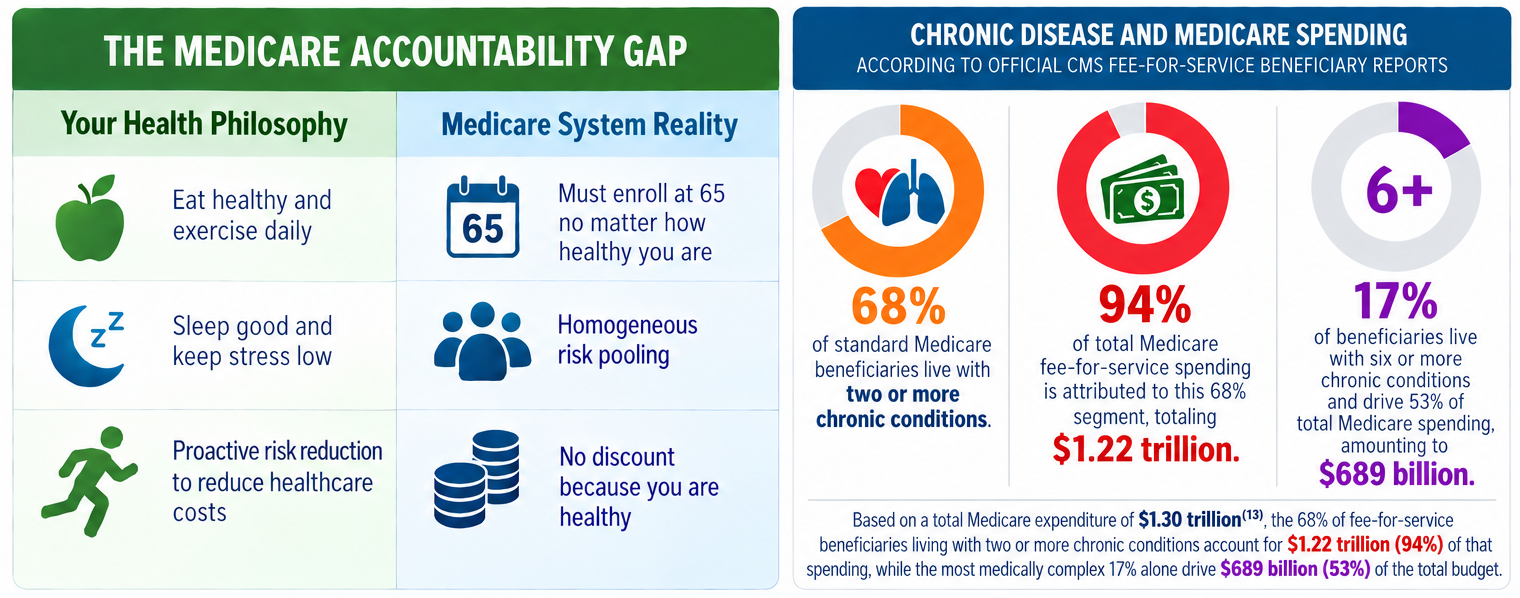
The explanation lies in the difference between individual actuarial pricing and a social insurance model.
In a traditional, private, under-65 insurance market, providers often reward low-risk individuals with lower premiums. Medicare, which is managed by the Centers for Medicare & Medicaid Services (CMS), does not operate this way. The program relies on a collective safety net where every Part B enrollee pays the same standard baseline premium regardless of age or personal biological health metrics. The only adjustment is an income-based surcharge that applies to higher earners(1).
From a public policy perspective, the government sets up the system this way to combat a phenomenon known to actuaries as adverse selection. If the program allowed perfectly healthy 65-year-olds to opt out completely, the remaining pool would consist almost exclusively of individuals with immediate, high-cost medical needs. To keep the program solvent, the system forces a homogeneous risk pool where the premiums of healthy participants subsidize the active care of the medically dependent, but the healthy people don’t get a discount if they don’t use the system less. Sounds unfair doesn't it?
The actuarial data illustrates why the system relies heavily on this structure. According to CMS estimates of fee-for-service beneficiaries, chronic disease is highly prevalent across the standard senior population.
Just look at these statistics:
- 68% of Medicare fee-for-service beneficiaries live with two or more chronic conditions(4). (Heart disease, diabetes, kidney disease, hypertension (high blood pressure), high cholesterol, arthritis, etc)
- This 68% segment accounts for a staggering 94% of total Medicare fee-for-service spending(4).
- The most medically complex tier (people living with six or more chronic conditions) makes up only 17% of fee-for-service beneficiaries but drives 53% of fee-for-service spending(4).
Based on a total Medicare expenditure of $1.30 trillion per year(13), the 68% of fee-for-service beneficiaries living with two or more chronic conditions account for a staggering $1.22 trillion (94%) of that spending, while the most medically complex 17% (6+ chronic conditions) alone drive $689 billion (53%) of the total budget.
Incredible to think about.
Because the demographic reality is heavily skewed toward active clinical management, the system uses age 65 as a strict administrative milestone. It does not check your cortisol levels, review your sleep data, or assess your cellular fitness. It simply assumes that eventual age-related biological changes or acute, unpreventable traumas (such as a slip on the ice, a viral illness, or an automobile accident) will eventually apply to everyone, and it uses lifetime late enrollment penalties to push everyone into participation(2).
Part 2: The High Cost of Independent Opt-Outs (Understanding Penalties)
If you are completely healthy, your initial instinct might be to ignore the system entirely and self-insure. However, federal guidelines are structured to make opting out a highly punitive financial choice over the long term. If you fail to establish what the government considers qualifying coverage when you first become eligible, Medicare levies permanent, compounding financial penalties(2). Your primary window to act is the Initial Enrollment Period (IEP).
This is a strict 7-month timeline that centers around your 65th birthday:
- Three months before the month you turn 65.
- The actual month of your 65th birthday.
- Three months after your birthday month.
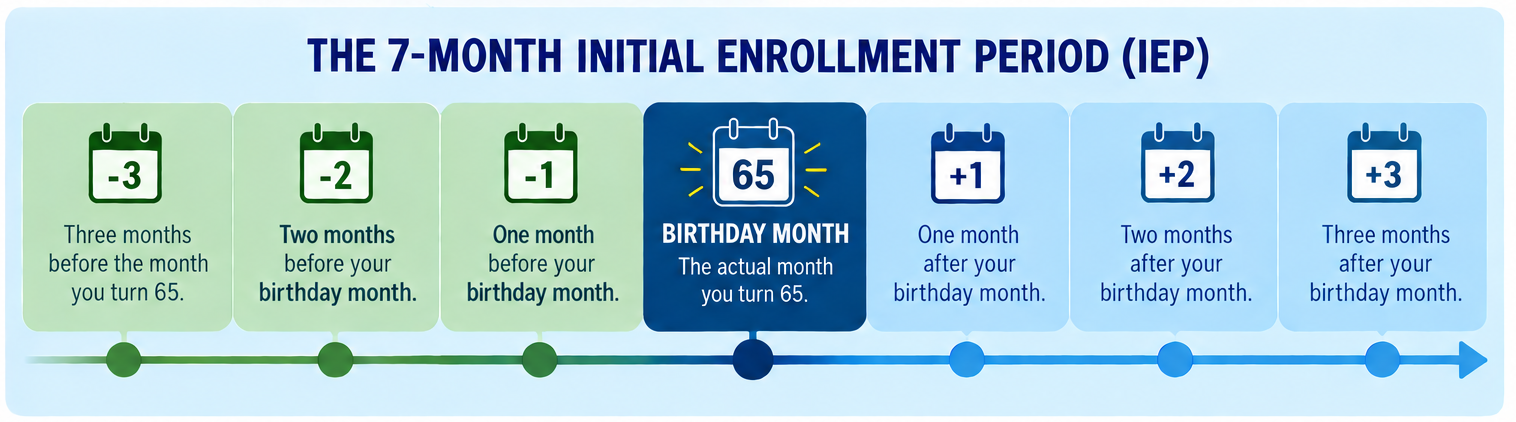
If you let this 7-month window pass without enrolling and you do not possess a qualifying employer group health exception, the financial consequences can be permanent.
The Part B Lifetime Premium Penalty
Medicare Part B covers doctor visits, outpatient hospital services, and other outpatient care(1). If you delay enrollment past your IEP, CMS assesses a permanent 10% premium surcharge for every full 12-month period you could have had Part B but didn't sign up(2).
This penalty is not a one-time fine; it is an ongoing premium increase that stays attached to your account for as long as you remain enrolled in Part B(2). Furthermore, because the penalty is calculated as a direct percentage of the current year's base rate, the absolute dollar amount of your penalty increases every single time the federal government adjusts the standard monthly premium upward. For baseline context, the standard monthly Part B premium in 2026 is $202.90(1).
The Part D Prescription Drug Penalty
Even if you take zero prescription medications and have no need for a pharmacy benefits plan, you still need creditable drug coverage to avoid a penalty. If you go without a Part D plan or other creditable drug coverage for a continuous period of 63 days or longer after your IEP ends, you incur a permanent Part D late enrollment penalty(2).
The calculation is based on 1% of the "national base beneficiary premium" multiplied by the exact number of full months you delayed enrollment. Like the Part B penalty, this surcharge lasts for the duration of your coverage and scales up as the national baseline premium rises year over year(2).
The Private Marketplace Misconception
A common point of confusion for healthy individuals is the status of individual private health insurance. If you purchase a private plan directly from a commercial insurance carrier, through a licensed health insurance broker, or via the ACA Health Insurance Marketplace, Medicare does not recognize this as qualifying coverage to delay Part B enrollment(6).
The only private insurance exception that shields you from Part B late-enrollment penalties is an active employer group health plan (either your own current employment or your spouse's current employment) where the company has 20 or more employees. If you are covered by an employer with fewer than 20 employees(6), or if you maintain an individual private or Marketplace policy, you must transition to Medicare at age 65 to avoid accumulating lifetime penalties.
Part 3: Strategic Pathways to Minimize Your Fixed Costs
While you cannot alter federal legislation, you can structurally navigate the Medicare options to align with your lifestyle. If you rarely utilize clinical medicine, you do not need to purchase expensive, low-deductible comprehensive insurance coverage. Instead, you can look into low-overhead pathways that satisfy federal requirements, eliminate lifetime penalties, and keep your fixed out-of-pocket costs to an absolute minimum.
Healthy individuals generally weigh two distinct ideological pathways when setting up their Medicare framework:
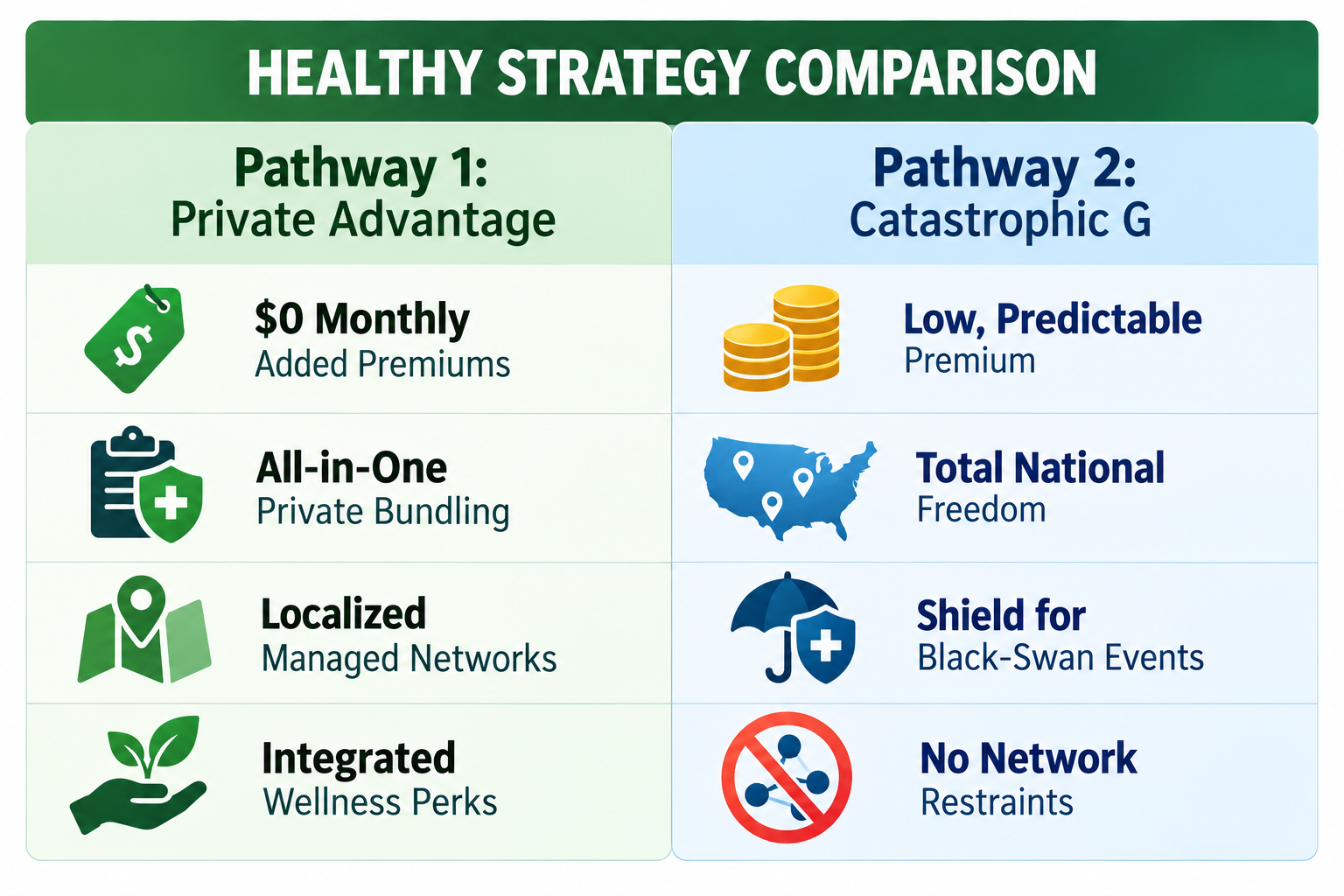
Pathway 1: The $0-Premium Private Insurance Route (Medicare Advantage / Part C)
Medicare Advantage plans, also known as Medicare Part C, are health plan options approved by Medicare but run by private insurance companies. When you select a Medicare Advantage plan, the private insurer contracts with the federal government to manage your Part A and Part B benefits, and they almost always bundle Part D prescription drug coverage into the same plan(7).
For a highly healthy individual, the primary appeal of this pathway is financial overhead reduction:
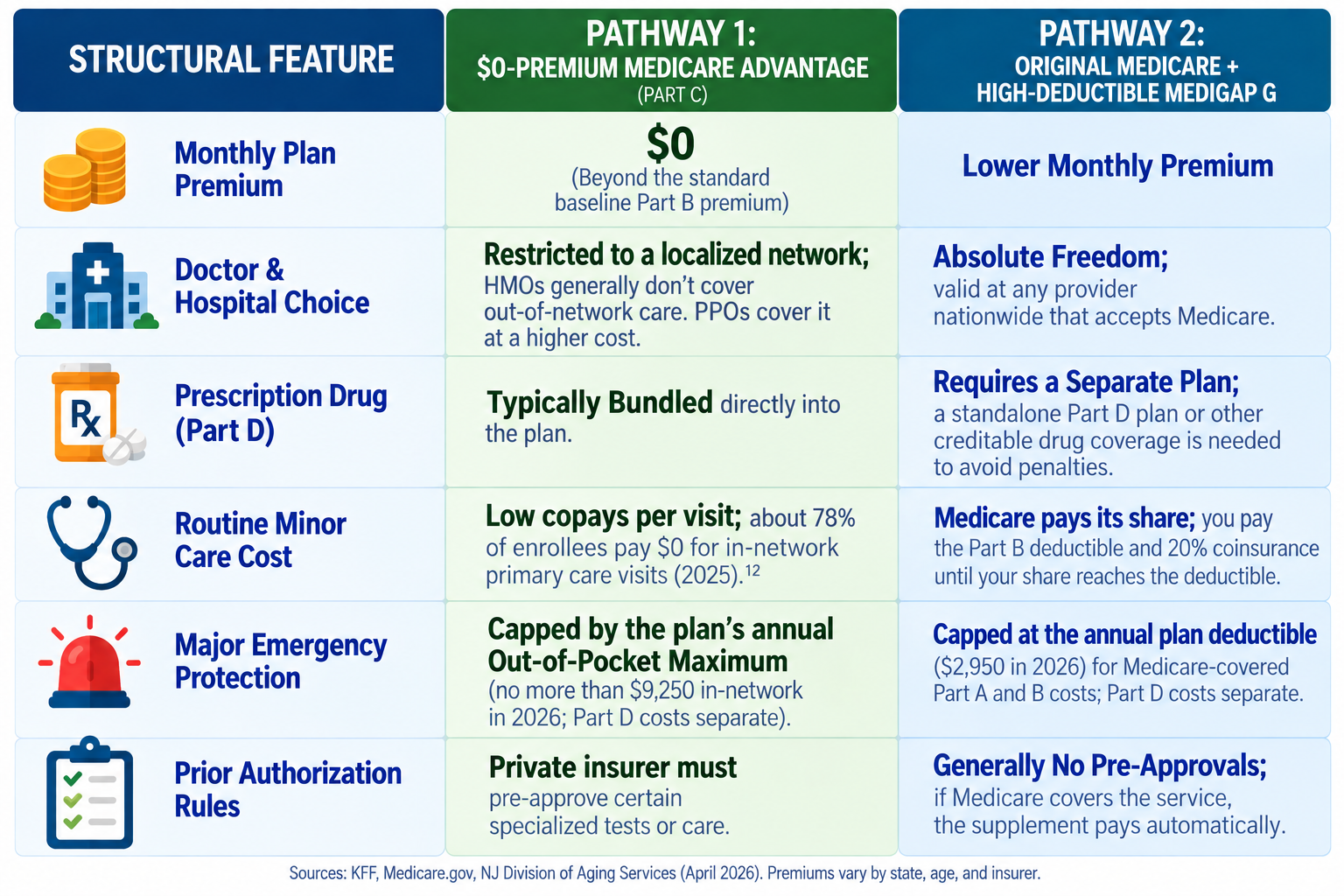
The Premium Structure: In many geographic markets, private insurers offer Medicare Advantage plans with a $0 monthly plan premium(7). It is critical to note that you must still pay your standard baseline Part B premium to the federal government(3), but you pay nothing additional to the private carrier.
The Wellness Incentives: Because private insurance companies maximize profit when their membership stays out of the hospital, many Advantage plans include added wellness perks that appeal directly to health-conscious individuals. These can include fitness benefits such as gym memberships and allowances for over-the-counter items(7).
The Trade-Off (Managed Care): The reason these plans can offer $0 premiums is that they operate on localized managed care networks, such as Health Maintenance Organizations (HMOs) or Preferred Provider Organizations (PPOs). HMOs generally only cover in-network care, PPOs charge more for out-of-network care, and nearly all plans use prior authorization protocols before approving certain services, such as hospital stays and advanced procedures(7). If you travel frequently or prefer absolute freedom over which specialist you see, this network structure requires careful review.
Pathway 2: The Catastrophic Route (High-Deductible Medigap Plan G)
If you dislike the concept of managed care networks, pre-authorizations, and geographic boundary restrictions, the second pathway pairs Original Medicare with a specialized private insurance policy called a High-Deductible Medicare Supplement (Medigap) Plan G(5).
Original Medicare gives you the unconditional right to see any doctor, specialist, or hospital across the United States, provided they accept Medicare patients. There are no localized networks and no primary care physician gatekeepers. However, Original Medicare does not have a "maximum out-of-pocket" limit(7), leaving you exposed to 20% co-insurance costs if an unexpected medical emergency occurs(3).
To cap this exposure at a minimal monthly cost, healthy individuals frequently look at High-Deductible Plan G:
The Low-Premium Advantage: Standard Medigap Plan G averaged $164 per month nationally in 2023(8), and High-Deductible Plan G carries some of the lowest premiums of any Medigap plan(5). Your own premium will depend on your zip code, age, and insurer.
The Deductible Mechanics: In exchange for this drastically lower premium, you agree to take on a structural deductible ($2,950 in 2026). Medicare still pays its normal share of your care. What you pay out of pocket is the cost-sharing Medicare leaves behind (the Part B deductible, 20% coinsurance, and the Part A deductible) until those costs add up to the deductible(5)(11).
The Peace-of-Mind Shield: The moment your share of Medicare-covered costs hits that deductible threshold, the policy transforms into a standard Plan G. For the remainder of the calendar year, the plan pays 100% of all Medicare-approved Part A and Part B out-of-pocket costs, protecting your retirement assets from major medical emergencies(5).
Part 4: Comparative Breakdown for Healthy Decision-Making
Choosing between these strategies requires balancing financial predictability against care flexibility. The following table provides a side-by-side breakdown of how these two structural options compare for an individual who maintains an optimized lifestyle and rarely requires medical intervention:
Part 5: Implementation Timeline & Strategic Takeaways
If you are approaching the age 65 milestone, navigating the system requires clear, chronological steps to preserve your choices. Medigap policies carry a crucial federal protection called the Medigap Open Enrollment Period. This window lasts six months, starting the first month you have Medicare Part B and are 65 or older. During this exclusive window, private insurance companies are legally forbidden from using medical underwriting to deny you coverage or from charging you higher premiums because of your health history(9).
If you choose a Medicare Advantage plan at 65, but decide years later that you want to switch back to Original Medicare with a Medigap policy, you may have to go through medical underwriting in most states. If you have developed even minor age-related conditions by then, private insurers can reject your application or charge significantly higher premiums(10).
Federal law does provide a one-year trial period: if you join a Medicare Advantage plan when you first enroll at 65 and leave it within that first year, you can still buy any Medigap policy sold in your state without underwriting(10). Therefore, healthy individuals often select High-Deductible Plan G at age 65 to permanently secure their access to the unconstrained Original Medicare network at the lowest possible baseline cost.
Ultimately, your healthy choices remain your greatest financial asset.
While you cannot opt out of the system's foundational costs without facing permanent lifetime penalties, understanding these options allows you to satisfy federal requirements while keeping your monthly fixed costs as low as possible and avoiding the penalties.
References
1. Centers for Medicare & Medicaid Services. (2025). 2026 Medicare Parts A & B Premiums and Deductibles. https://www.cms.gov/newsroom/fact-sheets/2026-medicare-parts-b-premiums-deductibles
2. Medicare.gov. (2026). Avoid late enrollment penalties. https://www.medicare.gov/basics/costs/medicare-costs/avoid-penalties
3. National Council on Aging. (2025). Navigating Your Medicare Coverage Options. https://www.ncoa.org/article/coverage-options-for-comprehensive-medicare-benefits/
4. Bipartisan Policy Center. (2020). Chronic Care Management Services Improve Health Outcomes and Reduce Costs for America's Seniors. https://bipartisanpolicy.org/article/chronic-care-management-services-improve-health-outcomes-and-reduce-costs-for-americas-seniors/
5. Mutual of Omaha. (2026). Medicare Supplement High Deductible Plan G. https://www.mutualofomaha.com/medicare-supplement-insurance/plan-high-deductible-g
6. KFF. (2025). I am about to turn 65; my spouse is 60 and still working. We are both covered under her employer's health plan. Do I have to do anything with regard to Medicare this year? https://www.kff.org/faqs/medicare-open-enrollment-faqs/employer-retiree-coverage/i-am-about-to-turn-65-my-spouse-is-60-and-still-working-we-are-both-covered-under-her-employers-health-plan-do-i-have-to-do-anything-with-regard-to-medicare-this-year/
7. KFF. (2026). Medicare Advantage in 2026: Premiums, Out-of-Pocket Limits, Supplemental Benefits, and Prior Authorization. https://www.kff.org/medicare/medicare-advantage-in-2026-premiums-out-of-pocket-limits-supplemental-benefits-and-prior-authorization/
8. KFF. (2024). Key Facts About Medigap Enrollment and Premiums for Medicare Beneficiaries. https://www.kff.org/medicare/key-facts-about-medigap-enrollment-and-premiums-for-medicare-beneficiaries/
9. Medicare.gov. (2026). Get ready to buy (Medigap Open Enrollment Period). https://www.medicare.gov/health-drug-plans/medigap/ready-to-buy
10. KFF. (2026). Medigap May Be Elusive for Medicare Beneficiaries with Pre-Existing Conditions. https://www.kff.org/medicare/medigap-may-be-elusive-for-medicare-beneficiaries-with-pre-existing-conditions/
11. Medicare.gov. (2026). Compare Medigap Plan Benefits. https://www.medicare.gov/health-drug-plans/medigap/basics/compare-plan-benefits
12. Jiang C, Lu CA, He L, et al. (2026). Primary Care Cost Sharing in Medicare Advantage. JAMA Health Forum, 7(7), e262232. https://pmc.ncbi.nlm.nih.gov/articles/PMC13355145/