
Key takeaways
- An HSA offers a triple tax advantage, pretax contributions, tax-free growth, and tax-free withdrawals for qualified medical expenses, a combination no 401(k), traditional IRA, or Roth IRA fully matches.
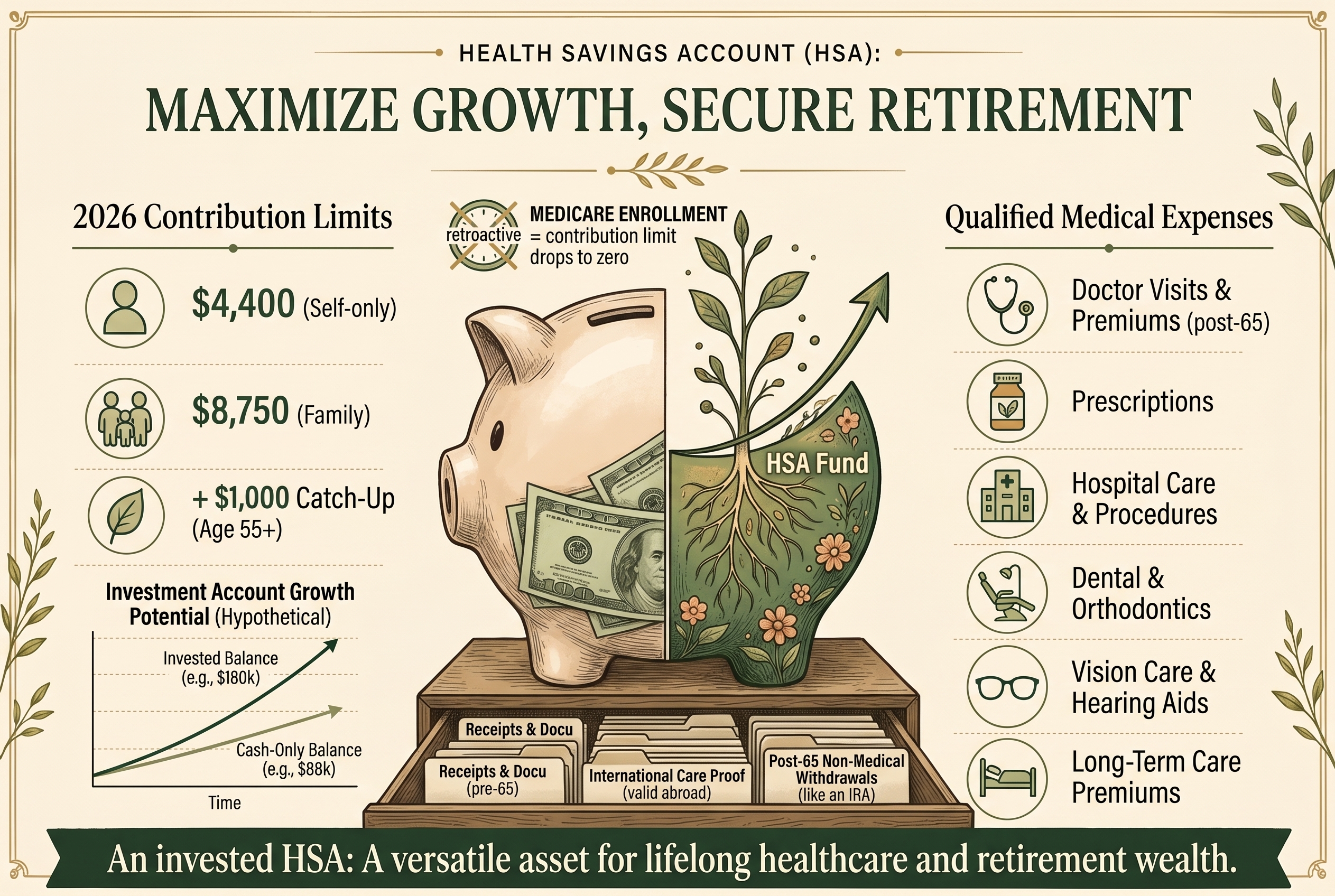
- For 2026, contribution limits are $4,400 for self-only coverage and $8,750 for family coverage, with an additional $1,000 catch-up for those 55 and older.
- Roughly 90% of HSA holders keep their entire balance in cash, and those accounts average nearly 10 times less than accounts with any money invested.
- There's no deadline to reimburse yourself for a past qualified medical expense, which allows invested HSA balances to compound for years before you ever touch them.
- After age 65, the 20% penalty on non-medical withdrawals disappears, and the account functions much like a traditional IRA while retaining tax-free treatment for medical expenses.
- Once you enroll in Medicare, your HSA contribution limit drops to zero, making the years just before enrollment a high-value window for contributions.
If you have a Health Savings Account (HSA), there's a good chance you treat it the way you'd treat a checking account set aside for the pharmacy and the dentist. Contribute a little from each paycheck, spend it down on copays and prescriptions, watch the balance hover near zero most of the year. That's a reasonable way to use an HSA. It's also the version that leaves the account's biggest advantage sitting untouched.
An HSA isn't just a way to pay medical bills with pretax dollars. For a lot of people in their 40s, 50s, and 60s, it can function as a second retirement account, one with tax treatment that beats a 401(k) or an IRA in one specific way. The catch is that this only works if you invest the money instead of leaving it in cash, which many people never do.
Why your HSA deserves more attention than your pharmacy receipts drawer
Retirement planning conversations tend to focus on two buckets, everyday living expenses and healthcare, and in practice most people badly underestimate the second one. Fidelity's 25th annual Retiree Health Care Cost Estimate puts the number at $185,500 for a single person retiring in 2026, up 7.5% from the year before, and that's before adding a spouse or accounting for long-term care(1). That figure isn't a sign of missing coverage. It assumes Original Medicare, Part D prescription coverage, and no unusual health event.
Where that money comes from is a separate question, and it's one an HSA is positioned to answer better than almost any other account.
Money goes in pretax, and it grows without being taxed along the way. When it comes out for a qualified medical expense, it comes out tax-free too. That's a genuine triple tax advantage, not marketing language. No other account available to most workers offers all three(1).
The problem isn't the account, it's what people do with the money once it lands there.
What makes an HSA different from every other account you own
A traditional 401(k) or IRA gives you one tax break. Contributions go in pretax, but withdrawals are taxed as ordinary income later. A Roth IRA gives you the reverse, no upfront deduction, but tax-free withdrawals down the road. An HSA is the only common account that gives you both ends of that deal, provided the money comes out for a qualified medical expense.
That third condition is the one people misunderstand. It sounds restrictive, but medical expenses in retirement are not a small or optional category. Medicare premiums, dental work, hearing aids, vision care, physical therapy, prescriptions, long-term care insurance premiums, and a long list of other costs all qualify under IRS rules(2). For most retirees, "qualified medical expense" ends up covering a wide swath of what they'd be spending money on anyway.
How much you can contribute in 2026
The IRS sets HSA contribution limits every year, and they've climbed steadily as healthcare costs have risen.
For 2026, the limits are:
Coverage type | 2026 annual limit |
|---|---|
Self-only HDHP coverage | $4,400 |
Family HDHP coverage | $8,750 |
Catch-up (age 55+) | Additional $1,000 |
These figures come directly from IRS Revenue Procedure 2025-19(3). The catch-up contribution has stayed at $1,000 for years because unlike the base limits, it isn't adjusted for inflation. If you're 55 or older with family coverage and your spouse is also 55 or older and HSA-eligible, each of you can add that catch-up to your own account, since spouses can't share a single HSA(2).
To qualify for an HSA at all, you have to be enrolled in a high deductible health plan (HDHP), have no other disqualifying coverage, and not be enrolled in Medicare. For 2026, a qualifying HDHP needs a minimum deductible of $1,700 for self-only coverage or $3,400 for family coverage, with a maximum out-of-pocket limit of $8,500 self-only or $17,000 family(3).
Why most HSA balances never leave cash
Here's the part that surprises people once they see it in writing. 40% of HSA holders have never invested any portion of their balance, even though the option exists(1). Industry-wide data from a firm that tracks the HSA market twice a year backs this up from a different angle. At the end of 2025, HSAs across the country held nearly $174 billion in roughly 41.7 million accounts, but only about 4.2 million of those accounts, roughly 10%, held any invested dollars at all(4).
In other words, nearly 90% of HSA holders are missing out on the tax-free growth an HSA is designed to offer.
The accounts that do invest look nothing like the ones that don't. HSAs with at least some money invested carried an average total balance of $24,252 at the end of 2025, nearly ten times larger than the average balance in accounts that stayed entirely in cash(4). Part of that difference reflects older, longer-held accounts naturally accumulating more. But a large part of it comes down to a simple decision, whether the owner ever moved money out of a low-interest cash account and into the market.
Why does this happen? It’s simple. Many people don't realize their HSA offers an investment option at all, while others assume they need to spend the balance down every year, the way they would with a flexible spending account (FSA), not realizing HSA funds roll over indefinitely with no expiration and no use-it-or-lose-it rule(2).
What changes once you invest instead of holding cash?
Most HSA providers require you to keep a minimum cash balance, commonly somewhere between $1,000 and $2,000, before letting you move the rest into investments. Some set the threshold as low as a few hundred dollars, and others require several thousand before the investment window opens at all. The exact threshold and the investment menu itself vary by provider, so it's worth checking your specific plan documents rather than assuming a number, and worth knowing before you decide because a low threshold means more of your balance can start compounding sooner.
Once you clear that threshold, the difference between investing and holding cash compounds quickly. Take someone with self-only coverage contributing the full $4,400 limit every year for 20 years. If that money sat in a typical HSA cash account earning close to nothing after fees, the ending balance would be close to the $88,000 in contributions, plus a modest amount of interest. If that same money were invested and grew at a hypothetical 7% average annual return, a purely illustrative assumption and not a guarantee of future performance, the ending balance would be closer to $180,000.
That's roughly $90,000 in growth that a cash-only approach would leave behind, and every dollar of it would come out tax-free for a qualified medical expense.
For a family contributing the full $8,750 limit under the same assumptions, the difference is proportionally larger. Twenty years of contributions total $175,000 in cash, versus a hypothetical invested balance closer to $359,000 at the same 7% average return. Again, this illustration rests on an assumed rate, not a projection or a promise, but it shows why the decision to invest rather than hold cash tends to outweigh which specific fund you pick once you get there.
Investing does introduce market risk that a cash account doesn't carry. Balances can go down as well as up, and money you'll need within the next year or two for a known medical expense generally shouldn't be sitting in the market. The strategy that works for most people is a two-bucket approach, keeping enough cash to cover a plan's annual deductible or a recent bill, and investing everything above that for the long term. Someone with a $3,000 deductible plan, for example, might keep $3,000 in cash and invest every dollar contributed beyond that, adjusting the cash bucket only if a known procedure or a family member's care is on the horizon.
What to invest in once you clear the cash threshold
Once the cash cushion is set, the investment menu inside most HSAs looks similar to what you'd find in a workplace 401(k), a lineup of mutual funds and index funds, sometimes with access to a full brokerage window through providers like Fidelity or Schwab. The reasoning that guides a retirement account applies here too. Younger HSA holders with decades until they'll need the money can lean toward stock-heavy, growth-oriented funds. Someone closer to retirement, or someone who expects to draw on the account for near-term medical costs, should lean more conservative.
Here's one useful mental shift. Since HSA withdrawals for medical expenses are always tax-free regardless of when they happen, there's an argument for treating the HSA as the last account you tap in retirement, not the first. Spend from a taxable brokerage account or a traditional IRA first, and let the HSA's investments compound untouched for as long as possible. The tax-free growth is worth more the longer it runs.
There's also a household-level decision worth making early. Spouses can't share a single HSA, so a married couple with family HDHP coverage where both spouses are 55 or older will typically end up with two separate accounts, each holding its own catch-up contribution. That's more paperwork than a single joint account, but it also means twice the tax-advantaged investment space, and it's worth setting up correctly from the start rather than consolidating contributions into one spouse's account and discovering the limit later.
The reimbursement strategy almost nobody uses
IRS Publication 969 confirms something most HSA holders never take advantage of. There is no deadline to reimburse yourself for a qualified medical expense(2). If you pay a medical bill out of pocket today, keep the receipt, and don't touch your HSA, you can withdraw that exact amount tax-free years or even decades later, as long as the expense happened after you opened the account.
That rule opens up a strategy some financial planners call the "shoebox method." Pay current medical expenses out of pocket from your checking account if you can afford to. Save every receipt and explanation of benefits. Let your HSA balance stay invested and compounding, untouched, for years. Then, whenever it's useful, whether that's next year or in retirement, reimburse yourself for the stack of old expenses you've accumulated, pulling out a lump sum tax-free.
The IRS doesn't require documentation up front. You self-report distributions on Form 8889 with your tax return, and your HSA custodian sends a Form 1099-SA showing what you withdrew(2).
But if the IRS ever questions a distribution, the burden is on you to prove it matched a real, unreimbursed, qualified expense.
Keeping organized records (the date of service, the provider, the amount, and proof you paid out of pocket and weren't reimbursed elsewhere) is what makes this strategy defensible rather than risky.
Can you be reimbursed for care received outside the US?
Medical tourism abroad is gaining in popularity which begs the question, can you be reimbursed for medical care you receive outside the US? The answer is yes, but with conditions.
The IRS applies the same qualified medical expense standard under Internal Revenue Code Section 213(d) no matter where the care was received(5).
A doctor's visit, dental work, or hospital stay abroad qualifies under the same rules as one at home, and the reimbursement strategy described above works exactly the same way. Pay out of pocket, keep the documentation, and reimburse yourself whenever it makes sense.
Two conditions apply specifically to care and medications obtained abroad, according to IRS Publication 502. The treatment has to be legal in both the country where it happened and in the United States. And if the expense involves a prescription drug, you have to consume it while you're still in that country. Buying medication overseas and bringing it home, even the exact same drug you'd otherwise be prescribed domestically, doesn't qualify(5).
Documentation becomes more important once the paper trail crosses a border. Keep the itemized receipt or invoice, convert the amount to US dollars using the exchange rate from the date you paid, and hold onto proof of payment the same way you would for a domestic bill. If the original receipt is in a foreign language, adding a short English note with the date, provider, and service gives you something easier to reference years later if you use the reimbursement strategy above.
None of this changes how the expense gets reported. It goes through the same HSA distribution a domestic expense would, just converted to US dollars first.
What happens once you turn 65
Before age 65, using HSA money for a non-medical expense triggers both ordinary income tax and a 20% penalty on top of it. That 20% penalty disappears entirely once you turn 65(2). After that point, non-medical withdrawals are taxed as ordinary income, the same as a traditional IRA, but without the extra penalty.
In other words, an HSA that's been invested for decades effectively becomes a second traditional IRA once you hit 65, with one upgrade added on top. Any portion still used for qualified medical expenses stays completely tax-free, even after that. There's no downside to keeping the account and no requirement to use it a specific way.
What changes once you enroll in Medicare?
There's one firm cutoff worth planning around. The moment you enroll in Medicare, your HSA contribution limit drops to zero(2). This applies even to retroactive Medicare coverage. If you delay signing up and your enrollment later gets backdated, any contributions made during that backdated window count as excess contributions and can trigger a penalty.
For most people, this means the years immediately before Medicare eligibility are the highest-value window for HSA contributions, since it's the last stretch where the account can still receive new money. If you're planning to delay Medicare enrollment past 65 for any reason, coordinate the timing with your HSA contributions carefully, ideally with a tax advisor, so you don't end up with an excess contribution to unwind later.
None of this affects money already sitting in the account. Once you stop contributing, the balance keeps growing if it's invested, and you can keep drawing on it tax-free for qualified medical expenses for the rest of your life, including Medicare premiums, copays, and coinsurance.
How an HSA compares to your 401(k) or IRA
None of this means an HSA should replace a 401(k) or IRA. Employer matching in a 401(k) is worth capturing before anything else, since it's an immediate return that no HSA can match. But once that match is captured, many financial planners rank HSA contributions ahead of additional 401(k) or IRA contributions, purely because of the double tax break on the way in and the way out.
Here's how the three compare on tax treatment:
Account | Contributions | Growth | Qualified withdrawals |
|---|---|---|---|
Traditional 401(k)/IRA | Pretax | Tax-deferred | Taxed as ordinary income |
Roth IRA | After-tax | Tax-free | Tax-free |
HSA | Pretax | Tax-free | Tax-free (medical expenses) |
The tradeoff is contribution room. Even the family HSA limit of $8,750 in 2026 is well below what a household can put into a 401(k), so an HSA works best as a complement to retirement accounts, not a replacement for them.
Here are some common mistakes worth avoiding
- Treating the HSA like a checking account. Spending the balance down to near zero every year forfeits the compounding that makes the account valuable over decades. If you can afford to pay routine medical costs from other savings, leaving the HSA invested is usually the stronger long-term move.
- Not understanding the power of the investment option. Many providers require an active step to open the investment side of the account, and it's often not visible from the main balance screen. If you've never looked, it's worth a call or a login to your specific provider to see what's available.
- Throwing away receipts. The reimbursement strategy only works if you can prove an expense happened and was never reimbursed elsewhere. A folder, a spreadsheet, or a dedicated app for tracking medical expenses turns an informal habit into a strategy you can rely on later.
If you're not sure whether your current HSA provider offers investment options, or whether a different provider would give you better fund choices or lower fees, comparing HSA providers side by side is the fastest way to find out.
References
1. Fidelity Investments. "Fidelity Investments Shares 25th Annual Retiree Health Care Cost Estimate." Business Wire, July 21, 2026. https://www.businesswire.com/news/home/20260721306626/en/Fidelity-Investments-Shares-25th-Annual-Retiree-Health-Care-Cost-Estimate-Highlighting-the-Importance-of-Incorporating-Potential-Health-Expenses-in-Retirement-Planning
2. Internal Revenue Service. Publication 969, Health Savings Accounts and Other Tax-Favored Health Plans (2025). https://www.irs.gov/publications/p969
3. Internal Revenue Service. Revenue Procedure 2025-19, 2026 inflation-adjusted HSA and HDHP limits. https://www.irs.gov/pub/irs-drop/rp-25-19.pdf
4. Devenir Research. "2025 Year-End Devenir HSA Research Report," Executive Summary, released April 23, 2026. https://www.devenir.com/wp-content/uploads/2025-Year-End-Devenir-HSA-Research-Report-Executive-Summary.pdf
5. Internal Revenue Service. Publication 502, Medical and Dental Expenses (2025). https://www.irs.gov/publications/p502
Contribution and HDHP figures reflect the 2026 tax year per IRS Revenue Procedure 2025-19. Retiree health care cost figures reflect Fidelity's 25th annual estimate, released July 2026. HSA market and investment adoption figures reflect Devenir's year-end 2025 survey, released April 2026. All figures are subject to change and should be verified against current provider and IRS guidance before acting on them.