
Key takeaways
- Build your retirement budget a full year out and test it by living on it, while you still have a paycheck to fall back on.
- Check your Social Security earnings record now, because errors reduce every future check.
- Your final year is your last chance to make payroll contributions, and 2026 limits allow up to $35,750 in a 401(k) for workers who turn 60 through 63 during the year.
- If Medicare is on the horizon, stop HSA contributions six months before you retire or apply for Social Security.
- Use a direct rollover to avoid 20% withholding, and think twice before rolling a 401(k) into an IRA if you might need the age-55 exception
For most of your working life, retirement sat somewhere out on the horizon. A date you could talk about in round numbers and revisit whenever the market had a good year. Then one day the horizon moves closer and the internal conversation changes. You start wondering whether your savings will last, what happens to your health insurance, and whether you've missed some form or deadline that everyone else seems to know about.
That unease is normal, and it usually comes from the sense that everything has to be figured out at once. It doesn't. The final year before you stop working is long enough to handle each decision in order, while you still have a paycheck, an HR department to answer questions, and time to fix anything that turns up wrong.
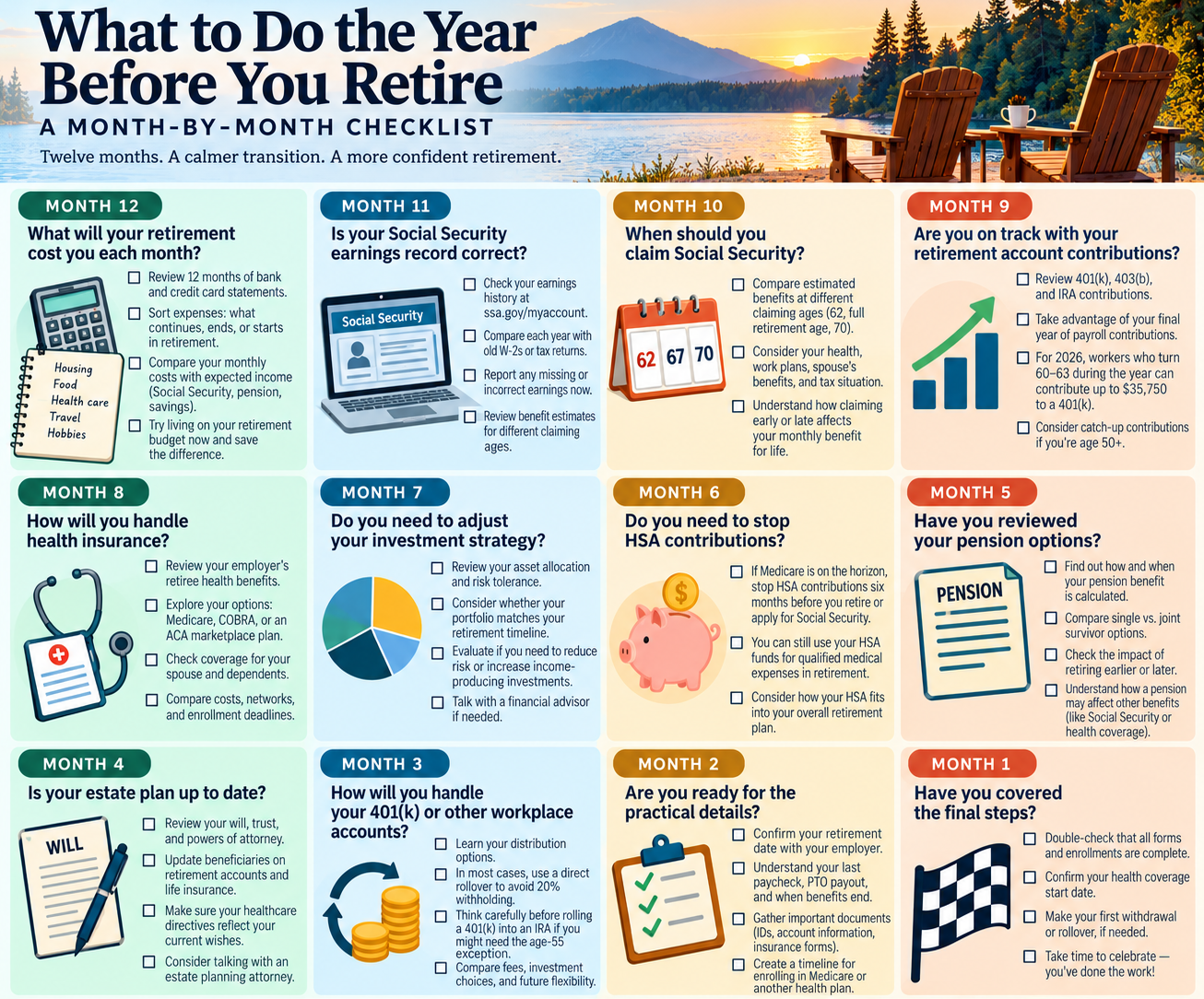
This checklist breaks that year into twelve months, starting a full year out and ending in the weeks before your last day. Some steps will apply to you as written, and others will depend on your age, your employer, and your family, so treat it as a working plan you adjust as you go.
Why does the last year before retirement deserve its own plan?
Retirement planning usually focuses on the size of your savings, but the year right before you leave work is about something different. It's the stretch when several separate systems, Social Security, Medicare, your employer's benefit plans, and the tax code, all start asking for decisions on their own schedules. Many of those schedules are fixed to your birthday or your last day of work rather than to when you feel ready, which is why it helps to see them laid out in advance.
Health care is the clearest example of a cost that catches people off guard. Fidelity's most recent Retiree Health Care Cost Estimate found that a 65-year-old retiring in 2026 can expect to spend an average of $185,500 on health care and medical expenses over the course of retirement, and that figure doesn't include long-term care. The same research found that 54% of pre-retirees mistakenly believe Medicare will cover all of their health expenses(1).
If you're carrying that assumption into your final working year, it's important to double check with real numbers from your current financial picture.
The good news is that a year gives you room. You can test your budget against reality, correct your earnings record, add to your retirement accounts one last time, and line up health coverage before the employer plan ends. The months below follow a logical order, but if your retirement date is closer than twelve months, start with the items that carry hard deadlines, which are the ones involving Medicare, your health savings account, and Social Security.
Month 12: What will your retirement cost you each month?
Start with spending, because every other decision in this checklist depends on it. Pull the last twelve months of bank and credit card statements and sort them into what will continue in retirement (food, mortgage, car, utilities, etc.), what will end (commuting, payroll deductions, retirement contributions), and what will start or grow such as travel, hobbies, and health insurance premiums your employer used to share.
Another good idea is to review how many subscriptions you are paying for every month. You’ll be surprised at how much money is flushed down the digital drain each month from what’s known as ‘subscription creep’.
Once you have a monthly figure, compare it with the income you expect from Social Security, any pension, and planned withdrawals from savings and investments. If the two don't line up, you've found the problem while you still have a full year of wages to work with. Many people find it useful to spend the next few months living on the projected retirement budget and saving the difference, which shows whether the plan holds up in daily life before you depend on it.
Month 11: Is your Social Security earnings record correct?
Your Social Security benefit is calculated from your highest 35 years of earnings, and if you have fewer than 35 years, the missing years count as zeros and will lower your monthly benefit. You can see your full earnings history, along with personalized benefit estimates, by reading your Social Security Statement through your my Social Security account at ssa.gov/myaccount(2).
Set aside an evening to compare each year on that record with your old W-2 forms or tax returns. A missing year or one recorded too low can reduce your benefit, and catching it now gives you time to get it fixed before you file. The Statement is also the starting point for the next month's decision, since it shows what your benefit would be at different claiming ages.
Month 10: When will you claim Social Security?
You can start Social Security retirement benefits as early as 62, but claiming before your full retirement age (FRA, the age at which you receive 100% of your benefit) permanently reduces the amount. For anyone born in 1960 or later, FRA is 67, and claiming at 62 cuts the benefit by 30%(3). Waiting past FRA works in the other direction, adding 8% a year in delayed retirement credits for people born in 1943 or later, but those increases stop at age 70(4).
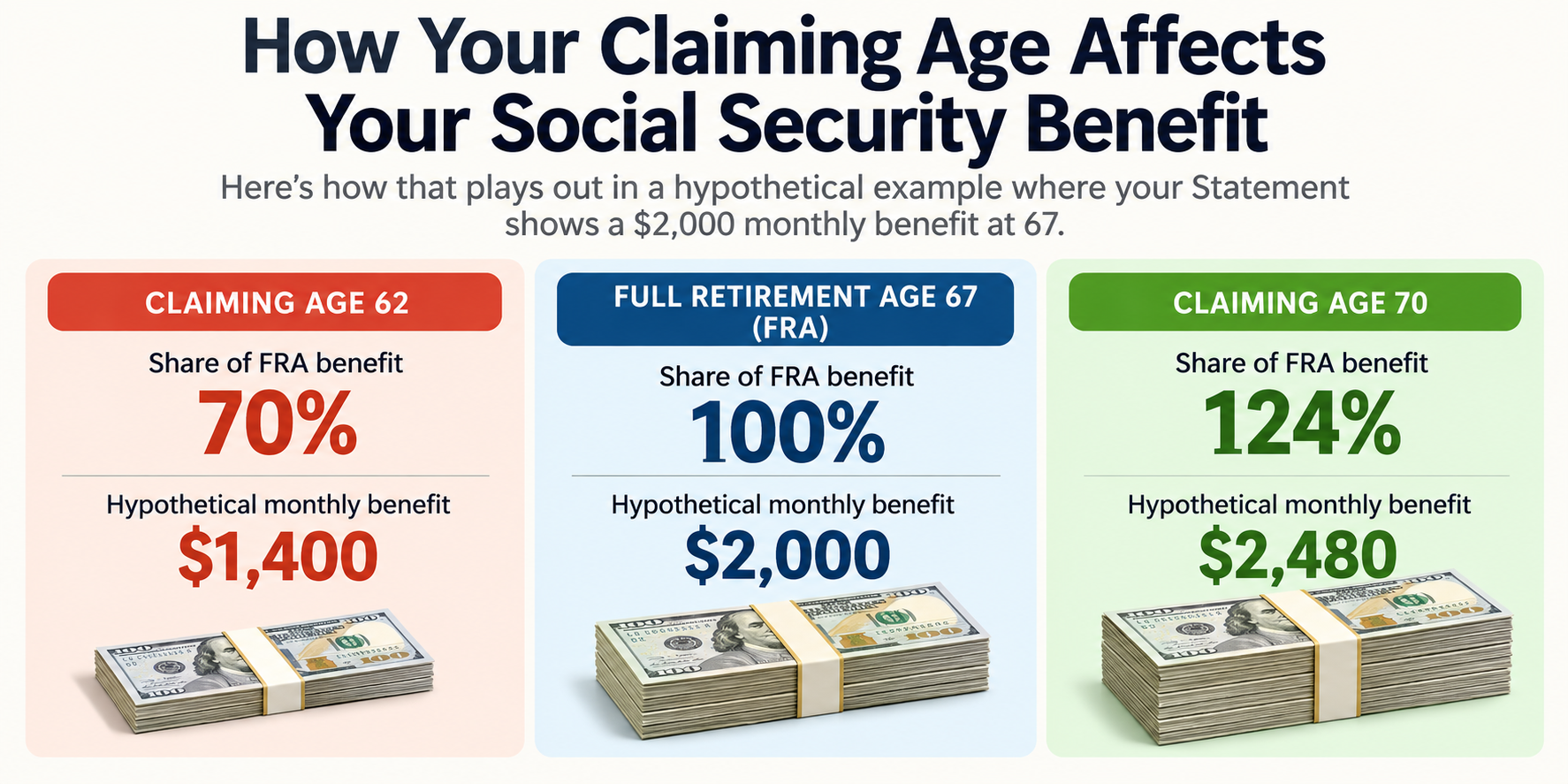
The difference between the earliest and latest options in that example is $1,080 a month. There's no single right answer, because health, other income, and a spouse's benefits all shape the choice, but deciding now on a target age (or at least a range) lets you plan the rest of the year around it.
Keep in mind that retiring and claiming don't have to happen at the same time, and you can stop working while delaying your benefit so it continues to grow(2).
Month 9: Have you added everything you can to your retirement accounts?
Your final working year is your last chance to make payroll contributions, and the limits for workers 50 and older are higher than the standard ones. For 2026, the standard 401(k) deferral limit is $24,500, workers 50 and older can add an $8,000 catch-up contribution annually, and those who turn 60, 61, 62, or 63 during the year can add $11,250 annually instead. The IRA limit is $7,500, plus a $1,100 catch-up for people 50 and older(5). You can learn more about catch-up contributions here.
In dollar terms, a 61-year-old could defer up to $35,750 into a 401(k) for the year, compared with $32,500 for someone who is 58. There's also a new rule to check with your plan administrator. For 2026, if your 2025 wages exceeded the $150,000 Roth catch-up wage threshold, your catch-up contributions must be designated as Roth contributions rather than pre-tax ones(5). If you're retiring partway through the year, raising your contribution rate now spreads those dollars across the paychecks you have left.
Month 8: What do your employer benefits owe you on the way out?
This is the month to sit down with HR, your Summary Plan Description, and your latest benefits statement. Start with vesting, which is the portion of employer contributions you own outright. Your own salary deferrals are always 100% vested, but employer matching or profit-sharing contributions may follow a schedule set by the plan, and amounts that aren't vested can be forfeited when you leave(6).
If you're a few months short of a vesting milestone, that may influence your exact departure date.
If you have a traditional pension, ask for written estimates of each payout option. Under federal law, the automatic form for a married participant is generally a qualified joint-and-survivor annuity (QJSA), which continues paying your spouse at least 50% of your benefit after your death, and choosing a different option requires your spouse's written, notarized consent(7). This is also the time to ask about unused vacation payouts, retiree health coverage, and any life insurance you can convert to an individual policy.
Month 7: How will you cover health care after your last day?
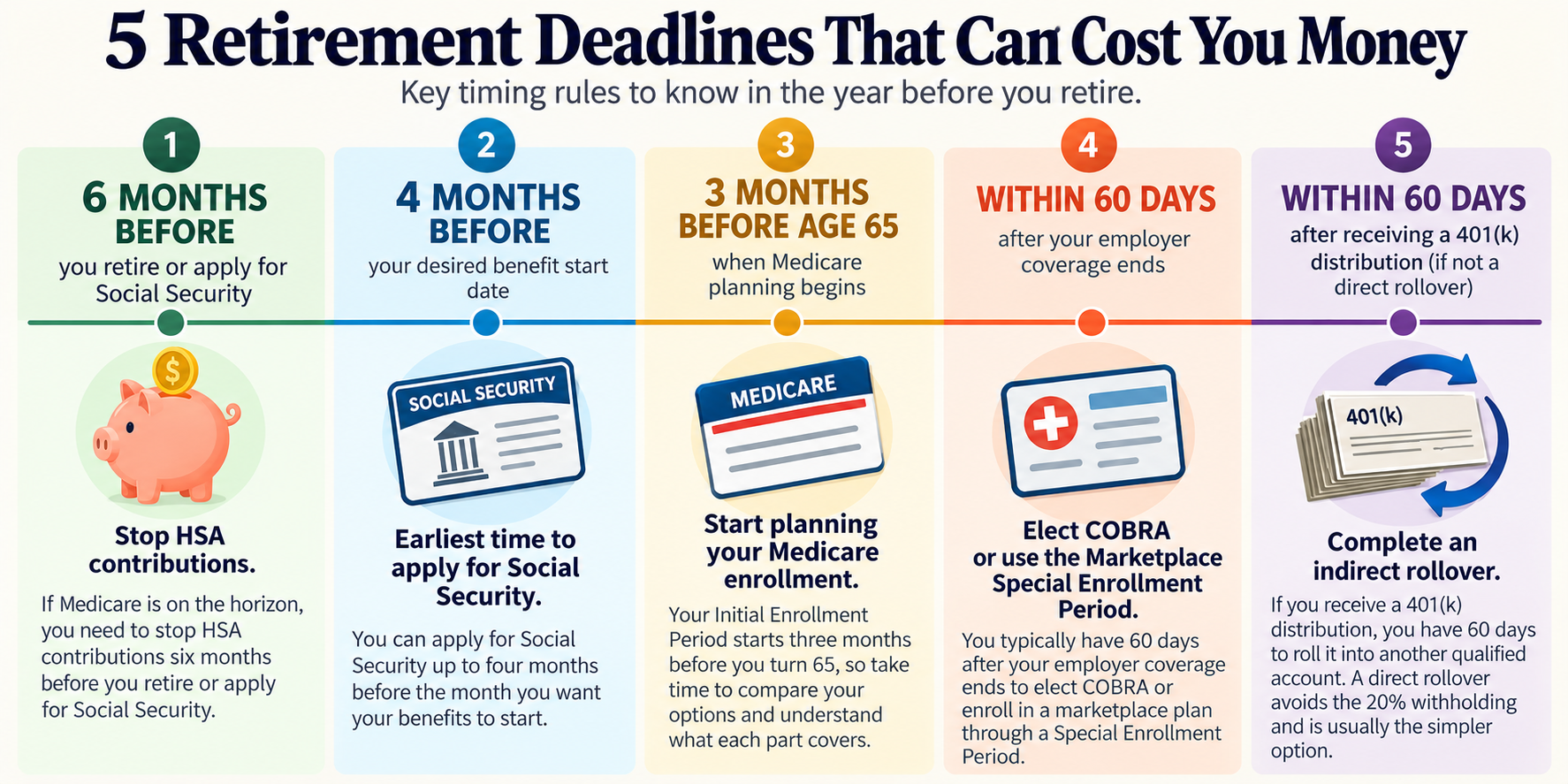
What you need here depends almost entirely on whether you'll be 65 when you retire. If you'll reach 65 near your retirement date and haven't started Social Security, plan to sign up for Medicare three months before your 65th birthday, unless you have group health coverage through a current employer(2). If you're still covered by an employer plan based on current work, you can wait to sign up for Part B, and you'll get an eight-month Special Enrollment Period that starts when the job or the coverage ends, even if you choose COBRA(10).
If you're retiring before 65, you'll need coverage to bridge the years until Medicare. COBRA (a federal law that lets you keep your employer's group plan temporarily) generally lasts up to 18 months after you leave a job, and you have 60 days to elect it, counted from when your coverage ends or when you receive the election notice, whichever is later. You'll usually pay the full premium, including the share your employer used to cover, plus 2%(11). The Health Insurance Marketplace is the other main option, and losing job-based coverage can qualify you for a Special Enrollment Period if you apply within 60 days before or after the coverage ends(12). Comparing both side by side now, using your real prescriptions and doctors, helps you avoid a rushed decision in your final weeks.
Month 6: Should you stop contributing to your health savings account?
If you have a health savings account (HSA, a tax-advantaged account paired with a high-deductible health plan) and expect to start Medicare or Social Security around the time you retire, this month carries a deadline that's easy to miss. You and your employer should stop HSA contributions 6-months before you retire or apply for Social Security benefits, which helps you avoid a tax penalty(10).
The reason is how Medicare coverage is backdated. Once Medicare coverage begins, you can't contribute to an HSA, and contributing after that point can trigger a tax penalty. Premium-free Part A coverage may start up to six months before the date you apply for Medicare or Social Security, though never earlier than the first month you were eligible, which means paycheck contributions made months before you file can land inside your Medicare coverage period(2).
Month 5: Could this year's income raise your Medicare premiums later?
Medicare Part B and prescription drug premiums include an income-related surcharge known as IRMAA (income-related monthly adjustment amount), and it's based on your income from an earlier tax return. For 2026 premiums, Social Security generally used tax returns filed in 2025 for tax year 2024. Joint filers with modified adjusted gross income (MAGI) above $218,000, or other filers above $109,000, pay the surcharge, which starts at an extra $81.20 a month for Part B and $14.50 for drug coverage at the first tier(9).
In a hypothetical case, a married couple whose MAGI lands just over that $218,000 line, with both spouses enrolled in Part B and drug coverage, would pay about $2,297 more for the year combined. That's why this month is a good time to review any large one-time income you're planning, such as a property sale or a large Roth conversion. And if your final full-salary year pushes you into a surcharge tier, stopping work is one of the life-changing events (along with marriage, divorce, or a spouse's death) that lets you ask Social Security to use your newer, lower income by filing Form SSA-44(9).
Month 4: Is it time to file for Social Security and Medicare?
If you've decided to start Social Security soon after you retire, you can apply up to four months before you want benefits to begin, and the easiest way is the online application through your my Social Security account. We’ve got a complete guide to Social Security here. You should still sign up for Medicare three months before your 65th birthday, even if you aren't ready to retire(15).
Applying at the four-month mark leaves time to fix any issue with your application before the first payment is due. If you're delaying benefits to a later age, you can skip the Social Security application for now, but the Medicare timing still applies unless you're covered by an employer plan through current work(2), as discussed in month seven above.
Month 3: Which accounts will you draw from first?
With your spending plan and claiming age in hand, map out where each month's income will come from in the first year. One rule can shape that order significantly. Withdrawals from a 401(k) or IRA before age 59½ are generally subject to an extra 10% tax, but if you leave your job during or after the year you turn 55, distributions from that employer's plan are exempt from the 10% tax. That exception doesn't apply to IRAs(13). You can learn more about how to structure retirement income from multiple accounts here.
For someone retiring at 57, that distinction can decide whether to leave money in the 401(k) for a few years instead of rolling it all into an IRA right away. A hypothetical $30,000 early withdrawal from an IRA would carry a $3,000 additional tax, while the same withdrawal from a qualifying 401(k) would not. This is also the month to set aside a cash reserve for the first stretch of retirement, so you aren't forced to sell investments during a down market just to pay the bills.
Month 2: Do your beneficiary forms match your wishes?
Retirement accounts and insurance policies don't follow your will. They pass directly to the beneficiaries named on each account, and those designations typically override your will and remain valid even through major life changes. For employer plans like 401(k)s, your spouse generally must be the primary beneficiary unless they sign a waiver giving up that right(8).
Pull up every account, including old 401(k)s from prior employers, and confirm both primary and contingent beneficiaries. This is also a sensible time to review your will, durable power of attorney, and health care directives, since the end of a working career is often when the people you'd name have changed.
Month 1: How do you move your 401(k) without losing money to withholding?
If you plan to roll your 401(k) into an IRA, ask for a direct rollover, where the plan sends the money straight to the new account. A distribution paid to you instead is subject to mandatory 20% federal withholding, even if you intend to roll it over, and you have 60 days to deposit it(14).
In a hypothetical $100,000 distribution paid to you, the plan would withhold $20,000 and send you $80,000. To roll over the full amount and avoid tax on the withheld portion, you'd have to make up that $20,000 from other savings within 60 days(14). A direct rollover however, avoids that problem entirely. In your final weeks, also confirm your last paycheck date, how unused vacation will be paid, and the date your employer health coverage ends.
Common mistakes that cost people money
Counting on COBRA to buy time for Medicare. If you're 65 or older and leave a job, COBRA doesn't extend your window to sign up for Part B. Waiting for COBRA to end before signing up for Part B is risky, because the eight-month Special Enrollment Period starts when you stop working, even if you choose COBRA, and waiting can leave you without coverage for months and add a monthly late enrollment penalty(10).
Rolling the 401(k) over too quickly. Moving everything into an IRA right after you leave feels tidy, but if you retired at 55 or later and may need money before 59½, that move gives up the age-55 exception, which applies only to employer plans(13).
Assuming you have to claim Social Security the day you stop working. Retiring and claiming are separate decisions. You can stop working and still delay your benefit, and because the monthly amount rises the longer you wait, up to age 70, a few years of living on savings can raise the check you receive for the rest of your life(2).
Get a second set of eyes on your plan
A checklist can tell you what to do, but it can't tell you whether your numbers will hold up for the next 25 or 30 years. If you're carrying more questions than answers into this final year, wondering whether the savings are enough or which account to tap first, you don't have to settle those questions alone. Talking it through with a professional who looks at your whole picture can turn a year of worry into a plan you trust.
References
1. Fidelity Investments. "Fidelity Investments Shares 25th Annual Retiree Health Care Cost Estimate, Highlighting the Importance of Incorporating Potential Health Expenses in Retirement Planning." Press release, July 21, 2026. https://newsroom.fidelity.com/pressreleases/fidelity-investments--shares-25th-annual-retiree-health-care-cost-estimate--highlighting-the-importa/s/0dd560b4-98cb-492e-bdec-f7168f97aede
2. Social Security Administration. "Your Retirement Checklist." Publication No. 05-10377, January 2022. https://www.ssa.gov/pubs/EN-05-10377.pdf
3. Social Security Administration. "Starting Your Retirement Benefits Early." https://www.ssa.gov/benefits/retirement/planner/agereduction.html
4. Social Security Administration. "Delayed Retirement Credits." https://www.ssa.gov/benefits/retirement/planner/delayret.html
5. Internal Revenue Service. Notice 2025-67, "2026 Amounts Relating to Retirement Plans and IRAs, as Adjusted for Changes in Cost-of-Living." https://www.irs.gov/pub/irs-drop/n-25-67.pdf
6. Internal Revenue Service. "Retirement Topics: Vesting." https://www.irs.gov/retirement-plans/plan-participant-employee/retirement-topics-vesting
7. Pension Benefit Guaranty Corporation. "Glossary" (Qualified Joint-and-Survivor Annuity; Spousal Consent). https://www.pbgc.gov/glossary
8. FINRA. "Advance Planning for Your Investments." Investor Information, August 2025. https://www.finra.org/sites/default/files/2025-08/InvestorEd-Advance_Planning_for_Your_Investments.pdf
9. Social Security Administration. "Premiums: Rules for Higher-Income Beneficiaries." https://www.ssa.gov/benefits/medicare/medicare-premiums.html
10. Medicare.gov. "Working Past 65." https://www.medicare.gov/basics/get-started-with-medicare/medicare-basics/working-past-65
11. U.S. Department of Labor, Employee Benefits Security Administration. "FAQs on COBRA Continuation Health Coverage for Workers." https://www.dol.gov/agencies/ebsa/about-ebsa/our-activities/resource-center/faqs/cobra-continuation-health-coverage-workers
12. HealthCare.gov. "Special Enrollment Opportunities." https://www.healthcare.gov/coverage-outside-open-enrollment/special-enrollment-period/
13. Internal Revenue Service. "Retirement Topics: Exceptions to Tax on Early Distributions." https://www.irs.gov/retirement-plans/plan-participant-employee/retirement-topics-exceptions-to-tax-on-early-distributions
14. Internal Revenue Service. "Rollovers of Retirement Plan and IRA Distributions." https://www.irs.gov/retirement-plans/plan-participant-employee/rollovers-of-retirement-plan-and-ira-distributions
15. Social Security Administration. "How do I apply for Social Security retirement benefits?" FAQ KA-01891. https://www.ssa.gov/faqs/en/questions/KA-01891.html
Contribution limits, the Roth catch-up wage threshold, and IRMAA amounts reflect 2026 figures and adjust annually. The health care cost estimate reflects Fidelity's 2026 release. Examples labeled hypothetical are illustrations only. All sources were verified against their live pages on October 6, 2026.
Investment disclaimer: Nothing on this site constitutes investment advice. All investors are encouraged to conduct their own research before making any investment decision. Past performance is not a guarantee of future results.
Medicare/Insurance disclaimer: Medicare plan availability and costs vary by location. Contact a licensed Medicare advisor or visit Medicare.gov to compare plans available in your area.
Editorial independence: Greensprout's editorial team writes on behalf of the reader. Our goal is to provide clear, useful information to help you make better financial decisions. Our editorial content is not influenced by advertiser relationships.
Affiliate disclosure: Greensprout is an independent, advertising-supported publisher and comparison resource. We may earn compensation when you click on links to products from our partners. This does not affect our editorial standards or recommendations.