
We like to think of our personal finances as one large, leaking bucket. When money feels tight, we look for the massive, obvious holes such as a high mortgage payment, a surging grocery bill, or an expensive car note. We assume that if we can just manage those big-ticket items, our financial foundation will remain rock-solid.
But modern corporate revenue strategies have evolved. Companies no longer focus solely on convincing you to make large, one-time purchases. Instead, they have shifted toward the highly lucrative world of recurring revenue models. As a result, the threat to your financial health is rarely a single, massive leak. Instead, your checking account is likely experiencing a silent coup staged by micro-transactions that are essentially dozens of tiny, pin-sized holes draining your wealth simultaneously.
This is the phenomenon of subscription creep.
It is the hidden drain of automated, recurring service fees that slip past your mental filters, bypass your emotional spending radar, and siphon away thousands of dollars a year.
In this comprehensive guide, we will break down the consumer psychology behind these invisible expenses, conduct a category-by-category forensic analysis of where your money is going, look at the compound long-term damage, and arm you with a step-by-step audit protocol to plug the leaks permanently.
Part 1: The Psychology of the Invisible Transaction
To understand why subscription creep is so incredibly effective, we have to look at how the human brain processes economic pain.
Behavioral economists often talk about the "pain of paying." When you open your physical wallet, pull out a crisp fifty-dollar bill, and hand it to a cashier, your brain experiences a mild psychological sting. You can visually see and physically feel the immediate loss of a resource. This friction is healthy; it acts as a natural brake on impulsive spending.
Digital ecosystems are explicitly engineered to eliminate this friction entirely. When you save a credit card to an app store, link your bank account to an auto-pay utility billing system, or authorize a biometric face scan, the emotional pain of spending drops to zero. You are no longer consciously deciding to part with your hard-earned cash every month. Instead, the transaction happens seamlessly in the background while you sleep.
Corporations actively exploit several documented cognitive biases to keep you paying for services you don’t use:
- Status Quo Bias: Human beings have an intense, innate preference for things to stay exactly as they are. Unless a major event forces us to change our behavior, our default action is always inaction. Subscription models turn this bias into a weapon. Once you sign up, the default setting is for the company to keep taking your money forever until you manually intervene.
- The Sunk Cost Fallacy: "I know I haven’t used that gym membership or streaming app in three months, but I might use it next week. Plus, I’ve already paid for the registration fee, so canceling it now feels like a waste." This faulty logic causes us to throw good money after bad, holding onto services out of a false sense of future utility.
- Hyperbolic Discounting: We are hardwired to value immediate rewards far more than future consequences. When a platform offers a "Free 7-Day Trial," our brains focus entirely on the immediate gratification of accessing the premium content today. We completely discount the future mental load and financial cost of having to remember to cancel that trial seven days from now.
By removing the physical and emotional friction of spending, companies have successfully detached our daily awareness from our actual cost of living.
RELATED READING: Learn about how grocery stores use psychology to get you to spend more money here.
Part 2: The Digital Drain: Category-by-Category Breakdown
Let’s step out of the abstract and take a look at the exact mechanics of how these automated traps function across different industries, and calculate the true, compound annual damage of these unnoticed leaks.
1. Streaming, Media, and Entertainment Creep
The Hook
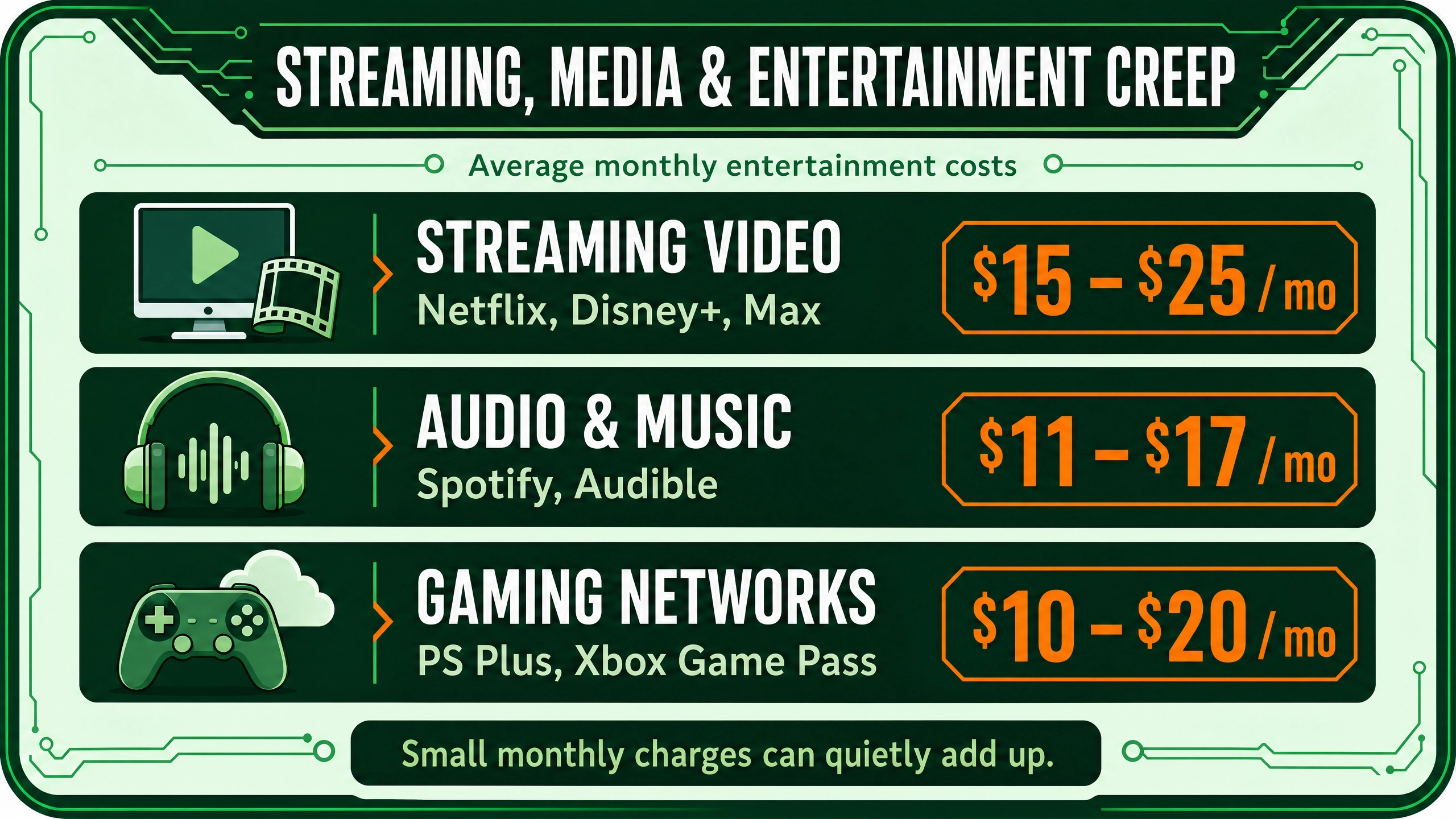
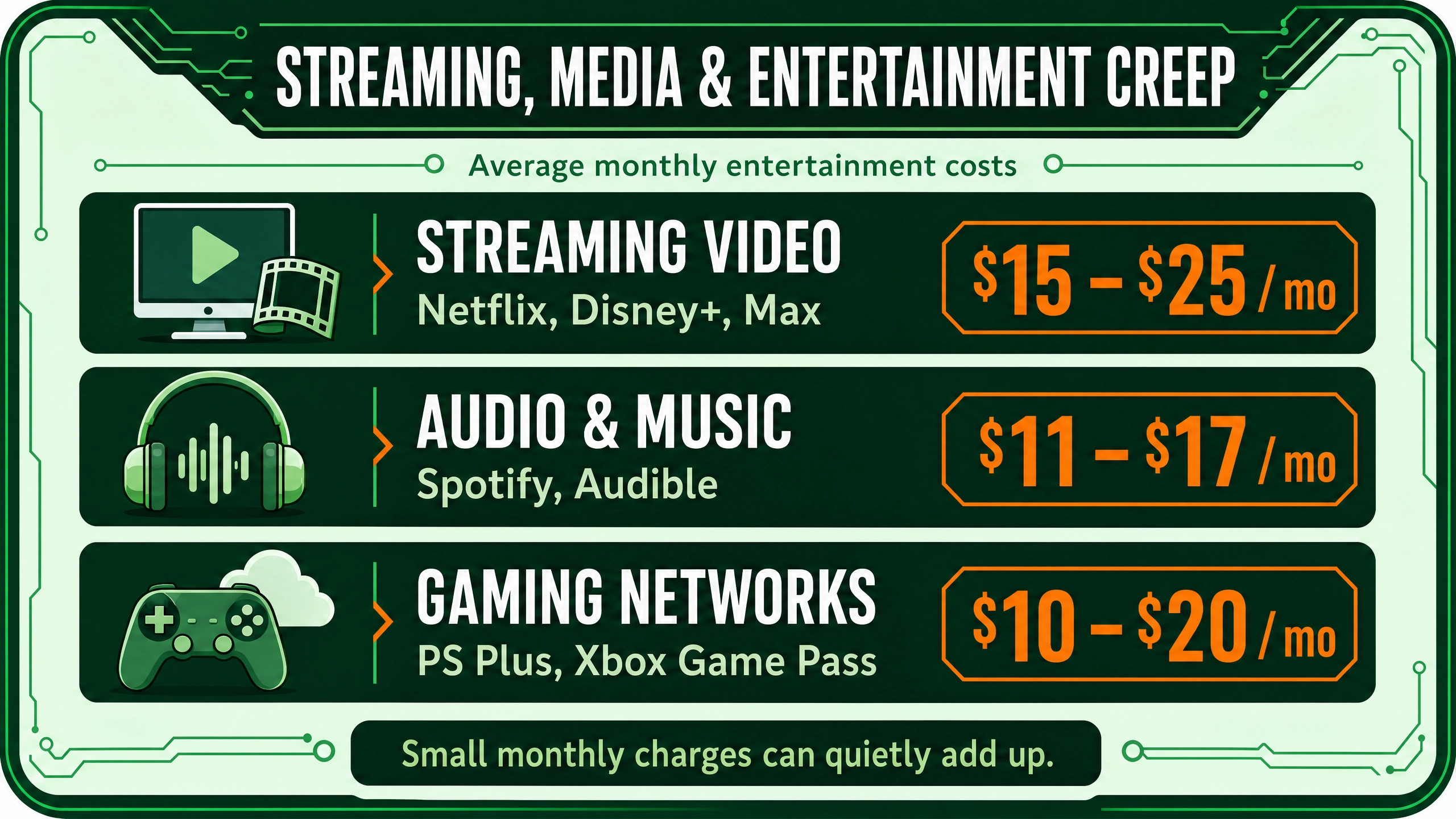
It always starts with an aggressive customer acquisition campaign: a hit show that everyone is talking about, an ad-free trial week, or a deeply discounted bundling offer ($1.99 a month for the first three months). You sign up to watch one documentary series or play one specific video game, finish it in a weekend, and fully intend to cancel it.
The Memory Fade
Because these charges occur automatically via card-on-file, you completely forget they exist. Furthermore, providers intentionally design their user interfaces to make cancellation a confusing, multi-step labyrinth hidden deep inside account sub-menus.
The Real Math
- Average monthly leak: $15 per platform × 3 forgotten or underutilized services = $45.00/month.
- Annualized loss: $540.00.
2. The App Store App Ecosystem Trap
Your smartphone is a highly optimized financial extraction device. Both Apple's App Store and Google Play have made purchase friction virtually non-existent.
The Hook
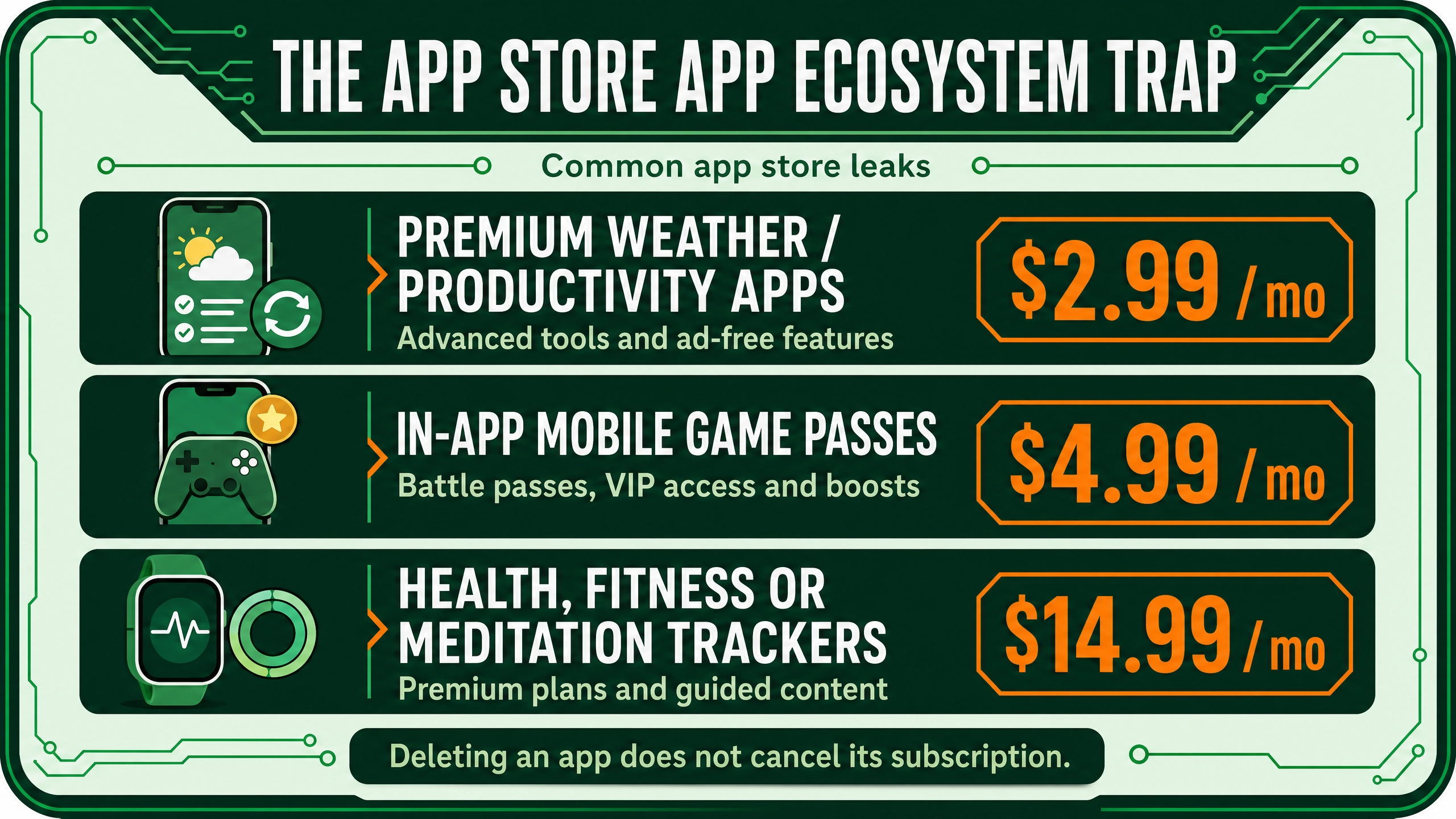
"Start your free trial to unlock premium features." It is the most profitable phrase in mobile software. Developers know that once your credit card information is linked to your device profile, authorized trials automatically transition into recurring monthly or annual billing structures without sending you a secondary confirmation or reminder email.
The Memory Fade
Unlike a physical utility bill that lands on your counter, mobile app subscriptions are buried deep inside your phone's operating system settings. Many consumers make the mistake of deleting the app icon from their home screen, assuming that uninstalls the expense. It doesn't. The background server keeps pinging your card every 30 days regardless of whether the app is on your phone.
The Real Math
- Average monthly leak: Two forgotten utility apps ($4.99 each) + one premium fitness/health tracker ($14.99) = $24.97/month.
- Annualized loss: $299.64.
3. Bank Penalties and Out-of-Network Friction
It is a profound irony of modern personal finance that it frequently costs a significant amount of money just to access your own money. Traditional brick-and-mortar banking institutions rely heavily on behavioral friction fees to hit their quarterly profit targets, whereas many online banks eliminate those fees.
The Hook
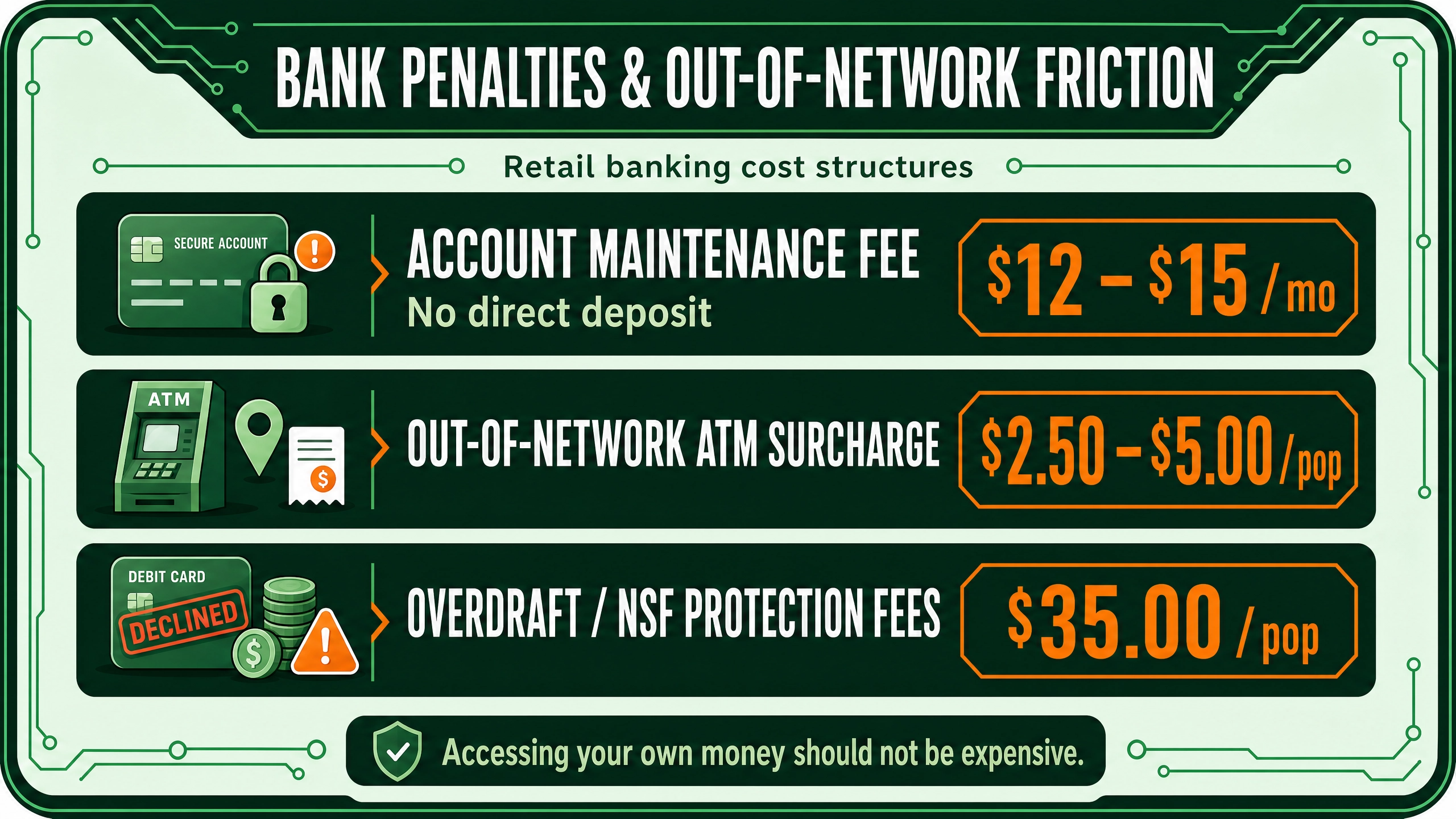
You open a checking account under a specific set of rules (e.g., "Free checking as long as you maintain student status" or "Free checking with regular direct deposits"). Then, life changes. You switch jobs, experience a temporary gap in employment, or graduate. Suddenly, your account balance dips below a hidden mathematical threshold, or your direct deposit cadence breaks.
The Memory Fade
Banks do not send an alert when they charge you a maintenance fee. These are listed as quiet line-item adjustments on page three of your statement. Similarly, hitting a non-network ATM for $40 because you are in a rush feels like a minor convenience, until the dual fees (one from the machine, one from your home bank) hit a week later.
The Real Math
- Average monthly leak: One account maintenance fee ($12) + three out-of-network ATM visits ($15 total) = $27.00/month.
- Annualized loss: $324.00.
4. Utility, Telecom, and "Mystery" Surcharges
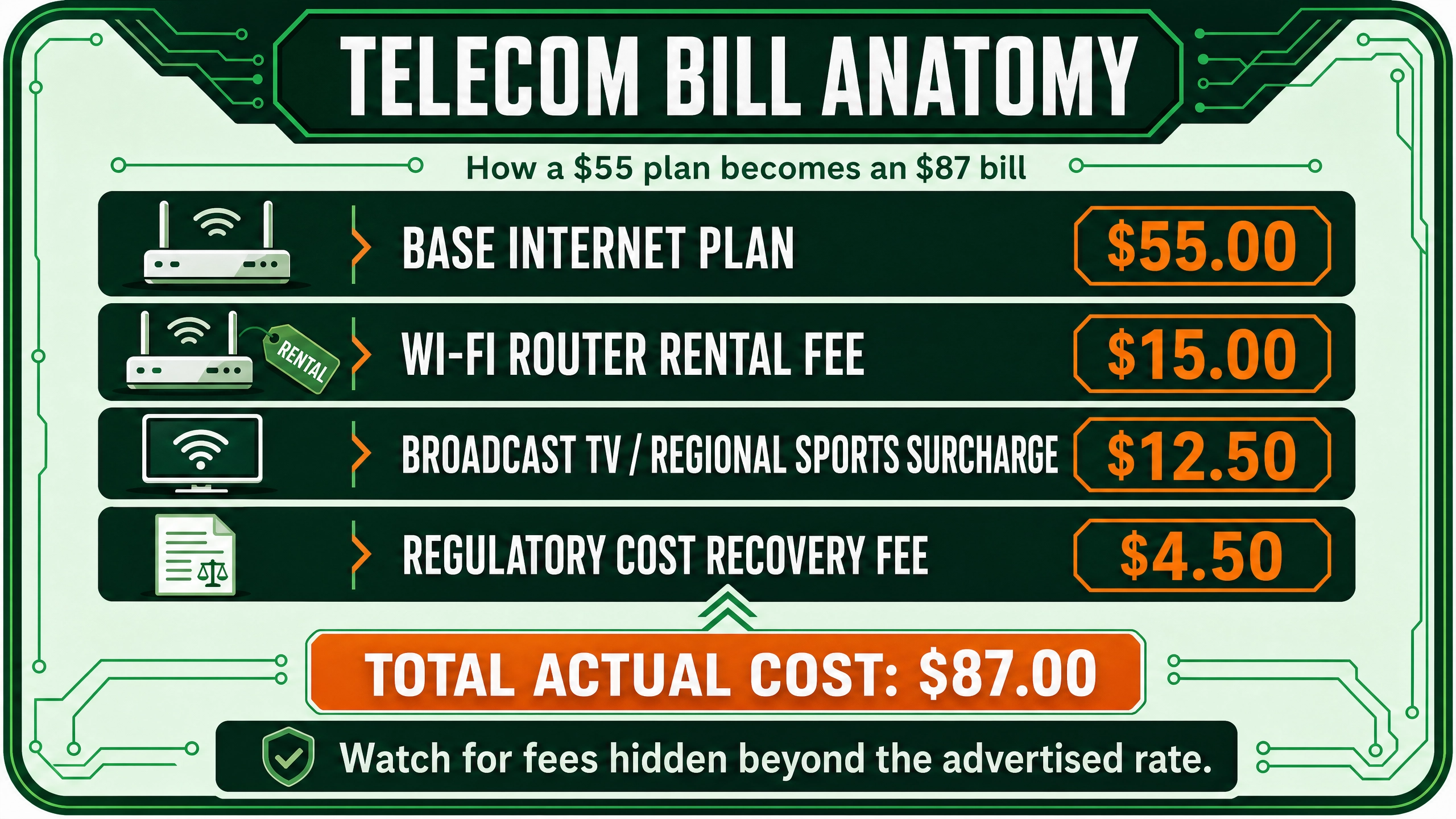
Telecom providers are masters of a practice known within financial circles as "drip pricing." This occurs when a company advertises a clean, low base rate up front, but then incrementally drips mandatory additions throughout the billing cycle.
The Hook
You sign a 12- or 24-month contract based entirely on a flat promotional rate advertised online or on a flyer.
The Memory Fade
When the actual bill arrives, it is significantly higher. Why? Because you didn't return their generic, low-cost Wi-Fi router, or because they tacked on localized infrastructure recovery fees. Over time, those 12-month promotional rates expire, bumping your base price up by $20 to $30 a month without any explicit warning.
The Real Math
- Average monthly leak: Unnoticed hardware rentals and expired promotional bumps across internet and phone plans = $35.00/month.
- Annualized loss: $420.00.
5. Cloud Storage and Software-as-a-Service (SaaS) Triggers
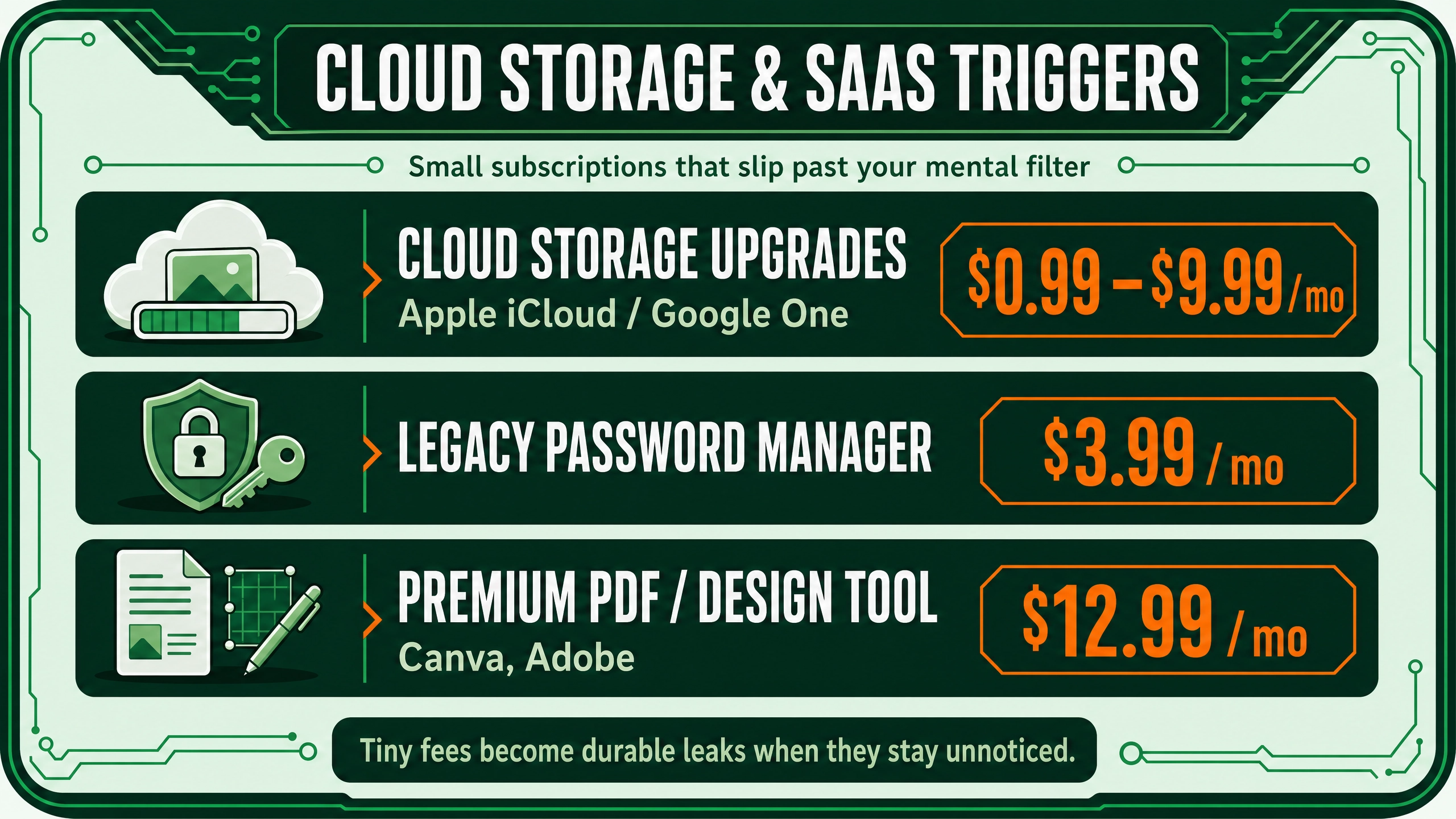
Because the base numbers in this category look completely harmless, it is the ultimate micro-leak category.
The Hook
Your phone flashes an ominous, bright red warning: "Storage Full. Photos will no longer back up." Panicked by the thought of losing your photos, you click the quickest option to expand your digital vault, usually a dirt-cheap tier like $0.99 or $2.99 a month. Later, you sign up for a premium PDF scanner or software tool for a specific, one-time project.
The Memory Fade
Because $2.99 or $3.99 is so psychologically insignificant, it completely misses your mental filter for "expenses." It blends perfectly into the background noise of your statement, and you continue to pay for it for years without a second thought.
The Real Math
- Average monthly leak: Unnecessary cloud upgrades plus an old productivity tool = $16.00/month.
- Annualized loss: $192.00.
Part 3: The Macro View: The Compound Damage
Let's aggregate these individual, seemingly minor leaks to see the true, staggering scale of the problem.
When you add up these individual leaks, the total monthly bleed can quickly add up to more than $100 a month.
On an annual timeline, that can translate to over $1,200 or more out the door.
This is not a matter of skipping your morning latte or sacrificing your quality of life. This is straight financial waste in the form of capital being handed directly to massive corporate balance sheets in exchange for zero realized value.
Over a ten-year horizon, if that same $100+ a month were simply swept into a basic index fund compounding at an average 8% return, it would grow to more than $20,000. You aren't just losing pocket change; you are actively bleeding an emergency fund, an investment portfolio, or a significant down payment on a home.
The 90-Day Financial Forensic Audit Protocol
Now that we have diagnosed the problem, it is time for the extraction process. To clear out these financial parasites, you need to execute a deliberate, structural audit. Do not rely on your memory; rely on cold, hard data. Follow this step-by-step protocol:
Step 1: The 90-Day PDF Extraction
Log into your primary checking account and credit card portals. Download the line-item PDF statements for the last three consecutive months. Do not look at the automated spending graphs provided by your bank app, they often miscategorize recurring subscriptions as "General Merchandise" or "Utilities."
Step 2: The Highlight Filter
Print out the statements or use a digital PDF highlighter. Run through every single transaction line by line. Highlight any item that occurs on a predictable monthly cadence, contains words like "PLUG", "BILL", "SUB", "RECURRING", or matches a flat dollar amount (like $9.99, $14.99, or $4.99).
Step 3: Uncover the Phone Settings Subscriptions
Grab your mobile device.
- On iOS: Open Settings > Click your name at the top > Tap Subscriptions.
- On Android: Open the Google Play Store app > Tap your profile icon > Tap Payments & Subscriptions > Tap Subscriptions.
You will almost certainly find at least one active, paying subscription for an app you deleted months ago. Cancel them directly from this screen.
Step 4: The "Keep, Negotiate, or Kill" Decision Matrix
Map every single recurring expense you uncover into one of three categories:
Category | Definition | Action Required |
|---|---|---|
Keep | Services used at least three times a week that bring genuine value. | Consolidate onto a single payment card for easy tracking. |
Negotiate | Essential services (Internet, Mobile, Insurance) with creeping costs. | Call the provider using our retention scripts to lower the rate. |
Kill | Services not used in the last 30 days, duplicate apps, and hidden fees. | Cancel immediately. No exceptions. |
Retention Scripts to Lower Essential Bills
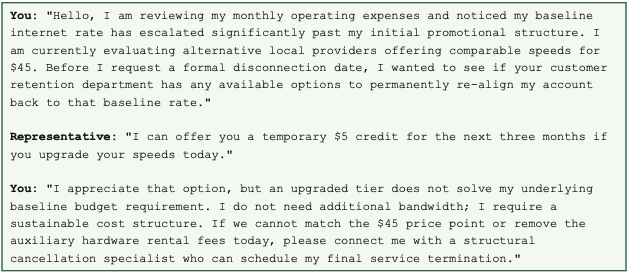
For the services you categorized as Negotiate (like your internet, cable, or mobile phone bills), you do not have to accept the creeping price increases. Telecom companies spend hundreds of dollars to acquire a customer; it is far cheaper for them to give you a discount than to lose you to a competitor.
Call their customer service line, bypass the automated voice system by saying "Disconnect Service," and talk directly to the Retention Department.
You can use these example scripts to help you navigate the conversation:
Building Financial Immunization for the Future
Performing an audit solves your current problem, but subscriptions will naturally start creeping back into your life within six months if you do not change your operational habits.
Use these defensive rules to permanently protect your accounts:
- Kill the Free Trial Auto-Renew Instantly: The absolute best time to cancel a "7-day free trial" is two minutes after you sign up. On almost all major platforms and app systems, canceling a trial immediately ensures you still get to use the remaining free days, but guarantees the system locks the gate before billing your card on day eight.
- Implement Virtual Burner Cards: Use services like Privacy.com or advanced features inside premium credit cards to generate unique, virtual card numbers for online subscriptions. You can set a strict hard spending limit on that specific virtual card (e.g., maximum $10/month). If the company tries to quietly raise their price to $12, the transaction automatically fails.
- Establish a Bi-Annual Audit Calendar: Set a recurring calendar notification on your phone for January 1st and July 1st labeled: "Forensic Financial Audit Day." Treat it like a mandatory doctor's visit. Spending 30 minutes twice a year reviewing your statements will protect your savings from future subscription decay.
By shifting from a passive consumer to an active financial gatekeeper, you ensure that your money goes exclusively toward things that add genuine value to your life rather than slipping away into the pockets of corporate automated billing systems.
If you want to learn more about how to cancel subscriptions for good, you can read our ruthless guide to canceling those subscriptions here.
References:
1. Streaming Cost Metrics: Tom's Guide Video Subscription Index & PCMag Global Streaming Service Pricing Matrix. https://www.tomsguide.com/entertainment/streaming/what-streaming-costs-in-2026-the-price-of-netflix-disney-plus-max-and-more; https://www.pcmag.com/explainers/im-spending-how-much-your-guide-to-streaming-service-costs-and-increases
2. Retail Checking Account Trends: MoneyRates Checking Fee and Maintenance Survey. https://www.moneyrates.com/research-center/bank-fees/
3. National Overdraft Standards: Bankrate Checking and Overdraft Fee Analysis. https://www.bankrate.com/banking/checking/banks-eliminated-overdraft-fees/
4. National Out-Of-Network ATM Metrics: Bankrate Annual ATM Cost and Surcharge Study. https://www.bankrate.com/banking/how-much-are-atm-fees/
5. No-Fee Account Options: CNBC Select Guide to Fee-Free Personal Checking. https://www.cnbc.com/select/best-no-fee-checking-accounts/
6. Hidden Telecom Drip-Pricing Surcharges: Consumer Reports Advocacy Cable Fee Investigation Report. https://advocacy.consumerreports.org/research/2019-cable-fee-report/