Key takeaways
- Most cancellation friction is intentional, built from a documented set of behavioral patterns rather than accidental bad design.
- Pulling three months of statements is the fastest way to find subscriptions you forgot you had.
- Decline retention offers based on whether you want the service, not on how good the discount sounds.
- Document every cancellation attempt with a confirmation number, chat transcript, or email, and check your next statement to confirm the charge actually stopped.
Subscriptions are everywhere. The average American now spends $111 a month on subscriptions, or $1,332 a year, up 23% from the year before(1). Mastercard's separate tracking puts average annual subscription spend at $1,887 as of 2025, up from $1,416 the prior year(2). The two figures measure different things and land in different places, which is itself the point. Most people don't have a precise number for what they're spending, because subscriptions are often designed to be forgotten (think: That $10/mo new year gym membership).
Americans also waste roughly $252 a year, on average, on subscriptions they don't use(1).
This guide isn't about willpower or budgeting discipline. It's about understanding the specific psychology mechanics companies use to keep you paying after you've decided to stop, and how to get past each one without losing an afternoon to hold music.
Why cancellation got so hard
Signing up for a subscription typically takes under a minute. Simply enter a card number, click confirm, done. But canceling the same subscription can take five steps, a phone call, a "why are you leaving" survey, and two rounds of discount offers before you reach a confirmation screen.
That asymmetry of signup to cancellation is not an accident of bad design. It's a deliberate structure, and researchers have started giving it a name, ‘the cancellation gap’.
A study presented at the 2026 European Association of Cognitive Ergonomics annual conference catalogued 44 distinct dark patterns across ten categories, based on a review of 28 industry and academic sources. The same research found that cancellation flows built with these patterns produced a 28% drop in user trust and a 54% drop in usability scores compared to flows that let people simply cancel(3).
Regulators have also taken notice. The Federal Trade Commission finalized a "click-to-cancel" rule in October 2024 requiring that canceling be at least as easy as signing up(4). A federal appeals court vacated the rule in 2025 on procedural grounds, and the FTC reopened rulemaking in March 2026 with public comments closing that April, while continuing to pursue enforcement actions against individual companies under existing consumer protection law in the meantime(5).
Separately, roughly 30 states now have their own automatic-renewal or negative-option laws, and some, including California's Automatic Renewal Law, already require clearer disclosure and easier cancellation than the vacated federal rule(5). The legal landscape is unsettled, but the behavioral psychology these companies use is well documented and largely unchanged.
The patterns worth knowing
Not every company uses every tactic, but many subscription cancellation flows draw from a short list of recurring moves identified in the 2026 cognitive ergonomics research. Recognizing the pattern in the moment is much of winning the battle.
- Roach Motel design is the most direct. You can subscribe with one click online, but canceling requires a phone call, a mailed letter, or a chat session during limited hours. If you signed up in an app and the only way to cancel is by calling a number that's never staffed when you're free (that's the common pattern). The response is to call right when the line opens, use the live chat option if one exists (it's often faster and creates a paper trail), and if a company legitimately offers no online cancellation path, document the date and time you called in case you need to dispute a later charge.
- Forced reasoning is a common tactic in cancellation flows. Before you can cancel, you're required to select a reason from a dropdown, sometimes several times, sometimes with follow-up questions probing each answer. This isn't market research. It's a stalling mechanism and a chance to route you into a counter-offer matched to your stated reason. Pick the vaguest available option ("no longer needed") and move forward without elaborating.
- Nagging and repeat retention offers show up the same way in flow after flow. You click cancel, and instead of a confirmation, you get a discount offer. Decline it, and a second offer appears. Some flows stack three or four of these before reaching an actual cancellation button. The fix here is simple but requires resolve. Decline every offer, because the goal is to make you tired enough to accept something you don't actually want. If a discount genuinely changes your mind, that's a legitimate outcome. If you're just exhausted, keep going.
- FOMO framing tells you what you'll lose. "You'll lose access to your saved photos," "Your points expire in 3 days," "You'll lose your founding member rate forever." Some of these warnings are true and worth weighing. Others are designed to trigger loss aversion regardless of whether the loss matters to you. Before you subscribed, you didn't have that founding rate either, and you were fine.
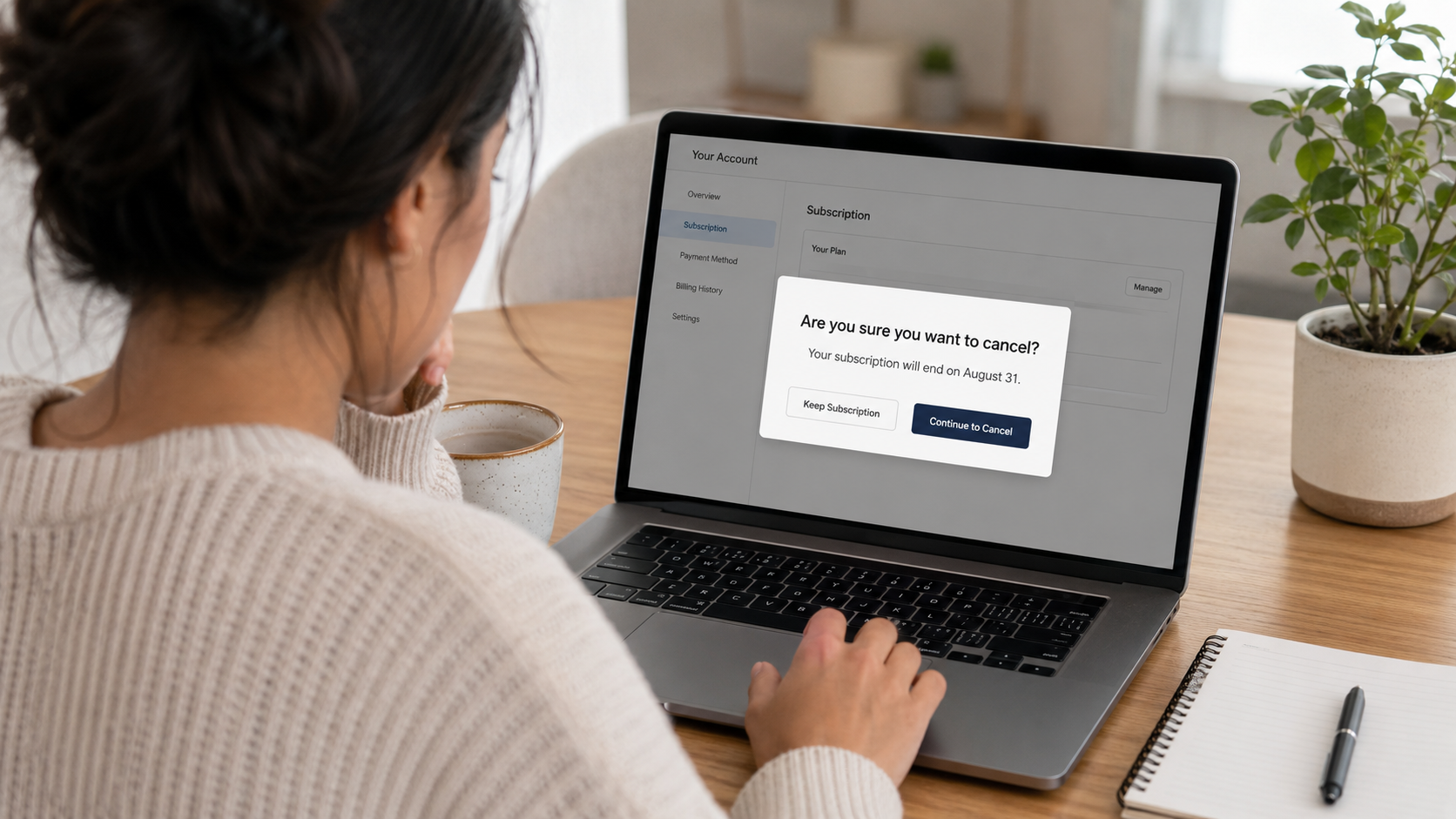
- Misdirection uses visual design against you. A bright, large "Keep My Subscription" button next to a small, gray, low-contrast "Continue to Cancel" link. It's not a bug. Read buttons before clicking based on color or size.
- Auto-renewal bias is the default itself. Subscriptions renew unless you act, rather than requiring you to opt in again. This shifts the entire relationship from active choice to passive continuation, and it's why a subscription you forgot about can run for years. The countermeasure isn't clever, it's structural: calendar reminders set at signup, not after the fact.
Beyond these, the research identified recurring patterns including confirmshaming (guilt-based copy like "No thanks, I don't want to save money"), obstruction through excessive account verification steps, hidden cancellation pages buried several menus deep in account settings, and time-limited retention offers designed to create artificial urgency. None of these require special tools to beat. They require recognizing them as they happen and continuing anyway.
A step-by-step approach that works across most services
Start by pulling your last three statements, whether that's a credit card, debit card, or bank statement, and flag every recurring charge. This step alone typically surfaces two or three subscriptions people forgot they had. Research from Self Financial, compiled in Fortunly's 2026 subscription statistics report, found nearly 60% of consumers have at least one unused paid subscription, averaging 2.6 unused subscriptions per person(2).
For each subscription you want to cancel, check whether the company operates in a state with cancellation-specific consumer protection laws. Roughly 30 states have moved beyond federal rules to require clearer disclosure and easier cancellation(5). If a company is dragging its feet and you're in one of those states, referencing the specific law by name in a written complaint tends to accelerate things.
Use the account settings path first, since it creates the cleanest record. If cancellation isn't available there, check for a live chat option before calling; chat transcripts are timestamped and easy to save. If a phone call is unavoidable, call at the start of business hours, state clearly that you want to cancel effective immediately, and if offered a retention deal, ask them to note in the account that you declined and want the cancellation processed today. Get a confirmation number or email before you hang up.
If a company refuses to cancel or claims you agreed to a minimum term you don't recall agreeing to, your card issuer is a legitimate backstop. Filing a dispute for a subscription charge after a documented cancellation attempt is a normal, appropriate use of chargeback rights.
Regulators take this seriously too.
The FTC and state attorneys general have pursued enforcement actions, including settlements in the millions of dollars and, in one case, over a billion dollars, against companies accused of failing to disclose subscription terms or obstructing cancellation(5).
Finally, after canceling, check your next one or two statements to confirm the charge actually stopped. A charge that continues after a customer believes they've successfully canceled, whether from a processing delay or an error, is common enough to be worth verifying. Catching it within a billing cycle is far easier than disputing it three months later.
Where this actually shows up in your budget
If forgotten or unwanted subscriptions add up to $50 a month, that's $600 a year, in the same range as the roughly $252 a year in unused-subscription waste identified in recent survey data(1), before accounting for subscriptions you're actively paying for but rarely use. Money that would otherwise disappear into a forgotten app or streaming tier could instead go toward a high-yield savings account. Moved from a checking account earning near-zero interest into an account paying a competitive savings rate, that difference compounds if you keep contributing what you're no longer bleeding out on subscriptions.
This is also a useful discipline heading into any period where you're tightening a budget, whether that's before a mortgage application, ahead of retirement, or simply because a fixed income makes every recurring charge matter more. Lenders and financial planners alike look at recurring monthly obligations as part of assessing what you can actually afford. Trimming subscriptions you don't use isn't just tidy, it can directly affect the numbers that matter for bigger financial decisions.
Common mistakes people make when trying to cancel
The most common mistake is stopping at the first offer. People decline once, get offered a discount, and accept it even though they'd already decided the service wasn't worth the full price. If the answer to ‘is this worth anything at all to me’ is no, a lower price doesn't change that answer, it just delays it.
The second is assuming a single cancellation attempt is enough. If you canceled online but the flow ended on an ambiguous confirmation screen rather than a clear ’your subscription is canceled and will not renew,’ check your next statement. Ambiguous confirmations are common enough that verifying is worth the two minutes it takes.
The third is avoiding the dispute process out of a sense that it's confrontational or excessive. It isn't. Card issuers built these processes specifically for situations where a merchant won't honor a cancellation request, and using them as intended isn't gaming the system, it's the system working as designed.
The fourth is treating annual subscriptions as a lost cause once you've missed the renewal date. Many services will still prorate a refund for unused months if you call and ask directly, particularly for services you can show you stopped using well before the renewal charge hit. It's not guaranteed, and some companies will simply say no, but asking costs nothing and works often enough to be worth the two-minute call.
If a company still won't cancel, here are some of your escalation options
Most cancellation attempts resolve well before it comes to this. But if you've documented a clear request and the company keeps charging you anyway, there's a real order of operations, and it doesn't require a lawyer to start.
Start with a dispute through your bank or card issuer. This is the fastest lever available and the one most people underuse. Card issuers are required to investigate billing disputes, and a documented cancellation attempt followed by a continued charge is exactly the kind of case this process exists for. Have your confirmation number, chat transcript, or email ready when you file.
If the subscription is billed through a bank account, credit card, or other financial product, file a complaint with the Consumer Financial Protection Bureau at consumerfinance.gov/complaint. The CFPB forwards complaints directly to the company and tracks response times, and most companies respond within 15 days(6). This step creates a formal record even if the company has been ignoring you directly.
For deceptive marketing or cancellation practices more broadly, the Federal Trade Commission is the relevant federal agency. Complaints can generally be filed at reportfraud.ftc.gov, though as of this writing that intake system is temporarily offline due to a federal government shutdown; consumer.ftc.gov remains available for guidance in the meantime(7). The FTC doesn't resolve individual disputes directly, but complaint volume shapes which companies get investigated, and the agency has secured settlements running from the millions into the billions of dollars against subscription companies for exactly this kind of conduct(5).
State attorneys general are often the fastest path to an actual resolution, especially in states with their own automatic-renewal laws. Every state AG's office has a consumer protection division that fields these complaints, and most can be reached through the National Association of Attorneys General's directory at naag.org/find-my-ag(8). Referencing your state's specific automatic-renewal statute, where one exists, tends to get a faster response than a general complaint.
If the amount at stake is substantial and every other avenue has stalled, small claims court is a legitimate last resort. Filing limits and procedures vary by state, but small claims court is built specifically for disputes in this dollar range, doesn't require an attorney, and a documented paper trail of cancellation attempts is typically all the evidence needed.
Compare what your freed-up cash could actually earn
Canceling a subscription is only half the win. The other half is what you do with the money afterward. See what a competitive savings rate looks like right now, and run the numbers on what redirecting even $50 a month could add up to over the next few years.
You can learn more about the 15 mistakes that could be costing you over $10,000 per year without you realizing it here.
References:
[1] CNET 2026 annual subscription survey, as reported by WFSB, "Average American now spending $111 a month on subscriptions, study finds," July 16, 2026 — https://www.wfsb.com/2026/07/16/average-american-now-spending-111-month-subscriptions-study-finds/
[2] Fortunly, "Subscription Spending Statistics for 2026" (Mastercard and Self Financial data compiled), updated May 14, 2026 — https://fortunly.com/statistics/subscription-spending-statistics/
[3] "Dark Patterns in Subscription Service Cancellation Processes," Proceedings of the 36th Annual Conference of the European Association of Cognitive Ergonomics, 2026 — https://dl.acm.org/doi/10.1145/3746175.3746211
[4] Federal Trade Commission, "Federal Trade Commission Announces Final 'Click-to-Cancel' Rule," press release, October 16, 2024 — https://www.ftc.gov/news-events/news/press-releases/2024/10/federal-trade-commission-announces-final-click-cancel-rule-making-it-easier-consumers-end-recurring
[5] Jones Day, "FTC Revives Click-to-Cancel Rule: New Risks for Subscription Businesses," May 2026 — https://www.jonesday.com/en/insights/2026/05/ftc-revives-clicktocancel-rule-new-risks-for-subscription-businesses
[6] Consumer Financial Protection Bureau, "Submit a complaint about a financial product or service" — https://www.consumerfinance.gov/complaint/
[7] Federal Trade Commission, ReportFraud.ftc.gov (current shutdown notice directing users to consumer.ftc.gov) — https://reportfraud.ftc.gov/
[8] National Association of Attorneys General, "Find My AG" directory (as referenced by CFPB's scam-reporting guidance) — https://www.naag.org/find-my-ag/