
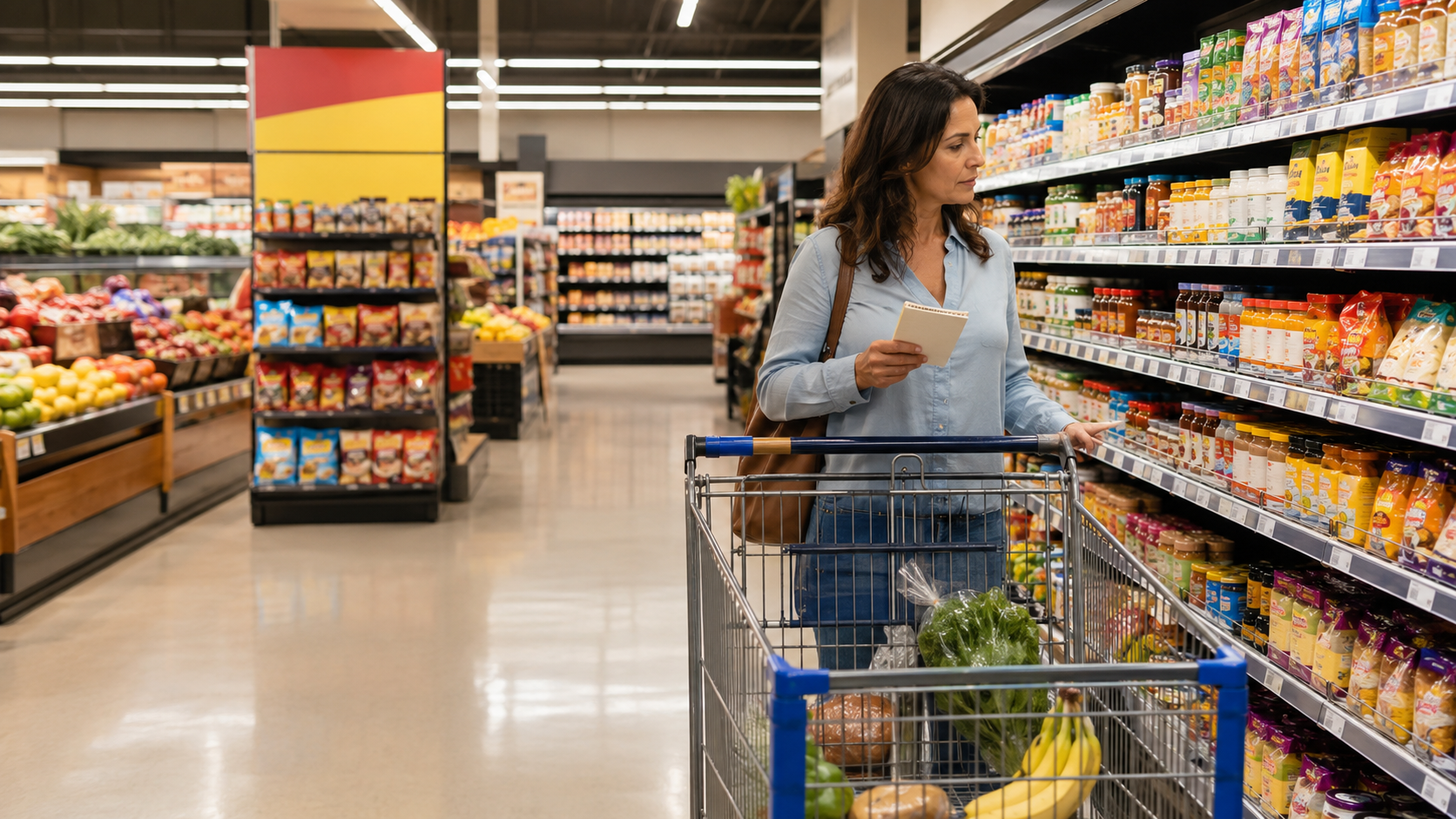
You went in for milk, eggs, and something for dinner. Twenty minutes later you're in the checkout line with a cart that somehow also contains a new steak sauce, a bag of chips you don't need, a magazine and candy bar you grabbed while waiting in line, and a receipt that's $60 higher than you expected.
Rest assured it's not a willpower problem.
Grocery stores are engineered environments, and nearly every choice inside one, from the size of the cart to the song playing overhead, has been tested for its effect on how much you spend. Retailers hire consultants, run in-store experiments, and track sales data down to the shelf facing, all in service of a longer, more expensive shopping trip. None of it makes grocery shopping some kind of trap you can't escape. It just means the grocery store layout has a job to do (which is to get you to spend more money) and once you can see how it works, it gets a lot easier to shop on your own terms instead.
Here's what the research actually shows about the most common tactics, and specific, low-effort ways to counter each one.
Your shopping cart is working against you
One of the most cited figures in retail psychology comes from an experiment described by branding consultant Martin Lindstrom in an account published in Harvard Business Review, where doubling the size of a standard shopping cart led shoppers to buy roughly 40% more than they normally would(1). The theory behind it is called emptiness aversion, a subconscious discomfort with a cart that looks too empty relative to its size, which pushes shoppers to keep adding items until the cart looks appropriately full(1).
What you can do while shopping
While you can't control the cart size a store hands you, you can decide which one you take. If your list has fewer than ten items, skip the oversized cart and grab a hand basket or mini-cart instead. It physically caps how much you can carry, which caps how much you're likely to buy on impulse. If you do end up with a full-size cart for a bigger trip, try loading your list items first and leaving the empty space at the back rather than the front. It won't stop the effect entirely, but it keeps the visual cue of empty space out of your line of sight for most of the trip.
Why the milk is always in the back
This one has two competing explanations, and the honest answer is that both are probably true at the same time. NPR's reporting on the question interviewed retail consultants and store executives who describe deliberate "basket-building," positioning staples like milk far from the entrance so shoppers walk past everything else in the store first(2). BJ's Wholesale Club's Rob Olsen put it directly, saying, "We call it building the basket in the business"(2).
But refrigeration logistics are real too. Wegmans' Kevin Lang told NPR it's "a consumer misconception" that milk placement is about forcing a longer walk, explaining that dairy sits near the loading dock and refrigerated storage to protect the cold chain during stocking(2). Both things can be true. The layout may genuinely be easier to stock that way, and stores have also noticed, and kept, the side effect of a longer shopping trip.
What you can do while shopping
No matter the cause of the milk location, the fix is the same. Shop with a list organized by the store's own layout, not by the meal you're planning, so you're moving through sections with intention instead of wandering the full perimeter every time you need a staple. Many (but not all) stores follow a similar general pattern, produce and bakery near the entrance, dairy and meat along the back and side walls, and packaged goods filling the aisles in between. Once you know your store's version of that pattern, you can build a list in the order you'll actually encounter things, which cuts down on backtracking and the extra browsing time that comes with it.
'Eye level is buy level'
An item's shelf position isn't random. A controlled eye-tracking study published in the Journal of Marketing found that a product's vertical position on the shelf, along with its number of facings, significantly affects how much attention and re-examination it gets from shoppers, with items at eye level consistently drawing more looks than those on the bottom shelf(3). That attention translates into consideration and purchases, which is exactly why the most profitable version of a product, not necessarily the cheapest, tends to occupy that prime eye level real estate(3).
What you can do while shopping
The cheaper store brand or the better unit price is frequently sitting one shelf up or one shelf down from whatever is staring back at you at eye level. Store brands in particular tend to get pushed to the top or bottom shelves precisely because they compete on price rather than brand recognition, so they don't need the premium real estate the way a national brand does. Before grabbing the first box of cereal, jar of sauce, or bag of coffee in front of you, glance up and down. That small habit is often the difference between the most profitable price for the store and the better price for you.
The sounds and smells you don't notice
Background music isn't just ambiance. A now-classic study in the Journal of Marketing found that slow-tempo music in a supermarket setting increased both the time shoppers spent in the store and the dollar amount of what they bought, compared to faster-tempo music, which sped shoppers through the aisles and reduced their overall spending(4). Stores looking to boost basket size have every incentive to keep the tempo slow.
Scent works the same way. Albertsons ran a case study piping the smell of baked cheesecake into select stores near the Easter holiday, an explicit test of whether the aroma of Philadelphia Cream Cheese would translate into more purchases of the product(5). The retailer's own framing was that the scent was designed to "disrupt the typical shopping behavior and encourage purchase"(5).
What you can do while shopping
Neither of these tactics requires elaborate countermeasures. If you know slow music tends to make you linger and browse, shop with headphones and your own playlist, ideally something with a tempo that matches how quickly you actually want to move through the store. And when you catch a suspiciously specific, suspiciously pleasant smell drifting through an aisle, treat it as a marketing signal, not a sign that the product nearby is fresher or better.
Loss leaders and the illusion of a deal
Milk and eggs are almost always priced close to cost, sometimes at an actual loss, because they're the items shoppers are most likely to price-check across stores(6). Michigan State food economist David Ortega has explained that keeping those staples artificially low creates the impression of overall value even when the rest of the cart is priced at a healthy margin(7). It works because the low price on something you buy every week is memorable, while the markup on twenty other items in the cart is easy to overlook.
BOGO deals lean on a related psychological quirk. Research published in the Journal of Business Research using eye-tracking found that shoppers pay more attention to, and show a stronger preference for, buy-one-get-one-free offers compared to equivalent percentage discounts, even when the actual savings work out the same or the percentage deal is technically better(8). Why? A "50% OFF" sticker asks you to do math. A "buy one, get one free" sign doesn't.
What you can do while shopping
The countermeasure for both is the same habit, checking the unit price rather than the framing on the sign. Most shelf tags already list the price per ounce, per pound, or per unit in smaller print below the sticker price, and comparing that number across brands and sizes takes the guesswork out of which option is actually cheaper. And before taking a BOGO deal, ask whether you'd actually buy two of that item at full price if there were no promotion attached. If the answer is no, it's not really a deal, it's just a bigger cart. However, on the opposite side, if it’s something you consume regularly anyway, taking advantage of the BOGO is probably a good idea.
The checkout lane isn't an accident
Checkout aisles occupy roughly just 1% of a typical supermarket's total merchandising space, but they generate about 4% of its profit, according to industry data reported by the Washington Post(9). That outsized return is exactly why the candy and magazine racks never move, even as self-checkout has cut into how much of that impulse business actually gets rung up(9).
That entire zone exists because shoppers standing in line, often a little bored and paying less attention than they were in the aisles, are more susceptible to a $2 chocolate bar or a magazine they weren't planning to buy.
Capital One Shopping's 2026 research backs up how common this is broadly, not just at checkout. The average consumer spent about $254 a month (or roughly $3,045 a year) on impulse purchases in 2025, and 92% of shoppers report some history of impulse buying, with about 80% of that behavior happening in physical stores rather than online(10). Separate research from IT Retail puts impulse purchases at roughly 62% of all supermarket sales, averaging about $281 a month(11).
What you can do while shopping
If checkout-lane impulse buys are a real pattern for you, self-checkout or online pickup and delivery remove the temptation almost entirely, since neither puts you standing next to a wall of candy with nothing to do but wait. If you're checking out with a cashier, a quick mental scan of your cart before you get in line is often enough to catch the "do I actually need this" moment before it becomes a $2.99 add-on. This is a situation where scrolling on your phone while you wait works in your favor, because checkout displays are designed to catch you in an idle moment with nothing else to look at. Keeping your attention on your phone screen instead of the shelves around you removes the exact condition those displays are counting on.
Endcaps are not always the best price
Those product displays at the end of each aisle are genuinely effective. Trade research reported by Progressive Grocer found that products placed on endcaps see roughly 2x to 5x the sales volume compared to the same product on a standard shelf(12). That's a real, well-documented lift, and it's exactly why manufacturers pay for that placement.
Paying for placement is the part that matters here. An endcap spot is bought real estate, not necessarily a clearance rack. Some endcap items are genuinely discounted, and some are simply the brand that paid to be seen first, counting on the extra visibility alone to drive the sales lift rather than a lower price.
What you can do while shopping
Before assuming an endcap display means the best price in the store, check the shelf tag and compare it to the same product's regular spot in its usual aisle. If the numbers match, you've lost nothing by checking. If they don't, you've just found the actual deal.
Mistakes that can undo your best intentions
Shopping hungry. Every tactic above that grocery stores use works better on a hungry brain. Low blood sugar makes impulse items like candy bars and chips look more appealing and makes the "just check the unit price" habit far easier to skip. So eat something before you go, even something small.
Shopping without a list. A list is the single most effective countermeasure to a store layout built around basket-building. Without one, you're relying entirely on willpower to resist a floor plan that was specifically designed to get you to fill your basket.
Assuming a promotional tag means the best price. BOGO stickers and endcap placement both feel like discounts, and sometimes they are. But neither guarantees it. Checking the unit price takes a few seconds and catches the cases where the "deal" isn't actually one.
How you can get some of that spending back
None of the habits above make grocery shopping a perfect money saving process, and that's fine. For the spending that happens anyway when there aren’t BOGO’s or other deals, cash back apps and credit cards that reward you for everyday spending are a straightforward way to recover some of it without changing how or where you shop.
Ibotta pays cash back after you scan a photo of your receipt in the app, or link a store loyalty account so purchases match to offers automatically with no receipt needed, and once your earnings hit a $20 minimum you can cash out to a bank account, PayPal, or a gift card(13).
Upside works differently. You claim a cash back offer in the app before you shop, pay with your linked credit or debit card, and the discount is applied automatically, with users earning an average of 8% cash back on groceries and dining(14).
Now that you’ve got some much needed information to help you save money at the grocery store, let’s get you up to speed on how to save more when you travel.
Learn 15 strategies to find cheap flights here.
About the Author
The Greensprout editorial team researches and writes about the everyday financial decisions that add up over time, from grocery budgets to retirement planning, with a focus on specific, actionable information over generic advice.
Disclaimer
Product prices, promotions, and cash back rates mentioned here are subject to change and vary by location and retailer. Information presented here does not guarantee any specific savings outcome. Greensprout's editorial team writes on behalf of the reader. Our goal is to provide clear, useful information to help you make better financial decisions. Our editorial content is not influenced by advertiser relationships. Greensprout is an independent, advertising-supported publisher and comparison resource. We may earn compensation when you click on links to products from our partners. This does not affect our editorial standards or recommendations.
Sources
1. Harvard Business Review via Martin Lindstrom — Shopping Carts Will Track Consumers' Every Move — https://www.martinlindstrom.com/harvard-business-review-shopping-carts-will-track-consumers-every-move/
2. NPR — Episode 555: Why Is the Milk in the Back of the Store? — https://www.npr.org/transcripts/494927147
3. Journal of Marketing (Chandon, Hutchinson, Bradlow, Young, 2009) — Does In-Store Marketing Work? — https://journals.sagepub.com/doi/10.1509/jmkg.73.6.1
4. Journal of Marketing (Milliman, 1982) — Using Background Music to Affect the Behavior of Supermarket Shoppers — https://www.academia.edu/57369350/Using_Background_Music_to_Affect_the_Behavior_of_Supermarket_Shoppers
5. Grocery Dive — Albertsons Ushers in Scent Marketing in Hopes Shoppers Stop, Smell, Then Buy — https://www.grocerydive.com/news/albertsons-ushers-in-scent-marketing-in-hopes-shoppers-stop-smell-then-bu/622111/
6. Tasting Table — The Grocery Store Deal That's Specifically Designed to Make You Spend More — https://www.tastingtable.com/2134274/grocery-store-loss-leaders-explained/
7. Marketplace — How Do Grocery Stores Decide Which Products Will Be Loss Leaders — https://www.marketplace.org/story/2025/06/06/how-do-grocery-stores-decide-which-products-will-be-loss-leaders
8. Journal of Business Research via ScienceDirect — Buy-One-Get-One-Free Deals Attract More Attention Than Percentage Deals — https://www.sciencedirect.com/science/article/abs/pii/S0148296319301705
9. Washington Post — Fast Checkouts Are Crushing Impulse Candy Sales, Here's Hershey's Plan to Change That — https://www.washingtonpost.com/news/business/wp/2015/01/29/fast-checkouts-are-crushing-impulse-candy-sales-heres-hersheys-plan-to-change-that/
10. Capital One Shopping Research — Impulse Buying Statistics — https://capitaloneshopping.com/research/impulse-buying-statistics/
11. IT Retail — Grocery Store Impulse Buying, Must-Know Stats and Strategies — https://www.itretail.com/blog/grocery-store-impulse-buying
12. Progressive Grocer — PG Web Extra: Endcaps and Center Store — https://progressivegrocer.com/pg-web-extra-endcaps-and-center-store
13. Ibotta — How It Works — https://home.ibotta.com/how
14. Upside — How It Works — https://upside.com/how-it-works/


