
Key takeaways
- Your Statement is available anytime through a free my Social Security account, and paper copies are mailed only to people 60 and older without an online account.
- Estimates assume you keep earning your most recent annual income until you claim, so they're most reliable in your mid-50s and later.
- Your benefit is based on your highest 35 years of indexed earnings, so every year on your earnings record counts, and errors are easiest to fix within about three years.
You've most likely paid into Social Security every year you've worked, and for most of that time the system probably felt abstract, a line on a pay stub of money that disappeared before it ever reached your account. Then as you get closer to retirement age, you start asking questions like how much will you get, when should you take it, and what happens to your spouse if something happens to you?
Your Social Security Statement is the one document that answers those questions using your own work history, and yet many people skim the first page, glance at a single number, and close the file.
But the Statement does more than show a benefit estimate. It shows how that estimate was calculated, what your family could receive if you became disabled or died, and the full year-by-year record of earnings that every one of your future checks will be based on. If that record has a mistake in it, the Statement is usually where you'll catch it.
This guide walks through each section in the order you'll see it, explains what the numbers mean for someone in your position, and points out the details that are easy to overlook.
Where do you find your Statement, and how often should you check it?
The Social Security Administration (SSA) makes your Statement available online through a free my Social Security account. If you're 60 or older and haven't set up an online account, SSA mails a paper Statement about three months before your birthday each year. If you're younger than 60 and don't have an account, you generally won't receive a paper copy at all(1).
Anyone 18 or older can open a my Social Security account. You'll sign in through Login.gov or ID.me, two identity verification services used across federal agencies, and you'll need a government-issued photo ID to finish setting it up. Once you're in, the account also lets you review your earnings, change your address or direct deposit, and monitor for unusual activity(3).
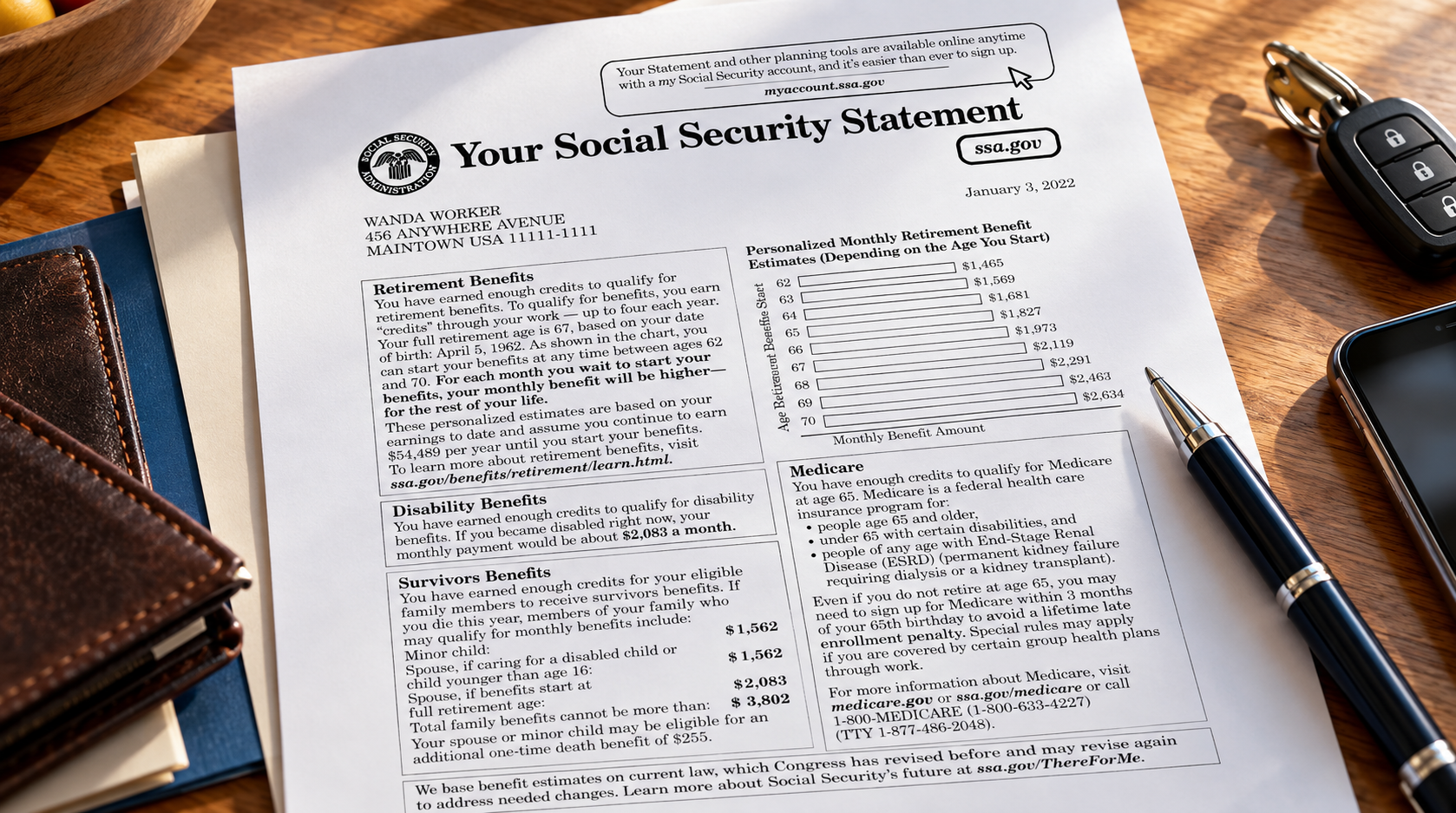
The redesigned Statement SSA introduced in recent years is shorter than older versions. It leads with a bar chart of your estimated retirement benefit at nine different claiming ages, then covers disability, survivors, Medicare, and your earnings history, and it comes with a fact sheet tailored to your age group(1). Checking it once a year, while last year's W-2 is still easy to find, is the simplest way to confirm your most recent earnings posted correctly.
What do the retirement estimates on the first page tell you?
The centerpiece of the Statement is a chart showing what your monthly retirement benefit would be if you started collecting at any age from 62 through 70. The Statement also tells you your full retirement age (FRA), which is the age at which you'd receive 100% of the benefit your work record qualifies you for(5).
Your FRA depends on the year you were born. It's 66 for people born from 1943 through 1954, rises by two months per birth year for those born 1955 through 1959, and reaches 67 for anyone born in 1960 or later(5). That age is the anchor for every other number on the chart.
Claiming before your FRA permanently reduces your monthly benefit. For someone whose FRA is 67, claiming at 62 cuts the benefit by 30%, so a $1,000 benefit becomes $700(5). Waiting past your FRA works in the other direction. For anyone born in 1943 or later, each year you delay adds 8% to your benefit through delayed retirement credits, and those credits stop accumulating once you reach 70(6).
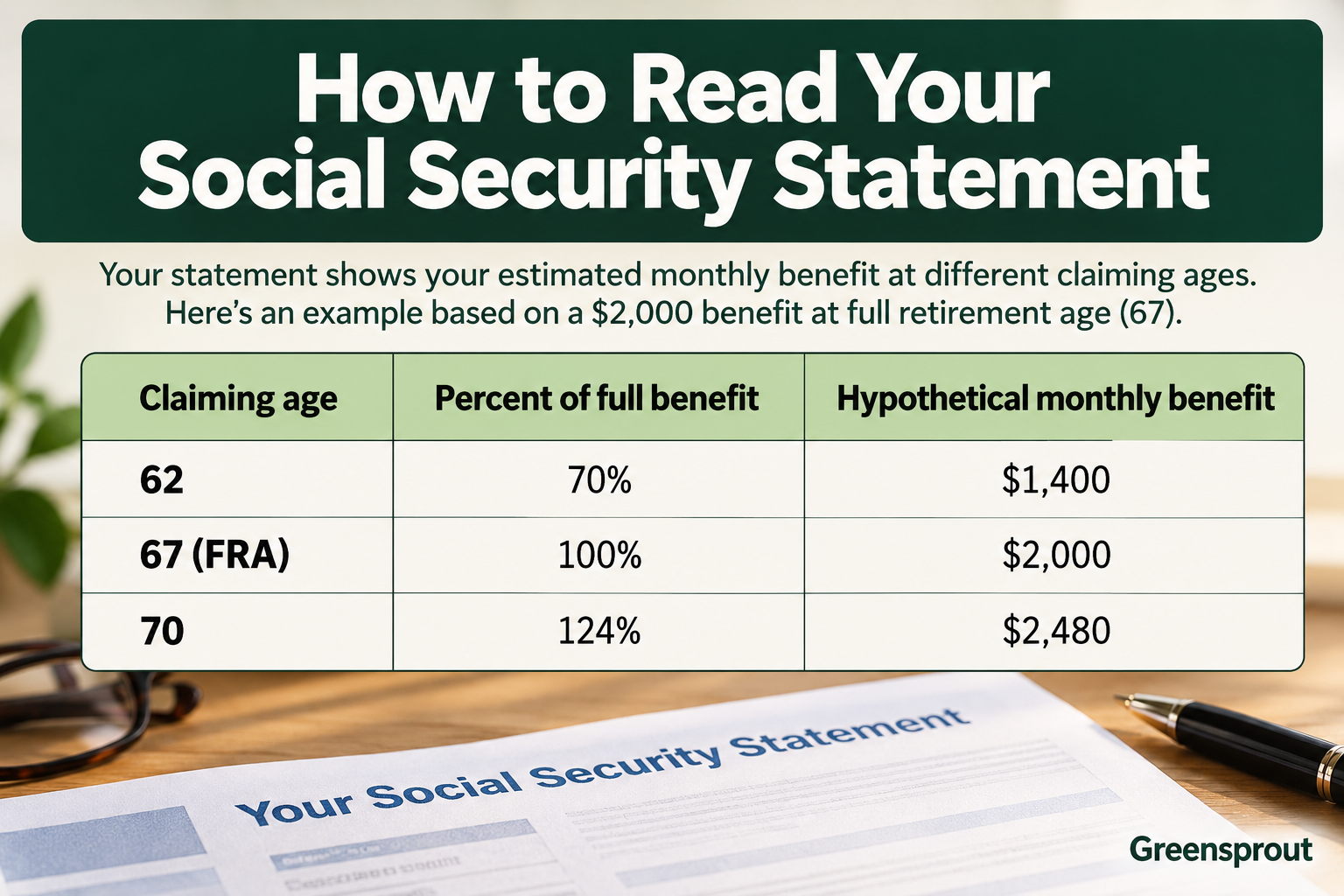
That's a difference of $1,080 a month between the earliest and latest claiming ages, or roughly $12,960 a year, for the same work history. The chart on your Statement shows these figures for your own record, so you don't have to estimate them yourself.
None of this means waiting is always the better choice. Claiming early gives you more months of payments, and your health, your other income sources, and your spouse's situation all shape which age makes sense(5). What the chart does is put a dollar figure on each option so you can weigh them with real numbers in front of you.
How much should you trust those estimates?
The estimates are personalized, but they rest on a few assumptions that are easy to miss. The most significant is that SSA assumes you'll keep earning the same amount you earned in your most recent year of work until you start benefits(7).
If you're planning to cut back, retire early, or switch to part-time work before you claim, your real benefit could come in lower than the chart suggests, especially if those final years would have replaced lower-earning years in your record.
SSA's own research shows estimates grow more reliable with age. An SSA analysis comparing Statement estimates against workers' actual benefits found that at age 55, 74% of estimates fell within 5% of the final benefit amount, while at age 25, only 7% did. Accuracy was also lower for women and for lower earners(7). In other words, the estimate on a 58-year-old's Statement is generally a solid planning number, while the one on a 35-year-old's Statement is a rough sketch.
Once you start collecting, your benefit is adjusted for cost-of-living increases, known as COLAs, which SSA applies to keep pace with inflation(7). If you'd like to see how inflation could change your figures, SSA's Online Calculator lets you enter the earnings from your Statement and display estimates in either today's dollars or future, inflated dollars(8).
Finally, the Statement notes that SSA bases its estimates on current law, "which Congress has revised before and may revise again to address needed changes"(4). The context behind that line comes from the Social Security Trustees, who report on the program's finances each year. Their 2026 report projects that the trust fund reserves for retirement and survivors benefits will be depleted in the fourth quarter of 2032, at which point incoming payroll taxes would cover 78% of scheduled benefits. Combined with the disability trust fund, reserves are projected to last until 2034, with 83% of scheduled benefits payable at that point(9).
Those projections describe what happens if Congress takes no action, and Congress has acted on Social Security's finances before. For planning purposes, some people choose to test their retirement budget against a lower benefit figure to see how much room they'd have.
What do the disability and survivors sections mean for your family?
These two sections are where the Statement shifts from your retirement to your family's protection, and they're often the most overlooked part of the document.
The disability section tells you whether you've earned enough credits to qualify for disability benefits and estimates what your monthly payment would be if you became disabled now. To qualify, you need enough work history, and your payment is based on your work history before the disability began(20).
That figure gives you a concrete baseline to compare against any private disability coverage you carry through work, so you can see how much of your paycheck would be replaced if you couldn't keep working.
The survivors section estimates what your family members could receive if you died. It typically shows amounts for a minor child, a spouse caring for a young or disabled child, and a spouse who has reached full retirement age, along with the maximum total your family could receive in a month. A surviving spouse can receive up to 100% of your benefit at their own full retirement age for survivors benefits, and children generally receive 75% of the parent's benefit. Spouses and some minor children may also qualify for a one-time death payment of $255(10).
If you're married, this section is worth reading alongside your life insurance and pension survivor elections. The survivors figure shows how much income your household would keep from Social Security alone, which makes it easier to judge whether the rest of your plan covers the difference.
How do spousal benefits fit into the picture?
Your Statement shows benefits based on your own record, but if you're married, your spouse may be eligible for a benefit based on your work history instead of, or in addition to, their own. A spouse's benefit can be up to one-half of the amount you're eligible to receive at your full retirement age, and it's permanently reduced if your spouse claims it before reaching their own FRA(11).
One detail surprises many couples. While delaying past your FRA increases your own benefit through delayed retirement credits, it does not raise your spouse's benefit above that one-half ceiling(11). If the reason you're considering waiting until 70 is to increase your spouse's monthly check while you're both alive, the numbers may not work the way you expect. Delaying does, however, carry over to your spouse's survivors benefit, because a widow or widower is entitled to the same delayed retirement credit increase the deceased spouse had earned(12).
What about the Medicare section?
The Statement also tells you whether you've earned enough credits to qualify for Medicare at 65 and reminds you to sign up on time. That reminder carries real financial weight. Your initial enrollment period is the seven-month window that begins three months before the month you turn 65. If you miss it and don't qualify for a special enrollment period, such as one tied to current employer coverage, your Part B premium can rise by 10% for each full 12-month period you were eligible but didn't enroll, and that higher premium generally lasts as long as you have Part B(13).
This is also the one deadline on the Statement that isn't tied to when you claim Social Security. Many people delay retirement benefits to 67 or 70 but still need to enroll in Medicare at 65, so it's worth putting that date on your calendar separately.
Why is the earnings record the most important page?
The earnings record lists every year you've worked, with two columns of figures for each year. The first shows earnings taxed for Social Security, and the second shows earnings taxed for Medicare. Every benefit estimate on the first page comes from the numbers on this page, which is why it deserves more attention than it usually gets.
SSA calculates your benefit by taking your 35 highest-earning years, adjusting each one for changes in average wages over time (a process called indexing), and averaging them(2). If you have fewer than 35 years with earnings, the missing years are counted as zeros, and the total is divided across 420 months regardless(14). That has two practical consequences. A year that's missing from your record or recorded too low can pull down your benefit for the rest of your life, and if you have fewer than 35 working years, each additional year you work replaces a zero and can raise your benefit.
You may notice the two columns don't always match. Social Security tax applies only up to an annual maximum, which is $184,500 for 2026, while Medicare tax has no earnings limit(15). If you were a higher earner in a given year, the Social Security column will be capped and the Medicare column will show your full earnings. That difference is expected and isn't an error.
Older years are often grouped together on the paper Statement, and the most recent year may appear as "not yet recorded" if your employer's report hasn't been posted yet. Your full year-by-year history is available online through your my Social Security account.
The Statement also shows how much you and your employers have paid in Social Security and Medicare taxes over your career. That total doesn't factor into your benefit calculation, but it's a useful reminder that the benefits on the first page are something you've paid for.
What should you do if your earnings record looks wrong?
Start by comparing each year on your record against your own documents, such as W-2 forms, tax returns, or old pay stubs. Common warning signs include a year showing zero when you know you worked, a year that looks far lower than you remember earning, or earnings that clearly aren't yours. Self-employed readers should check that their net self-employment income matches what they reported on their tax return for each year.
If you spot an error, the Statement directs you to report it through your my Social Security account or by calling SSA at 1-800-772-1213(21). You can also file Form SSA-7008, Request for Correction of Earnings Record, and send it with supporting evidence, such as W-2 or W-2c forms for wage earnings, or a copy of your tax return and proof of filing for self-employment income(16).
Timing is the reason not to put this off. Under the general rule, an earnings record can be corrected up to three years, three months, and 15 days after the year in which the wages were paid or the self-employment income was earned(17). There are exceptions, including cases where you applied for benefits or requested a correction before that limit ran out(18), but the older a mistake gets, the harder it can be to find the paperwork that proves it. Reviewing your record each year keeps any correction within easy reach.
If you worked in a job that didn't pay into Social Security, such as some teaching, firefighting, and police jobs in many states, or federal work under the Civil Service Retirement System, you may remember seeing notes on older Statements about the Windfall Elimination Provision (WEP) or Government Pension Offset (GPO), two rules that reduced benefits for people with those pensions. The Social Security Fairness Act, signed January 5, 2025, ended both provisions for benefits payable for January 2024 and later(19). If those rules shaped your earlier planning, your current Statement is a good place to see your updated estimate.
Common mistakes worth avoiding
Treating the age-62 figure as your benefit. The first number on the chart is the smallest one, and it's easy to anchor on it as "what Social Security pays." Every age on the chart is a real option, and the difference between the earliest and latest claiming ages can amount to thousands of dollars a year for the rest of your life.
Assuming the estimate holds even if you stop working early. The figures assume you keep earning at your most recent level until you claim. If you're planning to retire at 60 and claim at 67, those seven years of projected earnings won't happen, and your benefit may come in below what the Statement shows(7). A financial professional or SSA's Online Calculator can help you model the scenario that matches your plan.
Checking the earnings record only when it's time to claim. By the time most people file for benefits, many of their working years are well past the standard correction window, and the employers or records needed to prove a missing year may be gone. A five-minute annual review avoids that problem.
Where to go from here
Your Statement gives you the raw numbers, but turning them into a decision means fitting them alongside your savings, pensions, health, and your spouse's benefits. If you'd like help seeing how your claiming age fits into the rest of your retirement income, get matched with a financial advisor who can walk through your Statement with you by answering a few questions.
References
1. Social Security Administration. "Your Social Security Statement." https://www.ssa.gov/myaccount/statement.html
2. Social Security Administration. "Your Retirement Benefit: How It's Determined." Publication No. 05-10070, May 2026. https://www.ssa.gov/pubs/EN-05-10070.pdf
3. Social Security Administration. "my Social Security." https://www.ssa.gov/myaccount/
4. Social Security Administration. Sample Social Security Statement (mailed version), "Your Social Security Statement, Wanda Worker," April 28, 2025. https://www.ssa.gov/myaccount/assets/materials/statement-redesign-si-bw.pdf
5. Social Security Administration. "Retirement Benefits: Starting Your Retirement Benefits Early." https://www.ssa.gov/benefits/retirement/planner/agereduction.html
6. Social Security Administration. "Retirement Benefits: Delayed Retirement Credits." https://www.ssa.gov/benefits/retirement/planner/delayret.html
7. Social Security Administration, Office of Retirement and Disability Policy. "Analysis of Benefit Estimates Shown in the Social Security Statement." Briefing Paper No. 2020-01. https://www.ssa.gov/policy/docs/briefing-papers/bp2020-01.html
8. Social Security Administration. "Benefit Calculators." https://www.ssa.gov/benefits/calculators/
9. Social Security Administration. "Social Security Board of Trustees: Projection for Combined Trust Funds Remains Consistent with Prior Year." Press release, June 9, 2026. https://www.ssa.gov/news/en/press/releases/2026-06-09.html
10. Social Security Administration. "Survivor Benefits: How Much You Could Get." https://www.ssa.gov/survivor/amount
11. Social Security Administration. "Do You Qualify for Social Security Spouse's Benefits?" July 11, 2024. https://www.ssa.gov/blog/en/posts/2024-07-11.html
12. Social Security Administration. Social Security Handbook, Section 720, "Delayed Retirement Credit." https://www.ssa.gov/OP_Home/handbook/handbook.07/handbook-0720.html
13. Social Security Administration. "Medicare." Publication No. 05-10043. https://www.ssa.gov/pubs/EN-05-10043.pdf
14. Social Security Administration. "Annual Statistical Supplement, 2023, Appendix D: Computing a Retired-Worker Benefit." https://www.ssa.gov/policy/docs/statcomps/supplement/2023/apnd.html
15. Social Security Administration. "2026 Social Security Changes" (COLA fact sheet). https://www.ssa.gov/news/en/cola/factsheets/2026.html
16. Social Security Administration. Form SSA-7008, "Request for Correction of Earnings Record." https://www.ssa.gov/forms/ssa-7008.pdf
17. Social Security Administration. Social Security Handbook, Section 1423, "Time Limit for Correcting Earnings Record." https://www.ssa.gov/OP_Home/handbook/handbook.14/handbook-1423.html
18. Social Security Administration. Social Security Handbook, Section 1425, "Time Limit Extended if an Investigation Is in Progress." https://www.ssa.gov/OP_Home/handbook/handbook.14/handbook-1425.html
19. Social Security Administration. "Social Security Fairness Act: Windfall Elimination Provision (WEP) and Government Pension Offset (GPO) Update." https://www.ssa.gov/benefits/retirement/social-security-fairness-act.html
20. Social Security Administration. "Disability Benefits." https://www.ssa.gov/disability/
21. Social Security Administration. "What do I do if I need to remove earnings that are not mine from my Social Security record?" FAQ. https://www.ssa.gov/faqs/en/questions/KA-10123.html
Claiming-age table figures are hypothetical and for illustration only. Trust fund projections reflect the 2026 Social Security Trustees Report. The maximum taxable earnings figure applies to 2026 and adjusts annually.
Investment disclaimer: Nothing on this site constitutes investment advice. All investors are encouraged to conduct their own research before making any investment decision. Past performance is not a guarantee of future results.
Medicare/Insurance disclaimer: Medicare plan availability and costs vary by location. Contact a licensed Medicare advisor or visit Medicare.gov to compare plans available in your area.
Editorial independence: Greensprout's editorial team writes on behalf of the reader. Our goal is to provide clear, useful information to help you make better financial decisions. Our editorial content is not influenced by advertiser relationships.
Affiliate disclosure: Greensprout is an independent, advertising-supported publisher and comparison resource. We may earn compensation when you click on links to products from our partners. This does not affect our editorial standards or recommendations.