
Key takeaways
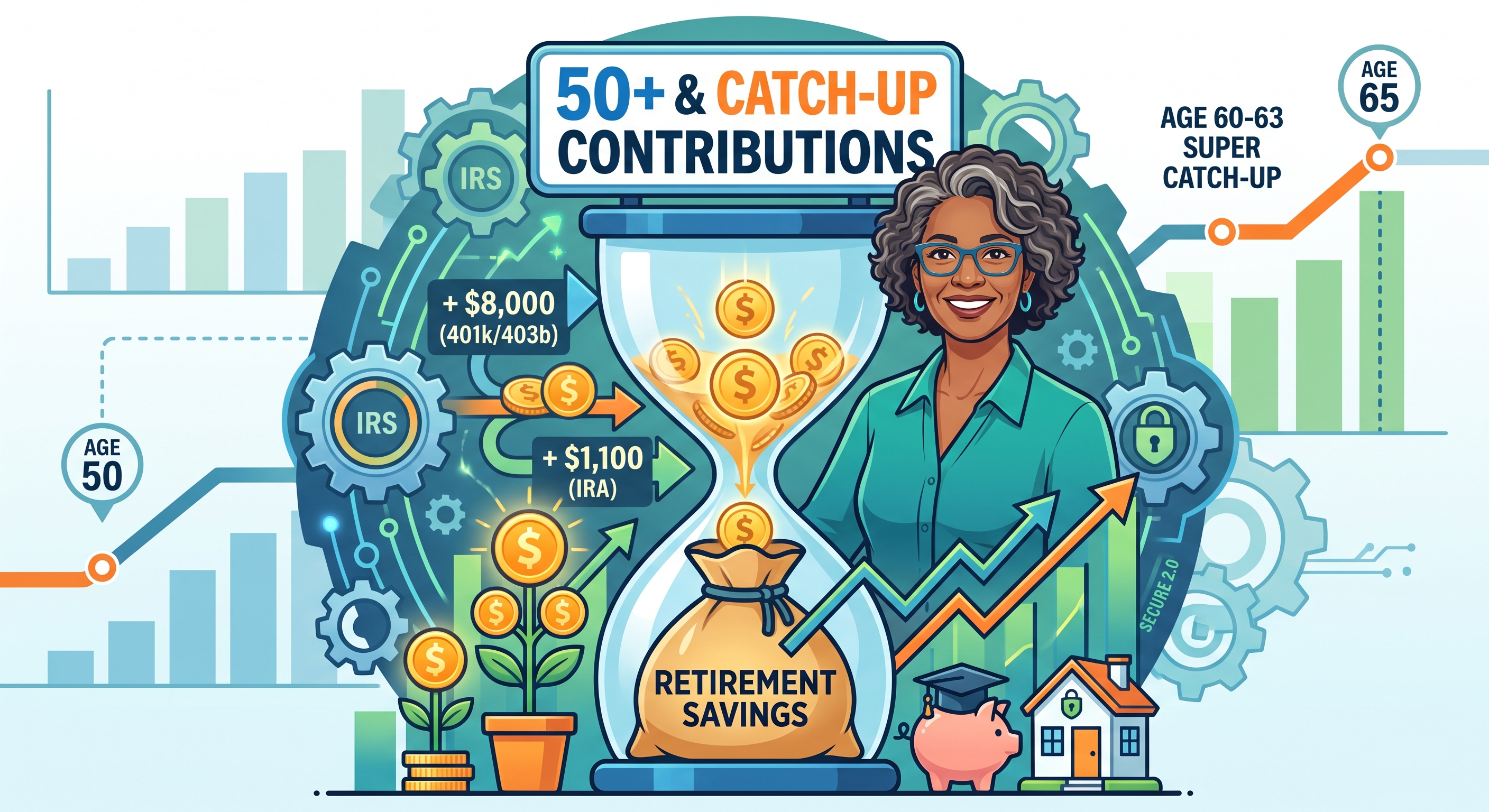
- For 2026, the standard 401(k), 403(b), and governmental 457 catch-up for those 50 and older is $8,000, bringing the total to $32,500.
- Workers who turn 60, 61, 62, or 63 in 2026 get a super catch-up of $11,250 instead, for a total of $35,750, replacing rather than adding to the standard catch-up.
- IRA catch-up contributions are smaller ($1,100 for 2026) but now adjust for inflation each year under SECURE 2.0.
- Long-tenured employees at schools, hospitals, and similar organizations may qualify for an additional 403(b) catch-up of up to $3,000 a year, capped at $15,000 over a lifetime.
- Governmental 457(b) plans can offer a three-year special catch-up before retirement, worth up to double the standard limit, but it can't be combined with the age-based catch-up in the same year.
- Starting in 2026, catch-up contributions from employees with prior-year wages above $150,000 must be made as Roth contributions in 401(k), 403(b), and governmental 457(b) plans.
If you're behind on retirement savings, whether you've got a 401(k) that's smaller than you'd like or you're just now starting to invest, there's a piece of good news waiting once you turn 50.
The IRS lets you contribute thousands more a year to your retirement accounts than everyone else.
This means turning 50 doesn't just change how you think about retirement, it changes what the tax code lets you do about it. Starting the year you turn 50, the IRS opens up extra room in most retirement accounts specifically so people who got a late start, hit a rough patch, or simply want to invest more in their peak earning years can do so. Few people use the full extent of it, partly because the rules are scattered across several account types and got noticeably more complicated in 2026.
This isn't a minor adjustment. Depending on which accounts you have access to, how long you've worked for your current employer, and how close you are to retirement, the combined value of the catch-up provisions available to you could add tens of thousands of dollars a year in extra contribution room.
Here's what catch-up contributions allow for 401(k)s, 403(b)s, 457 plans, IRAs, SIMPLE IRAs, and a couple of lesser-known provisions that can outweigh the standard catch-up once you know they exist.
Why the tax code gives you extra room after 50
The basic idea behind a catch-up contribution is simple. Every retirement account has an annual limit on what you can contribute, and once you turn 50, the IRS lets you contribute more than that limit, on top of it, in every year going forward. It's not a one-time bonus. It's a permanent increase in your contribution ceiling that stays in place for the rest of your working life.
SECURE 2.0, the retirement savings law passed in 2022, expanded this idea further for people in their early 60s specifically. Starting in 2025, workers who turn 60, 61, 62, or 63 during the year get access to an even larger catch-up amount in workplace plans, sometimes called the super catch-up. The logic is that these are typically the highest-earning years for most workers, and also the years right before retirement when saving or investing aggressively pays off the most. The same law also changed how high earners have to treat their catch-up contributions, a detail covered further down.
How much extra can you put into a 401(k), 403(b), or 457 plan?
For 2026, the standard employee contribution limit for a 401(k), 403(b), governmental 457 plan, or the federal Thrift Savings Plan is $24,500. If you're 50 or older at any point during the year, you can add a catch-up contribution of $8,000, bringing your total to $32,500(1).
That catch-up limit isn't a flat number that stays put. It rose from $7,500 in 2025 to $8,000 in 2026, and it will likely keep climbing with inflation in future years, the same way the base limit does.
Here's what that means in dollar terms over time. A 52-year-old who contributes the full $32,500 every year for 13 years, until age 65, and earns a hypothetical 7% average annual return, a purely illustrative assumption and not a guarantee of future performance, would end up with roughly $655,000 from contributions alone, before counting any employer match. The same person contributing only the standard $24,500 limit, without ever using the catch-up, would end up closer to $493,000 under the same assumptions. That's roughly $160,000 in additional retirement savings attributable entirely to using the catch-up provision every year, on top of whatever the base contributions would have grown to regardless.
What changes once you turn 60?
This is where SECURE 2.0's super catch-up comes in. If you turn 60, 61, 62, or 63 at any point during 2026, your catch-up limit isn't $8,000. It's $11,250(1), which brings your total possible contribution to $35,750 for the year.
The super catch-up replaces the standard catch-up for those specific ages. It doesn't stack on top of it. And it's strictly age-gated. The year you turn 64, you drop back down to the standard $8,000 catch-up, even if you were using the higher amount the year before. If you're in this age window and haven't checked whether your employer's plan has adopted the super catch-up provision yet, it's worth confirming directly, since not every plan has updated its documents to allow it.
Does this apply to IRAs too?
Yes, but the numbers are smaller. For 2026, the standard IRA contribution limit for either a traditional or a Roth IRA is $7,500(1). The catch-up for age 50 and older is $1,100, bringing the total to $8,600(1).
That catch-up amount used to be fixed at $1,000 for years without changing. SECURE 2.0 made it subject to annual cost-of-living adjustments starting in 2024, which is why it moved to $1,100 for 2026.
There's no separate super catch-up for IRAs at age 60 to 63. That enhanced provision only applies to workplace plans.
Whether you can deduct a traditional IRA contribution, catch-up included, depends on your income and whether you or your spouse is covered by a workplace retirement plan. For 2026, if you're covered by a workplace plan, the deduction phases out between $81,000 and $91,000 in modified adjusted gross income for single filers, and between $129,000 and $149,000 for married couples filing jointly when the spouse contributing is the one covered(1).
A Roth IRA has its own separate income limits regardless of workplace coverage, phasing out between $153,000 and $168,000 for single filers and between $242,000 and $252,000 for married couples filing jointly in 2026(1). If your income is above these ranges, you can still contribute to a traditional IRA, just without the upfront deduction, or explore a Roth conversion with a tax advisor.
What about a SIMPLE IRA?
The IRS refers to the IRA-based version as a SIMPLE retirement account in its official guidance, commonly known as a SIMPLE IRA. A separate plan type, the SIMPLE 401(k), shares the same dollar limits but works differently.
SIMPLE IRAs, common at small businesses, have their own separate set of limits. The standard 2026 contribution limit is $17,000, with a $4,000 catch-up for those 50 and older, for a total of $21,000(1). Employers who've adopted an enhanced version of the SIMPLE plan (a provision SECURE 2.0 made available to certain small employers) offer a higher base limit of $18,100, and a super catch-up of $5,250 for those 60 to 63, similar in concept to the 401(k) super catch-up(1).
If you're not sure which SIMPLE plan your employer offers, it's worth asking, since the difference between the standard and enhanced versions changes your available contribution room by a few thousand dollars a year.
What about an HSA?
A Health Savings Account isn't a retirement account in the traditional sense, but as we've covered in a separate article, it functions like one for many people once it's invested rather than left in cash. The HSA catch-up works differently from the accounts above. It's a flat $1,000 addition for anyone 55 or older, not indexed for inflation and not subject to a super catch-up at any age. For 2026, that brings total HSA contribution room to $5,400 for self-only coverage or $9,750 for family coverage(2). If both spouses on a family HDHP are 55 or older, each spouse adds the $1,000 catch-up to a separate account of their own, since HSAs can't be jointly owned.
What if you've worked for a tax exempt organization?
If you work for a school, hospital, church, or certain other tax-exempt organizations and participate in a 403(b) plan, there's a separate provision worth knowing about, sometimes called the 15-year rule. A 403(b) is a workplace retirement plan available to employees of schools, hospitals, churches, and other tax-exempt organizations, functioning much like a 401(k) but limited to that category of employer.
Employees with at least 15 years of service at the same qualifying employer may be able to contribute an additional amount, up to $3,000 a year, on top of everything else, up to a lifetime cap of $15,000 across all the years they use it(3).
This isn't automatic. Your employer's plan has to specifically offer it, and the exact amount you're eligible for depends on a formula tied to your years of service and how much you've contributed historically. If you qualify for both the 15-year rule and the standard age-50 catch-up in the same year, the IRS applies the 15-year catch-up first, then the age-based catch-up on top of whatever room remains(3). For a longtime teacher or hospital employee 50 or older, stacking both provisions in the same year could mean contributing well beyond the standard $32,500 ceiling other workers face.
What if you're a few years from retirement with a 457 plan?
A 457(b) is a similar workplace retirement plan offered mainly by state and local government employers, along with some tax-exempt organizations, with its own separate contribution limit that doesn't count against your 401(k) or 403(b) room.
Governmental 457(b) plans have their own separate enhancement, and it's arguably the most generous catch-up provision in the tax code, if your plan offers it. In the three calendar years immediately before the retirement age your plan defines as "normal," you may be able to contribute up to double the standard annual limit, or the standard limit plus whatever you were eligible to contribute in earlier years but didn't, whichever is larger(4).
For 2026, doubling the standard $24,500 limit works out to $49,000 for the year, without any age-50 or super catch-up added on top. That's the tradeoff. You generally can't combine this special three-year catch-up with the age-50 or super catch-up in the same year. The rules require using whichever provision produces the larger contribution, not both at once(4).
Someone eligible for both the 403(b) 15-year rule and a separate 457(b) plan through the same public employer could, in theory, be contributing to both accounts simultaneously, since the limits are tracked separately by account type.
Do high earners get the same tax break on catch-up contributions?
Not anymore, starting in 2026. Under a provision of SECURE 2.0 that took full effect this year, employees whose prior-year FICA wages (the Social Security wages reported on your W-2) from the employer sponsoring the plan exceeded $150,000 must make all of their catch-up contributions as Roth contributions, not pretax. This applies to 401(k), 403(b), and governmental 457(b) plans(1).
In practice, that means the tax benefit shifts rather than disappears. A high earner subject to this rule still gets to contribute the same $8,000 or $11,250 catch-up amount. They just don't get an upfront deduction for it the way they would with a standard pretax contribution. The money grows tax-free instead and comes out tax-free in retirement, the same as any other Roth contribution. Whether that's better or worse for you depends on whether you expect to be in a higher or lower tax bracket when you eventually withdraw the money, a question worth discussing with a tax advisor rather than assuming one way is automatically better.
This rule doesn't apply to SIMPLE or SEP IRAs, only to 401(k), 403(b), and governmental 457(b) plans(1).
It also creates a payroll timing issue worth watching for. Since the $150,000 threshold is based on your prior year's wages from the specific employer sponsoring the plan, someone who crosses that line for the first time in a given year may not find out until their catch-up contributions are already flowing in as Roth rather than pretax, simply because payroll systems apply the rule automatically once the threshold is confirmed. If you're close to that income level, it's worth checking with your HR or benefits department on how your specific plan handles the transition, since the rule doesn't require any action on your part but does change how your paycheck deductions are categorized.
Here are some common mistakes many people make
- Assuming the super catch-up applies automatically. Not every employer plan has adopted the age 60 to 63 super catch-up yet. If you're in that age range, confirm with your plan administrator before assuming the higher limit is available to you.
- Stacking catch-up provisions that can't be combined. The 457(b) special three-year catch-up can't be used in the same year as the age-50 or super catch-up. The 403(b) 15-year rule and the age-50 catch-up can be combined, but the order they're applied in changes how much room you have left.
- Overlooking the Roth requirement for high earners. If your wages crossed the threshold last year, your catch-up contributions this year have to go in as Roth, whether or not that's what you were planning. Check your paycheck withholding to make sure it's set up correctly rather than finding out at tax time.
- Treating all catch-up limits as one combined number. A 401(k) catch-up, an IRA catch-up, and an HSA catch-up are three completely separate allowances tied to three different accounts. Maxing out one doesn't reduce your room in the others, and someone with access to all three could be leaving thousands of dollars of available tax-advantaged space unused simply by not realizing each account has its own independent ceiling.
Figuring out which of these provisions apply to your specific plans, and which combination gets you the most savings, usually comes down to your individual mix of accounts, income, and years of service. Answer a few questions to get matched with a financial advisor who can walk through your specific situation.
References
1. Internal Revenue Service. Notice 2025-67, 2026 Amounts Relating to Retirement Plans and IRAs, as Adjusted for Changes in Cost-of-Living. https://www.irs.gov/pub/irs-drop/n-25-67.pdf
2. Internal Revenue Service. Revenue Procedure 2025-19, 2026 inflation-adjusted HSA and HDHP limits. https://www.irs.gov/pub/irs-drop/rp-25-19.pdf
3. Internal Revenue Service. "403(b) plans - Catch-up contributions." https://www.irs.gov/retirement-plans/403b-plans-catch-up-contributions
4. Internal Revenue Service. "Retirement Topics - 457(b) Contribution Limits." https://www.irs.gov/retirement-plans/plan-participant-employee/retirement-topics-457b-contribution-limits
All contribution limits and thresholds reflect the 2026 tax year as published by the IRS in Notice 2025-67 and related guidance. Employer plans are not required to adopt every catch-up provision described here, so availability should be confirmed with your plan administrator. All figures are subject to change and should be verified against current IRS guidance before acting on them.