

Key takeaways
- Claiming at 62 pays 70% of your full benefit when your full retirement age (FRA) is 67, while each full year you delay past FRA adds 8%, up to age 70.
- A spouse can receive up to half of the worker's full benefit, but the worker's delayed retirement credits don't raise it, and it stops growing at the spouse's own FRA.
- Survivor benefits reach 100% of the deceased worker's benefit at survivor FRA and include any delayed retirement credits, so the higher earner's claiming age can shape a surviving spouse's income for decades.
- Before FRA in 2026, SSA withholds $1 for every $2 you earn above $24,480, and those withheld months are credited back once you reach FRA.
- Depending on your combined income, up to 50% or 85% of your benefits can be taxable, and you can have 7%, 10%, 12%, or 22% withheld from each payment.
If you've spent a career watching Social Security taxes come out of every paycheck, the moment you finally get to collect can feel like the easy part. You've earned the benefit, the application can be done online, and for a lot of people the filing date gets chosen because it felt like the natural time rather than because anyone compared what the alternatives would pay.
The choices tucked into that application reach further than most people expect. The age when you file sets the size of every check that follows, and if you're married, it can set the income your spouse lives on for years after you're gone. A part-time job before a certain birthday can temporarily hold back your payments, and the withdrawals you take from retirement savings can decide how much of your benefit ends up taxed. None of these rules is hidden, but they rarely appear in one place.
This guide brings them together using the Social Security Administration's (SSA) own rules and figures, so you can see how your benefit is calculated, what each claiming age does to it, how spousal and survivor benefits work, what happens if you keep working, and when benefits become taxable before you commit to any of it.
How does Social Security decide what you'll receive?
You become eligible for retirement benefits by earning credits as you work and pay Social Security taxes, and anyone born in 1929 or later needs 40 credits, which is roughly 10 years of work(1). In 2026, each credit takes $1,890 in covered earnings, and wages up to $184,500 are subject to the Social Security portion of the payroll tax(2).
Once you qualify, SSA works out your basic benefit, which it calls your primary insurance amount (PIA), by taking your highest 35 years of earnings and adjusting them for the growth in average wages since you earned them. Your PIA is what you'd receive if you started benefits exactly at your full retirement age. Benefits also get a yearly cost-of-living adjustment (COLA), and you become eligible for those increases starting the year you turn 62, even if you don't file until 70(3).
For 2026, the COLA was 2.8%, which lifted the estimated average monthly benefit for retired workers to $2,071 and the average for a couple both receiving benefits to $3,208. The maximum monthly benefit for a worker retiring at full retirement age in 2026 is $4,152(2).
Social Security was never designed to cover everything on its own.
For someone who starts benefits at 67, it replaces about 42% of a medium earner's average wages, as much as 78% for very low earners, and about 28% for high earners, while most financial advisers suggest you'll need about 80% of your pre-retirement income to live comfortably(1). Savings, pensions, and work have to supply the rest.
Will the program be able to pay what it promises?
Projections released in June 2026 show the combined retirement and disability trust funds paying all scheduled benefits until 2034, and at that point incoming revenue would still cover 83% of scheduled benefits if Congress doesn't act. The retirement trust fund on its own is projected to run out of reserves in the fourth quarter of 2032, with 78% of benefits payable at that time(4). Those projections don't mean checks would stop, but they're a reason to build some flexibility into your plan.
Does a government pension still reduce your benefit?
Not anymore. The Social Security Fairness Act, signed into law on January 5, 2025, eliminated the Windfall Elimination Provision (WEP) and the Government Pension Offset (GPO), two rules that had reduced Social Security benefits for people who also received a pension from work that didn't pay Social Security taxes. The change covers benefits on your own record as well as spouse's and surviving spouse's benefits, and it applies to benefits payable for January 2024 and later(5).
What does your claiming age do to your monthly check?
Your full retirement age (FRA) is the age at which you're entitled to 100% of your PIA. It's 66 for anyone born from 1943 through 1954, rises by two months for each birth year after that, and reaches 67 for anyone born in 1960 or later(1). You can start as early as 62, but if you do your benefit is permanently reduced for each month you claim before full retirement age, and for someone whose FRA is 67, claiming at 62 pays only 70% of the full amount(6).
Waiting works in the other direction. For every full year you delay past FRA, SSA adds 8% to your benefit, and those increases, called delayed retirement credits, stop once you reach 70(1).
The table below shows how those rules play out for a hypothetical worker with an FRA of 67 and a PIA of $2,000 a month(1,6).
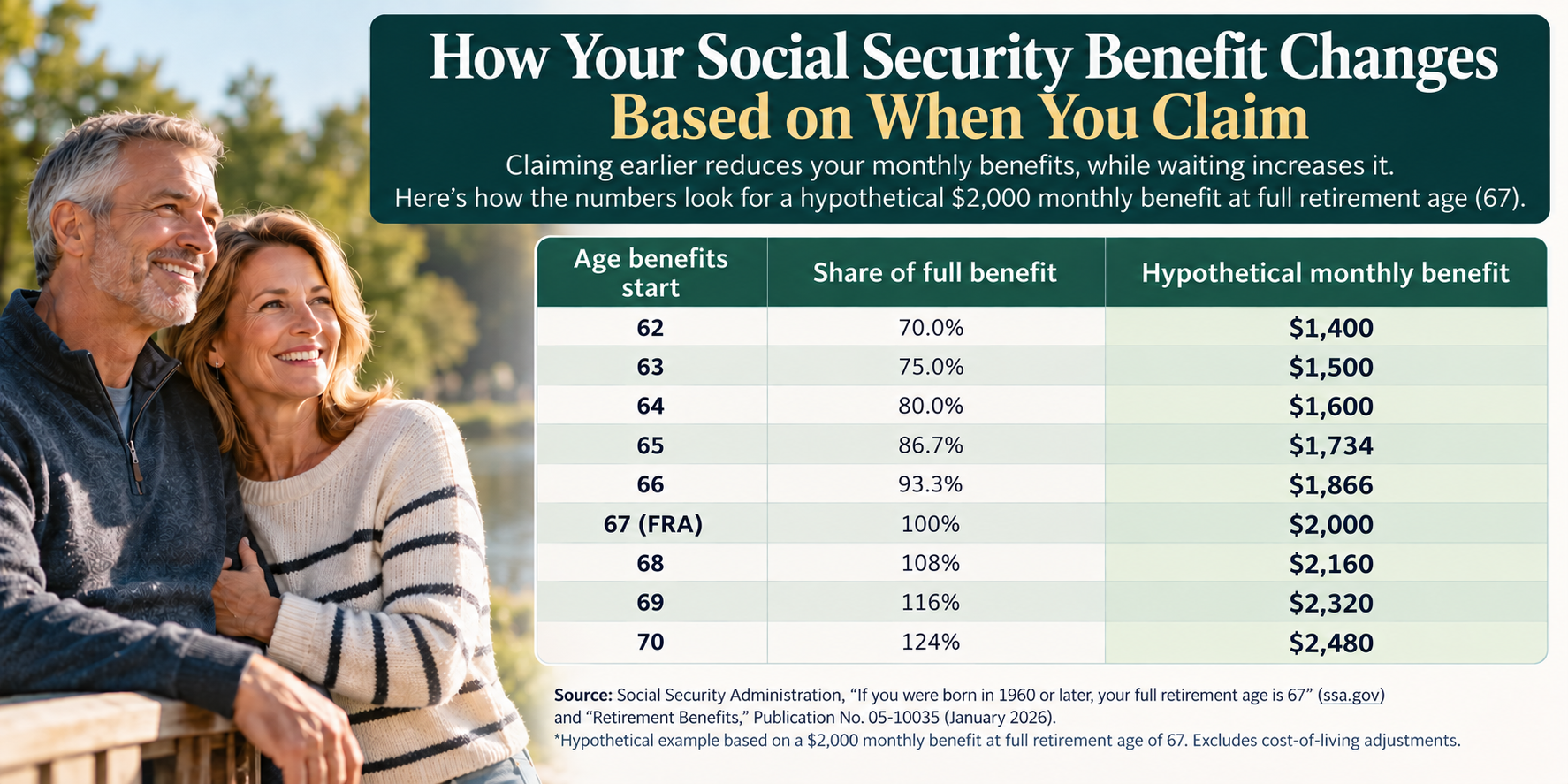
Comparing total dollars rather than monthly checks helps put the choice in perspective. In this hypothetical, the person who claims at 62 collects about $302,400 by age 80, while the person who waits until 70 collects about $297,600, so the two are close to even at that point. However by age 85, the person who claims later is ahead by roughly $60,000 ($446,400 compared with $386,400). These totals are illustrative and do not take into account COLAs and taxes, but they show why the answer depends so heavily on how long you expect to collect.
None of this makes waiting the right call for everyone. If your health is poor, if you have no other way to cover expenses until a later age, or if claiming would keep you from selling investments during a downturn, starting earlier can be a reasonable decision. For married couples, though, the higher earner's claiming age carries extra weight, because it can set the survivor benefit the other spouse lives on later, which the survivor section below explains.
What if you file and then change your mind?
SSA offers two limited ways to adjust the decision. You can cancel your application within 12 months of your benefits being approved, but you can do it only once, and you'll have to repay everything you and your family received, including money withheld for Medicare premiums, taxes, and garnishments, along with any medical costs Medicare Part A covered during that time(7).
Once that window closes, a second option opens at FRA. You can pause your payments at that point, which increases your future benefit by up to 8% per year plus inflation, and payments restart automatically at 70 if you don't restart them sooner. While your benefit is paused, anyone collecting on your record stops receiving payments as well, and if you're on Medicare, you'll need to keep paying your premiums to hold onto that coverage(8).
How do spousal benefits work?
A spouse who never worked, or who had low earnings, can receive up to half of the worker's full benefit. If you qualify for both your own retirement benefit and a spousal benefit, SSA always pays your own benefit first and then adds enough from the spousal benefit to bring the total up to the higher amount. For example, a person who qualifies for a $1,250 retirement benefit and a $1,400 spousal benefit would receive their own $1,250 plus $150 from the spousal benefit at FRA, for $1,400 in total(1).
Timing works a little differently for spouses.
A current spouse can't start spousal benefits until the worker has filed for their own retirement benefits. A spousal benefit claimed before the spouse's own FRA is permanently reduced, down to 32.5% of the worker's full benefit at 62 when FRA is 67, and it stops growing once the spouse reaches FRA(1,9). And while a worker who waits past FRA earns delayed retirement credits on their own check, SSA doesn't use those credits to increase a spouse's benefit(10).
If you were born on or after January 2, 1954, and you're eligible for both your own retirement benefit and a spousal benefit, filing for one automatically counts as filing for the other, a rule SSA calls deemed filing. That means you can't claim the spousal benefit on its own and leave your own benefit to keep growing(1).
One worker's record can pay a family only so much, generally between 150% and 180% of the worker's own benefit, and if a spouse's and children's benefits exceed that limit, SSA reduces their payments rather than the worker's(1).
What if you're divorced?
A marriage that ended can still count. You can receive benefits on an ex-spouse's record if the marriage lasted at least 10 years, you're 62 or older, and you're currently unmarried. Unlike a current spouse, you don't have to wait for your ex to file, as long as you're both at least 62 and have been divorced for at least two continuous years. The benefit you receive doesn't reduce what your ex or their current spouse can get(1), and payments to ex-spouses don't count toward the family maximum(9).
What happens to your benefits when a spouse dies?
For many workers, the survivor protection earned through payroll taxes is probably worth more than their individual life insurance. A surviving spouse who has reached survivor FRA generally receives 100% of the deceased worker's basic benefit amount. Survivor FRA isn't always the same as the FRA for your own retirement benefit, since it's 66 for survivors born from 1945 through 1956 and rises gradually to 67 for anyone born in 1962 or later. You can start reduced survivor benefits as early as 60, or 50 if you have a disability, and a surviving spouse of any age who is caring for the worker's child younger than 16 generally receives 75% of the worker's benefit(5).
Survivor payments claimed at 60 start at 71.5% of the deceased spouse's benefit and increase the longer you wait, up to survivor FRA(11).
Two rules shape how large that benefit ends up being. If the worker who died was receiving reduced benefits because they claimed early, the survivor benefit is based on that reduced amount(5). If the worker instead earned delayed retirement credits by waiting past FRA, SSA includes those credits when it calculates the surviving spouse's benefit(10).
Take a hypothetical couple in which one spouse has a PIA of $2,400 and the other has a PIA of $800. If the higher earner claims at 62, their check is reduced to $1,680, and a surviving spouse's benefit would be based on that reduced amount rather than the full $2,400. If the higher earner instead waits until 70, the survivor benefit would be calculated from that larger figure(10). For the lower earner, whose own benefit is $800 at FRA, that one decision could shape their income for life.
Remarrying before 60 (or before 50 with a disability) usually ends eligibility for survivor benefits on a late spouse's record, but remarrying after that age doesn't, and at 62 or older you can take benefits on your new spouse's record instead if they'd be higher. A former spouse can also receive survivor benefits at 60 or older (50 to 59 with a disability) if the marriage lasted at least 10 years(5).
You can't collect a survivor benefit and your own retirement benefit in full at the same time, because SSA pays whichever is higher rather than adding them together. You can, however, start with one and switch later, such as taking survivor benefits first and moving to your own retirement benefit at 70, when it has reached its highest amount(11).
Survivor benefits are claimed by phone or at a Social Security office, and applying promptly is important because some claims are paid only from the date you apply rather than the date of death. A one-time payment of $255 may also go to a surviving spouse or child who meets SSA's requirements, and that payment has to be requested within two years of the death(5).
Can you work while collecting before full retirement age?
You can, but earnings above certain limits cause SSA to temporarily withhold benefits, a rule known as the retirement earnings test. If you're under FRA for the whole year, SSA deducts $1 from your benefits for every $2 you earn above $24,480 in 2026. In the year you reach FRA, the limit rises to $65,160, SSA deducts $1 for every $3 you earn above it, and only your earnings in the months before you reach FRA count(12).
For a hypothetical 63-year-old earning $34,480, that's $10,000 over the limit, so SSA would withhold $5,000 in benefits for the year. Only wages from a job and net earnings from self-employment count toward the limit, and that includes bonuses, commissions, and vacation pay. Pensions, annuities, investment income, interest, veterans benefits, and other government or military retirement benefits don't count(12).
Withheld benefits aren't gone for good.
Once you reach FRA, SSA recalculates your benefit to give you credit for the months it reduced or withheld, and from that month on your earnings no longer reduce your benefits, however much you make. SSA also recalculates your benefit each year if your latest year of work is one of your highest-earning years(12).
A special rule helps people who retire partway through a year after already earning more than the annual limit. For one year, usually the first year you receive benefits, SSA pays a full check for any month in which you earn $2,040 or less (or $5,430 or less if you reach FRA in 2026) and don't perform substantial services in self-employment. SSA defines substantial services as working more than 45 hours a month in a business, or between 15 and 45 hours in a highly skilled occupation(1,13).
The earnings test also applies if you're collecting spousal or survivor benefits and still working before FRA, but your earnings reduce only your own benefits, not those of other family members(5,9).
Will you owe income tax on your Social Security?
About 40% of people who receive Social Security pay federal income tax on their benefits. Whether you do depends on what SSA calls your combined income, which is your adjusted gross income plus any non-taxable interest plus half of your Social Security benefits for the year. That figure determines how much of your benefit can be taxed, using the thresholds in the table below(1).
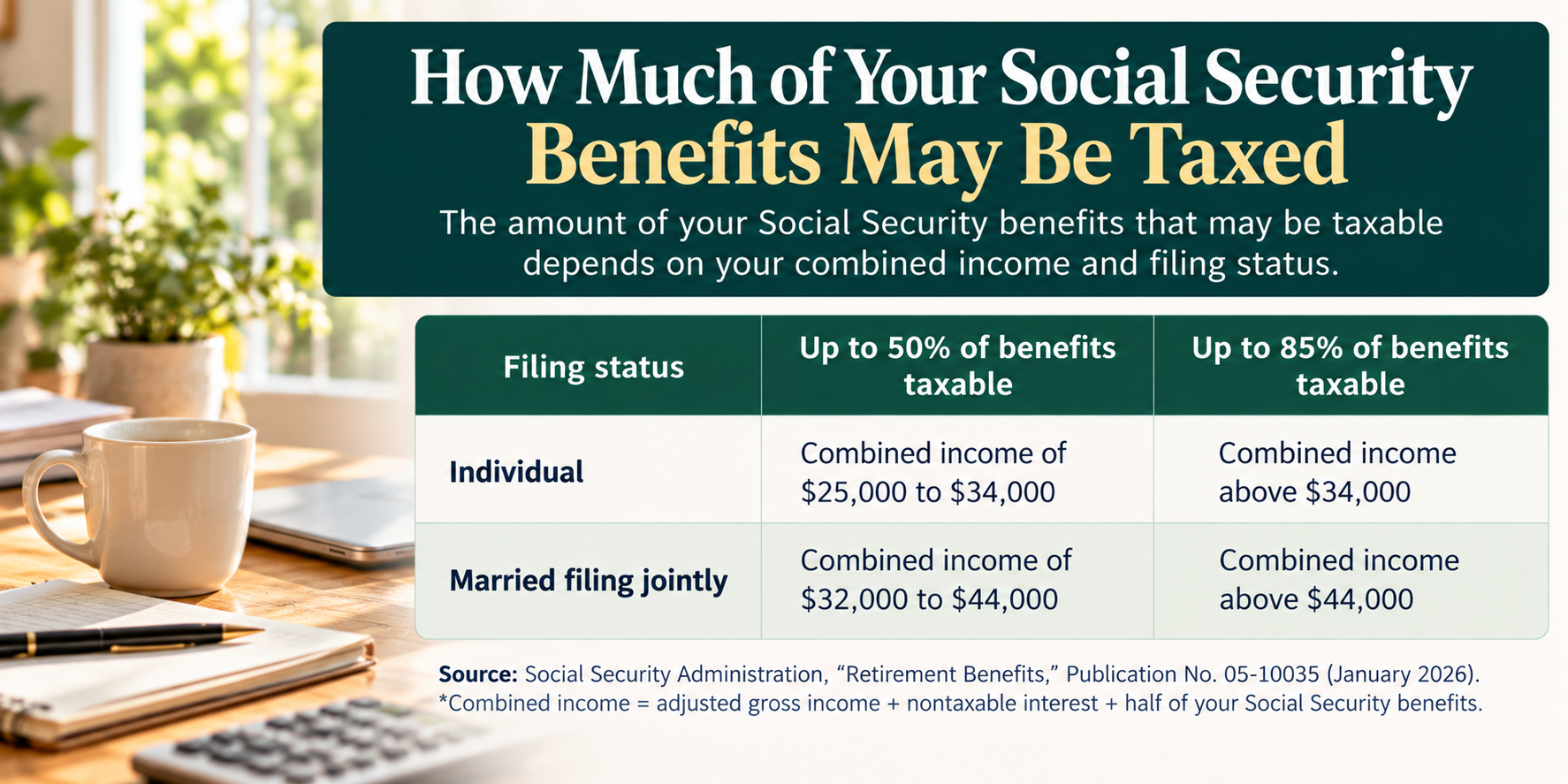
If you're married and file separately, you'll probably owe tax on your benefits. The percentages in the table describe how much of your benefit is subject to income tax, not the tax rate itself, so reaching the top tier means up to 85% of your benefit is taxed alongside your other income(1).
Consider a hypothetical single retiree whose only other income is $20,000 from a pension and IRA withdrawals, and who receives $24,000 a year in Social Security. Half of the benefit is $12,000, which brings combined income to $32,000, inside the range where up to 50% of benefits can be taxed. Because withdrawals from traditional retirement accounts raise your adjusted gross income, the timing and size of those withdrawals can change how much of your Social Security ends up taxed.
At the end of each year, SSA mails you a Form SSA-1099 showing the benefits you received, which you'll use when you file your federal return. Having tax withheld from your benefits isn't required, although it can be easier than making quarterly estimated tax payments(1). You can choose to withhold 7%, 10%, 12%, or 22% of each monthly payment, and you can start, change, or stop withholding through your personal my Social Security account or by phone(14).
Where do people usually go wrong?
Treating the claiming decision as a solo choice. When the higher earner in a marriage files early, the reduction doesn't end with their own check. Because a survivor benefit is based on the reduced amount the worker was receiving, an early claim can lower the income a widow or widower lives on for years(5). Comparing claiming ages as a household decision gives a clearer view of what's at stake.
Assuming money withheld under the earnings test is lost. Some people turn down work, or leave a job early, because they believe every withheld dollar is forfeited. SSA credits those withheld months back by recalculating your benefit once you reach FRA(12). The earnings test can still squeeze your cash flow before FRA, but it works more like a delay than a permanent penalty.
Waiting past full retirement age for a larger spousal check. Delaying your own benefit to 70 can make sense, but a spousal benefit stops growing at FRA, and the worker's delayed retirement credits don't increase it(9,10). If your own retirement benefit is small and most of your check would come from the spousal benefit, waiting past FRA means giving up months of payments with little to show for it.
Who can help you decide when to claim?
If you're within a few years of filing, or you and your spouse haven't yet talked through whose benefit should start first, the choices in this guide can feel like a lot to hold in your head at once. A financial advisor can look at your claiming age alongside your savings withdrawals, your taxes, and your spouse's income, and help you see how each option would play out for your household before any of it becomes permanent.
Answer a few questions to get matched with a financial advisor.
Investment disclaimer: Nothing on this site constitutes investment advice. All investors are encouraged to conduct their own research before making any investment decision. Past performance is not a guarantee of future results.
Affiliate disclosure: Greensprout is an independent, advertising-supported publisher and comparison resource. We may earn compensation when you click on links to products from our partners. This does not affect our editorial standards or recommendations.
References
1. Social Security Administration. "Retirement Benefits" (Publication No. 05-10035, January 2026). https://www.ssa.gov/pubs/EN-05-10035.pdf
2. Social Security Administration. "2026 Cost-of-Living Adjustment (COLA) Fact Sheet." https://www.ssa.gov/news/en/cola/factsheets/2026.html
3. Social Security Administration. "Your Retirement Benefit: How It's Determined" (Publication No. 05-10070, May 2026). https://www.ssa.gov/pubs/EN-05-10070.pdf
4. Social Security Administration. "Social Security Board of Trustees: Projection for Combined Trust Funds Remains Consistent with Prior Year." June 9, 2026. https://www.ssa.gov/news/en/press/releases/2026-06-09.html
5. Social Security Administration. "Survivors Benefits" (Publication No. 05-10084, April 2026). https://www.ssa.gov/pubs/EN-05-10084.pdf
6. Social Security Administration. "If you were born in 1960 or later, your full retirement age is 67." https://www.ssa.gov/benefits/retirement/planner/1960.html
7. Social Security Administration. "Cancel your benefits application." https://www.ssa.gov/manage-benefits/cancel-your-benefits-application
8. Social Security Administration. "Pause your Retirement benefit." https://www.ssa.gov/manage-benefits/pause-retirement
9. Social Security Administration. "What you could get from Family benefits." https://www.ssa.gov/family/amount
10. Social Security Administration. Code of Federal Regulations § 404.313, "What are delayed retirement credits and how do they increase my old-age benefit amount?" https://www.ssa.gov/OP_Home/cfr20/404/404-0313.htm
11. Social Security Administration. "What you could get from Survivor benefits." https://www.ssa.gov/survivor/amount
12. Social Security Administration. "Receiving Benefits While Working." https://www.ssa.gov/benefits/retirement/planner/whileworking.html
13. Social Security Administration. "Special Earnings Limit Rule." https://www.ssa.gov/benefits/retirement/planner/rule.html
14. Social Security Administration. "Request to withhold taxes." https://www.ssa.gov/manage-benefits/request-withhold-taxes
COLA, taxable maximum, credit amount, earnings test limits, and average and maximum benefit figures reflect 2026 amounts and adjust annually; confirm the current year's figures before relying on them. Reduction percentages and delayed retirement credits reflect rules for people born in 1960 or later. Trust fund projections reflect the 2026 Trustees Report released June 9, 2026. All illustrative examples are hypothetical.