

Key takeaways
- Your Initial Enrollment Period is seven months, centered on your 65th birthday, and signing up before your birthday month avoids any delay in Part B coverage.
- Active employer coverage can let you delay Part B without a penalty, but COBRA doesn't extend your window, and the end of COBRA or retiree coverage doesn't open a new one.
- Part A and Part B leave you paying deductibles and 20% coinsurance with no annual out-of-pocket cap, while Part D caps covered drug costs at $2,100 in 2026 and $2,400 in 2027.
- Late enrollment penalties for Part B and Part D generally last as long as you have that coverage and grow the longer you wait, and they're avoidable with on-time enrollment or creditable coverage.
- IRMAA is based on income from two years earlier, and a qualifying life change like retirement can justify a request for a lower premium.
Somewhere in the months before your 65th birthday, insurance companies start paying more for your attention. All of this tends to land at the same moment you're weighing when to retire, when to claim Social Security, and what your Medicare health coverage should look like for the next few decades.
What sets Medicare apart from most financial decisions is how much of it the calendar decides for you. If you sign up on time, the process is more manageable than its reputation suggests. If you miss a window, or assume your current coverage protects you when it doesn't, the costs can follow you as a higher premium for as long as you live.
This guide walks through Medicare in the order you'll run into it, from enrollment and what Parts A, B, and D cost to the income-based surcharge known as IRMAA and the services Medicare won't pay for at all. Choosing a specific plan is a separate decision, and it goes much more smoothly once this foundation is in place.
How do the parts of Medicare fit together?
Medicare's lettered parts are less confusing once you see that two come from the government directly and two come from private insurers approved by Medicare.
Part A is hospital insurance. It covers inpatient hospital stays, care in a skilled nursing facility, hospice, inpatient rehabilitation, and some home health care. Part B is medical insurance, covering doctors' services, outpatient hospital care, durable medical equipment (things like walkers, wheelchairs, and hospital beds), and many other services Part A doesn't(1). Together, Parts A and B are called Original Medicare.
Part D is prescription drug coverage, sold by private insurance companies that contract with Medicare. Part C, better known as Medicare Advantage, is a private alternative that delivers your Part A and Part B benefits through one plan, which may or may not include drug coverage. To join a Medicare Advantage plan you need both Part A and Part B, while a standalone Part D plan only requires one or the other(13).
Whatever you eventually decide about private plans, everyone starts by enrolling in Part A and Part B through Social Security, and that step runs on a fixed schedule.
When does your Medicare clock start?
Your first chance to sign up is called your Initial Enrollment Period, or IEP. It lasts seven months, beginning three months before the month you turn 65 and ending three months after it(3). For someone born in June, that window runs from March 1 through the end of September.
If you qualify for premium-free Part A, it starts the month you turn 65.
For Part B, signing up before your birthday month means coverage starts the month you turn 65, while signing up during your birthday month or the three months after means coverage starts the following month(3). Coverage always begins on the first of the month, and if your birthday falls on the first, your Part A starts the month before you turn 65.
If you're already getting Social Security benefits at least four months before you turn 65, you'll be enrolled in Part A and Part B automatically, and your welcome package with your Medicare card arrives three months before your coverage starts(4).
If you live in Puerto Rico, you get Part A automatically, but you have to sign up for Part B if you want it(17).
If you haven't started Social Security benefits by then, you'll need to sign up for Medicare yourself, which you can do online through the Social Security Administration(18).
What if you're still working at 65?
Whether you can safely delay Medicare comes down to one question, which is whether your health insurance comes from an employer where you or your spouse are actively working.
If it is, and that coverage is a group health plan available to employees generally, you can usually wait to sign up for Part B without a penalty. Once you or your spouse stop working, or once that job-based coverage ends (whichever happens first), you get an 8-month Special Enrollment Period to sign up(5).
Employer size plays a role here as well.
If the employer has fewer than 20 employees, Medicare generally pays first and your group plan pays second, and when your plan is the second payer you may need to sign up for Part B before it will pay(6). That makes it worth confirming with your benefits administrator before you turn down Part B.
COBRA, the program that lets you keep a former employer's coverage after you leave, doesn't count as coverage from active employment, and signing up for COBRA doesn't pause or extend your eight-month window. Retiree coverage and self-employed coverage may not qualify as employer group coverage either, and Medicare's guidance for anyone whose coverage doesn't qualify is to sign up at 65 to avoid the Part B penalty(5).
If you don't have to pay a premium for Part A, Medicare notes that you can sign up for it at 65 or anytime later, even while you're still working, and wait on Part B(5).
There's one catch worth planning around if you have a health savings account (HSA), which is a tax-advantaged account paired with a high-deductible health plan. Under IRS rules, your HSA contribution limit drops to zero starting with the first month you're enrolled in Medicare, and that includes months of retroactive coverage(14). Retroactive coverage comes into play because when you sign up for premium-free Part A after 65, it's backdated up to six months, though never earlier than the month you turned 65(3). Medicare advises that you and your employer stop HSA contributions six months before you retire or apply for Social Security benefits to avoid a tax penalty(5).
What does Part A cost?
About 99% of Medicare beneficiaries pay no monthly premium for Part A, because they or a spouse worked at least 40 quarters (roughly 10 years) in jobs that paid Medicare taxes. If you have fewer than 40 quarters, you can buy Part A. In 2026 that costs $311 a month if you or your spouse have 30 to 39 quarters, and $565 a month if you have fewer than 30(1).
Part A's deductible applies to each "benefit period" rather than to each calendar year. A benefit period starts the day you're admitted as an inpatient in a hospital or skilled nursing facility and ends once you've gone 60 days in a row without inpatient hospital care or skilled nursing care(15).
You pay the deductible every time a new benefit period begins, and because there's no limit on how many benefit periods you can have in a year, two separate hospital stays can mean paying it twice(2).
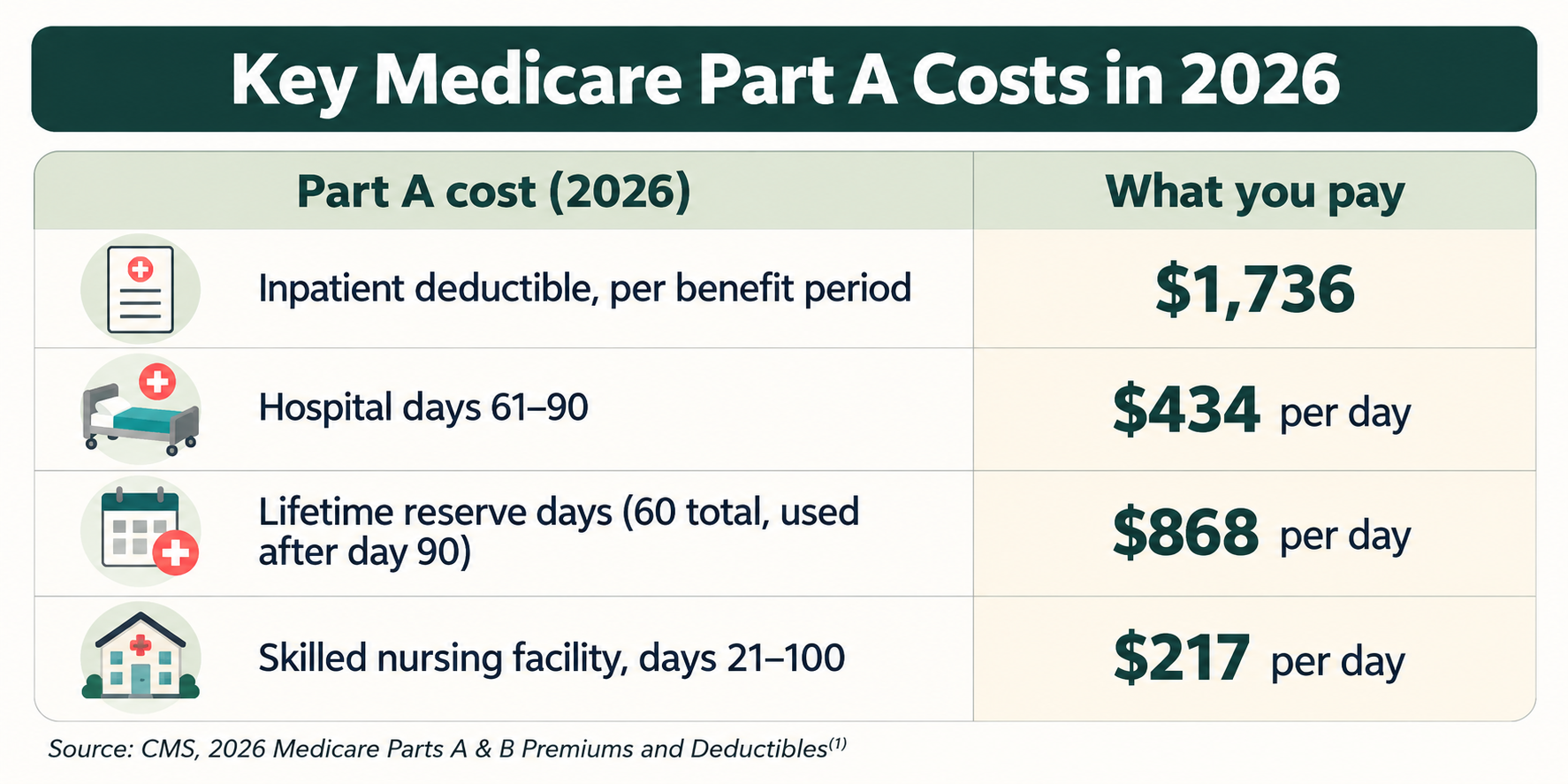
After day 150 of a hospital stay, or day 100 in a skilled nursing facility, you pay all costs for the rest of that benefit period(2).
What does Part B cost?
The standard Part B premium in 2026 is $202.90 a month, up from $185 in 2025, and the annual deductible is $283(1). You pay the premium every month whether or not you use any Part B services, and higher earners pay more, which the IRMAA section below explains.
Once you've met the deductible, you generally pay 20% of the Medicare-approved amount for each covered service, as long as your provider accepts that amount as full payment. On a hypothetical $30,000 Medicare-approved bill for outpatient surgery, 20% works out to $6,000, plus whatever is left of your $283 deductible. If the surgery happens in a hospital outpatient department, you'll also owe the hospital a separate copayment(2).
That 20% has no ceiling. Original Medicare has no yearly out-of-pocket limit for Part A or Part B services, which means a serious illness can generate bills with no upper bound unless you have supplemental coverage or a Medicare Advantage plan(2).
That single fact drives much of the plan-shopping decision that comes after enrollment.
How does Part D drug coverage work?
Part D coverage comes from private insurers, so premiums, covered drug lists, and pharmacy networks all vary by plan. What doesn't vary are the federal limits every plan has to follow.
In 2026, no Part D plan can charge a deductible above $615. After the deductible, you pay 25% of the cost of your covered drugs until your out-of-pocket spending reaches $2,100 for the year, and from that point you pay nothing for covered Part D drugs through December. For 2027, those limits rise to a $700 maximum deductible and a $2,400 out-of-pocket cap(7).
If you go 63 or more days in a row without Part D or other "creditable" drug coverage (coverage that's similar in value to Part D) after your IEP ends, a permanent penalty gets added to your premium(7). Your current drug plan has to tell you whether its coverage is creditable, and it sends that information every year, so hold on to those notices in case you need them later(5).
What happens if you miss your window?
If you don't sign up for Part B during your IEP and don't qualify for a Special Enrollment Period, your next chance is the General Enrollment Period, which runs January 1 through March 31 each year. Coverage starts the month after you sign up, which can leave you without Part B for months, and late enrollment penalties may apply(3).
Those penalties aren't one-time fees. They're added to your monthly premium, and for Part B and Part D they generally last as long as you have that coverage(8).
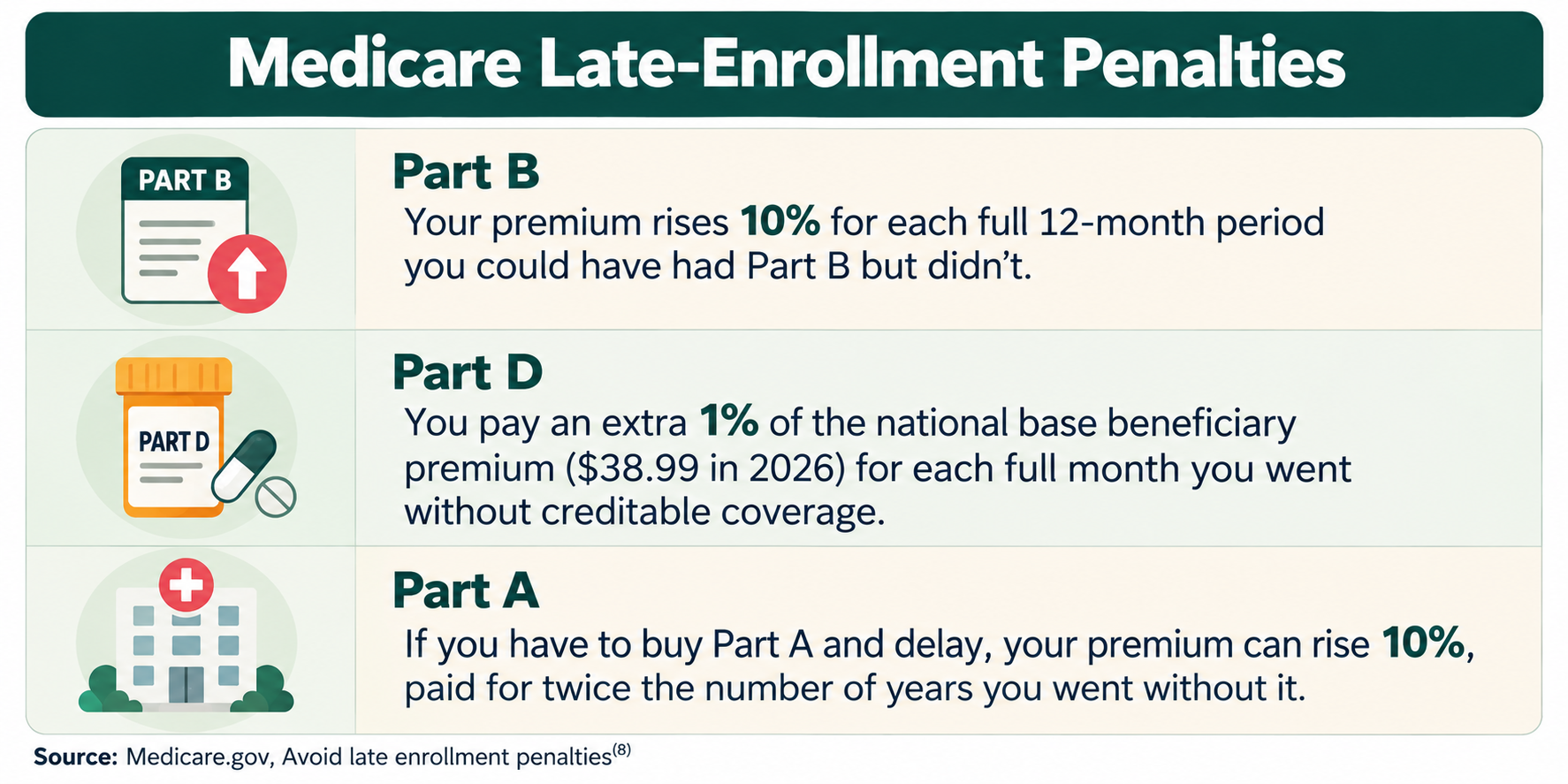
To see how this adds up, take a hypothetical 68-year-old who skipped Part B for three full years without qualifying for a Special Enrollment Period. Her penalty would be 30% of the standard premium, which at 2026 rates adds about $60.90 a month, or roughly $730 a year. Because the penalty is calculated as a percentage of each year's standard premium, that dollar amount rises whenever the premium does.
The Part D penalty is smaller but works the same way. A hypothetical retiree who went 24 months without creditable drug coverage would owe 24% of $38.99, which rounds to $9.40 a month on top of whatever plan he chooses, for as long as he has Part D(8).
What is IRMAA, and who pays it?
IRMAA stands for Income-Related Monthly Adjustment Amount. It's a surcharge added to your Part B and Part D premiums when your income crosses certain thresholds, and roughly 8% of people with Part B pay it(1).
Social Security uses your modified adjusted gross income (MAGI), which is your adjusted gross income plus any tax-exempt interest, from the most recent tax return the IRS provides. For 2026 premiums, that's generally your 2024 return(9).
In other words, the income you report at 63 can set your premiums at 65.
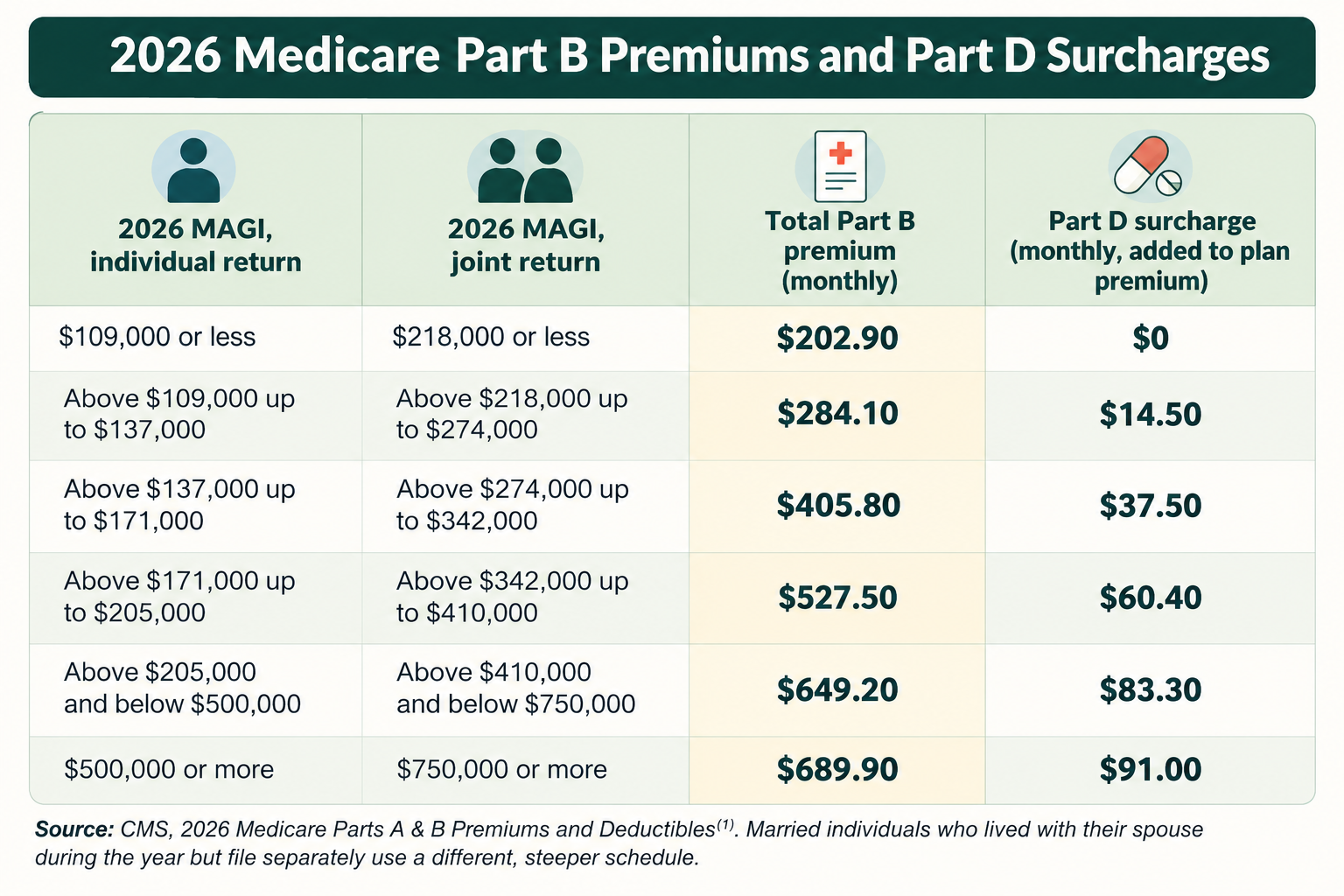
Each tier works like a cliff. A married couple with a hypothetical joint MAGI of $218,000 pays the standard premium, while the same couple at $218,001 moves into the next tier. If both spouses have Part B and Part D, each pays an extra $81.20 a month for Part B and $14.50 for Part D at that first tier, which comes to about $2,297 a year for the household.
That lookback is why timing large, one-time income events carefully can pay off. A big Roth conversion, the sale of a rental property, or a year of heavy capital gains two years before you enroll can all push your MAGI into a higher tier for that premium year. Social Security sets each year's surcharge from the most recent tax return the IRS provides, so the income on one return is tied to the premiums for one specific year(9).
If your income has dropped since the tax year Social Security used, you can ask for a new determination. Qualifying life-changing events include marriage, divorce, or the death of a spouse, you or your spouse stopping work or reducing hours, loss of income-producing property to a disaster or another event beyond your control, and certain employer pension changes or settlements. You make the request on Form SSA-44 with documentation of the event and your lower income(9). Because stopping work is on that list, the form is especially relevant for new retirees whose final full-salary years pushed them into a surcharge tier.
What doesn't Medicare cover?
Anything outside Part A and Part B is yours to pay unless you have other coverage.
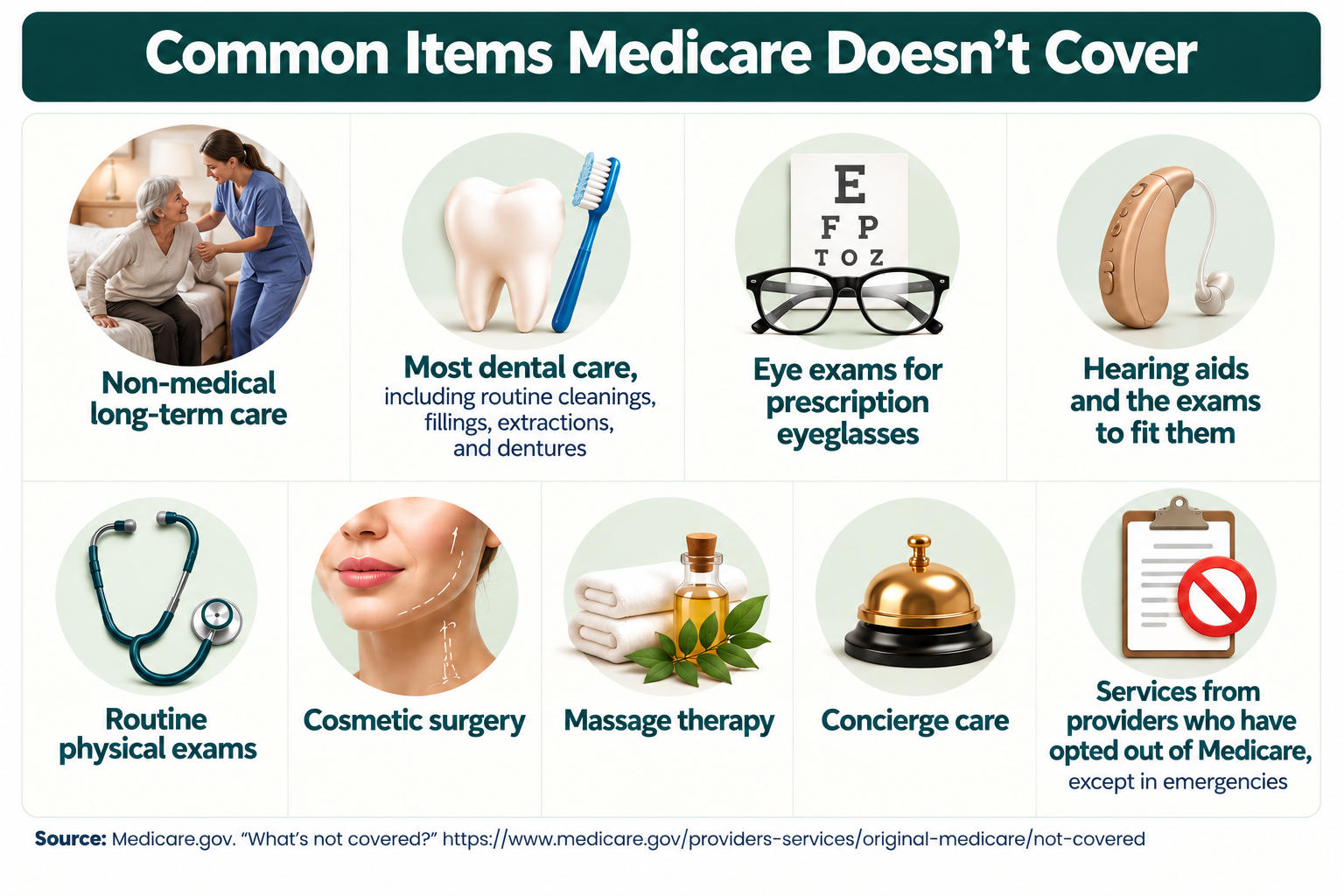
Dental care has narrow exceptions. Medicare may pay for dental services closely tied to certain covered treatments, such as a heart valve replacement, an organ transplant, cancer treatment, or dialysis for end-stage renal disease(10).
The routine physical exclusion is easy to misread. Part B does cover a one-time "Welcome to Medicare" preventive visit within your first 12 months of Part B and a yearly wellness visit after that, and you pay nothing for either when your provider accepts assignment. Medicare is clear, though, that the yearly wellness visit is a conversation to build a plan to prevent disease or disability and isn't a routine physical exam(16).
Long-term care is the exclusion with the biggest financial stakes.
Most long-term care is help with everyday personal tasks like bathing, dressing, and using the bathroom, and Medicare doesn't pay for these services, including care in a nursing home or in the community(11). Medicaid may cover it if you meet your state's eligibility rules, and private long-term care insurance is the other main option.
What Medicare does cover is short-term skilled nursing care, and the conditions are strict.
You need a medically necessary inpatient hospital stay of at least three consecutive days, and time spent in the hospital "under observation" or in the emergency room before admission doesn't count toward those three days, even if you stayed overnight(12). If you or a family member are in the hospital and a skilled nursing stay may follow, asking whether you've been formally admitted as an inpatient is one of the most valuable questions you can ask.
What happens every fall once you're enrolled?
Each year, Medicare's Open Enrollment Period runs from October 15 through December 7, and during it you can join, switch, or drop a Medicare Advantage or Part D plan, or move between Original Medicare and Medicare Advantage. Changes take effect January 1, and the plan has to receive your request by December 7(13).
Reviewing your coverage each fall makes sense even if you're satisfied, because plan premiums and other costs can change from one year to the next(2).
If you're in a Medicare Advantage plan, a second window runs January 1 through March 31, when you can switch to another Advantage plan or return to Original Medicare(13).
Common mistakes to avoid
Treating COBRA or retiree coverage like a job-based plan. COBRA doesn't extend your time to sign up for Part B, and the end of COBRA or retiree coverage doesn't open a Special Enrollment Period of its own(3). Waiting for COBRA to run out before signing up can leave you facing months without Part B until the General Enrollment Period, plus a permanent penalty.
Leaving HSA contributions running. Part A's six-month backdating can turn paycheck contributions you made before you ever signed up into excess contributions under IRS rules(14).
Skipping Part D because you don't take many prescriptions. If you don't have other creditable coverage, going without Part D starts the penalty clock, and the penalty stays with you after your health changes. Medicare itself suggests considering a low-premium plan for this reason(7).
Ignoring the IRMAA letter. If Social Security used a year when you were still earning a full salary and you've since retired, filing Form SSA-44 asks Social Security to base your premium on your newer, lower income, which can drop you to a lower tier or remove the surcharge entirely if that income falls below the first threshold(9).
Where to go from here
If your 65th birthday is on the calendar, or you're heading into your first fall Open Enrollment and aren't sure your current setup still fits, the next step is seeing what coverage looks like where you live, with your own doctors and prescriptions factored in. That's also where the choice between Original Medicare with supplemental coverage and Medicare Advantage becomes concrete instead of theoretical.
If you’ve taken care of your health and want to learn more how to minimize your Medicare costs while avoiding penalties, you can read our comprehensive guide to minimizing costs and avoiding penalties here.
References
1. Centers for Medicare & Medicaid Services. "2026 Medicare Parts A & B Premiums and Deductibles." Fact sheet, November 14, 2025. https://www.cms.gov/newsroom/fact-sheets/2026-medicare-parts-b-premiums-deductibles
2. Medicare.gov. "Costs." https://www.medicare.gov/basics/costs/medicare-costs
3. Medicare.gov. "When does Medicare coverage start?" https://www.medicare.gov/basics/get-started-with-medicare/sign-up/when-does-medicare-coverage-start
4. Medicare.gov. "I'm getting Social Security benefits before 65." https://www.medicare.gov/basics/get-started-with-medicare/before-65
5. Medicare.gov. "Working past 65." https://www.medicare.gov/basics/get-started-with-medicare/medicare-basics/working-past-65
6. Medicare.gov. "When can I sign up for Medicare?" https://www.medicare.gov/publications/02179-Medicare-and-other-health-benefits-your-guide-to-who-pays-first.pdf
7. Medicare.gov. "How much does Medicare drug coverage cost?" https://www.medicare.gov/health-drug-plans/part-d/basics/costs
8. Medicare.gov. "Avoid late enrollment penalties." https://www.medicare.gov/basics/costs/medicare-costs/avoid-penalties
9. Social Security Administration. "Premiums: Rules for Higher-Income Beneficiaries." https://www.ssa.gov/benefits/medicare/medicare-premiums.html
10. Medicare.gov. "What's not covered?" https://www.medicare.gov/providers-services/original-medicare/not-covered
11. Medicare.gov. "Long-term care." https://www.medicare.gov/coverage/long-term-care
12. Medicare.gov. "Skilled nursing facility care." https://www.medicare.gov/coverage/skilled-nursing-facility-care
13. Medicare.gov. "Joining a plan." https://www.medicare.gov/basics/get-started-with-medicare/get-more-coverage/joining-a-plan
14. Internal Revenue Service. "Publication 969, Health Savings Accounts and Other Tax-Favored Health Plans." https://www.irs.gov/publications/p969
15. Medicare.gov. "Your Medicare Benefits." Publication 10116. https://www.medicare.gov/publications/10116-your-medicare-benefits.pdf
16. Medicare.gov. "Yearly wellness visits." https://www.medicare.gov/coverage/yearly-wellness-visits
17. Social Security Administration. "Medicare Ready." https://www.ssa.gov/myaccount/assets/materials/medicare-ready.pdf
18. Social Security Administration. "Sign up for Medicare." https://www.ssa.gov/medicare/sign-up
Part A and Part B premiums, deductibles, coinsurance, and IRMAA amounts reflect 2026 figures published by CMS on November 14, 2025. Part D limits reflect 2026 and 2027 figures published on Medicare.gov. Penalty and cost examples labeled hypothetical are illustrations only. All sources were re-verified against their live pages on October 1, 2026. This article will be updated when CMS publishes 2027 Part A and Part B amounts.
General information: This article is for general educational purposes and isn't legal, tax, or insurance advice. For free, unbiased one-on-one help, contact your State Health Insurance Assistance Program (SHIP) at shiphelp.org, or call 1-800-MEDICARE (1-800-633-4227; TTY 1-877-486-2048).
Medicare/Insurance disclaimer: Medicare plan availability and costs vary by location. Contact a licensed Medicare advisor or visit Medicare.gov to compare plans available in your area.
Editorial independence: Greensprout's editorial team writes on behalf of the reader. Our goal is to provide clear, useful information to help you make better financial decisions. Our editorial content is not influenced by advertiser relationships.
Affiliate disclosure: Greensprout is an independent, advertising-supported publisher and comparison resource. We may earn compensation when you click on links to products from our partners. This does not affect our editorial standards or recommendations.