
Key takeaways
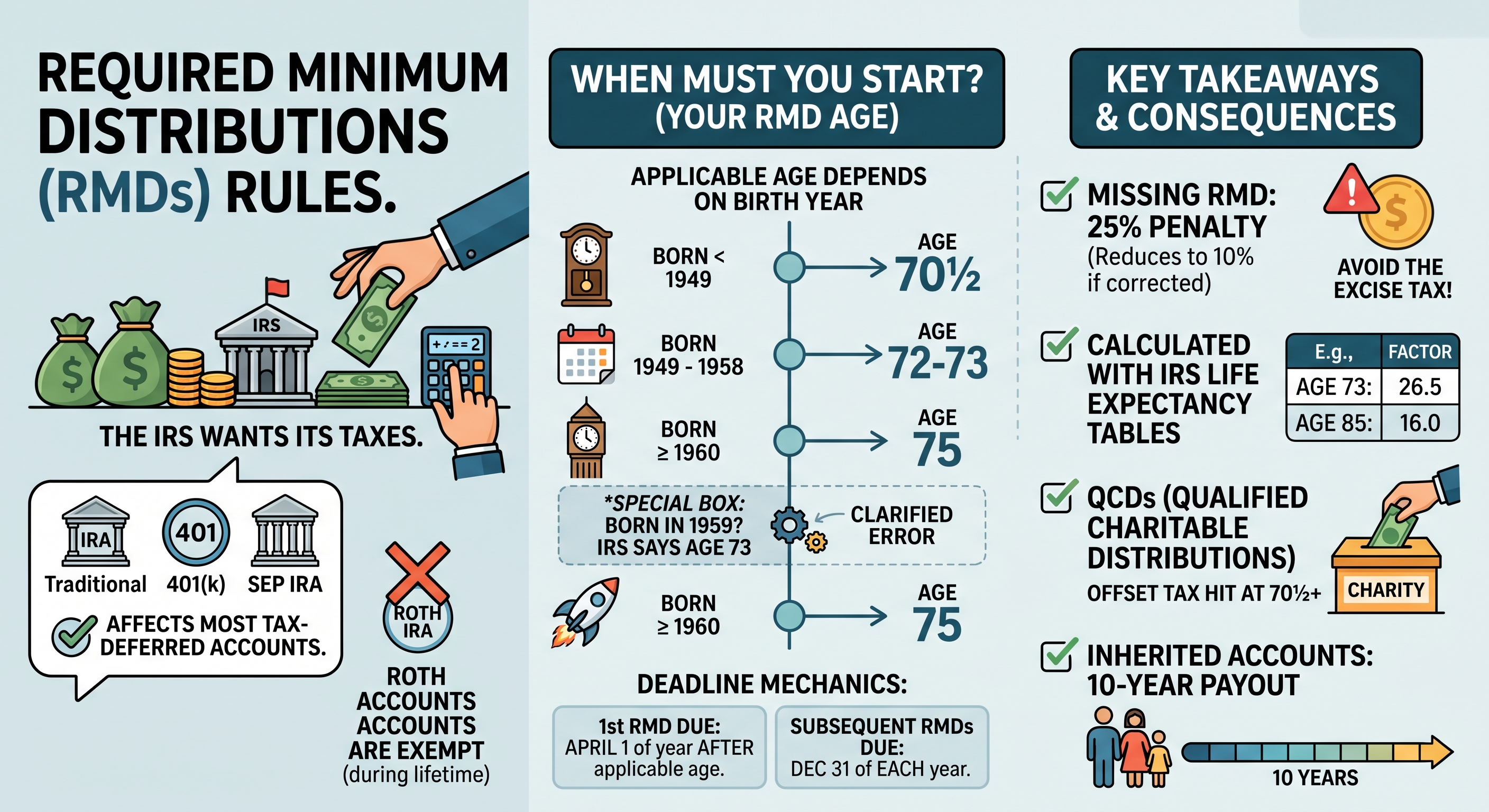
- Your applicable RMD age depends on your birth year
- The first RMD is due by April 1 of the year after you reach your applicable age
- Missing an RMD triggers a 25% excise tax on the shortfall, reduced to 10% if corrected within two years
- Roth IRAs and Roth employer accounts are exempt from lifetime RMDs entirely.
If you've spent years contributing to a 401(k), rolling over an old account into an IRA, and not touching any of it, the IRS eventually stops letting you decide when that money gets taxed. Once you hit a certain age, you're required to start withdrawing a minimum amount every year, whether you need the income or not, and getting it wrong comes with a real penalty.
Required minimum distributions, or RMDs, are the withdrawals the IRS requires from most tax-deferred retirement accounts once you reach a certain age. The rule exists because those accounts were funded with pre-tax dollars, and the government wants its share eventually. But the rules have shifted three times in the past six years, the deadlines are less intuitive than they look, and one birth year in particular got caught in a drafting error that Congress still hasn't fixed.
Here's what applies now, who it applies to, and where people most often get it wrong.
Why this keeps changing, and who it affects
For decades, the RMD age was 70½, a threshold that felt arbitrary even to the people who had to plan around it. The Setting Every Community Up for Retirement Enhancement (SECURE) Act of 2019 raised that age to 72. Then the SECURE 2.0 Act of 2022 raised it again, to 73, and set up a further increase to 75 for younger retirees(2). Three different ages in six years is enough to trip up even someone who has been paying close attention, and it's part of why so many people approaching this milestone aren't sure which rule applies to them.
The rules apply to traditional IRAs, SEP IRAs, SIMPLE IRAs, and most employer-sponsored plans, including 401(k), 403(b), and 457(b) accounts(3). Roth IRAs are the notable exception. As long as you're the original account owner, a Roth IRA has never required withdrawals during your lifetime, and since 2024, that same exemption extends to Roth accounts inside a 401(k) or 403(b)(4). If you inherit any of these accounts, different rules apply, covered later in this piece.
This isn't a niche concern. About a third of US households own a traditional IRA(5), and millions more carry balances in old 401(k) plans from previous employers. If you have money sitting in any of these accounts, at some point the IRS is going to require you to start taking it out, whether you need the income or not.
Your required beginning date depends on your birth year
The applicable age for your first RMD depends on when you were born, not on when the law changed(6).
The IRS's final regulations set the schedule as follows:
- Born before July 1, 1949: age 70½
- Born July 1, 1949 through December 31, 1950: age 72
- Born January 1, 1951 through December 31, 1958: age 73
- Born in 1959: age 73
- Born on or after January 1, 1960: age 75
That entry for people born in 1959 needs its own explanation, because the statute itself is broken. SECURE 2.0 was drafted in a way that technically assigns two different ages, 73 and 75, to that single birth year(7). Four members of Congress from both parties acknowledged the error in a 2023 letter and promised a fix, but no corrective legislation has passed. In the absence of one, the IRS issued a regulation resolving the ambiguity in favor of age 73 for anyone born in 1959(8).
Once you know your applicable age, the deadline mechanics follow a specific pattern.
Your first RMD is due by April 1 of the year after you reach that age. Every RMD after that is due by December 31 of the same year. That means if you turn 73 in 2026, your first distribution isn't due until April 1, 2027, but your second distribution is still due by December 31, 2027, which puts two taxable distributions in the same calendar year unless you take the first one earlier(9).
For someone whose income already sits near a higher tax bracket threshold, that stacking effect can push a chunk of otherwise-avoidable income into a higher tax rate.
Taking the first distribution by December 31 of the year you reach your applicable age, rather than waiting until the following April, is usually the simpler and cheaper choice.
There's one important carve-out. If you're still working and don't own 5% or more of the company sponsoring your plan, you can generally delay RMDs from that specific employer's 401(k) until the year you actually retire, even past your applicable age(10). This delay only applies to the plan at your current employer. It doesn't apply to IRAs, and it doesn't apply to 401(k) accounts from jobs you've already left.
How the withdrawal amount is calculated
The formula is straightforward. Take your account balance as of December 31 of the prior year, then divide it by a life expectancy factor the IRS publishes in what's called the Uniform Lifetime Table(11). The result is the minimum amount you must withdraw for that year. You're always free to take more than the minimum; you just can't apply an excess withdrawal from one year toward a future year's requirement.
Here's what that factor looks like at a few common ages(12):
Age | Life expectancy factor |
|---|---|
73 | 26.5 |
75 | 24.6 |
80 | 20.2 |
85 | 16.0 |
90 | 12.2 |
A quick example shows how the balance and the factor interact. Someone with a $500,000 IRA who turns 75 in 2026 divides that balance by 24.6, for a required withdrawal of about $20,325. The same $500,000 balance at age 85 divides by 16.0, requiring about $31,250. As the factor shrinks with age, a level balance produces a larger percentage withdrawal each year, which is the mechanism designed to draw the account down over time rather than let it compound indefinitely.
If your spouse is your sole beneficiary and is more than 10 years younger than you, a different table applies, called the Joint and Last Survivor table, which produces a larger factor and therefore a smaller required withdrawal(13). For most married couples, where the age difference is smaller, the standard Uniform Lifetime Table still applies.
If you own more than one IRA, you calculate the RMD separately for each account, but you can withdraw the combined total from any single IRA or a mix of them. That flexibility doesn't extend to 401(k) or 403(b) plans, however. Distributions from those accounts must be taken separately from each individual plan. This means you can't satisfy one employer plan's RMD by pulling extra from a different one(14).
What happens if you miss it, and how to fix it
Missing an RMD, or taking less than required, triggers an excise tax under Internal Revenue Code Section 4974. The default penalty is 25% of the shortfall, but that drops to 10% if you correct the mistake within two years and file the right paperwork(15). Prior to 2023, this penalty stood at 50%, so the reduction under SECURE 2.0 is a real improvement, but a 25% tax on a missed distribution is still a costly way to learn about a deadline(1).
Correcting a missed RMD involves withdrawing the shortfall as soon as you catch it and filing Form 5329 with your tax return for the year the distribution was originally due(16). The IRS can waive the excise tax entirely if you can show the shortfall was due to reasonable error and that you're taking steps to fix it, which typically means attaching a brief letter of explanation to the form(17). Custodians and plan administrators are required to notify you or offer to calculate your RMD each year by January 31, but the legal responsibility for taking the correct amount ultimately sits with you, not with them(18).
Inherited accounts follow a different clock entirely
If you inherit a retirement account, the RMD rules that applied to the original owner mostly stop applying to you, replaced by a separate set of beneficiary rules. For most people who inherit a retirement account from someone who died after 2019, the entire balance must be distributed within 10 years of the original owner's death(19). This is often called the 10-year rule, and unlike the old stretch IRA rules that let beneficiaries draw down an inherited account over their own life expectancy, this newer rule forces a full payout on a fixed schedule regardless of the beneficiary's age.
There are exceptions. A surviving spouse, a minor child of the original owner, a disabled or chronically ill beneficiary, and anyone not more than 10 years younger than the original owner all qualify as what the IRS calls eligible designated beneficiaries, and each can generally stretch distributions over their own life expectancy instead of following the 10-year rule(20).
If the original account owner had already started taking RMDs before they died, most beneficiaries subject to the 10-year rule must also continue taking annual distributions during those 10 years, not just a single payout at the end. Given how easy it is to misread which category applies to a specific inheritance, this is one area where reviewing the actual plan documents or speaking with the account custodian before assuming a payout schedule tends to save real money later.
Qualified charitable distributions can offset the tax hit
For anyone 70½ or older who's charitably inclined, a qualified charitable distribution (QCD) is one of the more useful tools tied to this whole system. A QCD lets you direct your IRA custodian to send money straight to a qualifying charity, and that amount counts toward your RMD for the year without being added to your taxable income(21). For 2025, the exclusion limit is $108,000 per person, rising to $111,000 for 2026(22). If you and your spouse both have IRAs, you can each use the exclusion separately.
The distinction that trips people up is the direct-transfer requirement. If the money touches your hands first, even briefly, before going to the charity, it's a regular taxable distribution followed by a separate charitable deduction, not a QCD. The transfer has to move directly from the IRA custodian to the organization to qualify(23).
Mistakes worth avoiding
Don’t assume the age is still 72, or worse, 70½. The rule has changed twice since 2019, and a lot of the advice still circulating online reflects an earlier version. Confirm your applicable age against your actual birth year before assuming anything.
Don’t overlook an old 401(k). People who consolidate their financial life around a current IRA sometimes forget a 401(k) sitting at a former employer. That account is still subject to its own RMD, calculated and withdrawn separately from anything in an IRA.
Not understanding the still-working exception applies to one plan only. The delay for people still employed only covers the 401(k) at the company where you currently work, and only if you don't own 5% or more of that business. It has no effect on IRAs or on accounts from prior jobs.
Assuming a Roth 401(k) works like a Roth IRA in every respect. Before 2024, Roth accounts inside employer plans were still subject to RMDs during the owner's lifetime, even though Roth IRAs weren't. That inconsistency is gone now, but older articles and even some outdated plan documents haven't caught up.
The examples above use round numbers to show how the mechanics work. Your actual required withdrawal depends on your exact birth date, your account balances at the end of last year, and who you've named as a beneficiary.
If this is too much to figure out on your own, finding an advisor can help. You can get started by answering a few questions:
References
1. Internal Revenue Service. "Retirement plan and IRA required minimum distributions FAQs." https://www.irs.gov/retirement-plans/retirement-plan-and-ira-required-minimum-distributions-faqs
2. Internal Revenue Bulletin 2024-33, T.D. 10001, "Required Minimum Distributions" (final regulations). https://www.irs.gov/irb/2024-33_IRB
3. Internal Revenue Service. "Retirement topics - Required minimum distributions (RMDs)." https://www.irs.gov/retirement-plans/plan-participant-employee/retirement-topics-required-minimum-distributions-rmds
4. Internal Revenue Bulletin 2024-33, T.D. 10001, referencing SECURE 2.0 Act Section 325. https://www.irs.gov/irb/2024-33_IRB
5. Investment Company Institute. "Rollovers Fuel Multi-Trillion IRA Market," June 3, 2026 (33% of US households owned a traditional IRA as of mid-2025). https://www.ici.org/news-release/rollovers-fuel-multitrillion-ira-market
6. Internal Revenue Bulletin 2024-33, T.D. 10001, Section I.B, "Distributions commencing during an employee's lifetime." https://www.irs.gov/irb/2024-33_IRB
7. Federal Register, REG-103529-23, "Required Minimum Distributions+," Section B, "Determination of Applicable Age for Employees Born in 1959." https://www.federalregister.gov/documents/2024/07/19/2024-14543/required-minimum-distributions
8. Federal Register, REG-103529-23, proposed § 1.401(a)(9)-2(b)(2)(v). https://www.federalregister.gov/documents/2024/07/19/2024-14543/required-minimum-distributions
9. Internal Revenue Service. "Retirement topics - Required minimum distributions (RMDs)," "Required beginning date for your first RMD." https://www.irs.gov/retirement-plans/plan-participant-employee/retirement-topics-required-minimum-distributions-rmds
10. Internal Revenue Service. "Retirement plan and IRA required minimum distributions FAQs," Q1 and Q3. https://www.irs.gov/retirement-plans/retirement-plan-and-ira-required-minimum-distributions-faqs
11. Internal Revenue Service. Publication 590-B (2025), "Figuring the Owner's Required Minimum Distribution." https://www.irs.gov/publications/p590b
12. Federal Register, REG-103529-23, "Table 2 to Paragraph (c)," Uniform Lifetime Table. https://www.federalregister.gov/documents/2024/07/19/2024-14543/required-minimum-distributions
13. Internal Revenue Service. Publication 590-B (2025), "Sole beneficiary spouse who is more than 10 years younger." https://www.irs.gov/publications/p590b
14. Internal Revenue Service. "Retirement plan and IRA required minimum distributions FAQs," Q5. https://www.irs.gov/retirement-plans/retirement-plan-and-ira-required-minimum-distributions-faqs
15. Internal Revenue Service. "Retirement plan and IRA required minimum distributions FAQs," Q8. https://www.irs.gov/retirement-plans/retirement-plan-and-ira-required-minimum-distributions-faqs
16. Internal Revenue Service. "Retirement topics - Required minimum distributions (RMDs)," "Extra taxes for not taking RMDs." https://www.irs.gov/retirement-plans/plan-participant-employee/retirement-topics-required-minimum-distributions-rmds
17. Internal Revenue Service. "Retirement plan and IRA required minimum distributions FAQs," Q9. https://www.irs.gov/retirement-plans/retirement-plan-and-ira-required-minimum-distributions-faqs
18. Internal Revenue Service. Publication 590-B (2025), "Statement of required minimum distribution (RMD)." https://www.irs.gov/publications/p590b
19. Internal Revenue Service. "Retirement plan and IRA required minimum distributions FAQs," Q1. https://www.irs.gov/retirement-plans/retirement-plan-and-ira-required-minimum-distributions-faqs
20. Internal Revenue Service. Publication 590-B (2025), "10-year rule" and "Eligible designated beneficiaries." https://www.irs.gov/publications/p590b
21. Internal Revenue Service. Publication 590-B (2025), "Qualified charitable distributions (QCDs)." https://www.irs.gov/publications/p590b
22. Internal Revenue Service. Publication 590-B (2025), "Qualified charitable distributions (QCDs)" and "Jim's Illustrated 2026 QCD Adjustment Worksheet." https://www.irs.gov/publications/p590b
23. Internal Revenue Service. Publication 590-B (2025), "Qualified charitable distributions (QCDs)," example. https://www.irs.gov/publications/p590b