

Key takeaways
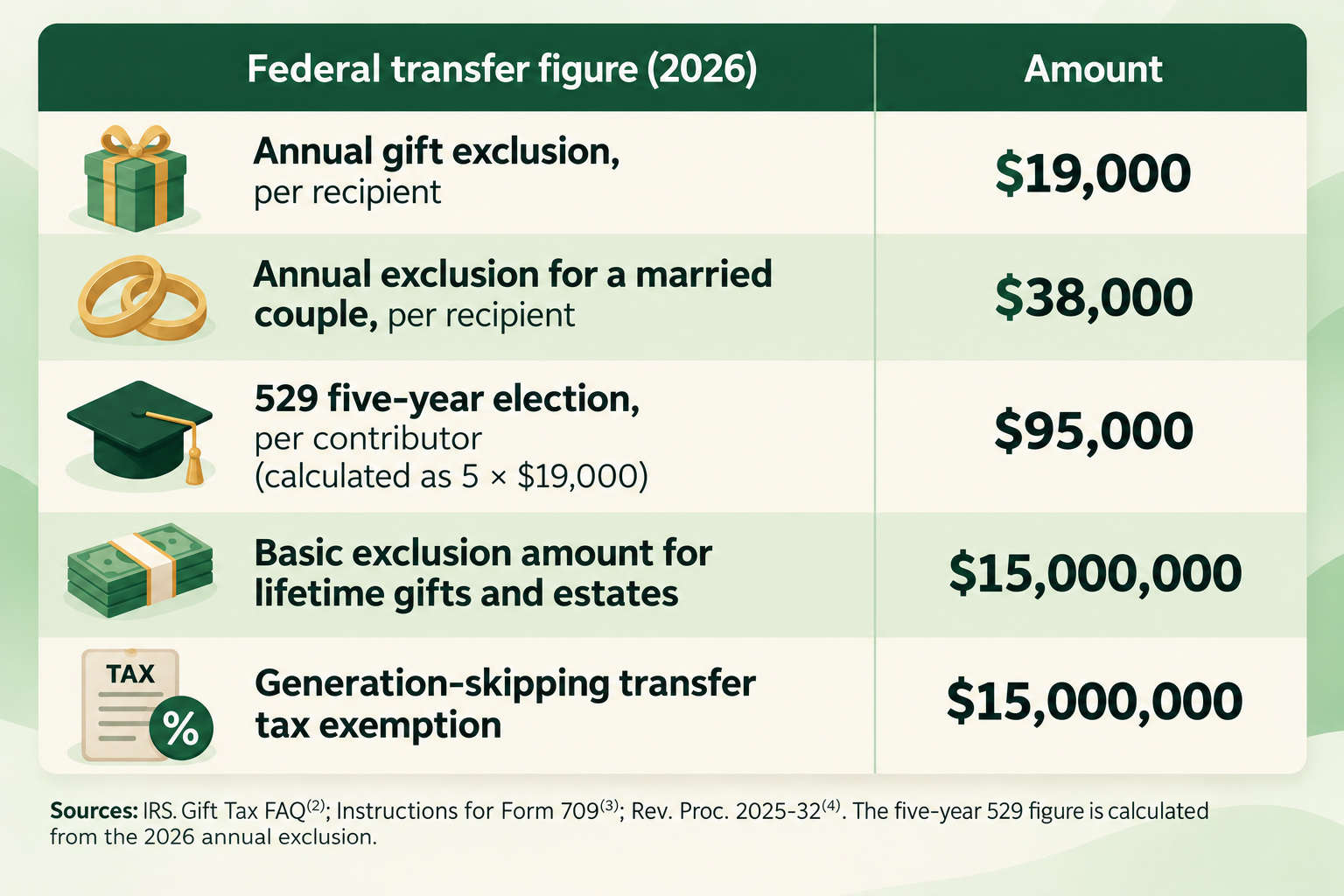
- For 2026, you can give each grandchild up to $19,000 ($38,000 for a married couple) without making a taxable gift, and larger gifts usually mean filing Form 709 rather than paying tax.
- Tuition paid directly to a school and medical bills paid directly to a provider don't count against any gift limit.
- A grandparent-owned 529 keeps the money under your control, allows five years of exclusions in one contribution, and no longer reduces federal aid eligibility the way it once could.
- Custodial accounts and outright inheritances eventually belong to the grandchild without conditions, and a minor heir may require a court-supervised guardianship.
- Gifted assets carry your cost basis, inherited assets generally get a fresh basis at death, and gifts within five years of a Medicaid application can trigger a penalty period.
For a lot of grandparents, helping a grandchild is one of the most satisfying things you can do with your money. It might be a check tucked into a birthday card, a contribution toward a first semester of college, or the hope that what you've saved over a lifetime will give the next generation a steadier start than you had.
But good intentions don't always travel smoothly through the tax code, state property law, and financial aid formulas.
A gift made one way can leave a grandchild with a large tax bill when they sell inherited stock, hand a sizable sum to a 21-year-old with no strings attached, or complicate your own eligibility for long-term care help years later.
This guide covers the general rules for passing money, investments, and property to grandchildren, from the 2026 federal gift tax limits to 529 plans (a tax-advantaged savings account for education costs), custodial accounts, wills, trusts, and beneficiary designations. It explains how each route works rather than which one you should choose, because the right approach depends on your family, your state, and your own finances.
Why does the way a gift is made change the outcome?
Every transfer to a grandchild travels through some kind of vehicle. A check you write today is an outright gift. A 529 account you open is a gift you still control. A custodial account is a gift the grandchild will control at an age set by state law. And anything you leave at death moves by will, trust, beneficiary designation, or the way the asset is titled, each with its own process and timeline.
Those vehicles differ in who controls the money and when, in how the federal tax system treats the transfer, and in how the money is counted if the grandchild applies for financial aid or you later apply for Medicaid.
It also helps to know where the federal estate tax line sits, because many people assume it applies to them when it doesn't. For deaths in 2026, an estate tax return is required only when the gross estate, increased by certain lifetime taxable gifts, is worth more than $15,000,000(1). Below that level, the decisions that remain are mostly about control, income tax, and financial aid.
How much can you give a grandchild in 2026 without filing a gift tax return?
The federal gift tax works on a per-recipient annual exclusion. For 2026, you can give up to $19,000 to any one person without it counting as a taxable gift, and the exclusion applies separately to each recipient, so a grandparent with four grandchildren can give each of them $19,000 in the same year.
The donor, not the grandchild, is generally responsible for any gift tax, and making a gift doesn't ordinarily affect your federal income tax, which also means the gift isn't deductible(2).
Married couples get a larger number because each spouse has an exclusion of their own. When spouses give away property they own together, each is entitled to the annual exclusion, which brings the 2026 total to $38,000 per recipient(2). If one spouse makes the entire gift from separate funds, the couple can still elect to treat it as made half by each, but that election (called gift splitting) requires filing a gift tax return on Form 709 regardless of the amount, and it applies to every gift either spouse makes to third parties that year(3).
In a hypothetical example, a married couple with three grandchildren, where each spouse gives $19,000 from their own account to every grandchild, would move $114,000 out of their names in 2026 without making a taxable gift or filing Form 709, as long as every gift was an outright gift the grandchild could use right away. That last condition is important, because a gift whose benefit doesn't begin until some future date, which can happen with certain transfers into trusts, doesn't qualify for the exclusion and must be reported even if it's under $19,000(3).
What happens when a gift goes over the annual limit?
Giving more than $19,000 to one grandchild in a year doesn't mean you'll owe tax. It means you file Form 709 by April 15 of the following year, and the portion above the exclusion is reported as a taxable gift(3). For 2026, the basic exclusion amount is $15,000,000, and it's used to figure the credit available against both gift tax and estate tax(4).
In a hypothetical case, a widowed grandmother gives her grandson $50,000 toward a home down payment in 2026. The first $19,000 is covered by the annual exclusion, and the remaining $31,000 is a taxable gift she reports on Form 709. She wouldn't owe gift tax unless her lifetime taxable gifts pushed past the credit the $15,000,000 basic exclusion amount provides, but that $31,000 reduces what remains available to shelter her estate later(3)(4).
Is there a separate tax on gifts that skip a generation?
There is, and it applies directly to grandchildren. The generation-skipping transfer (GST) tax reaches transfers to a "skip person," meaning someone assigned to a generation two or more below the donor, exactly where a grandchild sits(3). For 2026, each person's GST exemption is $15,000,000(4).
Transfers fully covered by the annual exclusion, and payments that qualify for the tuition or medical exclusions described below, aren't subject to the GST tax. If the grandchild's parent (your child) died before the gift, the grandchild is treated as your child for generation purposes. Trusts are the area to watch, since the IRS cautions that some trust transfers that aren't subject to gift tax today can become subject to GST tax later(3).
Which payments don't count against the limit at all?
Tuition you pay directly to a qualifying school on a grandchild's behalf isn't treated as a gift, and neither are medical expenses you pay directly to the provider, including medical insurance premiums. These exclusions apply regardless of your relationship to the person, and you don't report them on Form 709. The payment must go straight to the school or provider, though, and the educational exclusion covers tuition only, not books, supplies, or room and board. Contributions to a 529 plan don't qualify for it either(3).
In a hypothetical example, a grandfather pays his granddaughter's $40,000 annual tuition directly to her university and also gives her $19,000 in cash that year. Neither transfer is a taxable gift. Had he written the $40,000 check to her instead, $21,000 of it would have been a taxable gift requiring a Form 709.
How does a 529 plan work when a grandparent owns it?
A 529 plan, formally called a qualified tuition program and named for the section of the tax code that created it, is a tax-advantaged education account sponsored by a state or an educational institution. Anyone can open one and name a grandchild as beneficiary, with no income limits. Earnings aren't subject to federal tax when used for qualified education expenses, although contributions aren't deductible on your federal return. And the person who opens the account controls the money until it's withdrawn, which is the key difference from gifts given to a grandchild outright(5).
Qualified expenses include costs for college, vocational school, and other eligible postsecondary programs, certain registered apprenticeship costs, and K-12 expenses such as tuition, books, tutoring, and testing fees. K-12 expenses are capped at $20,000 per year across all of a grandchild's 529 accounts, up from $10,000 before the end of 2025, and up to $10,000 per person over a lifetime can go toward student loans(6).
Can you front-load years of gift contributions at once?
A 529 contribution is treated as a present gift, so it qualifies for the annual exclusion, and a special election lets you treat a large contribution as if it were made evenly over five years, applying one-fifth against each year's exclusion. The most recent Form 709 instructions set the cap at $95,000, five times the $19,000 exclusion, and with the exclusion unchanged for 2026 the same calculation produces $95,000 this year. You make the election on Form 709 for the year of the contribution, each spouse can make it separately, and because each fifth uses that year's exclusion, other gifts to the same grandchild during those five years count as additional gifts(3).
In hypothetical terms, two grandparents who each make the election could put $190,000 into one grandchild's 529 in 2026 without making a taxable gift, provided neither gives that grandchild anything else through 2030.
What if the grandchild doesn't need the money for school?
You can change the 529 beneficiary to another member of the family, such as the grandchild's sibling, without tax consequences(5). Since 2024, the beneficiary can also roll 529 money into their own Roth IRA, subject to the annual Roth contribution limit and a $35,000 lifetime cap, as long as the account has been open at least 15 years and the money moves by direct trustee-to-trustee transfer. Contributions from the most recent five years, and their earnings, aren't eligible(6).
When a distribution is larger than the beneficiary's qualified expenses, a portion of the earnings becomes taxable(6).
An additional tax also generally applies to that taxable amount unless an exception covers it, such as the beneficiary's death or disability or a tax-free scholarship(7).
How does a grandparent-owned 529 affect financial aid?
Beginning with the 2024-25 award year, the federal need analysis stopped counting "money received by or paid on behalf of the student" as untaxed income, so money a grandparent pays toward a grandchild's education, whether from a 529 or a checking account, is no longer added to the student's income in the federal aid formula. Colleges can still request additional information when awarding their own institutional aid, so the federal change doesn't guarantee identical treatment at every school(8).
How do custodial accounts work for a grandchild?
Custodial accounts are created under each state's version of the Uniform Transfers to Minors Act (UTMA), or the older Uniform Gifts to Minors Act (UGMA), and they let an adult manage property for a child without a trust. The trade-off is permanence. For example, under Florida's version, a transfer to a custodial account is irrevocable and the property legally belongs to the minor from the start(9). The custodian must turn gifted property over at 21, and although a donor can set the termination age at 25, the grandchild keeps the right to demand the full balance at 21 unless specific written-notice steps are followed(10).
Since the property belongs to the grandchild, so does the income it produces. If a child's interest, dividends, and other unearned income total more than $2,700, part of it may be taxed under the special "kiddie tax" rules on Form 8615, which can reach children under 18 and, in some cases, older teens and full-time students under 24 who don't provide more than half their own support(11).
Is it better to give now or let assets pass at death?
A completed lifetime gift, one where you keep no control over it, isn't included in your gross estate, so future growth on that asset happens outside your estate(1).
The cost of giving early tends to show up in income tax. When you give property, the recipient generally takes over your original cost basis, so the gain that accumulated while you owned it travels with the gift(2). Inherited property works differently, because its basis is generally its fair market value on the date of death, which leaves little or no gain if it's sold soon afterward(1).
Here's how that plays out in a hypothetical case. You bought shares for $5,000 that are now worth $19,000. If you give them to a grandchild who sells right away, the grandchild reports a $14,000 capital gain. If the grandchild instead inherits the shares at your death, when they're still worth $19,000, the basis generally resets to $19,000 and an immediate sale produces no gain. For assets with large unrealized gains, that difference can outweigh the appeal of giving early, while cash doesn't carry the same issue.
How does money reach a grandchild after you're gone?
What you own at death moves through a handful of channels, and state law shapes all of them. In California, for example, someone who dies without a will, trust, or other arrangement has their assets distributed to surviving relatives under state intestate succession law. Some assets skip that process and pass directly to a surviving co-owner or to named beneficiaries, including joint bank accounts, certain jointly owned property, life insurance, retirement accounts, and real estate or vehicles with a transfer-on-death deed or registration.
In California, with or without a will, your heirs may still need to go through probate, the court process for distributing an estate(12).
A revocable living trust is the main alternative for keeping assets out of probate. You create it during your lifetime, usually serve as your own trustee, and name a successor trustee to take over later. Probate is a public process that can be expensive and lengthy, which is one reason people set up a trust, but the trust only works for property you move into it(13).
What happens when the heir is still a minor?
Naming a young grandchild directly in a will or on a beneficiary form can create a practical problem. In California, a court-appointed guardian of the estate takes control of a child's money and property, preserves it until the child turns 18, files an inventory and regular accountings with the court, and then turns everything over at 18. Some financial institutions, insurers, and courts won't release funds for a minor until a guardian has been appointed, although alternatives such as an account accessible only by court order are sometimes available(14). Naming a trust as the beneficiary, with a trustee who manages the money on terms you set, is another way around that process, though the trust has to be drafted in advance.
How do inherited retirement accounts work for grandchildren?
When an account owner dies in 2020 or later, only an "eligible designated beneficiary" can stretch withdrawals over their own life expectancy, a group that includes the owner's spouse, the owner's minor child, a disabled or chronically ill individual, and anyone not more than 10 years younger than the owner. Other individual beneficiaries must empty the inherited account by the end of the 10th year after the owner's death, and they include taxable distributions in their gross income(15).
A grandchild who isn't disabled or chronically ill generally falls into that second group, since the minor-child exception covers only the owner's own children.
Can gifts to grandchildren affect your own long-term care coverage?
If you later apply for Medicaid to cover nursing home or other long-term care, the state looks back 60 months (5 years) for assets transferred for less than fair market value. A transfer inside that window triggers a penalty period during which Medicaid won't pay for long-term care, figured by dividing the total value transferred by the state's average monthly private-pay cost of nursing facility care(16).
In a hypothetical example, a grandparent who gave grandchildren $90,000 during the five years before applying, in a state where private-pay nursing home care averages $10,000 a month, could face a penalty period of about nine months. A gift under the $19,000 federal exclusion is still a transfer for which the giver receives nothing in return(2), which is what the Medicaid look-back examines(16).
What are the most common mistakes grandparents make?
Adding a grandchild to a deed or bank account as a shortcut. If you buy property with your own funds and title it jointly with right of survivorship, you've generally made a gift of half its value. With a joint bank account, a gift occurs when the grandchild withdraws money for their own use(3). Joint ownership also means the asset passes to the co-owner at your death, regardless of what your will says about dividing things among other grandchildren(12).
Giving away low-basis stock you could have left instead. A gifted asset carries your original basis, while an inherited one generally resets to its value at your death(1)(2). For highly appreciated holdings, the timing of the transfer can change the tax bill more than the size of the gift.
Naming a minor directly as a beneficiary. An inheritance left to a young grandchild with no trust or custodian in place can require a court-supervised guardianship and be turned over in full at 18(14). A custodial account opened as a college fund carries a similar surprise, since the grandchild gets the money at the age state law sets, whether or not it goes to school(9)(10).
Where to go from here
The money you set aside for your grandchildren is a way of staying part of their lives. Whether it arrives as a help or a headache depends on the route it takes, and the right route depends on your health, your other heirs, your state's laws, and how much you'll need for yourself. If you want to give generously without creating a tax bill, a court process, or a Medicaid problem you didn't see coming, a professional who can look at your whole picture can help you put the pieces in the right order.
References
1. Internal Revenue Service. "Frequently Asked Questions on Estate Taxes." https://www.irs.gov/businesses/small-businesses-self-employed/frequently-asked-questions-on-estate-taxes
2. Internal Revenue Service. "Frequently Asked Questions on Gift Taxes." https://www.irs.gov/businesses/small-businesses-self-employed/frequently-asked-questions-on-gift-taxes
3. Internal Revenue Service. "Instructions for Form 709 (2025), United States Gift (and Generation-Skipping Transfer) Tax Return." https://www.irs.gov/instructions/i709
4. Internal Revenue Service. Revenue Procedure 2025-32, Sections 2.14 and 4.42, 2026 inflation-adjusted items. https://www.irs.gov/pub/irs-drop/rp-25-32.pdf
5. Internal Revenue Service. "529 Plans: Questions and Answers." https://www.irs.gov/newsroom/529-plans-questions-and-answers
6. Internal Revenue Service. "Topic No. 313, Qualified Tuition Programs (QTPs)." https://www.irs.gov/taxtopics/tc313
7. Internal Revenue Service. "Instructions for Form 5329 (2025)," Part II, Additional Tax on Certain Distributions From Education Accounts and ABLE Accounts. https://www.irs.gov/instructions/i5329
8. U.S. Department of Education, Federal Student Aid. Dear Colleague Letter GEN-23-11, "FAFSA Simplification Act Changes for Implementation in 2024-25," August 4, 2023. https://fsapartners.ed.gov/knowledge-center/library/dear-colleague-letters/2023-08-04/fafsa-simplification-act-changes-implementation-2024-25
9. The Florida Legislature. 2026 Florida Statutes, Section 710.113, "Validity and effect of transfer." https://www.leg.state.fl.us/statutes/index.cfm?App_mode=Display_Statute&URL=0700-0799/0710/Sections/0710.113.html
10. The Florida Legislature. 2026 Florida Statutes, Section 710.123, "Termination of custodianship." https://www.leg.state.fl.us/statutes/index.cfm?App_mode=Display_Statute&URL=0700-0799/0710/Sections/0710.123.html
11. Internal Revenue Service. "Topic No. 553, Tax on a Child's Investment and Other Unearned Income (Kiddie Tax)." https://www.irs.gov/taxtopics/tc553
12. State of California Department of Justice, Office of the Attorney General. "Estate Planning: Wills and Trusts." https://oag.ca.gov/consumers/general/estate-finance
13. Consumer Financial Protection Bureau. "What Is a Revocable Living Trust?" https://www.consumerfinance.gov/ask-cfpb/what-is-a-revocable-living-trust-en-1775/
14. Judicial Council of California. Form GC-206-INFO, "Information on Probate Guardianship of the Estate." https://courts.ca.gov/sites/default/files/courts/default/2024-11/gc206info.pdf
15. Internal Revenue Service. "Retirement Topics: Beneficiary." https://www.irs.gov/retirement-plans/plan-participant-employee/retirement-topics-beneficiary
16. Centers for Medicare & Medicaid Services. "Sections 6011 and 6016: New Medicaid Transfer of Asset Rules Under the Deficit Reduction Act of 2005," enclosure to State Medicaid Director Letter, July 27, 2006. https://www.hhs.gov/guidance/sites/default/files/hhs-guidance-documents/CMS/2006.smdl-enclosures.dra-sections-6011-and-6016.pdf
Gift, estate, and GST figures reflect 2026 amounts published in Rev. Proc. 2025-32 and on IRS.gov. The five-year 529 election cap is calculated from the 2026 annual exclusion, since the most recent Form 709 instructions cover 2025. 529 expense limits reflect IRS Topic No. 313 as updated in 2026. State-law examples (Florida custodial accounts, California probate and guardianship) are illustrations only, and rules in other states differ. Examples labeled hypothetical are illustrations only. All sources were verified against their live pages on October 14, 2026. This article should be updated when the IRS publishes 2027 inflation adjustments.
General information: This article is for general educational purposes only and isn't legal, tax, investment, or financial planning advice. Gift, estate, trust, guardianship, custodial account, and Medicaid rules depend on your state of residence, your family circumstances, the specific terms of your accounts and documents, and other personal factors, and they can change. Nothing here is a recommendation to use any particular gifting strategy, account type, or estate planning document. Before transferring assets to grandchildren or changing a will, trust, or beneficiary designation, consider speaking with a qualified estate planning attorney, a tax professional, and a financial professional about your specific situation.
Investment disclaimer: Nothing on this site constitutes investment advice. All investors are encouraged to conduct their own research before making any investment decision. Past performance is not a guarantee of future results.
Editorial independence: Greensprout's editorial team writes on behalf of the reader. Our goal is to provide clear, useful information to help you make better financial decisions. Our editorial content is not influenced by advertiser relationships.
Affiliate disclosure: Greensprout is an independent, advertising-supported publisher and comparison resource. We may earn compensation when you click on links to products from our partners. This does not affect our editorial standards or recommendations.