

Key takeaways
- Leaving work in your 50s doesn't mean your retirement savings have to sit untouched until 59½, because the IRS allows a few ways to reach the money without the early withdrawal penalty.
- The Rule of 55 lets you take money from the workplace plan of the job you leave, as much or as little as you need, but it doesn't follow that money into an IRA.
- A 72(t) payment plan can draw from an IRA even while you're still working, but it locks you into fixed yearly payments for years.
- Breaking a 72(t) payment plan early brings back the penalty on everything you've already taken, so it fits best when you're sure of your income needs.
- Regular income tax still applies to both, so avoiding the penalty is not the same as withdrawing tax free.
Plenty of careers end earlier than planned. A buyout offer arrives at 56, a company reorganizes and your role disappears at 57, or you look at your savings, your health, and the years ahead and decide you've worked long enough. Whatever the reason, you can end up with a healthy balance in your 401(k) and several years to go before the age the tax code treats as retirement.
The money is yours to withdraw whenever you like, but taking it early usually costs extra. For people who stop working in their 50s, two federal tax rules offer a way around that cost, and they work in very different ways.
Both rules come with strict conditions, and a misstep can bring back the very penalty you were trying to avoid. Knowing how each one works before you pick a last day or move any money keeps your options open.
Why does age 59½ make early retirement harder?
Withdrawals from a 401(k), an IRA, or a similar retirement account before age 59½ are known as early or premature distributions. Most retirement plan distributions are subject to income tax, and early withdrawals also carry an additional 10% tax unless an exception applies(1).
The additional tax equals 10% of the part of the distribution that's included in your taxable income(2).
For someone who stops working at 56 and needs $40,000 a year from savings to cover living costs, the additional tax alone would come to $4,000 a year in this hypothetical, or about $14,000 over the three and a half years until 59½. That cost comes on top of regular income tax, and it applies even though the money was saved for exactly this purpose.
The IRS lists a long set of exceptions to the 10% additional tax. Many are narrow and tied to specific events, such as total and permanent disability, unreimbursed medical expenses above 7.5% of adjusted gross income, an IRS levy, or one distribution per year for personal or family emergency expenses(1). They help in particular situations but won't cover several years of bills.
Two exceptions can cover several years of living costs:
- The first is the separation from service exception, widely called the Rule of 55
- The second is a series of substantially equal periodic payments, often called a 72(t) plan after the section of the Internal Revenue Code that contains it.
This article calls the second one a 72(t) payment plan. Both let you draw income for years without the additional tax, but they apply to different accounts and come with very different strings.
How does the Rule of 55 work?
Under the Rule of 55, distributions from a qualified employer plan avoid the 10% additional tax when the employee separates from service during or after the year the employee reaches age 55(1).
"Separates from service" is the IRS's term for leaving the job, whether you quit, retire, or are laid off.
Once you qualify, the rule doesn't dictate how much you take or when. You can withdraw a large amount one year to pay off a mortgage, a small amount the next, and nothing the year after, and none of it carries the additional tax.
Which accounts does the Rule of 55 cover?
The Rule of 55 applies to qualified employer plans, such as a 401(k), and not to IRAs, SEP IRAs, or SIMPLE IRAs(1). IRS Topic 558, which lists the age 55 exception, says the exceptions on that list apply to distributions from a qualified plan other than an IRA(2).
The exception is tied to separating from the employer that maintains the plan in or after the year you turn 55. A 401(k) from a job you left at 48 generally doesn't qualify, because that separation happened years before you reached the qualifying age. The plan from the job you leave at 55 or later is the one the rule protects.
Rolling your 401(k) into an IRA after you leave ends the Rule of 55 protection for that money, because the exception doesn't extend to IRAs(1). Withdrawals from the IRA before 59½ would face the 10% additional tax unless another exception applied.
Does the month you leave make a difference?
The rule looks at the year you turn 55, not your birthday. The IRS wording covers an employee who separates from service during or after the year the employee reaches age 55(1). If your 55th birthday falls in November and you leave your job in March of that year, you still qualify. Leave in December of the year before, and you don't, so check the calendar if you have any say in the date of a buyout or retirement.
What about police officers, firefighters, and other public safety workers?
Some public safety employees qualify earlier. For a qualified public safety employee in a governmental plan, the exception applies when the employee separates from service during or after the year they reach age 50 or complete 25 years of service under the plan, whichever comes first. A similar rule covers employees who provide firefighting services(2).
The IRS says this version of the exception also includes specified federal law enforcement officers, corrections officers, customs and border protection officers, federal firefighters, private-sector firefighters, and air traffic controllers(1). If you work in one of these fields, ask your plan administrator whether your plan counts as one that qualifies, since the rules depend on the type of plan as well as the job.
What does a Rule of 55 withdrawal look like in dollars?
Consider a hypothetical 56-year-old who leaves a job with $400,000 in that employer's 401(k) and withdraws $30,000 a year until 59½. Because of the Rule of 55, none of those withdrawals carry the 10% additional tax, which saves $3,000 a year compared with the same withdrawals from an IRA without another exception. The $30,000 is still taxable income each year.
A taxable eligible rollover distribution paid to you from an employer plan is subject to mandatory income tax withholding, generally at 20%, while a direct rollover isn't(5). In the hypothetical, a $30,000 withdrawal could arrive as roughly $24,000, with the rest sent to the IRS and settled when you file your return. Ask for a larger withdrawal if you need the full amount in hand.
How does a 72(t) payment plan work?
A 72(t) payment plan works the opposite way from the Rule of 55. Instead of letting you withdraw whatever you need, it requires you to take a set series of payments calculated from your account balance and life expectancy. As long as you follow that schedule, the payments avoid the 10% additional tax(3).
A 72(t) payment plan is available from both qualified employer plans and IRAs(1). When the payments come from an employer plan, you must have separated from service with that employer before the payments begin, but that requirement doesn't apply to IRAs. In practice, that means you can set one up from an IRA while you're still working, including in your early 50s. One of the IRS's own examples involves a taxpayer who started at age 52(3).
How is the yearly payment calculated?
IRS Notice 2022-6 sets out three approved methods. Under the required minimum distribution method, each year's payment is the account balance divided by a life expectancy figure from an IRS table, so the payment is recalculated every year and rises or falls with the balance. Under the fixed amortization method, the balance is paid out in level amounts over a number of years taken from an IRS life expectancy table, using an interest rate you choose. Under the fixed annuitization method, the balance is divided by an annuity factor based on the value of $1 a year paid for the rest of your life. Both fixed methods produce the same payment every year(4).
The interest rate for the two fixed methods can be any rate up to the greater of 5% or 120% of the federal mid-term rate for either of the two months before payments begin(4). A higher rate produces larger payments, so the rate you choose is one of the main levers on how much income the plan provides.
The notice allows three life expectancy tables, which are the Uniform Lifetime Table in its appendix, the Single Life Table, and the Joint and Last Survivor Table. The Uniform Lifetime Table in the notice lists a figure of 43.6 years at age 55(4). Here's how the first two methods compare for a hypothetical $500,000 IRA at that age.
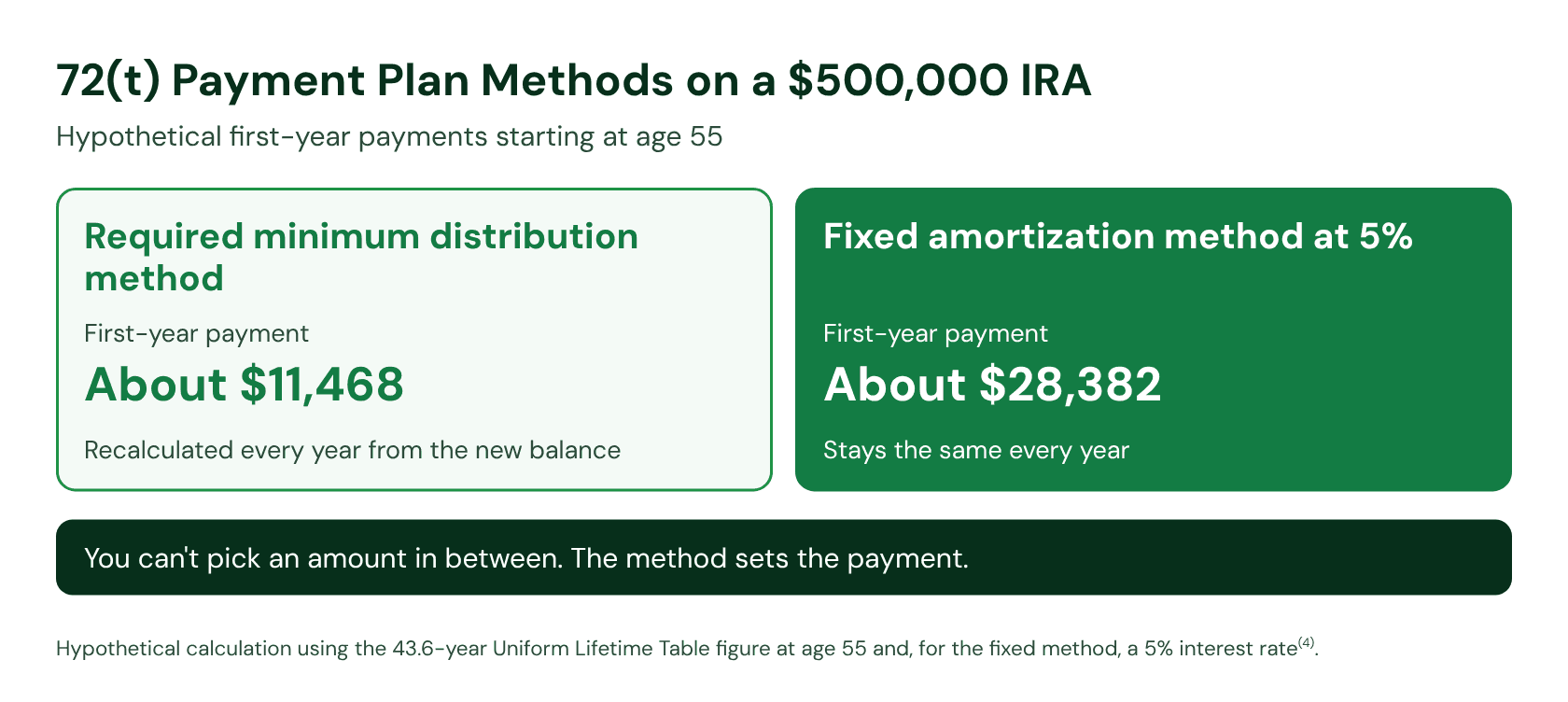
The two payments are far apart, and the rules don't let you pick a number in between. If you need $45,000 a year, neither method pays that much from a $500,000 account, and if you need $15,000, the fixed method would pay out far more than you need.
How long are you locked in?
Once a 72(t) payment plan starts, you can't change it until the later of two dates, the fifth anniversary of your first payment or the date you reach age 59½(3).
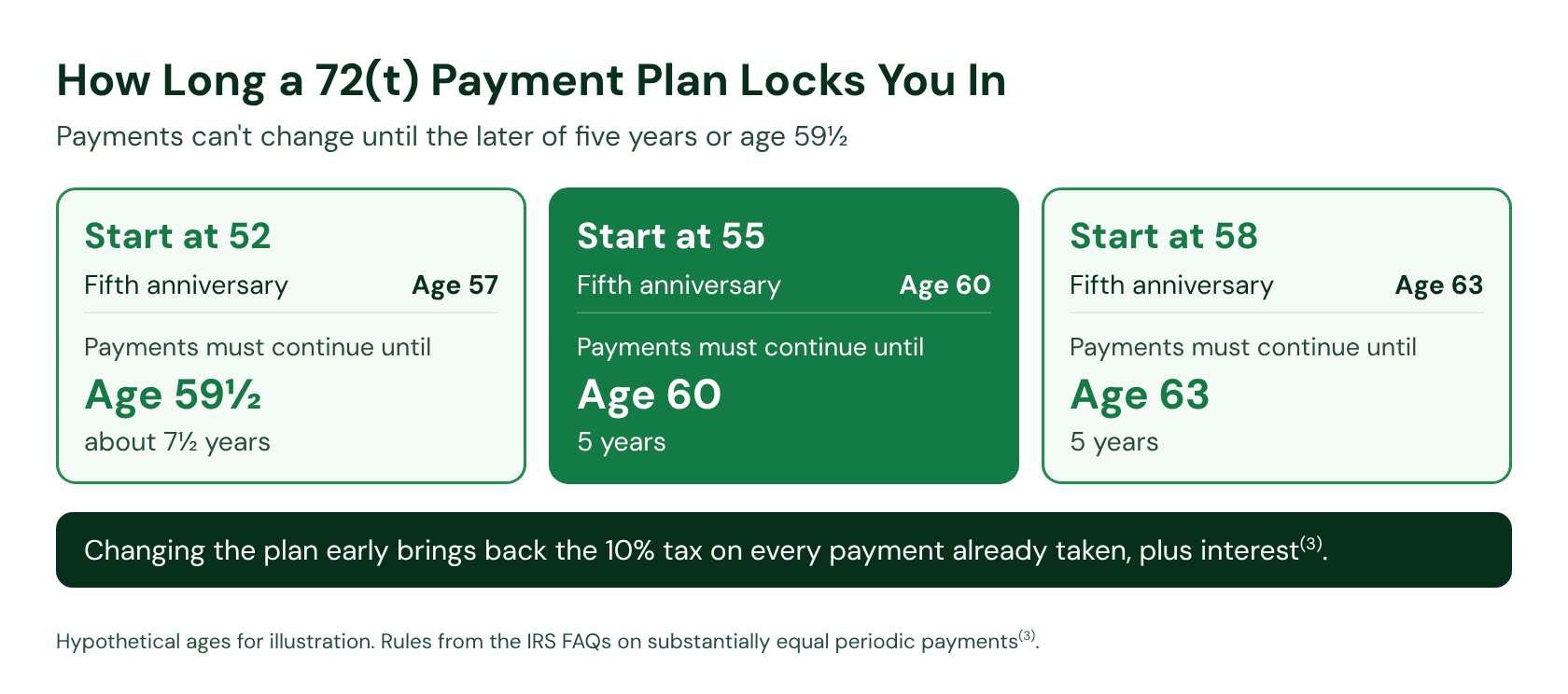
In one IRS example, a taxpayer who started at age 52 with the first payment on December 1, 2020, can't take an extra distribution or change the annual amount until February 15, 2028, the date that taxpayer reaches 59½, even though the fifth yearly payment came in 2024(3). Starting later doesn't free you sooner, either. Someone who starts at 58 is committed until 63, well past the age when the 10% additional tax would no longer apply.
What happens if you change the payments?
Changing the payments before the commitment ends is called a modification, and the cost is steep. Taking an annual amount that's smaller or larger than the plan calls for triggers a recapture tax equal to the full 10% additional tax that would have applied to every payment taken so far, plus interest for the years it was deferred. You also can't add money to the account or take any payments from it outside the plan(3). Notice 2022-6 adds that a transfer of part of the balance to another retirement plan, or a rollover of an amount you received, counts as a modification(4).
In the hypothetical above, someone who started fixed payments of $28,382 at 55 and then took an extra $20,000 in the third year would owe the 10% tax on the $56,764 already withdrawn, about $5,676, plus interest, on top of any tax due on the extra $20,000.
A change made because of the taxpayer's death or disability isn't treated as a modification(3).
If you started with one of the fixed methods, you may switch to the required minimum distribution method once, in any later year, without it counting as a modification. That switch lets the payment follow the account balance from year to year, which can help if the account has shrunk in a down market, but any later change after that would be a modification. A final payment that empties the account isn't treated as a modification, either(4).
Each 72(t) payment plan is figured for one account, and you can't combine the balances of several accounts into one plan or take the combined total from one account. You can set up separate plans from separate accounts, each with its own schedule(3).
How do the two rules compare side by side?
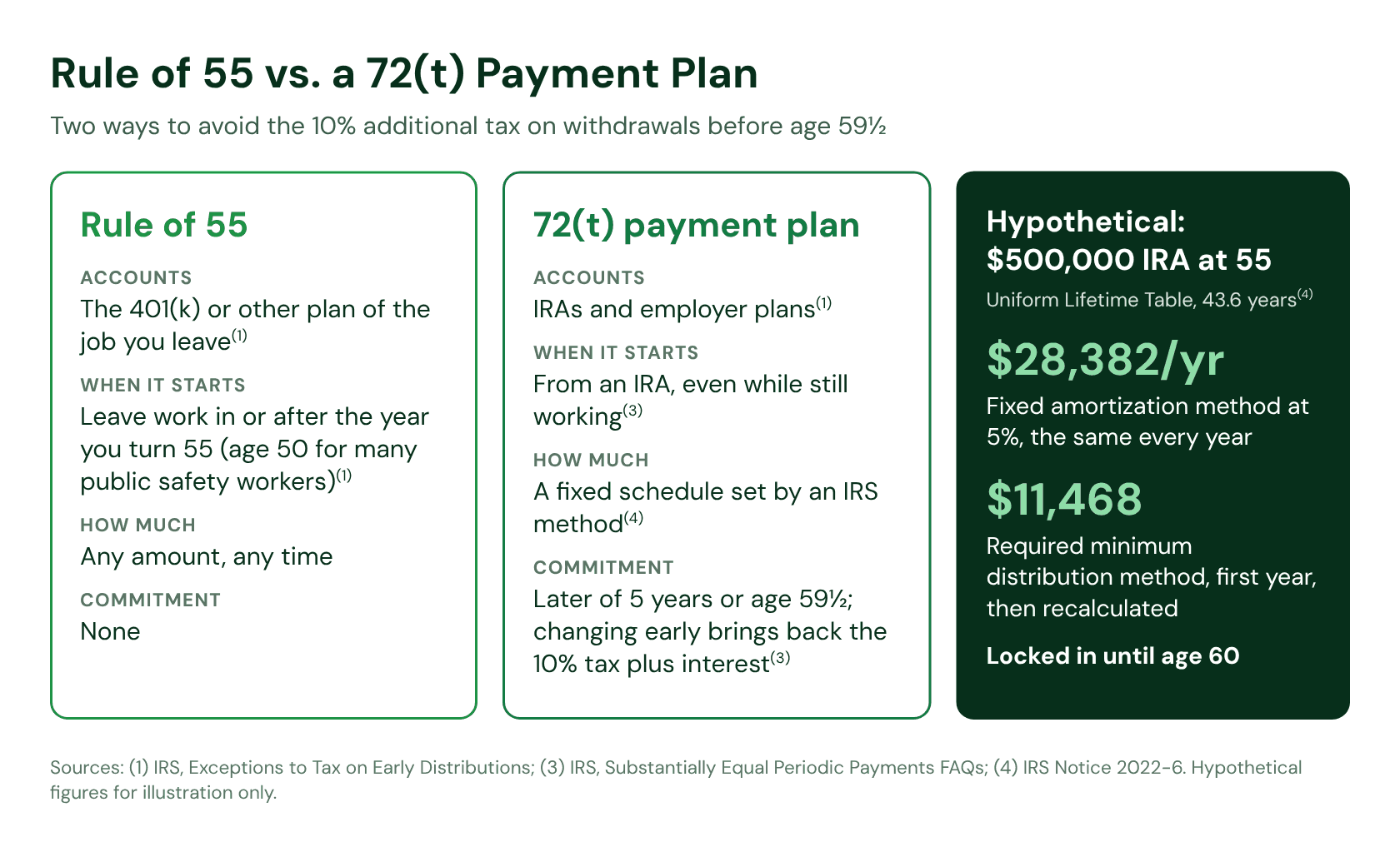
Which approach fits you?
If most of your savings sit in the 401(k) of the job you're leaving at 55 or later, the Rule of 55 is usually the simpler choice. You can take what you need as your expenses change, and nothing ties you to a schedule. The main thing to protect is the account itself, by leaving the money in that plan for as long as you expect to draw from it before 59½.
A 72(t) payment plan is more likely to come up when your savings are mostly in IRAs, when you're leaving work before the year you turn 55, or when the money you'd need is in a plan from an earlier job. It works best when you need a steady, predictable amount each year and are confident that amount will hold for at least five years and until 59½.
Someone with both kinds of accounts can use both rules. Because the Rule of 55 covers the employer plan you leave and a 72(t) payment plan can run from an IRA(1), you could draw flexible amounts from the 401(k) and set a fixed schedule on one IRA, keeping the rest of your IRA money untouched.
Before choosing either, ask your plan administrator how withdrawals work after you leave, including how often you can take money out and how the plan handles withholding. Because a 72(t) payment plan repeats the same calculation for years, it's worth having a tax professional or advisor check it before the first payment, so a mistake in year one doesn't carry through every year that follows.
Common mistakes with early withdrawals
Rolling the 401(k) into an IRA too soon
Moving a workplace plan into an IRA can seem like a natural step when you leave a job, but the Rule of 55 doesn't apply to IRAs(1). If you expect to need the money before 59½, rolling it over can turn penalty-free withdrawals into taxed ones. You can still roll the balance over later, after 59½ or once you no longer need early access.
Leaving in the wrong year
The Rule of 55 depends on separating from service during or after the year you turn 55(1). Leaving in December of the year you're 54, rather than January of the following year, can mean years of withdrawals carry the 10% additional tax.
Treating a 72(t) account like a regular account
One extra withdrawal, a new contribution, or a transfer out of the account can count as a modification and bring back the 10% tax on every earlier payment, plus interest(3, 4). Once the plan starts, leave that account alone apart from the scheduled payments, and use other accounts for any new savings.
Forgetting about income tax
Both rules remove only the 10% additional tax. The withdrawals are still subject to income tax(1), and in the years before Social Security begins, they may be your main source of taxable income. Plan for the tax bill along with the withdrawal.
Check your plan before you set your last day
The date you leave, the account the money sits in, and the method you pick can each decide whether early withdrawals cost you an extra 10%. An advisor who works through those details with you before you leave can help you choose between the Rule of 55, a 72(t) payment plan, or a mix of both.
If you need help navigating these complexities, find an advisor that can help by answering a few questions below:
Greensprout is an independent, advertising-supported publisher and comparison resource. Our editorial team writes on behalf of the reader, and our goal is to provide clear, useful information to help you make better financial decisions. We may earn compensation when you click on links to products from our partners. This does not affect our editorial standards or recommendations.
Nothing on this site constitutes investment advice. All investors are encouraged to conduct their own research before making any investment decision. Past performance is not a guarantee of future results.
This article is for general educational purposes and is not tax advice. Plan rules vary, and tax law can change, so confirm the details with your plan administrator and a tax professional before acting.
References
1. Internal Revenue Service. "Retirement Topics: Exceptions to Tax on Early Distributions." https://www.irs.gov/retirement-plans/plan-participant-employee/retirement-topics-exceptions-to-tax-on-early-distributions
2. Internal Revenue Service. "Topic No. 558, Additional Tax on Early Distributions From Retirement Plans Other Than IRAs." https://www.irs.gov/taxtopics/tc558
3. Internal Revenue Service. "Retirement Plans FAQs Regarding Substantially Equal Periodic Payments." https://www.irs.gov/retirement-plans/retirement-plans-faqs-regarding-substantially-equal-periodic-payments
4. Internal Revenue Service. "Notice 2022-6: Determination of Substantially Equal Periodic Payments." https://www.irs.gov/pub/irs-drop/n-22-06.pdf
5. Internal Revenue Service. "Topic No. 413, Rollovers From Retirement Plans." https://www.irs.gov/taxtopics/tc413