
Key takeaways
- A pension lump sum is your future monthly checks converted into one payment today, and the interest rate the plan uses decides how large that payment is.
- The monthly payment protects you from outliving your money, while the lump sum gives you control, flexibility, and something to leave behind.
- Taking the lump sum moves the job of making the money last, and the risk of getting it wrong, from the plan to you.
- If you're married, your spouse's future income is part of the decision, and federal law gives your spouse a say in it.
- How you receive a lump sum decides whether taxes come out right away, so the paperwork deserves as much care as the choice itself.
If you're getting close to retirement, your employer's benefits office may send you a letter asking you to choose between two very different ways to collect your pension. One is a modest monthly amount you'd receive for the rest of your life. The other is a single payment that can run well into six figures.
Both numbers describe the same pension, but you only get to pick one. The forms that come with them are full of technical terms that are hard to follow, and once you sign you'll live with your choice for decades.
This article walks through how a plan arrives at the lump sum, how to test whether it would last as long as the monthly checks, what each choice means for your spouse, your protections, and your taxes, and the mistakes that are hardest to undo. The goal is to give you enough clarity to judge your own offer.
What are you choosing between?
A traditional pension, also called a defined benefit plan, promises you a set income in retirement based on a formula rather than an account balance. The Pension Benefit Guaranty Corporation (PBGC) is the federal agency created by the Employee Retirement Income Security Act of 1974 (ERISA) to encourage private sector defined benefit plans and keep pension payments flowing, and it protects the retirement security of about 30 million workers in private sector pension plans(1).
When a plan offers you a choice, the monthly option pays you a steady income for the rest of your life, much like keeping part of your paycheck. Its drawbacks are less flexibility, and the possibility that it pays nothing to your survivors depending on the form you choose. The lump sum lets you pay off large debts, and anything you don't spend can pass to your heirs, but it also makes you responsible for turning the money into future income, and you may outlive it.
Once your first payment arrives, you can't change your selection(2).
Employers that close a pension plan in what's called a standard termination typically settle every benefit owed by purchasing a group annuity contract from an insurer, which then takes on the responsibility of paying benefits. If the plan permits, some or all participants may instead be paid lump sums(4). That's one way an offer can arrive, though plans can also include a lump-sum option as a regular choice at retirement.
How does the plan turn your monthly pension into a lump sum?
The lump sum is a present value, which is the amount of money today that's treated as equal to a stream of payments in the future. To calculate it, the plan estimates how long you're likely to collect and then discounts each future payment by an interest rate, on the theory that a dollar paid 20 years from now is worth less than a dollar today.
Federal tax rules set a floor on that calculation. The interest rates that plans use to figure minimum lump sums under Section 417(e) of the Internal Revenue Code are three segment rates, which the IRS publishes each month. For September 2026, the three rates were 5.06%, 5.99%, and 6.72%(7).
A higher discount rate shrinks the present value of the same payments, so when rates rise, lump sums fall, and when rates drop, lump sums grow.
Here's a hypothetical illustration using a single flat rate for simplicity:
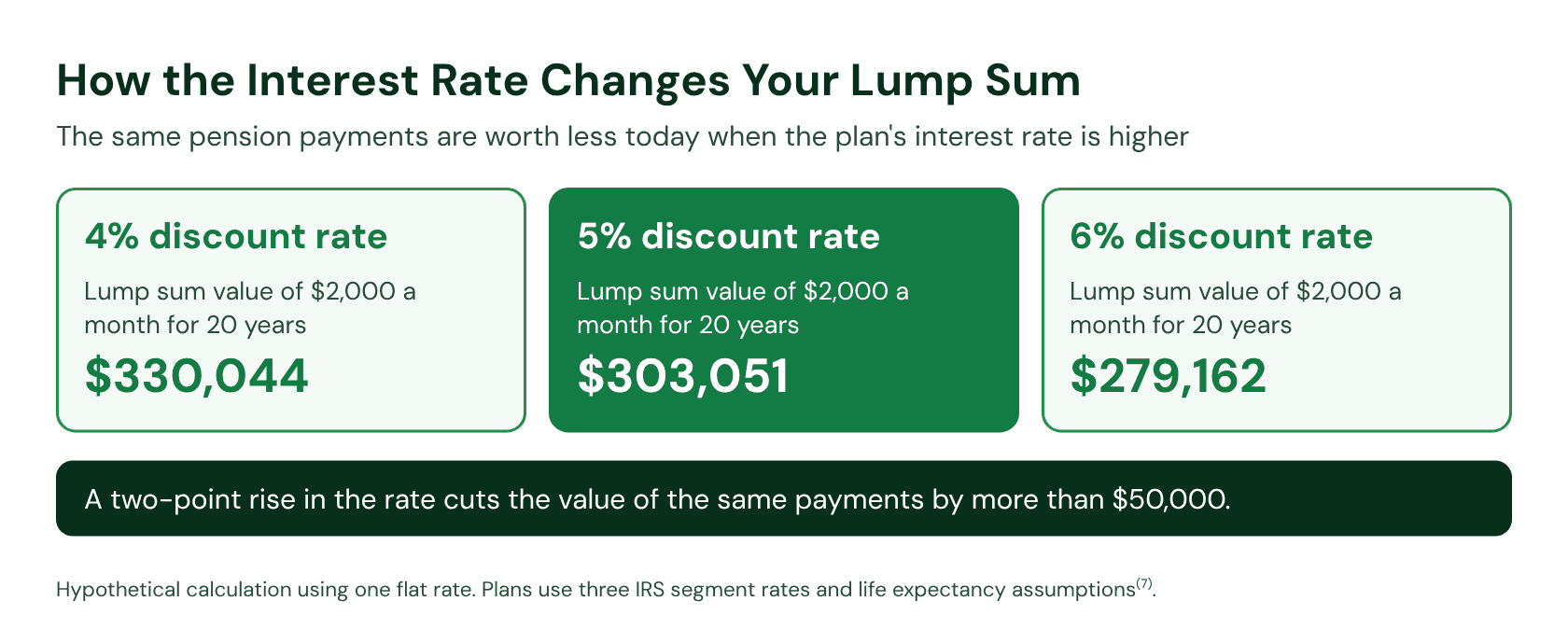
In this hypothetical, a two-point swing in the rate moves the value of the same stream of payments by more than $50,000. Because the IRS rates change from month to month, ask your plan which month's rates it uses for your calculation, since the timing of your retirement date can change the size of your offer.
Your plan has to show you how the options compare
You don't have to calculate the comparison entirely on your own. Federal regulations require a defined benefit plan's explanation of your options to describe the relative value of each optional form of benefit compared with the value of the qualified joint and survivor annuity, the standard married-couple payout covered below. The plan can show this as a percentage or factor of that annuity's value, by stating the annuity amount that's equal in value to the optional form, or by stating the present value of both(6).
The same rules let a plan describe any option worth between 95% and 105% of the joint and survivor annuity as approximately equal in value to it, and when a lump sum falls in that group, the lump sum is the form used for the comparison(6). If your paperwork says the lump sum is approximately equal in value, that can mean it's worth as little as 95% of the annuity under the plan's own assumptions.
How long would the lump sum have to last?
A present value tells you what the plan thinks your payments are worth, but your own question is more personal. If you took the lump sum and paid yourself the same monthly amount, would the money last as long as you do?
Consider a hypothetical 65-year-old who is offered either $2,000 a month for life or a single payment of $290,000. Dividing the lump sum by the monthly payment shows that the checks would add up to $290,000 after 145 months, or about 12 years. That simple breakeven point, around age 77, is an easy figure to compare against, but it ignores the fact that money you hold can earn a return while you spend it.
Life expectancy puts the comparison in context. On average, a man who has just turned 65 can expect to live about 18.1 more years, and a woman about 20.7 more years(8). Those are averages for the whole population, which means many 65-year-olds will live well past 83 or 85.
Here's what it would take for the hypothetical $290,000 to keep paying $2,000 a month:
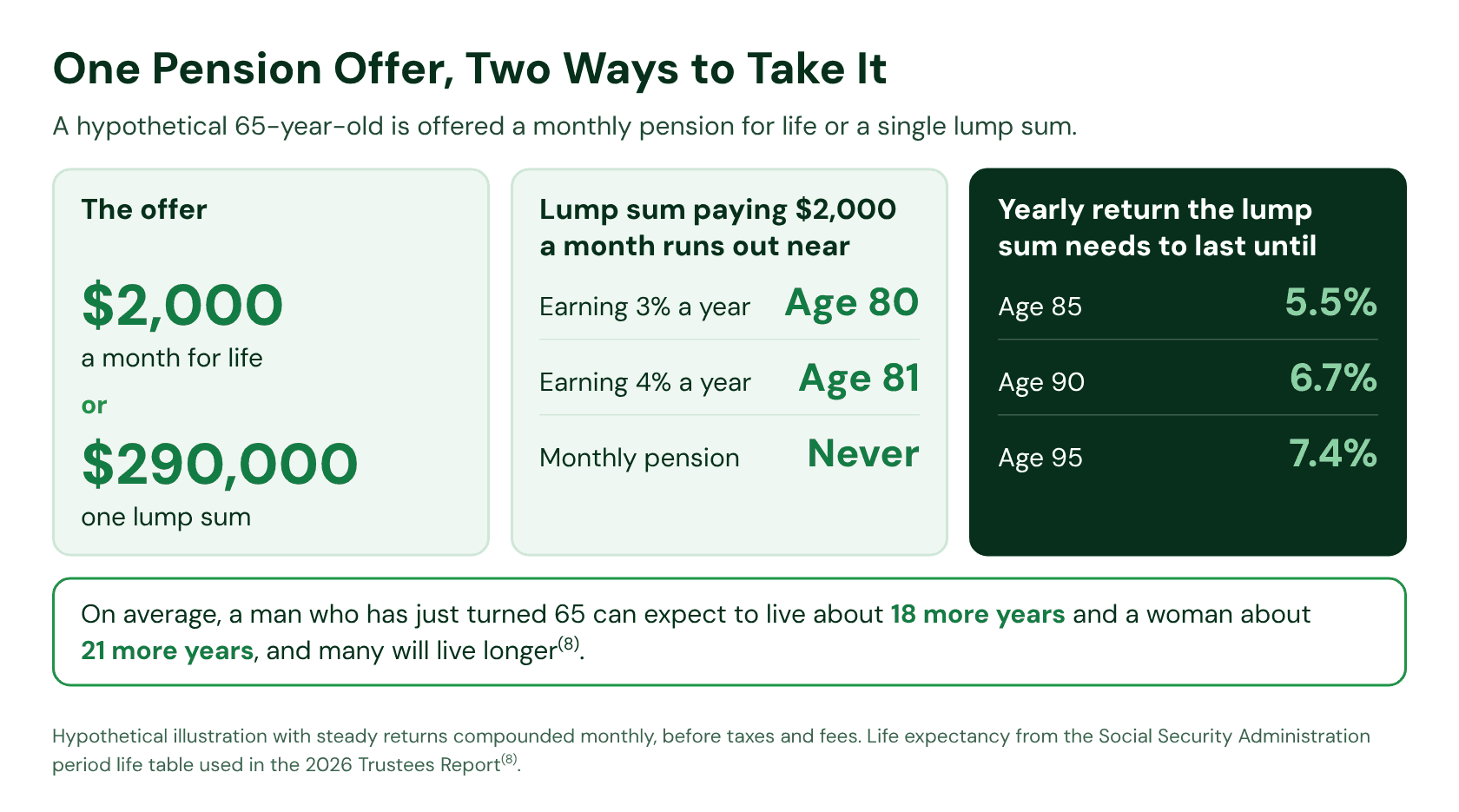
Turned around, the same hypothetical $290,000 earning a steady 4% a year would run out after about 16.5 years, shortly after age 81, and at 3% it would last about 15 years, until around age 80. The monthly pension, by contrast, keeps paying for as long as you live. To stay ahead, the lump sum has to earn a steady return year after year without a bad stretch of markets early in retirement, and an investor taking that route also takes on the chance of losing money.
What happens to your spouse under each choice?
If you're married, federal law makes your spouse's income part of the default. A plan that's subject to these rules must pay married participants their benefit as a qualified joint and survivor annuity (QJSA), which is a lifetime annuity for you that continues to your surviving spouse after your death. The survivor's payment must be no less than 50% and no greater than 100% of what you received while you were both alive(5).
To choose a different form, such as a lump sum or a single-life annuity, you and your spouse must consent in writing, and the plan must require that a plan representative or notary witness your spouse's consent. A participant who waives the QJSA may instead elect a qualified optional survivor annuity (QOSA)(5).
The lump sum handles a spouse differently. Nothing is promised to your survivor, but whatever is left when you die can pass to your heirs(2). The question for a couple is whether the surviving spouse would rather have a guaranteed check for life or control of whatever money remains, and whether that money is likely to remain at all.
Which option keeps your money better protected?
A monthly pension from a private employer comes with a federal backstop. When The Pension Benefit Guaranty Corporation (PBGC) becomes trustee of a pension plan, it can guarantee benefits only up to limits set by federal law, using a formula tied to the Social Security index. For 2027, the maximum guarantee at age 65 is $8,113.64 a month for a straight-life annuity and $7,302.28 for a joint and 50% survivor annuity when both spouses are the same age. The formula provides lower amounts for younger ages, and choosing a larger survivor benefit generally means a lower maximum(3). Those limits are well above the hypothetical $2,000 pension, so a benefit of that size would generally fit within the guarantee.
Taking the money as a lump sum ends that protection, because the PBGC guarantee covers monthly payments and a consumer who takes a lump-sum payout loses it.
If you invest the lump sum in the stock market, you could lose some or all of the money(12). Keeping it in safer investments lowers that risk, but as the hypothetical above shows, lower returns also make it harder for the money to last.
The calculation looks different in a standard termination, where a plan settles its obligations by purchasing a group annuity from an insurer that takes over responsibility for paying benefits(4). In that case, you're weighing a lump sum against an insurer's promise rather than the plan's.
How is each option taxed?
Monthly pension payments are fully taxable if you have no investment in the contract, which generally means you didn't contribute any after-tax amounts. If you did contribute after-tax dollars, the payments are partially taxable(9). Either way, the tax arrives a little at a time, spread over the years you collect.
A lump sum puts more weight on how the money leaves the plan. If you have the plan pay it directly to an IRA or another retirement plan, which is known as a direct rollover, no taxes are withheld. If the plan pays the distribution to you, 20% must be withheld for taxes. You then have 60 days to roll it over, and to roll over the full amount, you must use other funds to make up the 20% that was withheld. Whatever you don't roll over is taxable, and you may also owe an additional tax unless an exception applies(10).
Withdrawals before age 59½ generally carry an additional 10% tax. One exception covers employees who separate from service during or after the year they reach age 55, but it applies to qualified employer plans and not to IRAs(11). If you're leaving work between 55 and 59½ and may need some of the money soon, the decision on where the lump sum goes can determine whether that early-withdrawal exception is still available to you.
If you keep the lump sum rather than rolling it over, you'll pay taxes on the payout, and the whole taxable amount lands in a single tax year instead of being spread across many years of pension checks(13). Rolling it into an IRA or another plan postpones the tax until you withdraw the money, which lets you choose the timing.
Does inflation change the comparison?
A fixed monthly payment buys less every year that prices rise. In a hypothetical where inflation averages 2.5% a year, a $2,000 monthly pension that never increases would have the purchasing power of about $1,221 in today's dollars after 20 years, and at 3% inflation, about $1,107.
Your plan documents will say whether your payments include cost-of-living increases. If they don't, part of the lump sum's appeal is that you can invest some of it for growth to keep pace with rising prices. The tradeoff is that growth investments carry the market risk described above, so protecting against inflation and protecting against loss pull in opposite directions.
Which situations favor each choice?
PBGC suggests weighing a few factors, which are your health and your spouse's, your investment skills and your spouse's and how they may change as you age, your living expenses now and in the future, your savings (and your spouse's), other steady income (Social Security, pensions from other employers), debt (mortgage, car, credit cards, student loans, child support payments), and taxes on the annuity or lump sum(2).
The monthly payment option tends to fit when your other guaranteed income, such as Social Security, won't cover your essential expenses, when you or your spouse are in good health and come from a long-lived family, or when you'd rather not manage a large sum of money into your 80s and 90s.
The lump sum can fit when your essential expenses are already covered by other income, when you have a clear use for the flexibility such as paying off high-interest debt, or when leaving money to heirs is a priority. A lump-sum payout might also make sense if you're in critically poor health, since a lifetime annuity pays the least to someone who doesn't live long enough to collect much of it(12).
Ask your plan whether you can split the benefit, too. Some plans allow a combination of payouts, such as part of the benefit as a lump sum and the rest as monthly income, which can give you some flexibility without giving up guaranteed income entirely(12).
Common mistakes with pension lump sum offers
Comparing the lump sum to a simple payback point
Dividing the lump sum by the monthly payment gives a breakeven age, but it says nothing about what return you'd need or how long you're likely to live. Compare the offer against how long the money would last at a return you could realistically expect to earn, and plan for living past the average life expectancy rather than to it.
Skipping the relative value disclosure
Your plan's explanation of your options shows how the lump sum compares in value with the joint and survivor annuity, and that comparison is the plan's own statement of what you'd be trading(6). Mistakes can happen in a lump-sum calculation, so ask the plan to show how it calculated your benefit and check it before you sign(13).
Letting the check come to you
Having the plan pay a lump sum to you rather than directly to an IRA or another plan triggers the 20% withholding, and rolling over the full amount afterward means finding that 20% from other money within 60 days(10). A direct rollover avoids both problems if you intend to keep the money invested for retirement.
Deciding under pressure
Scammers and fraudsters often target older consumers, and a large pension payout makes an obvious target(13). Be wary of advisers who earn a commission from selling you particular products or investments, and take your time to verify information and ask questions before you act(12). Anyone who promises high returns with low risk and pushes you to act quickly is a reason to slow down.
Get a second opinion before you sign
A pension election is permanent once payments start, and the right answer depends on your health, your other income, your spouse, and how comfortable you are managing a large sum for decades. An advisor who doesn't earn a commission on what you do with the money can test your offer against those details before you sign.
Find the right advisor for your situation by answering a few questions:
Greensprout is an independent, advertising-supported publisher and comparison resource. Our editorial team writes on behalf of the reader, and our goal is to provide clear, useful information to help you make better financial decisions. We may earn compensation when you click on links to products from our partners. This does not affect our editorial standards or recommendations.
Nothing on this site constitutes investment advice. All investors are encouraged to conduct their own research before making any investment decision. Past performance is not a guarantee of future results.
This article is for general educational purposes and is not tax advice. Pension rules vary by plan, and tax law can change, so confirm the details of your offer with your plan administrator and a tax professional before acting.
References
1. Pension Benefit Guaranty Corporation. "Who We Are." https://www.pbgc.gov/about/who-we-are
2. Pension Benefit Guaranty Corporation. "Annuity or Lump Sum." https://www.pbgc.gov/workers-retirees/learn/annuity-lump-sum
3. Pension Benefit Guaranty Corporation. "Maximum Monthly Guarantee Tables." https://www.pbgc.gov/workers-retirees/learn/guaranteed-benefits/monthly-maximum
4. Pension Benefit Guaranty Corporation. "Standard Terminations." https://www.pbgc.gov/employers-practitioners/plan-terminations/standard
5. Internal Revenue Service. "Retirement Topics: Qualified Joint and Survivor Annuity." https://www.irs.gov/retirement-plans/plan-participant-employee/retirement-topics-qualified-joint-and-survivor-annuity
6. 26 CFR § 1.417(a)(3)-1, Required Explanation of Qualified Joint and Survivor Annuity and Qualified Preretirement Survivor Annuity. Legal Information Institute, Cornell Law School. https://www.law.cornell.edu/cfr/text/26/1.417(a)(3)-1
7. Internal Revenue Service. "Minimum Present Value Segment Rates." https://www.irs.gov/retirement-plans/minimum-present-value-segment-rates
8. Social Security Administration, Office of the Chief Actuary. "Actuarial Life Table" (Period Life Table, 2023, as used in the 2026 Trustees Report). https://www.ssa.gov/oact/STATS/table4c6.html
9. Internal Revenue Service. "Topic No. 410, Pensions and Annuities." https://www.irs.gov/taxtopics/tc410
10. Internal Revenue Service. "Rollovers of Retirement Plan and IRA Distributions." https://www.irs.gov/retirement-plans/plan-participant-employee/rollovers-of-retirement-plan-and-ira-distributions
11. Internal Revenue Service. "Retirement Topics: Exceptions to Tax on Early Distributions." https://www.irs.gov/retirement-plans/plan-participant-employee/retirement-topics-exceptions-to-tax-on-early-distributions
12. Consumer Financial Protection Bureau. "Pension Lump-Sum Payouts and Your Retirement Security" (January 2016). https://files.consumerfinance.gov/f/201601_cfpb_pension-lump-sum-payouts-and-your-retirement-security.pdf
13. Consumer Financial Protection Bureau. "Key Tips to Consider If Choosing a Lump-Sum Pension Payout" (January 12, 2016). https://www.consumerfinance.gov/archive/blog/key-tips-to-consider-if-choosing-a-lump-sum-pension-payout/