
Key takeaways
- Once your income passes a certain level, each extra dollar you withdraw from savings can also make part of your Social Security taxable.
- Because one dollar of income can add more than one dollar of taxable income, some middle-income retirees pay a higher rate on their next dollar than their tax bracket suggests.
- The costly range has an upper limit, and income above it goes back to being taxed at your ordinary bracket.
- Which accounts you draw from, and in which years, can move you through the range faster or keep you out of it.
- The income levels that trigger tax on benefits aren't adjusted for inflation, so more retirees reach them as incomes rise over time.
Picture two tax years that look almost the same. In the first, you took your usual withdrawals from your IRA and your Social Security checks arrived on schedule. In the second, you pulled out a few thousand dollars more from your IRA to replace a car or help with a family expense, and when the return was finished, the federal tax bill had climbed by far more than that extra withdrawal seemed to justify.
Many retirees who collect Social Security and also draw on savings land in a stretch of income where each additional dollar makes part of their Social Security taxable as well, so a single withdrawal ends up counted almost twice. This article calls that stretch the tax torpedo, because it can catch retirees who are nowhere near the top tax brackets.
The sections below explain how the IRS decides how much of your Social Security benefit is taxable, where the costly range starts and stops for a hypothetical retired couple, which kinds of income push you into it, and the withdrawal choices that can carry you through it or around it.
Why can one more dollar of income cost more than your tax bracket suggests?
Money you take out of a traditional IRA is normally taxed once, at your tax bracket rate.
Social Security can change that. Once your income passes certain levels, each extra dollar you take out can also make part of your Social Security benefit taxable. You end up paying tax on more than the money you withdrew, so the real tax rate on that withdrawal can be well above your bracket. The sections below show where those income levels are and how much extra it can cost.
Congress began taxing Social Security benefits in 1983, and the income levels that trigger the tax have never been adjusted for inflation or wage growth(1). As incomes rise over time, more retirees cross them, including households with an ordinary pension or a modest IRA who would never think of themselves as high income.
How does the IRS decide how much of your Social Security is taxable?
The IRS starts with a figure the tax code builds from three pieces, known as provisional income. You add one-half of your Social Security benefits to all your other income, including tax-exempt interest such as interest from municipal bonds, and compare the total with a base amount for your filing status. The base amount is $25,000 for single filers, heads of household, and qualifying surviving spouses, $32,000 for married couples filing jointly, and $0 for married people who file separately and lived with their spouse at any time during the year(2).
Once your provisional income passes the base amount, part of your Social Security becomes taxable. Between the base amount and a second, higher line, up to 50% of your benefit can be taxed. Above the second line, which is $34,000 for single filers and $44,000 for joint filers, up to 85% can be taxed(1). However high your income goes, the IRS never taxes more than 85% of your benefit(3).
The table below shows where those lines fall. How quickly your taxable share climbs as your income rises is what creates the tax torpedo, and the next section walks through it.
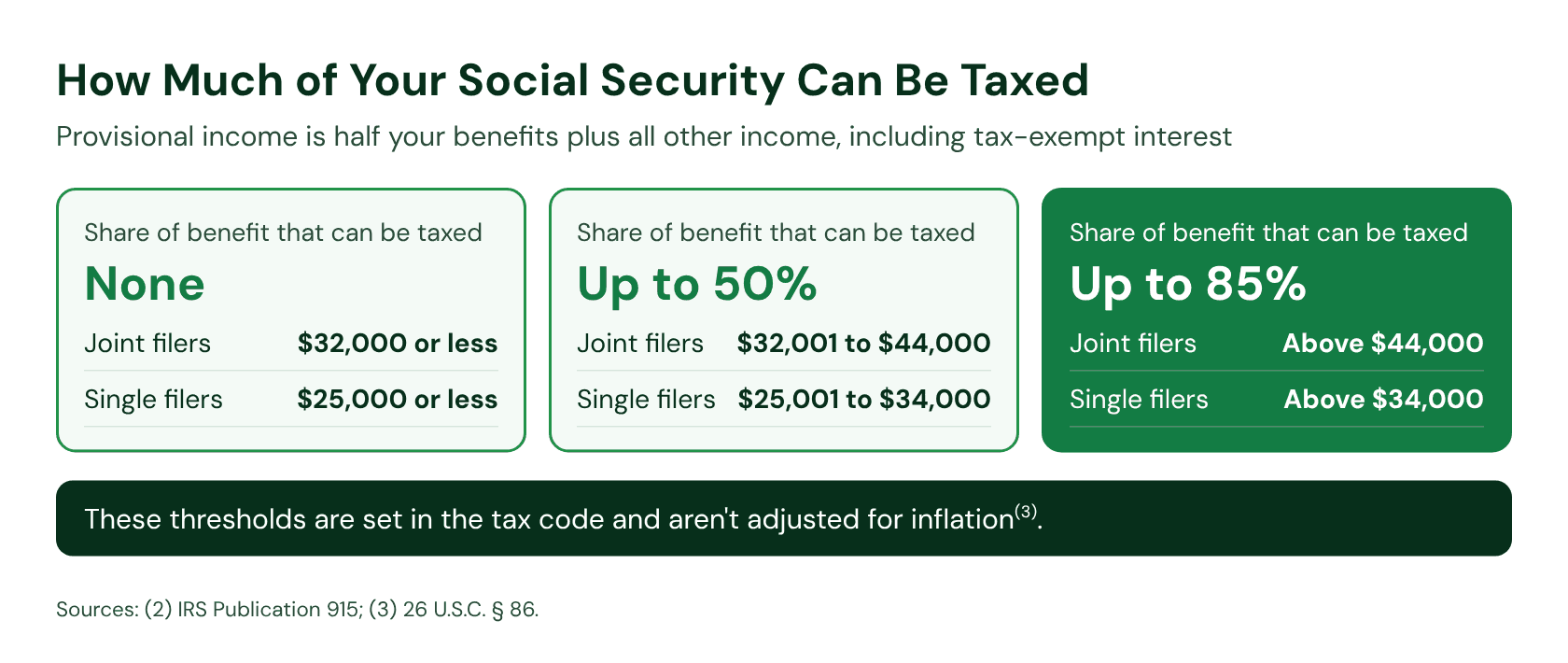
Thresholds from 26 U.S.C. 86 and IRS Publication 915. These dollar amounts are set in the statute and are not adjusted for inflation.
However high your income goes, at least 15% of your benefit stays out of taxable income, because the tax code never includes more than 85% of benefits(3). The 85% cap is also what ends the torpedo.
Where does the torpedo range begin and end?
The torpedo range runs from the point where your benefits first become taxable to the point where 85% of them already are. Inside it, every extra dollar of ordinary income does two things at once.
It counts as taxable income itself, and it raises provisional income, which drags more of your benefit into taxable income along with it.
In the first tier, each extra dollar of other income adds 50 cents of taxable benefits, so $1,000 of income becomes $1,500 of taxable income. In the second tier, each extra dollar adds 85 cents of taxable benefits, so $1,000 becomes $1,850. Multiplying those amounts by your bracket gives your marginal tax rate, which is the rate you pay on the next dollar. The image below shows that hypothetical calculation for the three lowest federal brackets.
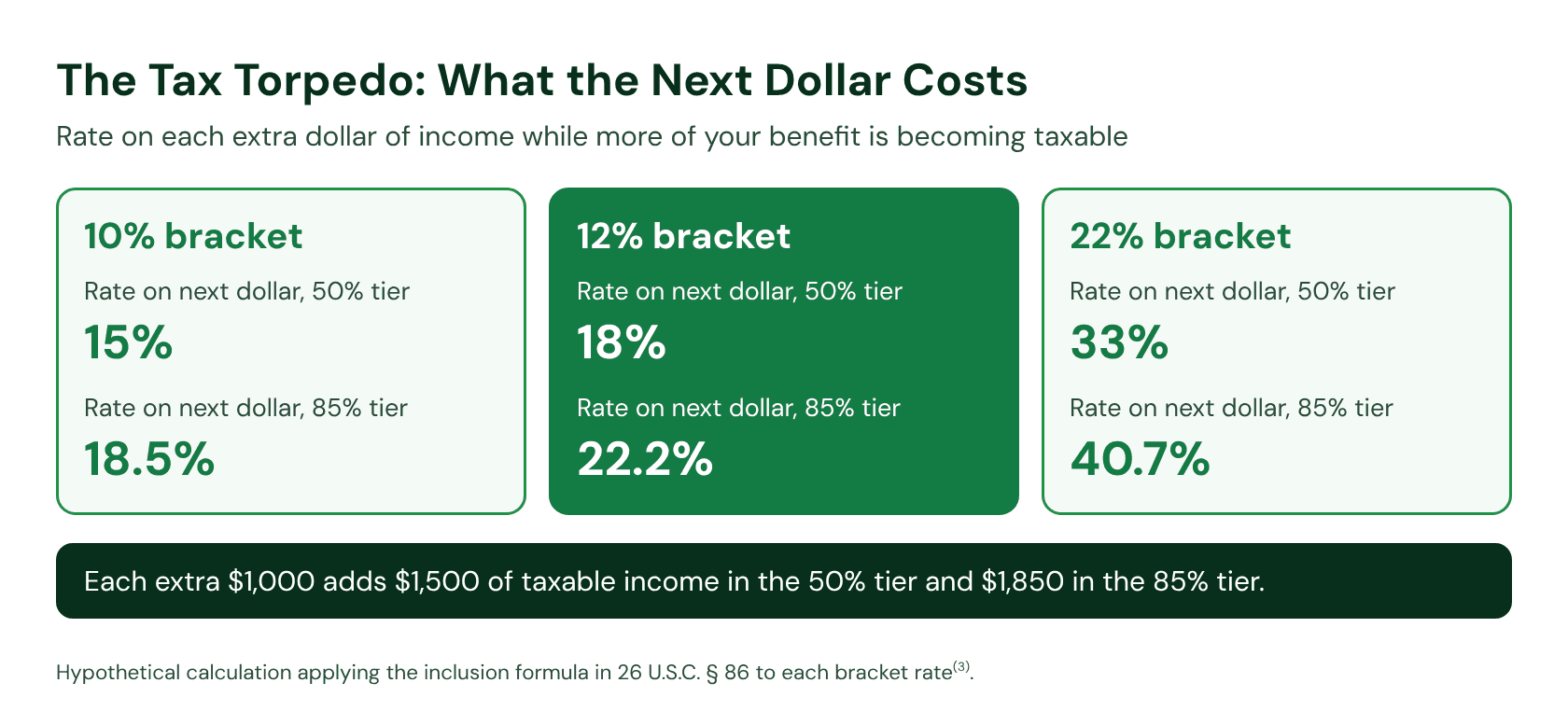
Hypothetical calculation applying the inclusion formula in 26 U.S.C. 86 to each bracket rate. Rates apply only while the taxable share of benefits is still rising.
Once 85% of your benefit is taxable, the multiplier disappears. From that point, an extra $1,000 of income adds exactly $1,000 of taxable income, and your marginal rate drops back to your bracket rate.
What could this look like for a retired couple?
Consider a hypothetical married couple, both age 67, filing jointly for tax year 2026. They receive $50,000 a year in combined Social Security benefits, and everything else they live on comes from taxable withdrawals from traditional IRAs. Distributions from a traditional IRA are taxable in the year you receive them(4), so each withdrawal counts in full as other income.
For 2026, the couple's standard deduction is $32,200, and each spouse adds an extra $1,650 standard deduction for being 65 or older. Joint filers pay 10% on taxable income up to $24,800 and 12% on taxable income from $24,800 to $100,800(5). They also qualify for the senior deduction, a separate $6,000 deduction for each taxpayer age 65 or older that applies from 2025 through 2028 and is available whether or not you itemize(6). Their total deductions come to $47,500.
Here’s how much each extra $1,000 of IRA withdrawals costs them in federal tax as their withdrawals rise, in this hypothetical.
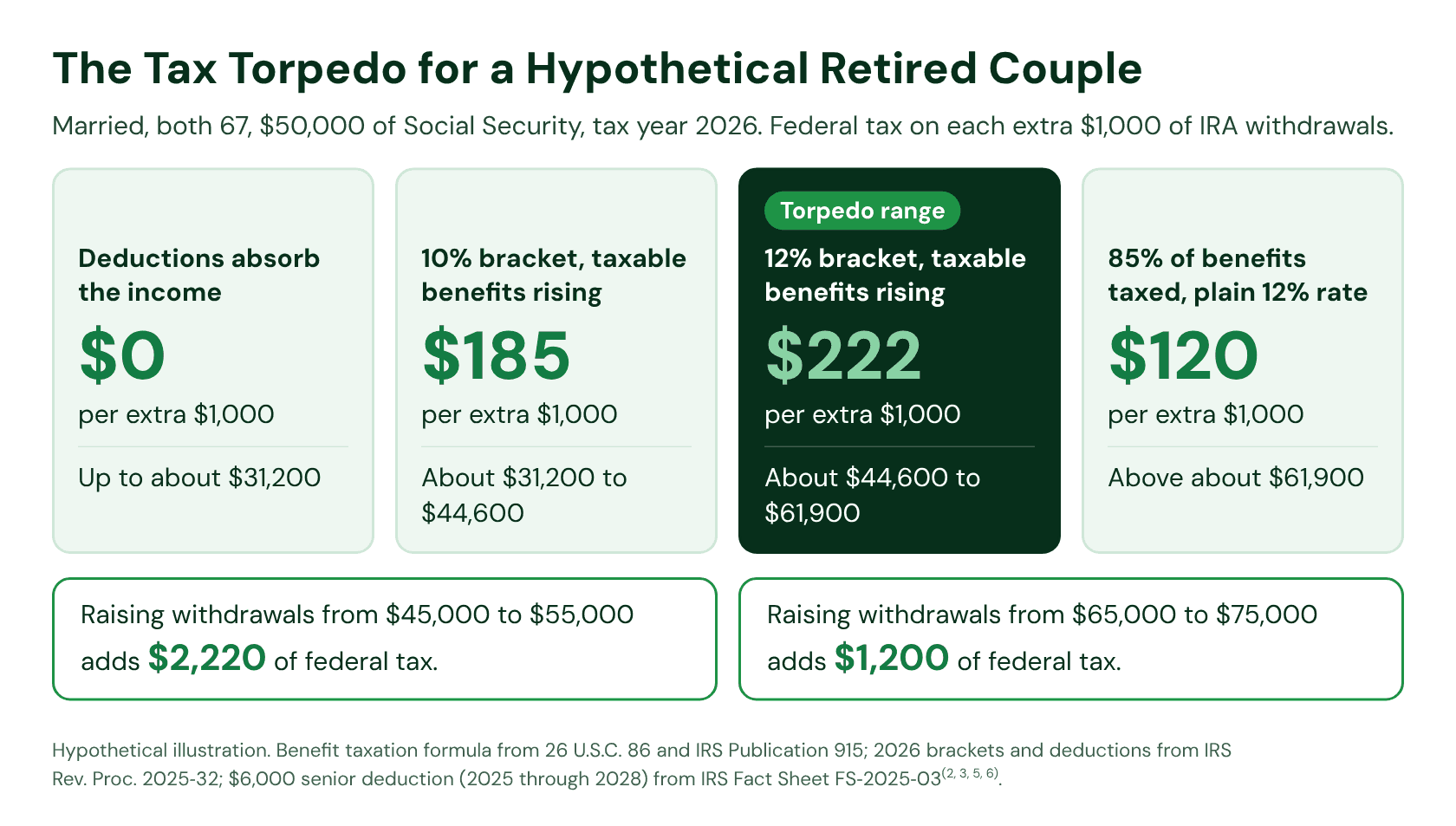
Hypothetical illustration for tax year 2026 using the inclusion formula in 26 U.S.C. 86, tax rates and deductions from IRS Revenue Procedure 2025-32, and the senior deduction from IRS Fact Sheet FS-2025-03.
At $50,000 of withdrawals, the couple's provisional income is $75,000, which is their $50,000 of withdrawals plus half of their $50,000 in benefits. That's $31,000 above the $44,000 second threshold, so their taxable benefits are 85% of $31,000, or $26,350, plus the $6,000 carried over from the first tier, for a total of $32,350. Their adjusted gross income is $82,350, their taxable income after $47,500 of deductions is $34,850, and their tax is $3,686.
Pulling one more $1,000 from the IRA raises their taxable benefits by $850 and their taxable income by $1,850, which adds $222 of tax. In other words, a couple in the 12% bracket pays 22.2 cents on that dollar. The higher rate starts at about $44,600 of withdrawals, where their taxable income moves into the 12% bracket, and holds until their withdrawals reach about $61,900, the point where 85% of their benefit, or $42,500, is taxable. After that, each additional $1,000 costs them $120, the plain 12% rate.
In this hypothetical, raising withdrawals from $45,000 to $55,000 adds $2,220 of federal tax, while raising them from $65,000 to $75,000 adds $1,200. The second $10,000 comes later in the stack and costs $1,020 less.
Can a single retiree face a higher rate?
Single filers reach both thresholds at lower incomes, $25,000 and $34,000 of provisional income, and their tax brackets are narrower too. For 2026, single filers pay 12% on taxable income from $12,400 to $50,400 and 22% above that, up to $105,700(5). A single retiree with a larger benefit can still be inside the torpedo range when taxable income crosses into the 22% bracket, which puts the rate on the next dollar at 40.7%.
The senior deduction can push the rate higher while it lasts, because it shrinks by 6% of the amount by which modified adjusted gross income (MAGI, your adjusted gross income with certain items added back) exceeds $75,000 for single filers or $150,000 for joint filers(1). Take a hypothetical single filer age 67 with $40,000 of Social Security and $46,000 of IRA withdrawals in 2026. Each extra $1,000 withdrawal adds $850 of taxable benefits, falls in the 22% bracket, and trims the senior deduction at the same time, so the next $1,000 costs about $431 in federal tax.
Which kinds of income push you into the torpedo range?
Almost any income that appears on your tax return raises provisional income, and some income that doesn't appear as taxable still counts. These are the sources to watch.
- Traditional IRA and 401(k) withdrawals. They're taxable in the year you take them(4), so they count dollar for dollar.
- Required minimum distributions (RMDs). You must begin taking them by April 1 of the year after you reach age 73(4), which can push income higher whether or not you need the money.
- Tax-exempt interest. Interest from municipal bonds isn't taxed on its own, but it's added back when the IRS measures whether your benefits are taxable(2).
- Pensions, wages, interest, dividends, and capital gains. The tax code builds provisional income from adjusted gross income, so anything that raises adjusted gross income also raises the taxable share of your benefit(3).
Qualified withdrawals from a Roth IRA work differently. If you meet the requirements, qualified distributions are tax-free(7), so they don't add to adjusted gross income and don't raise the taxable portion of your benefit. For a retiree near the torpedo range, a Roth withdrawal covers spending without raising the tax on benefits.
How can you plan withdrawals around the torpedo?
Each of these choices works by controlling how much income lands in each tax year, and some trade a lower tax bill later for a higher one now. Knowing where your income will land before you decide which account to draw from is the starting point for all of them.
Draw from traditional accounts before benefits begin
The torpedo applies only once you're collecting benefits, because the tax code measures taxable benefits as a share of the benefits you received during the year(3). In the years between leaving work and claiming Social Security, traditional IRA withdrawals are taxed only at your ordinary bracket. Some retirees use those years to live on IRA money and claim Social Security later. Benefits grow by 8% for each year you delay past full retirement age if you were born in 1943 or later, and the increase stops at age 70(8).
Convert to a Roth in lower-income years
Moving money from a traditional IRA to a Roth IRA isn't free. A conversion to a Roth IRA results in taxation of any untaxed amounts in the traditional IRA, and Roth IRAs don't require RMDs during your lifetime(9). Paying tax on a conversion in a year when your income is low, especially before benefits start, can shrink the traditional balance that would otherwise feed the torpedo later and build a tax-free bucket you can draw from when you're near the torpedo range.
Mix tax-free money in once benefits start
After you begin collecting, the order of your withdrawals each year can change your tax as much as the total. A household near the top of the torpedo range for the year might cover the next expense from a Roth IRA, a cash reserve, or the original investment in a taxable brokerage account instead of a traditional IRA. Spreading a large expense across two tax years can also keep each year's income lower in the range, while a household already past the 85% point may find that taking a bit more from a traditional account this year costs only the ordinary bracket rate.
Give through your IRA after 70½
If you give to charity, a qualified charitable distribution (QCD) may help. A QCD is an otherwise taxable distribution from an IRA owned by someone age 70½ or older that is paid directly to a qualified charity, and it can satisfy all or part of your RMD for the year. When the full distribution is a QCD, the taxable amount reported on your return is zero(10), so the gift doesn't add to the income that determines how much of your benefit is taxed.
Plan for the tax so it doesn't surprise you
If your benefits become taxable, withholding can keep the added tax from arriving all at once. Social Security lets you have federal tax withheld from your monthly payment at 7%, 10%, 12%, or 22%(11), which spreads the added tax across the year.
Does the new senior deduction change how benefits are taxed?
The senior deduction lowers taxable income for many older households, but it doesn't change the calculation of how much of your benefit is taxable, which still follows Section 86 of the tax code(1).
The deduction does move the torpedo for many households by absorbing more income before any tax applies. In the hypothetical couple's case, it's part of why they owe nothing until their withdrawals pass about $31,200. Because the deduction is scheduled to run only through 2028(6), the torpedo range could start at a lower income for the same household after that, so check your projections again once the rules change.
Common mistakes retirees make with the tax torpedo
Assuming your bracket is your rate on the next dollar
A retiree in the 12% bracket may plan an extra withdrawal expecting to pay 12 cents on the dollar and end up paying 22.2 cents. Before a large withdrawal, run your projected return with and without it, so you see the change in tax rather than the bracket alone.
Treating municipal bond interest as invisible
Tax-exempt interest is added to your other income when the IRS figures whether your benefits are taxable(2). Shifting money into municipal bonds to lower your tax bill can still push more of your benefit into taxable income, so compare the after-tax result of the bond with a taxable alternative that takes your benefit into account.
Waiting for the thresholds to rise
The $25,000, $32,000, $34,000, and $44,000 thresholds are written into the tax code without any inflation adjustment(1). A plan that keeps you just below them this year may not keep you below them in ten years, especially once RMDs begin, so revisit the plan as your income changes.
See where your income lands before you withdraw
Knowing your provisional income for the year, and where it sits compared with the two thresholds, tells you whether your next withdrawal will cost your bracket rate or something closer to double it. If you’d like a professional to help you navigate the complexities of retirement planning, finding an advisor is easier than ever. You can get started by answering a few questions below.
Find the right advisor for you
Greensprout is an independent, advertising-supported publisher and comparison resource. Our editorial team writes on behalf of the reader, and our goal is to provide clear, useful information to help you make better financial decisions. We may earn compensation when you click on links to products from our partners. This does not affect our editorial standards or recommendations.
Nothing on this site constitutes investment advice. All investors are encouraged to conduct their own research before making any investment decision. Past performance is not a guarantee of future results.
This article is for general educational purposes and is not tax advice. Tax brackets and deductions change each year with inflation, and tax law can change, so confirm current figures with the IRS or a tax professional before acting.
References
1. Congressional Research Service. "Taxation of Social Security Benefits and the Senior Deduction in P.L. 119-21: In Brief," R48613, August 1, 2025. https://www.congress.gov/crs-product/R48613
2. Internal Revenue Service. "Publication 915 (2025), Social Security and Equivalent Railroad Retirement Benefits." https://www.irs.gov/publications/p915
3. 26 U.S. Code § 86, Social Security and Tier 1 Railroad Retirement Benefits. Legal Information Institute, Cornell Law School. https://www.law.cornell.edu/uscode/text/26/86
4. Internal Revenue Service. "Publication 590-B (2025), Distributions from Individual Retirement Arrangements (IRAs)." https://www.irs.gov/publications/p590b
5. Internal Revenue Service. "Revenue Procedure 2025-32" (tax year 2026 inflation adjustments). https://www.irs.gov/pub/irs-drop/rp-25-32.pdf
6. Internal Revenue Service. "Tax Deductions for Working Americans and Seniors," Fact Sheet FS-2025-03. https://www.irs.gov/newsroom/one-big-beautiful-bill-act-tax-deductions-for-working-americans-and-seniors
7. Internal Revenue Service. "Roth IRAs." https://www.irs.gov/retirement-plans/roth-iras
8. Social Security Administration. "Delayed Retirement Credits." https://www.ssa.gov/benefits/retirement/planner/delayret.html
9. Internal Revenue Service. "Retirement Plans FAQs Regarding IRAs." https://www.irs.gov/retirement-plans/retirement-plans-faqs-regarding-iras
10. Internal Revenue Service. "Retirement Plans FAQs Regarding IRAs Distributions (Withdrawals)." https://www.irs.gov/retirement-plans/retirement-plans-faqs-regarding-iras-distributions-withdrawals
11. Social Security Administration. "Request to Withhold Taxes." https://www.ssa.gov/manage-benefits/request-withhold-taxes