

Key takeaways
- A fixed withdrawal plan keeps your yearly withdrawal low enough to last through the worst markets, so in good years you may spend less than you could.
- Guardrails let you start with a larger withdrawal in exchange for cutting back after bad markets and taking a raise after good ones.
- Guardrails work best when guaranteed income covers your essential bills.
- Expect a paycheck that changes from year to year, a smaller balance later in life, and a yearly review to stay on track.
Retirement income planning usually starts with one question, which is how much you can take from your savings each year without running out. The answer you hear most often is a fixed number, set once and raised with inflation, and for many retirees that number pays for less than the retirement they spent decades saving toward. If you've ever postponed a trip or held off on a new car during a rough stretch in the market, you've already practiced what withdrawal guardrails turn into written rules.
You start with a larger paycheck from your portfolio, and you agree in advance to trim it by a set amount when markets go badly and to give yourself a raise when they go well. This article walks through where the rules came from, how each one works, what they look like in dollars on a hypothetical $800,000 portfolio, and what you give up in exchange for spending more early on, so you can judge whether a flexible plan fits the way you want to live in retirement.
Why does a fixed withdrawal rate feel so cautious?
The fixed approach traces back to a 1994 paper by financial planner William Bengen, who tested withdrawals against historical market returns and inflation. His method sets the first year's withdrawal as a percentage of the starting portfolio and then adjusts that dollar amount for inflation every year after. Assuming a portfolio split evenly between stocks and intermediate-term Treasuries and a need for at least 30 years of income, he found that a 4% first-year withdrawal had never exhausted a portfolio in fewer than 33 years, and that in most historical cases it led to portfolio lives of 50 years or longer. He described a 5% starting rate as risky and 6% or more as gambling(1).
Because Bengen's 4% was designed to survive the worst periods in the historical record, in many other periods it leaves retirees with far more money at the end than they ever needed. That leftover money represents spending they passed up in their 60s and 70s, when many retirees most want to travel or help their family.
Morningstar's current research lands in a similar place. Its 2026 estimate for a new retiree who wants steady, inflation-adjusted spending is a 3.9% starting withdrawal, defined as the highest rate with a 90% probability of money remaining after 30 years, for portfolios holding between 30% and 50% in stocks. On a hypothetical $800,000 portfolio, that's $31,200 in the first year, or $2,600 a month before taxes. The same research found that retirees willing to tolerate some fluctuation in their spending can start with a withdrawal rate of nearly 6%, because flexible strategies keep retirees from overspending in weak markets while giving them a raise in stronger ones(3).
What are withdrawal guardrails?
Guardrails are a set of decision rules that tie your annual withdrawals to how your portfolio is doing, within limits. Financial planner Jonathan Guyton and computer scientist William Klinger published the best-known version in the Journal of Financial Planning in 2006, following up on research Guyton published in 2004(2, 4).
You pick a starting withdrawal rate, which is your first-year withdrawal divided by your portfolio's value. Each year you divide your scheduled withdrawal by your current balance and compare the result to where you started. If that percentage drifts too far above your starting rate because the portfolio has fallen, you cut spending, and if it drifts too far below because the portfolio has grown, you take a raise. Between those two boundaries, you keep adjusting for inflation the way a fixed plan would.
Because the rules commit you in advance to cutting back when markets fall, they allow a higher starting withdrawal than a plan that has to survive the worst case with no adjustments at all(3).
How do the Guyton-Klinger rules work?
The 2006 paper uses four rules. Two of them govern how ordinary years are handled, and the other two act as the guardrails themselves.
Where does each year's withdrawal come from?
The portfolio management rule decides which investments you sell to fund each withdrawal. Its central instruction is that no withdrawals come from any stock holding following a year with a negative return, as long as cash and fixed-income asset holdings are enough to cover the withdrawal(2). In practice, that means keeping a cushion of safer assets you can draw from while stocks recover, rather than selling shares at a loss after they've dropped.
When is the yearly inflation increase skipped?
Under the inflation rule, your withdrawal rises each year by the rate of inflation as measured by the Consumer Price Index (CPI), with a maximum increase of 6% in any one year. The withdrawal rule adds an exception, so that in the version the paper uses, there's no inflation increase following a year when the portfolio's total return was negative and the new withdrawal rate would be higher than your initial rate. There's no make-up later for a missed increase, so a freeze leaves your dollar withdrawal flat while prices keep rising(2).
What triggers a spending cut?
The capital preservation rule is the guardrail on the downside. It applies when a year's withdrawal rate has risen more than 20% above your initial withdrawal rate, and it reduces that year's withdrawal by 10%. The reduced amount then becomes the base for calculating the following year's withdrawal. The authors tested deeper cuts of 15% and 20% and found they did not noticeably improve the probability of success, which is why the rule settles on 10%(2).
That 20% is measured relative to your starting rate rather than as 20 percentage points. If you began at 5%, the cut kicks in when your current withdrawal rate climbs above 6%.
The capital preservation rule expires 15 years before the maximum age you're planning for, so a retiree planning to age 100 would stop applying it after 85. The authors found that keeping the rule active in those final years significantly reduced purchasing power without a corresponding improvement in the probability of success(2). Weak returns are especially dangerous early in retirement and less so later on, which is why the cutback rule drops away near the end(4).
What triggers a raise?
The prosperity rule works in reverse. In any year when your withdrawal rate falls more than 20% below your initial rate, that year's withdrawal increases by 10%, and the higher amount becomes the basis for the next year. Starting at 5%, the trigger is a current withdrawal rate below 4%. The paper found that larger stock allocations produced more raises under this rule, and that raises came more frequently than cuts(2).
What does a guardrail year look like in dollars?
Consider a hypothetical retiree with an $800,000 portfolio who starts at 5%, which is a $40,000 first-year withdrawal, or about $3,333 a month. With a 5% start, the cut triggers above a 6% withdrawal rate and the raise triggers below 4%. Assume inflation in the first year runs 3%.
Here's how three different second years would play out under the rules described above:
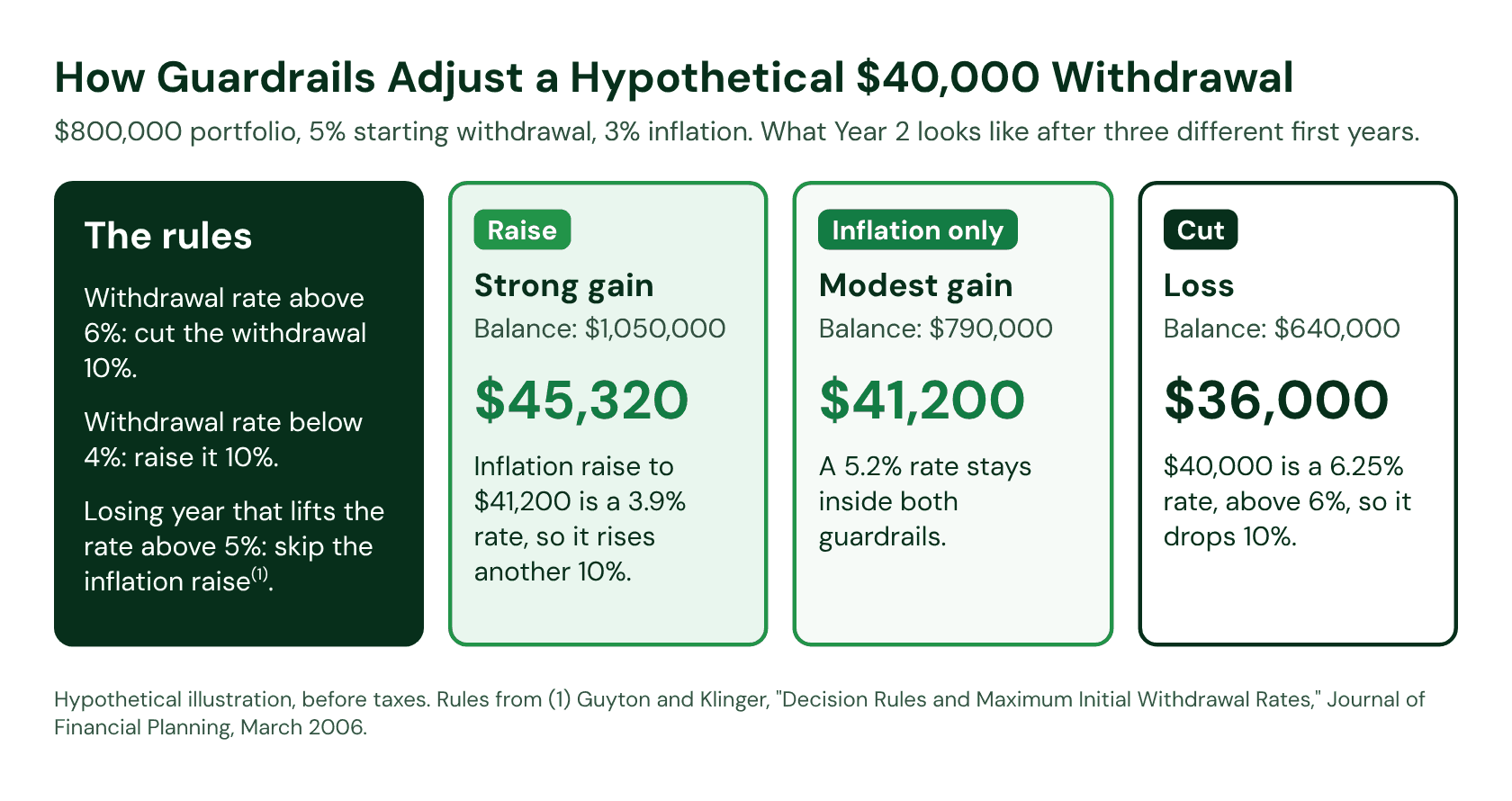
In the losing year, this retiree's monthly withdrawal drops from about $3,333 to $3,000, a cut of roughly $333 a month. For comparison, Bengen's 4% on the same $800,000 supports a $32,000 first-year withdrawal, about $2,667 a month, so even after the cut the guardrails retiree is still taking more than the fixed plan's starting paycheck. In the strong year, the prosperity rule lifts the monthly withdrawal to about $3,777 instead of the $3,433 a plain inflation increase would have produced.
How much higher can guardrails let you start?
Morningstar's testing of the method gives a more current picture. For a portfolio split evenly between stocks and bonds, guardrails supported an average safe starting rate of 5.3% over 30 years with a 90% probability of success, which was the highest starting rate of any method in that study. Portfolios with more stock supported even higher starting rates, reaching 5.6% at 80% stocks(4).
On a hypothetical $800,000 portfolio, the difference between a 3.9% fixed start and a 5.3% guardrails start is $31,200 versus $42,400 in the first year, or about $933 more a month before taxes, and the rules that make that possible come with conditions.
Published starting rates also move from year to year. Morningstar's base-case rate was 3.3% in 2021, 4.0% in 2023, and 3.9% for 2026(3), so treat any published starting rate as a range to discuss rather than a number to lock in.
How deep can the cuts go?
Cuts add up when bad years happen back to back, because each reduced withdrawal becomes the base for the next year's calculation(2). In the hypothetical above, a second triggered cut would take the $36,000 withdrawal to $32,400, which is 19% below the retiree's starting $40,000 before counting any inflation increases skipped along the way. A third would bring it to $29,160, below the $32,000 the fixed 4% our hypothetical retiree started with.
Historical testing shows how far that compounding can go. In a March 2024 analysis on Kitces.com, Derek Tharp and Justin Fitzpatrick applied the Guyton-Klinger rules to another hypothetical retiree withdrawing $43,000 a year from a $1 million portfolio split 60% stocks and 40% bonds. For a retiree who started just before the Global Financial Crisis, inflation-adjusted spending fell to 28% below the originally planned level. In the Dot-Com Bubble, the Great Depression, and the stagflation era, spending bottomed out 36%, 45%, and 54% below the planned level.
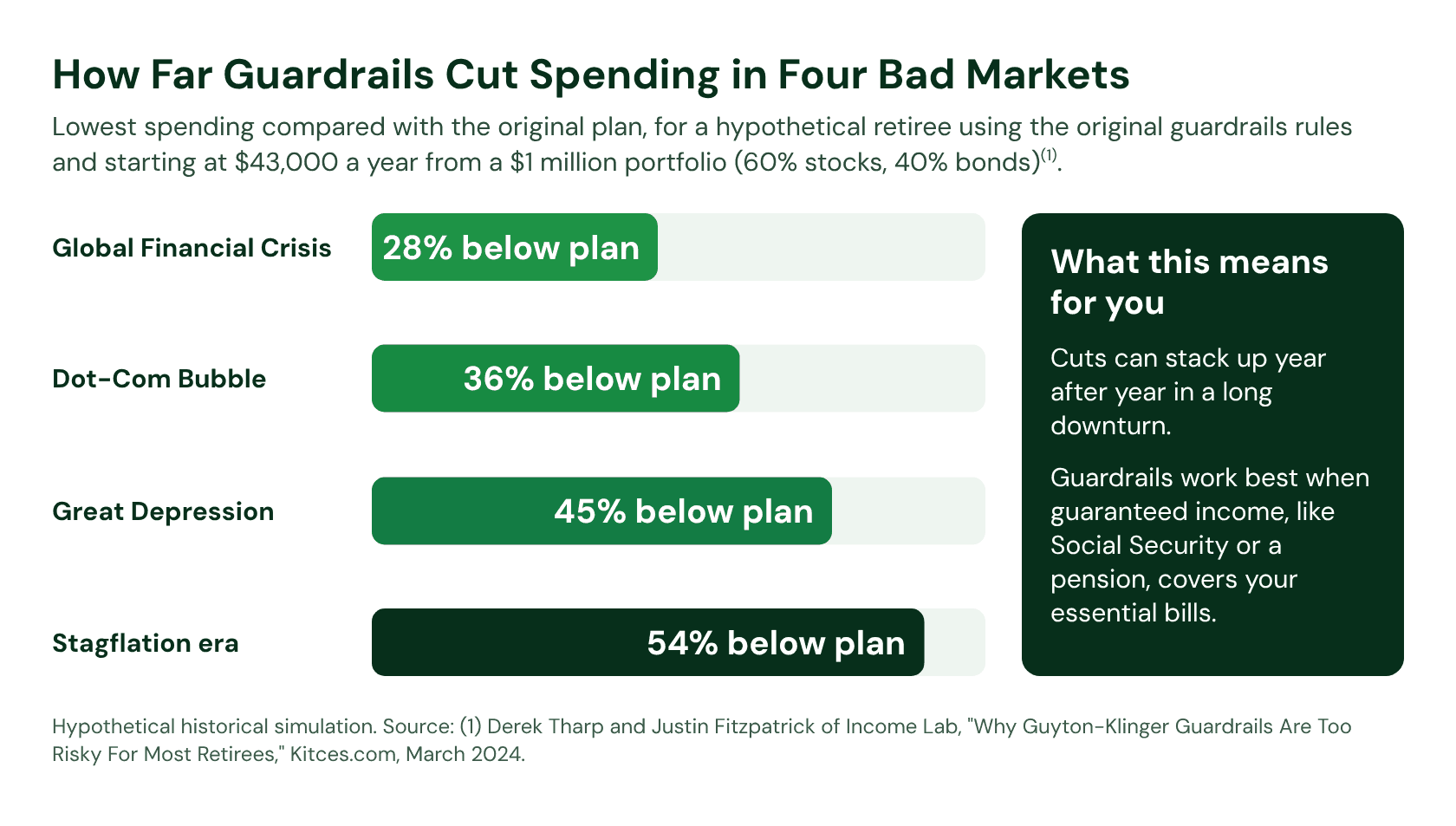
The authors argue that the Guyton-Klinger rules trigger withdrawal and spending cuts when they aren't needed(5).
Both authors work at Income Lab, whose software was used to calculate these examples and which offers its own alternative to the Guyton-Klinger rules, so the findings come from a firm with a financial stake in the comparison(5). Their historical figures still show what the original rules can demand in a bad stretch. A useful test before adopting guardrails is whether your essential bills would still be covered if your portfolio withdrawal fell by a quarter (25%) or more and stayed there for several years.
What do you give up for the higher starting withdrawal?
- The first tradeoff is a less predictable paycheck, because guardrails can change your spending after both very good and very bad years. In Morningstar's testing, the standard deviation of guardrails cash flows (a measure of how widely they swing from year to year) was the second highest of the methods examined, and portfolios with more stock saw larger swings because they triggered raises and cuts more often(4).
- The second is a smaller balance late in life. Because guardrails encourage you to spend more when the portfolio does well, retirees using them will generally have less left after 30 years than they would with a fixed inflation-adjusted plan, which makes the method less suitable if leaving a sizable inheritance is a priority. A retiree who wants to leave an inheritance while still using the system could pass on the raises after good years(4).
- The third is ongoing work. A fixed plan can be set once and left alone, but guardrails require you to recalculate your withdrawal rate every year and act on the result, including in the years when cutting back is the last thing you want to do(4).
How do Social Security and required withdrawals fit in?
Guardrails govern your portfolio withdrawals, not your whole income.
Morningstar's safe withdrawal estimates leave out Social Security and any other income that doesn't come from your portfolio. Its research found that flexible methods such as guardrails work more efficiently when a large, predictable stream of guaranteed income such as Social Security or a pension, already covers part of your spending. Delaying Social Security to get a bigger monthly check is one way to build that guaranteed income, although more lifetime income generally means less left for heirs(3).
Guaranteed income also decides how much a guardrails cut hurts. On a $40,000 portfolio withdrawal, a 10% cut is $4,000 a year, or about $333 a month. If Social Security, a pension, or an annuity already pays your fixed bills, that $333 comes out of extras like travel or gifts to family. If your portfolio is what pays the property taxes and utilities, the same cut comes out of money you need for those bills.
Required minimum distributions (RMDs) add another layer once you reach 73. An RMD is the minimum amount you must withdraw each year from traditional, SEP, and SIMPLE IRAs and workplace retirement plan accounts, and you're allowed to withdraw more than the minimum. Missing it can bring a 25% excise tax on the amount you should have withdrawn, or 10% if you withdraw it within two years. Roth IRAs and designated Roth accounts in 401(k) and 403(b) plans don't require withdrawals while the owner is alive(6).
A guardrail cut can call for spending less than your RMD in a given year. The RMD rule controls what has to leave the tax-deferred account, not what you spend, so you can take the required amount, set aside the tax, and move the remainder into savings or a taxable account.
Who’s best fit for withdrawal guardrails?
Guardrails tend to suit retirees whose essential expenses are largely covered by guaranteed income, who have discretionary spending they could trim for a year or two, and who would rather spend more in the early years of retirement than leave the largest possible estate. For retirees who want more from their portfolios without radical adjustments to their standard of living, Morningstar describes the system as striking a pleasing balance(4).
They're a weaker fit if your portfolio covers most of your fixed bills, if a smaller check in a down year would mean falling behind on obligations, if leaving a set amount to children or charity is a top goal, or if you know you won't revisit your withdrawal every year. A fixed plan at a lower starting rate gives up some income in exchange for predictability, and for some households that trade is the right one.
Common mistakes people make
Skipping the cut when it comes
The higher starting withdrawal is sustainable only because you've agreed to cut back after bad markets. A retiree who takes the larger first-year paycheck but ignores the reduction when the guardrail triggers is running a fixed plan at a starting rate the research considers too high. Morningstar found that retirees who hit poor returns in the first five years of retirement and didn't adjust their spending downward were much more likely to exhaust their savings(3).
Using a starting rate from a portfolio mix different from yours
A published starting rate only fits a portfolio like the one it was tested on, including how much of it is in stocks. In Morningstar's testing over 30 years, guardrails supported a 5.3% start with half the portfolio in stocks and 5.6% with 80% in stocks(4). If you hold fewer stocks than the research assumed and still use its starting rate, you're withdrawing more than your portfolio was tested to support.
Counting on the raises
The prosperity rule adds a raise only when your withdrawal rate falls well below your starting rate, and the inflation increase is skipped after a losing year that pushes your rate above where you began(2). A retiree who budgets for steadily rising withdrawals may instead see several years of flat or reduced spending, so it's safer to plan around the starting amount and treat any raise as a bonus.
Where to go from here
Choosing a starting rate and a set of rules is easier with someone who can test your own accounts, income sources, and spending against both good and bad markets. A fee-only fiduciary advisor can model a guardrails plan alongside a fixed one, so you can see how each would treat your budget through a rough decade before you commit to either.
Nothing on this site constitutes investment advice. All investors are encouraged to conduct their own research before making any investment decision. Past performance is not a guarantee of future results.
Greensprout is an independent, advertising-supported publisher and comparison resource. We may earn compensation when you click on links to products from our partners. This does not affect our editorial standards or recommendations.
All dollar figures in this article are hypothetical illustrations based on the assumptions stated with each example. They are not projections of any investment's performance.
References
1. William P. Bengen. "Determining Withdrawal Rates Using Historical Data." Journal of Financial Planning, October 1994, reprinted by the Financial Planning Association, March 2004. https://www.financialplanningassociation.org/sites/default/files/2021-04/MAR04%20Determining%20Withdrawal%20Rates%20Using%20Historical%20Data.pdf
2. Jonathan T. Guyton and William J. Klinger. "Decision Rules and Maximum Initial Withdrawal Rates." Journal of Financial Planning, March 2006. https://www.financialplanningassociation.org/sites/default/files/2021-11/2006%20-%20Guyton%20and%20Klinger%20-%20Decision%20Rules%20and%20SWR%20(1).PDF
3. Morningstar. "What's a Safe Retirement Withdrawal Rate for 2026?" https://www.morningstar.com/retirement/whats-safe-retirement-withdrawal-rate-2026
4. Morningstar. "Want to Boost Your Retirement Income? 'Guardrails' Could Help." https://www.morningstar.com/retirement/want-boost-your-retirement-income-guardrails-could-help
5. Derek Tharp and Justin Fitzpatrick. "Why Guyton-Klinger Guardrails Are Too Risky For Most Retirees (And How Risk-Based Guardrails Can Help)." Kitces.com, March 27, 2024. https://www.kitces.com/blog/guyton-klinger-guardrails-retirement-income-rules-risk-based/
6. Internal Revenue Service. "Retirement Topics: Required Minimum Distributions (RMDs)." Last reviewed April 8, 2026. https://www.irs.gov/retirement-plans/plan-participant-employee/retirement-topics-required-minimum-distributions-rmds