

Key takeaways
- Balance transfers and consolidation loans depend on qualifying for new credit and work best when the payoff plan fits the promotional period or a loan term no longer than you need.
- A consolidation loan secured by your home turns unsecured card debt into debt that puts your house at risk.
- Early withdrawals from retirement accounts before 59½ generally carry a 10% additional tax plus income tax, with an exception for workplace plans after separating from service at 55 or later.
- Debt management plans keep payments on schedule and usually don't affect your taxes, but they run for years and may restrict new credit.
- Debt settlement involves falling behind on payments, leaves negative marks for seven years, and can create taxable income, with retirement accounts counted when the IRS measures insolvency.
Carrying a balance in your fifties or sixties feels different than it did at 35. Maybe a stretch of medical bills landed on a credit card, a layoff came a few years before you planned to stop working, or you helped an adult child through a hard year and the balance never came back down. Maybe nothing went wrong at all, and you simply want to walk into retirement without a monthly card payment following you there.
Whatever brought you here, the options for getting out from under that debt come with consequences that look different at this stage of life. A move that would be a minor setback at 35 can affect the mortgage refinance you're planning, the retirement savings you can't rebuild, or the home that may be your largest asset. The same choice can also change your tax bill in a year when you're living on a fixed income.
This guide walks through the main paths people use to pay down or resolve unsecured debt, which includes balance transfer cards, debt consolidation loans, credit counseling with a debt management plan, and debt settlement. It explains how each one works, what it does to your credit, and the after-50 situations where each one tends to come up, so you can match the options to your own circumstances. It draws heavily on consumer guidance from two federal agencies, the Consumer Financial Protection Bureau (CFPB) and the Federal Trade Commission (FTC).
Why does getting out of debt look different after 50?
The mechanics of a balance transfer or a settlement don't change when you turn 50. What changes is the rest of your financial picture, and several pieces of it come into play at this age in ways they usually don't earlier.
The first is the money sitting in your retirement accounts. By your fifties, a 401(k) or IRA balance may be the largest pool of cash you can reach, and pulling from it to clear a card balance carries tax costs that a younger borrower might not face in the same way. Those costs are covered in detail below, along with the exceptions that apply after age 55.
The second is your home. Many people over 50 have substantial equity in their homes, and a second mortgage or home equity line of credit can look like an inexpensive way to wipe out high-interest cards. The FTC points out that some consolidation loans require your home as collateral, and if you can't make the payments, or make them late, you could lose your home(1). When you use your home to pay off credit cards, a drop in income later puts your house at risk instead of just your credit.
The third is your income itself. If you're already drawing Social Security or expect to soon, a debt collector has to sue you and win before it can touch those benefits, and even then your bank must protect two months of direct-deposited payments(9). That tells you how much of your income would be exposed if you chose an option that involves falling behind on payments, such as debt settlement.
The fourth is your credit timeline. If you plan to refinance, downsize, or buy a smaller home in the next few years, the credit damage from some debt strategies will still be on your report when you apply. Negative items such as collections, charge-offs, and late payments stay on a credit report for seven years from the last activity or first delinquency date(3). For someone who is 58, that can run past a planned downsizing at 62 or 63.
None of this means one option is right and another is wrong. It means the questions you ask when considering your options should include your retirement accounts, your home, your income sources, and your plans for borrowing in the next several years, along with the interest rate on the debt itself.
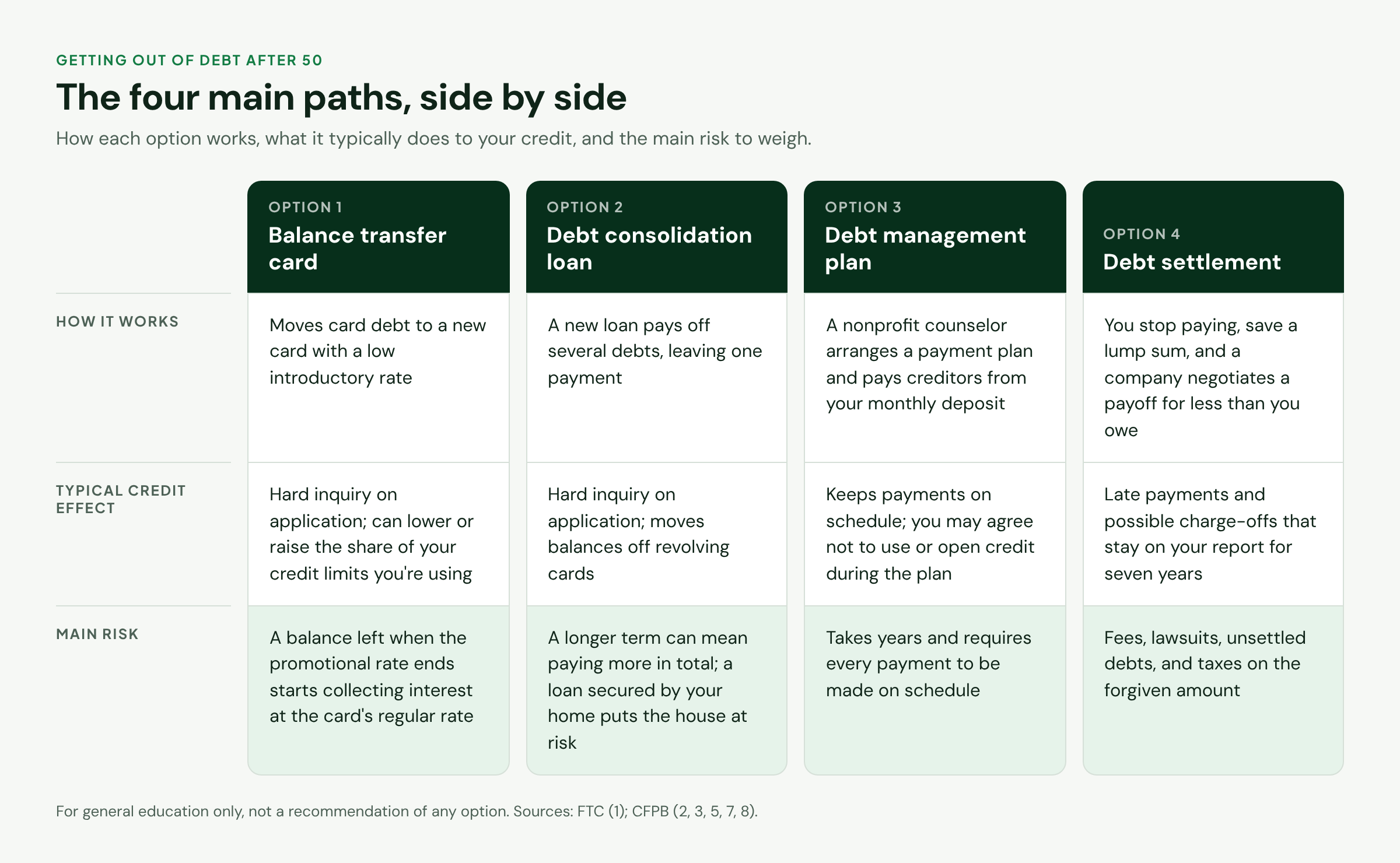
How does a balance transfer work, and what does it do to your credit?
A balance transfer moves debt from one or more cards to a new card, usually one offering a low or 0% introductory rate on the transferred amount. That introductory rate has to stay in effect for at least six months, unless you fall more than 60 days behind on a payment, and the issuer must tell you how long the rate introductory lasts and what rate applies afterward(5).
A 0% offer can still cost you money. The card issuer is allowed to charge a balance transfer fee on it(4). And on many cards, if you carry a balance from month to month, new purchases start collecting interest the day you make them, even while the transferred balance sits at 0%(6).
Here's a hypothetical example. Say you transfer $15,000 to a card with an 18-month 0% period and a 3% transfer fee. The fee adds $450, bringing the balance to $15,450. Paying that off before the promotion ends takes about $858 a month. If $858 doesn't fit your budget, whatever remains when the promotion ends starts collecting interest at the card's regular rate.
What happens to your credit score?
Applying for a new card triggers a hard inquiry, which is a lender's review of your credit report after you apply for credit. Hard inquiries affect your score because many scoring models look at how recently and how often you apply for credit(7). Applying for several cards in a short period can make it appear to lenders that you're dealing with financial setbacks(8).
The transfer can also change how much of your available credit you're using, which credit scoring models look at. The CFPB notes that many experts recommend using less than 30% of your total credit limit, and that people with the highest scores often use less than 10%8).
A new card raises your total credit limit, which lowers the share you're using. Closing your old cards after the transfer lowers your total limit, which raises the share you're using on the same balance. In a hypothetical case, a $15,000 balance against $40,000 in total limits uses 37.5% of your available credit. Close an old card with a $20,000 limit, and the same balance now uses 75%. Your older cards also make up part of your credit history, and a long credit history helps your score(8).
When does a balance transfer tend to fit after 50?
Balance transfers tend to fit when your credit is still strong, the debt is a size you can realistically clear within the promotional period, and you can commit to a fixed monthly amount without adding new charges. A large card balance that would take five years to pay off usually doesn't fit an 18-month window, even at 0%.
How does a debt consolidation loan work, and when does it cost more than your current debts?
A debt consolidation loan is money you borrow to pay off several debts, leaving you with one loan and one payment. Banks, credit unions, and other lenders offer them, and the new loan may carry a lower interest rate than the debts it replaces(3).
The CFPB flags several catches. A low rate may be a teaser rate that applies only for a limited time, after which your payment could rise. A lower monthly payment may simply reflect a longer repayment period. And once you add up the loan's length, fees, and costs, you might pay more in total than you would have on your original debts(3).
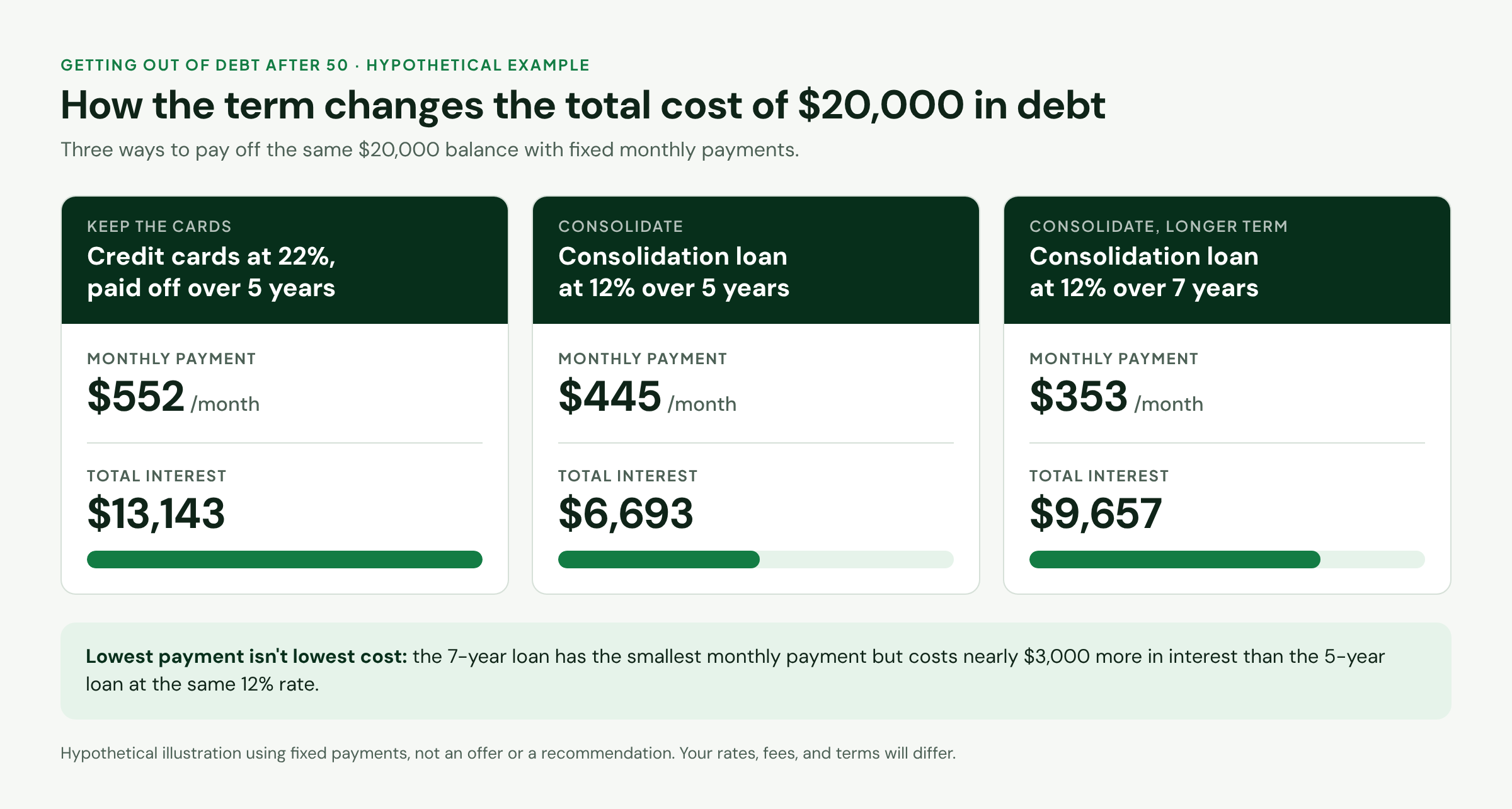
In this example, the seven-year loan has the lowest payment, but it costs nearly $3,000 more in interest than the five-year loan at the same rate. Before you sign, compare the total cost, which includes the interest and any fees over the loan's full life.
What changes when the loan is secured by your home?
Consolidation can also be done through a second mortgage or a home equity line of credit. Because your home is the collateral, falling behind on the loan puts your house at risk, and these loans can carry costs called points, with one point equal to 1% of the amount you borrow(1). For someone counting on home equity to fund retirement, a downsize, or long-term care, turning unsecured card debt into debt secured by the house shifts what you stand to lose if your income changes later.
What happens to your credit score?
The application brings a hard inquiry(7). Once the loan pays off your cards, those card balances drop relative to their limits, and how much of your credit limit you're using is one of the factors scoring models look at. This is called credit utilization. Making every loan payment on time also builds on the factor most scores treat as the most important, which is your repayment history(8).
When does a consolidation loan tend to fit after 50?
A consolidation loan tends to fit when you can qualify for a rate well below what you're paying now, at a term no longer than you'd need otherwise, and when the steady payment fits the income you expect to have over the life of the loan, including after you stop working.
Should you tap your 401(k) or IRA to pay off debt?
By your fifties, a retirement account can look like the simplest way to make credit card debt disappear. The tax rules make it more expensive than it first appears, and this is one of the decisions that's specific to borrowers in this age range.
What does an early withdrawal cost?
Distributions from a 401(k) or IRA before age 59½ generally carry a 10% additional tax on the taxable portion, on top of regular income tax(12, 13). In a hypothetical case, withdrawing $20,000 at age 56 to clear a card balance would add $2,000 in additional tax before counting the income tax on the full $20,000.
There are exceptions. For workplace plans such as a 401(k), the 10% additional tax doesn't apply to distributions made after you separate from service with your employer after reaching age 55(12). That exception covers the employer plan, not an IRA, and the withdrawal is still subject to income tax.
What about borrowing from your 401(k) instead?
Some workplace plans allow loans, though plans aren't required to offer them, and IRAs can't offer participant loans at all. The most you can borrow is generally 50% of your vested balance or $50,000, whichever is less, and you usually have to repay the loan within five years with payments at least every quarter(13).
The risk for people in their fifties is what happens if your job ends. Your employer can require you to repay the full balance when you leave, and if you can't, the unpaid amount is treated as a distribution and reported to the IRS. If you're under 59½ and no exception applies, that can trigger the same taxes as an early withdrawal. Rolling the outstanding amount into an IRA or another eligible plan by your tax filing deadline for that year can avoid the immediate income tax(13).
How do credit counseling and debt management plans work?
Credit counseling organizations are usually nonprofits that advise you on managing your money and debts, and they typically offer free educational materials and workshops. An initial session generally lasts about an hour(3).
If your situation calls for it, a counselor may set up a debt management plan. You make one monthly payment to the counseling organization, and it pays your creditors on a schedule worked out in advance.
Your creditors may agree to lower your interest rates or waive certain fees(1).
A debt management plan usually doesn't reduce the amount you owe. Instead, it works to lower your overall monthly payment, sometimes by extending your repayment time or getting creditors to lower your rates, and the arrangement usually doesn't affect your taxes(3).
These plans cover unsecured debts such as credit cards, medical bills, and student loans, not debts secured by a house or car. A successful plan requires regular, on-time payments and can take 48 months or more to finish, and you may have to agree not to apply for or use any more credit until it's done(1).
What can go wrong with a debt management plan?
A debt management plan only works if the organization running it does its job and you keep up every payment for years. The CFPB notes that the FTC has found some organizations offering debt management plans have defrauded people(15). These are the risks to weigh:
- The organization may not pay your creditors. You send your payment to the counseling organization, not to your creditors, so you're relying on it to pass the money along on time. The CFPB advises confirming with your creditors that they've accepted the proposed plan before you send the organization any payment(15). After you enroll, the FTC suggests calling each creditor at the start of every month and checking your statements to make sure the agency paid them on time(14).
- Fees you may not be told about. Nonprofit status doesn't make a plan free. Some credit counseling organizations charge high fees and may not disclose them(1), and some push "voluntary" contributions that can add to your debt(14).
- Late fees while you wait to enroll. If you stop paying your creditors before they've accepted you into a plan, you'll face late fees, penalties, and negative entries on your credit report(14).
- The plan doesn't erase what's already on your report. Late payments and delinquencies from before you enrolled stay on your credit report(14).
- It only works if you finish. A plan can take 48 months or more and requires regular, on-time payments the whole way through, and it doesn't help everyone(1).
What happens to your credit score?
A legitimate credit counselor never advises you to stop paying your debts(3), so a debt management plan is structured around continuing on time payments, the factor most credit scores weigh first(8). The plan's own requirement can affect your plans, though. If you may need a car loan or a mortgage refinance during the next four years, ask the counselor how the plan's credit restrictions would apply before you enroll.
How do you tell a good counselor from a bad one?
The FTC suggests looking for an organization that doesn't charge you before helping, uses counselors accredited or certified by an outside organization, gives you a written quote for any fees, and offers budget counseling and free educational materials. If a counselor says a debt management plan is your only option before reviewing your finances in detail, the FTC advises finding a different counselor(1).
When does a debt management plan tend to fit after 50?
A debt management plan tends to fit when you can afford to repay what you owe if the interest rates come down, you want a fixed end date, and you don't expect to need new credit during the years the plan runs.
How does debt settlement work, and what does it cost you?
Debt settlement companies, sometimes called debt relief companies, offer to negotiate with your creditors so you can pay a lump sum that's less than what you owe. While that happens, you set aside money each month in a dedicated account until there's enough to make a settlement offer, and these programs often encourage you to stop paying your creditors in the meantime(1).
What does settlement do to your credit?
This is where settlement differs most from the other options. When you stop paying, late fees, penalty interest, and other charges usually pile up, and creditors tend to step up their collection efforts(2). Not paying while you save toward a settlement can lower your credit scores and lead creditors or collectors to file lawsuits against you(3). If you miss minimum payments for four to six months, your creditor may charge off the debt as a loss, which can damage your score further, and you still owe the debt even after that happens(1).
Those late payments and charge-offs remain on your credit report for seven years from the last activity or first delinquency date(3). Even a settlement you negotiate yourself, without a company, can hurt your credit report and score if it involves late payments or paying less than you owe(1). The CFPB warns plainly that debt settlement may leave you deeper in debt than when you started(2).
What other risks come with settlement?
- Creditors don't have to agree. Your creditors have no obligation to negotiate, many lenders don't work with debt settlement companies, and many apply standard policies rather than negotiating your individual situation(1,3).
- You may not finish. Many people can't keep up the monthly deposits long enough and drop out, leaving them with fees already paid, unsettled debts, and late payments on their credit report(1).
- Lawsuits can still happen. You can be sued while waiting for a settlement, and a creditor that wins may be able to garnish your wages or put a lien on your home(1).
- Unsettled debts keep growing. Unless most of your debts settle, the penalties and fees on the rest may wipe out any savings on the ones that do(2).
What fees can a settlement company legally charge?
A debt settlement company could be breaking the law if it charges you a fee before three things happen. It must have settled or changed the terms of at least one of your debts, you must have agreed to that result, and you must have made at least one payment to the creditor under the new agreement. Money you save in the dedicated account still belongs to you, the account must be run by an independent third party, and you can withdraw your funds at any time without penalty(3).
The FTC adds that only scammers guarantee to settle all your debts, promise results from a "government" debt relief program, or say they can stop all collection lawsuits(1).
Will you owe taxes on the forgiven amount?
Possibly. When a debt is forgiven for less than the amount owed, the canceled portion is generally taxable, and you must report it on your tax return for the year it was canceled(10). A bank, credit union, or other lender that cancels $600 or more must file Form 1099-C and send you a copy, but you're required to report taxable canceled debt whether or not you receive the form(11).
Here's how that looks in a hypothetical case. A $20,000 card balance settles for $9,000. The remaining $11,000 is canceled debt, and in a hypothetical 12% tax bracket, it would add $1,320 to your federal tax bill unless an exclusion applies.
Outside of bankruptcy, the main way to exclude canceled credit card debt from income is insolvency. You're insolvent to the extent that your total liabilities are more than the fair market value of everything you own immediately before the cancellation, and you can exclude canceled debt only up to that amount(11).
When the IRS measures insolvency, it counts your retirement accounts and your interest in a pension plan as assets, even though creditors generally can't reach them(11). Someone in their fifties with a sizable 401(k) may not be insolvent on paper, even while struggling to pay their bills each month. Go back to the hypothetical $20,000 card balance that settled for $9,000, leaving $11,000 of canceled debt. If that borrower had $30,000 in total debts and $22,000 in assets right before the settlement, they'd be insolvent by $8,000, so they could exclude $8,000 of the canceled amount and owe tax on the remaining $3,000. Add a $100,000 401(k) to the same borrower's assets, and they're no longer insolvent, so the full $11,000 may be taxable.
When does settlement tend to come up after 50?
Settlement tends to come up when you're already far behind, can't repay the full balance even at lower interest rates, and can absorb years of credit damage along with a possible tax bill. A nonprofit credit counselor or a bankruptcy attorney can lay out the alternatives before you sign a settlement contract(2).
What protections apply if you fall behind while on Social Security?
If you receive Social Security, the rules around collections work differently than they do for wages. Before a debt collector can take Social Security or VA benefits, it must sue you and win a judgment, then get a court order directing your bank to turn over money from your account(9).
When your bank receives that order, it must check whether you received federal benefits by direct deposit during the previous two months, and two months' worth of those benefits stays protected and available to you. In a hypothetical case, if you receive $1,800 a month in Social Security by direct deposit, your bank must leave you access to $3,600. Money above that amount can be frozen or garnished, unless another federal or state exemption covers it and you go to court to have it released(9).
Two details stand out. The automatic protection depends on direct deposit, so benefits received by check and then deposited don't get it, and your entire balance could be frozen until you prove in court where the money came from. And the protections don't cover every kind of debt. Social Security can sometimes be garnished to pay money you owe the government, such as back taxes or federal student loans, or for child or spousal support(9).
Which option fits where you are now?
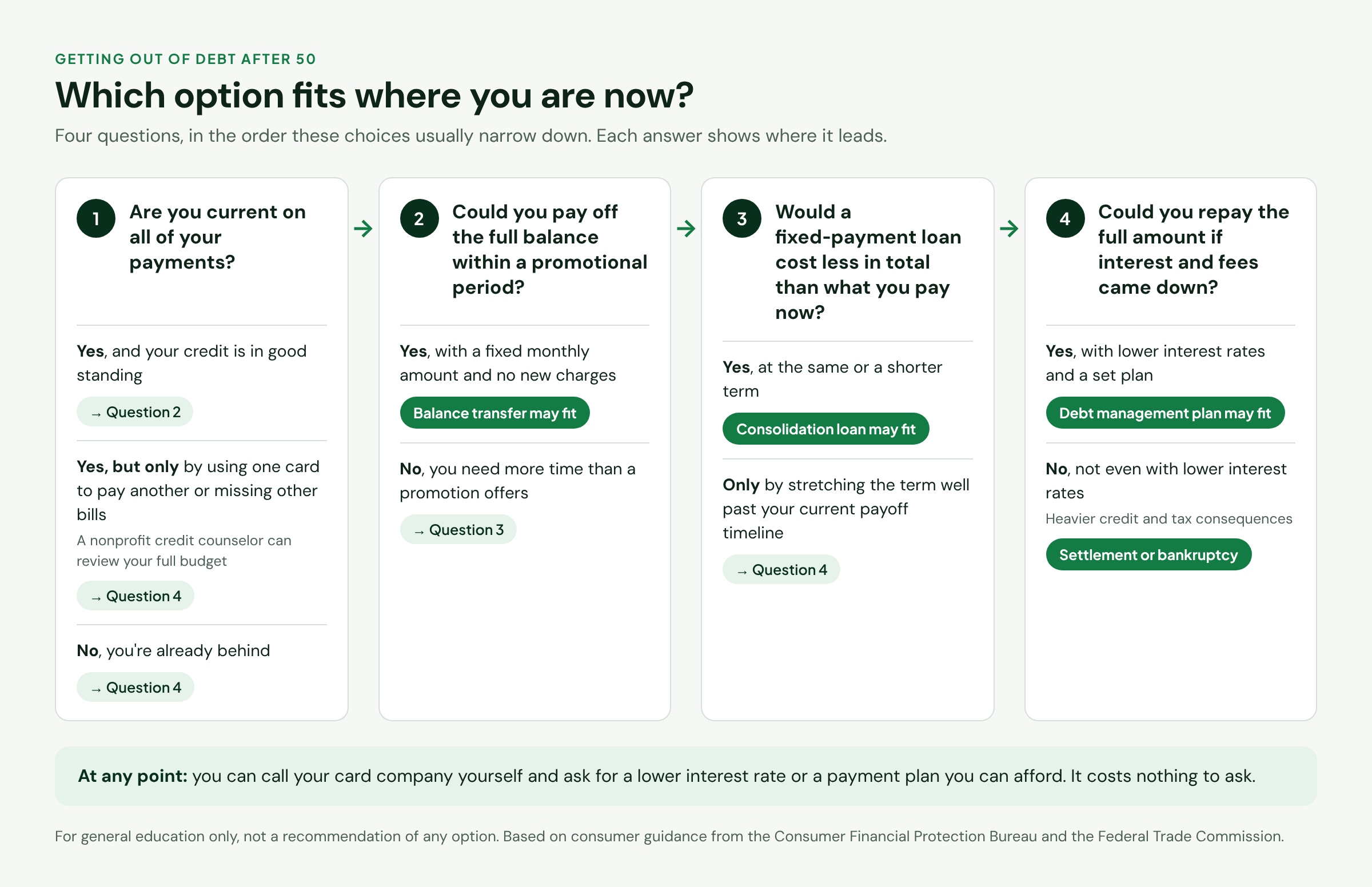
The questions below follow the order in which these choices usually narrow down. Each answer points to the situations where an option tends to come up, based on everything covered above.
Question 1. Are you current on all of your payments?
- Yes, and your credit is in good standing. Balance transfers and consolidation loans, which depend on qualifying for new credit, are generally open to you. Go to Question 2.
- You're current, but only by using one card to pay another or by missing other bills. A nonprofit credit counselor can help here, since a good counselor reviews your finances before suggesting a plan(1). Go to Question 4.
- No, you're already behind. Most credit scores treat repayment history as the number one factor(8). Go to Question 4.
Question 2. Could you pay off the full balance within a promotional period?
- Yes, with a fixed monthly amount and no new charges. This is the situation balance transfers are designed for.
- No, you need more time than a promotion offers. Go to Question 3.
Question 3. Would a fixed-payment loan cost less in total than what you pay now?
- Yes, at the same or a shorter term. A consolidation loan may fit, keeping in mind the added risk if the loan is secured by your home.
- Only by stretching the term well past your current payoff timeline. As the hypothetical consolidation table shows, the lower payment may cost more overall. Go to Question 4.
Question 4. Could you repay the full amount if interest and fees came down?
- Yes, with lower interest rates and a set plan. This is the situation a debt management plan through a nonprofit credit counselor is designed for.
- No, not even with lower interest rates. Debt settlement and bankruptcy are the remaining paths, and both carry the heavier credit and tax consequences covered above. A nonprofit credit counselor and a bankruptcy attorney can each explain the options open to you, and some bankruptcy attorneys offer a free initial consultation(2).
Whichever situation fits yours, you can also call your card company directly. It may be willing to lower your interest rate or set up a payment plan you can afford, and you don't need to pay anyone to make that call for you(1).
What do people over 50 commonly get wrong about getting out of debt?
Assuming old debt can't come back
Collectors have a limited time to sue over a debt, called the statute of limitations, and once it runs out the debt is considered time-barred. In some states, though, making a payment or acknowledging the debt in writing restarts that clock(1). If you're weighing a settlement on an account that's been in collections for years, it's worth finding out where it stands under your state's law before making any payment.
Treating the lowest monthly payment as the best deal
A smaller payment is easier on a fixed budget, but the CFPB notes that a lower payment on a consolidation loan may come from stretching the repayment period, and that you could pay more overall(3). In the hypothetical table above, the lowest payment carried a higher total cost than the five-year option at the same interest rate.
Overlooking taxes and credit timing until after the decision
A settlement can produce a tax bill the following spring, and the insolvency exclusion counts your retirement accounts as assets(11). The credit damage from late payments lasts seven years(3). Both are easier to plan around before you sign than after, particularly if you expect to refinance, downsize, or apply for a new mortgage within that window.
Compare your options before you commit
You've spent decades building a credit history, a retirement balance, and equity in your home. The path you choose now decides how much of each you carry into the years ahead, so it's worth seeing the full terms of every option side by side before you sign anything.
References
1. Federal Trade Commission. "How To Get Out of Debt," December 2025. https://www.bulkorder.ftc.gov/sites/bulkorder.ftc.gov/files/publications/964a_how-to-out-of-debt-dec2025-508.pdf
2. Consumer Financial Protection Bureau. "What is a debt relief program and how do I know if I should use one?" https://www.consumerfinance.gov/ask-cfpb/what-is-a-debt-relief-program-and-how-do-i-know-if-i-should-use-one-en-1457/
3. Consumer Financial Protection Bureau. "What is the difference between credit counseling and debt settlement, debt consolidation, or credit repair?" https://www.consumerfinance.gov/ask-cfpb/what-is-the-difference-between-credit-counseling-and-debt-settlement-debt-consolidation-or-credit-repair-en-1449/
4. Consumer Financial Protection Bureau. "What is a balance transfer fee? Can a balance transfer fee be charged on a zero percent interest rate offer?" https://www.consumerfinance.gov/ask-cfpb/what-is-a-balance-transfer-fee-can-a-balance-transfer-fee-be-charged-on-a-zero-percent-interest-rate-offer-en-53/
5. Consumer Financial Protection Bureau. "How long can I keep a low rate on a balance transfer or other introductory rate?" https://www.consumerfinance.gov/ask-cfpb/how-long-can-i-keep-a-low-rate-on-a-balance-transfer-or-other-introductory-rate-en-15/
6. Consumer Financial Protection Bureau. "Do I pay interest on new purchases after I get a zero or low rate balance transfer?" https://www.consumerfinance.gov/ask-cfpb/do-i-pay-interest-on-new-purchases-after-i-get-a-zero-or-low-rate-balance-transfer-en-49/
7. Consumer Financial Protection Bureau. "What is a credit inquiry?" https://www.consumerfinance.gov/ask-cfpb/what-is-a-credit-inquiry-en-1317/
8. Consumer Financial Protection Bureau. "How do I get and keep a good credit score?" https://www.consumerfinance.gov/ask-cfpb/how-do-i-get-and-keep-a-good-credit-score-en-318/
9. Consumer Financial Protection Bureau. "Can a debt collector take my federal benefits, like Social Security or VA payments?" https://www.consumerfinance.gov/ask-cfpb/can-a-debt-collector-take-my-social-security-or-va-benefits-en-1157/
10. Internal Revenue Service. "Topic no. 431, Canceled debt – Is it taxable or not?" https://www.irs.gov/taxtopics/tc431
11. Internal Revenue Service. Publication 4681, "Canceled Debts, Foreclosures, Repossessions, and Abandonments (for Individuals)," for use in preparing 2025 returns. https://www.irs.gov/pub/irs-pdf/p4681.pdf
12. Internal Revenue Service. "Topic no. 558, Additional tax on early distributions from retirement plans other than IRAs." https://www.irs.gov/taxtopics/tc558
13. Internal Revenue Service. "Retirement Topics – Loans." https://www.irs.gov/retirement-plans/plan-participant-employee/retirement-topics-loans
14. Federal Trade Commission. "Fiscal Fitness: Choosing a Credit Counselor," November 2012. https://www.bulkorder.ftc.gov/system/files/publications/pdf-0040-fiscal-fitness-choosing-a-credit-counselor.pdf
15. Consumer Financial Protection Bureau. "What is credit counseling?" https://www.consumerfinance.gov/ask-cfpb/what-is-credit-counseling-en-1451/
All sources were verified against their live pages on November 1, 2026, and references 14 and 15 on November 2, 2026. Examples labeled hypothetical, including interest rates, fees, tax brackets, and benefit amounts, are illustrations only. Statute of limitations rules vary by state. This article should be reviewed when the IRS updates Publication 4681 for 2026 returns.
General information: This article is for general educational purposes only and isn't legal, tax, credit counseling, or financial advice. Debt relief, credit reporting, collection, garnishment, and tax rules depend on your state of residence, the terms of your accounts, and your personal financial situation, and they can change. Nothing here is a recommendation to use any particular debt relief option, lender, or company. Before enrolling in a debt relief program, borrowing against your home or retirement account, or settling a debt, consider speaking with a nonprofit credit counselor, a tax professional, and, where appropriate, a consumer or bankruptcy attorney.
Credit disclaimer: Credit scores and creditworthiness are assessed individually by each lender. Information presented here does not guarantee approval for any financial product.
Investment disclaimer: Nothing on this site constitutes investment advice. All investors are encouraged to conduct their own research before making any investment decision. Past performance is not a guarantee of future results.
Editorial independence: Greensprout's editorial team writes on behalf of the reader. Our goal is to provide clear, useful information to help you make better financial decisions. Our editorial content is not influenced by advertiser relationships.
Affiliate disclosure: Greensprout is an independent, advertising-supported publisher and comparison resource. We may earn compensation when you click on links to products from our partners. This does not affect our editorial standards or recommendations.