

Key takeaways
- Translate your fee into dollars each year and compare it with the deductions on your custodian statements.
- Published surveys put typical AUM fees at about 1% to 1.2% for portfolios under $1 million and lower for larger accounts, with Cerulli projecting about 0.66% above $10 million.
- On average, about 41% of an AUM fee is attributed to planning and other services, so a bundled fee should come with planning you can identify.
- Investment advisers owe a fiduciary duty of care and loyalty, deliver disclosure documents on a schedule, and keep your assets with a qualified custodian.
- If your advisor isn't meeting those responsibilities, ask for an itemized list of services, negotiate, or move to someone who will.
Every quarter, a line on your account statement shows how much you pay the person who manages it. After five or ten years, that payment can start to feel like a subscription you signed up for once and never revisited. You may genuinely like your advisor, and the balance may have grown, yet neither of those facts tells you whether the fee is paying for work done on your behalf.
That question is harder to answer than it should be, because good advice is mostly invisible. You can see your balance, but you can't see the years of experience, the research behind a recommendation, the conflict an advisor chose to avoid, or the tax decision that saved you money, unless you know what to look for and where it's written down.
Advisers who charge a fee are held to specific legal duties, they have to put their fees and conflicts of interest in writing. Published industry surveys show roughly what other advisors charge for similar accounts.
This guide, a companion to our article on how to find and vet a financial advisor, walks through what you're paying, how that compares with survey benchmarks, every major responsibility your advisor is accountable for, and the checks that show whether those responsibilities are being met.
How much are you paying each year?
Advisory fees are usually quoted as a percentage, which makes them easy to underestimate. A registered investment adviser has to describe in its brochure (Part 2A of Form ADV, the disclosure document advisers file with regulators and give to clients) how it's paid, provide a fee schedule, and say whether its fees are negotiable. It also has to disclose whether it bills you or deducts the fee directly from your account, how often it charges, and what other costs you may pay on top, such as brokerage, custody fees, and fund expenses(1).
If your adviser takes its fee straight from your account, you have an independent record to check it against. Under the Securities and Exchange Commission's (SEC's) custody rule, an adviser with access to client money generally must keep it with a qualified custodian, such as a bank or registered broker-dealer, and must have a reasonable basis for believing that custodian sends you a statement at least quarterly listing every transaction in the account(2). The SEC has explained that clients can compare those custodian statements with what they receive from their adviser to determine whether transactions, including deductions to pay advisory fees, are proper(3).
What a fee costs over time: On a hypothetical $100,000 investment growing 4% a year for 20 years, a 0.25% annual fee leaves approximately $208,000, a 0.50% fee leaves approximately $198,000, and a 1.00% fee leaves approximately $179,000(4).
As a hypothetical example, a 1% annual fee on a $1,000,000 portfolio comes to $10,000 in the first year, and the same fee on $500,000 comes to $5,000, before any fund expenses or trading costs.
What do advisors typically charge, according to published surveys?
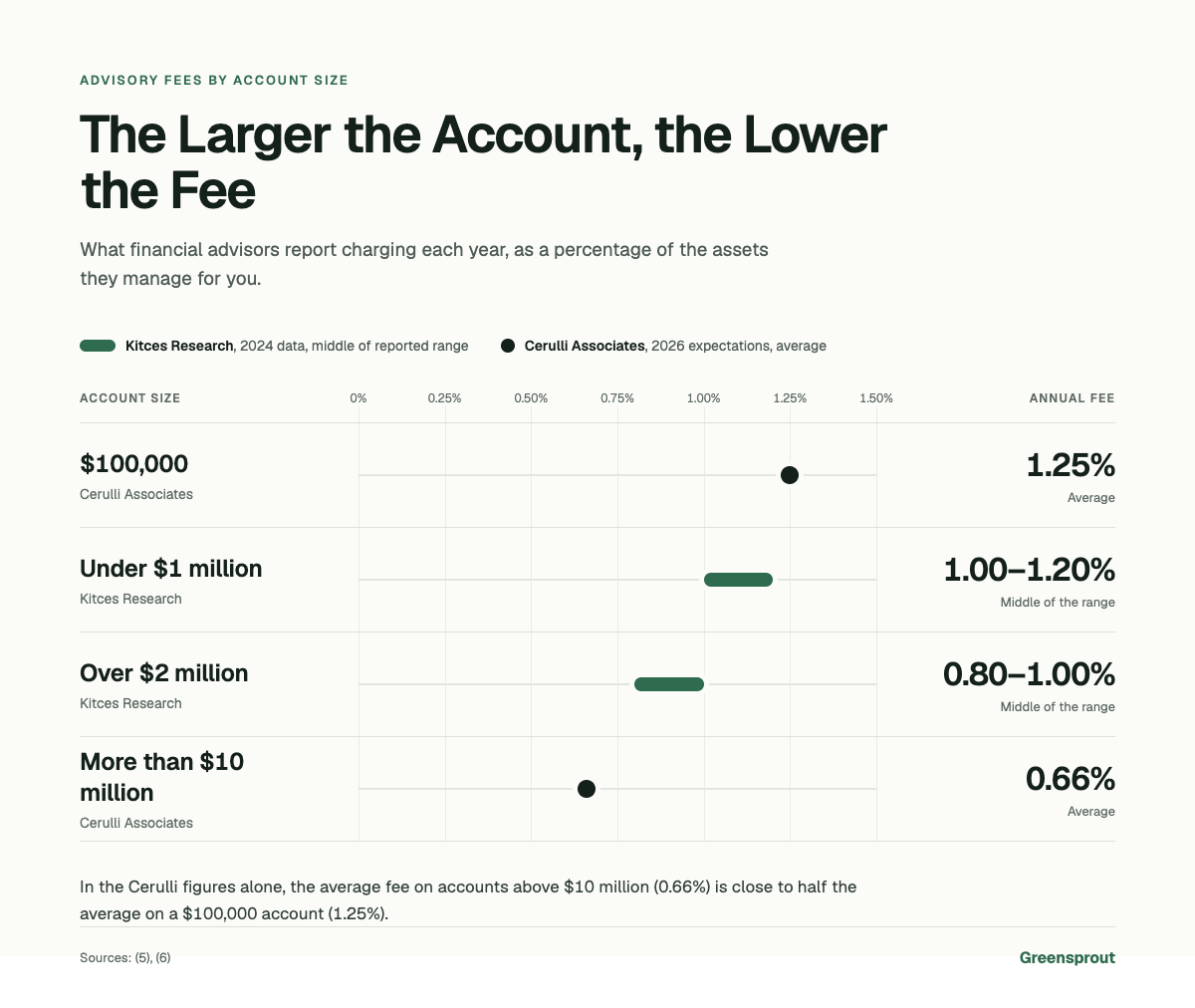
The closest thing to a market price for advice comes from surveys of advisors themselves. The two below are recent and published, and both show the same pattern, which is that the percentage you pay falls as your account grows. Because they rely on what advisors report, they work best as a reference range rather than a verdict on any single fee.
Kitces Research, an industry research group that studies how financial planners work, found in its 2024 research that 86% of advisory firms rely on an asset-based fee as their primary way of charging. That fee is a percentage of assets under management (AUM), meaning the money the advisor oversees for you. Among advisors in the middle of the range (between the 25th and 75th percentiles), fees averaged 100 to 120 basis points for portfolios under $1 million and 80 to 100 basis points once portfolios grew past $2 million(5). A basis point is one hundredth of a percentage point, so 100 basis points equals 1%.
Cerulli Associates, a research firm that surveys financial advisors, published its own figures in April 2025. It projected average fees for 2026 of about 125 basis points for clients with $100,000 in investable assets and about 66 basis points for clients with more than $10 million, and 83% of advisors expected to charge less than 1% for clients with more than $5 million(6).
The same Kitces research shows what a typical fee is supposed to cover. On average, advisors attribute 59% of their AUM fee to investment management and 41% to financial planning and other services, and advisors who bundle planning into the fee attribute 46% to planning, compared with 27% for those who don't(5). Applied to the hypothetical $1,000,000 portfolio paying $10,000 a year, the average split would put roughly $4,100 toward planning, so it's fair to ask what that share is paying for in your case.
A fee inside these ranges isn't automatically fair, and a fee outside them isn't automatically excessive. Whether the price is reasonable depends on what you receive for it, which is where your advisor's legal responsibilities come in.
What is your advisor legally responsible for?
"Financial advisor" is a general title, so the duties you're owed depend on what kind of professional you've hired. Because this guide is about ongoing fees, it focuses on investment advisers and covers brokers at the end of this section.
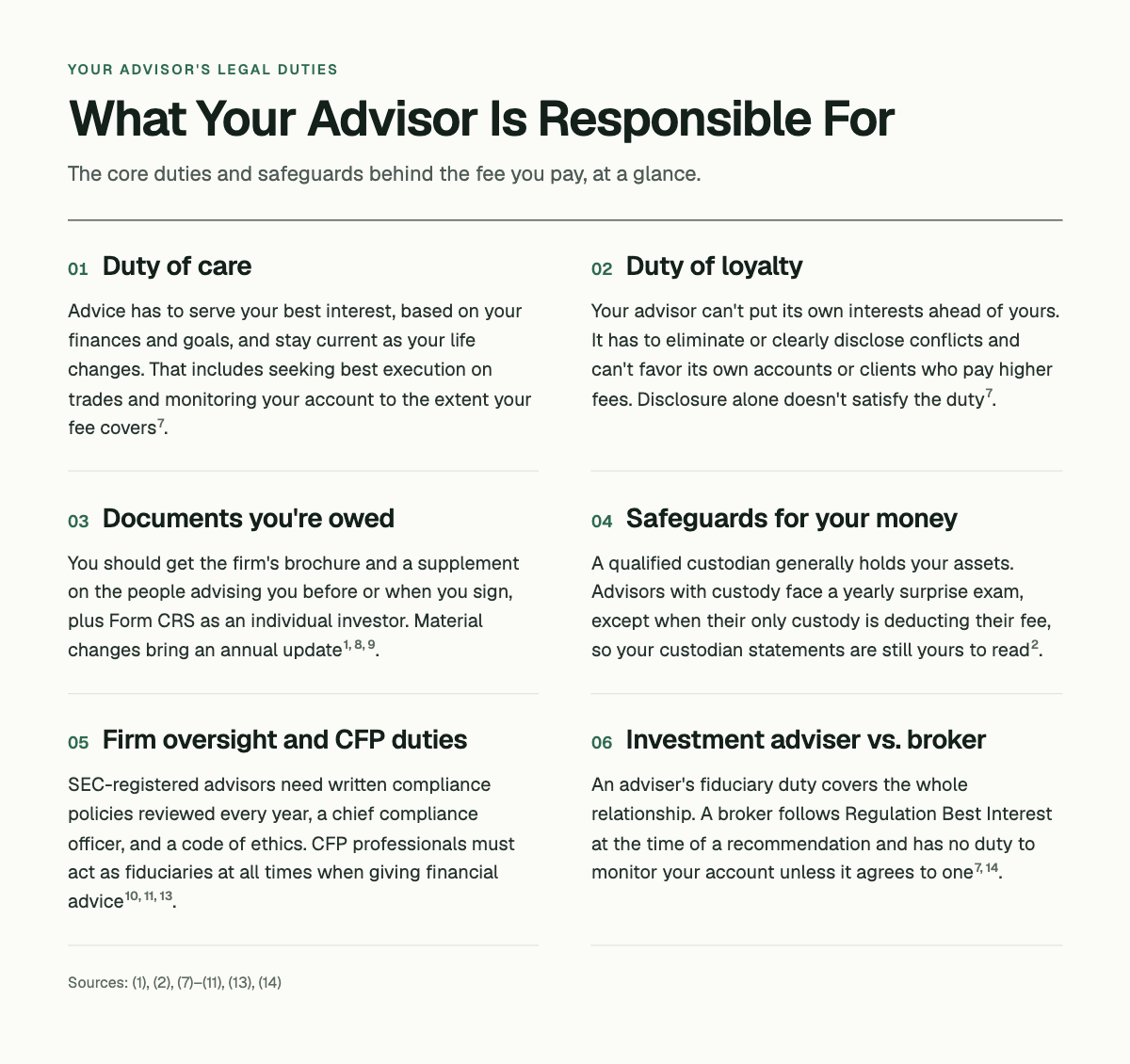
Under federal law, an investment adviser is a fiduciary, and that duty is made up of a duty of care and a duty of loyalty. It applies to the entire relationship and can't be waived, though its specific obligations follow the scope of services you've agreed to(7).
What does the duty of care require?
The SEC describes the duty of care as including three obligations, which are to give advice in your best interest, to seek best execution of your trades when the adviser picks the brokers who carry them out, and to provide advice and monitoring over the course of the relationship(7).
Best-interest advice starts with knowing you. An adviser to an individual should, at a minimum, make a reasonable inquiry into your financial situation, financial sophistication, investment experience, and goals, and an adviser building a comprehensive plan would generally need details such as your income, investments, assets and debts, marital status, tax status, and insurance. That picture generally has to be kept current, and the SEC gives a change in tax law, your retirement, or a change in marital status as examples of events that could require a fresh look. The duty also covers advice about which type of account to use and whether to roll money from a workplace retirement plan into an account the adviser manages(7).
Cost is part of that judgment but doesn't settle it. A fiduciary isn't required to recommend the lowest-cost option, but it can recommend a higher-cost investment only if it reasonably concludes that other factors outweigh the cost for you. The adviser also has to investigate an investment well enough that its advice isn't based on materially inaccurate or incomplete information(7).
Best execution means seeking the most favorable total cost or proceeds on each trade under the circumstances, which involves more than the lowest commission, and evaluating periodically and systematically the execution clients receive. Monitoring scales with what you pay for. When an adviser has an ongoing relationship and charges a periodic asset-based fee, its duty to advise and monitor is relatively extensive, while an adviser paid once for a one-time plan is unlikely to have any duty to keep watching. The agreed frequency of monitoring is itself a material fact the adviser must disclose(7).
What does the duty of loyalty require?
The duty of loyalty means an adviser can't place its own interests ahead of yours. It must make full and fair disclosure of all material facts about the relationship, including the capacity in which it's acting, and it must eliminate or fully disclose any conflict that might incline it, consciously or unconsciously, to give advice that isn't disinterested(7).
That disclosure has to be specific enough for you to understand it. Saying a firm "may" have a conflict isn't adequate when the conflict exists, and even full disclosure with your consent doesn't on its own satisfy the duty to act in your best interest. An adviser also can't favor its own accounts, or clients who pay higher fees, over yours(7).
Which documents are you owed, and when?
Your adviser must deliver its brochure before or at the time you sign an advisory contract, along with a brochure supplement on the people who will advise you. Each year, within 120 days after the end of its fiscal year, it must send either a current brochure or a summary of material changes if anything material has changed, and it must send prompt updates whenever it adds or materially revises disciplinary information(8). The supplement covers the individual's education, business experience over the past five years, disciplinary history, outside business activities, and any compensation tied to selling securities or other products(1).
Advisers serving individual investors also have to provide a relationship summary, called Form CRS, which explains the firm's services, fees and costs, conflicts of interest, standard of conduct, and any reportable legal or disciplinary history. It also includes suggested questions, such as how much of $1,000 invested would go to fees and costs and how much would be invested for you(9).
How is the money itself protected?
When an adviser has custody of your assets, a qualified custodian must hold them, either in a separate account under your name or in an account holding only client assets. When the adviser opens a custodial account for you, it must tell you in writing who the custodian is, and if it also sends you its own statements, it must urge you to compare them with the custodian's(2).
Advisers with custody generally also need a surprise examination by an independent public accountant at least once each calendar year. That exam isn't required when an adviser's only form of custody is its authority to deduct its fee from your account, which is one more reason to read your custodian statements yourself(2).
What internal rules does the firm have to follow?
Every SEC-registered adviser must adopt written policies and procedures designed to prevent violations of the Investment Advisers Act, review them at least once a year, and designate a chief compliance officer to administer them(10). It must also maintain a written code of ethics that sets a standard of conduct reflecting its fiduciary duty, requires compliance with federal securities laws, requires employees with access to client trading information or recommendations to report their personal holdings and trades for the firm to review, and requires violations to be reported to the chief compliance officer(11). The brochure must describe that code and state that you can request a copy(1).
The SEC's marketing rule governs how an adviser presents itself. An advertisement can't include an untrue statement of material fact or a claim the adviser can't substantiate, can't discuss potential benefits without fair and balanced treatment of the risks, and can't show performance before fees unless it shows performance after fees with at least equal prominence(12).
What extra duties apply if your advisor is a CFP professional?
A Certified Financial Planner (CFP) professional must act as a fiduciary at all times when providing financial advice. That includes a duty of loyalty, a duty of care, and a duty to follow your reasonable and lawful instructions, along with duties of competence and diligence, such as responding to your reasonable questions in a timely and thorough manner. When a CFP professional provides financial planning, they're responsible for implementing, monitoring, and updating the recommendations unless those tasks are specifically excluded from the engagement. They also can't borrow from or lend to clients outside narrow exceptions or mix your assets with their own, and violations can lead to discipline by CFP Board(13).
What changes if your advisor is a broker?
Brokers making recommendations to individual investors fall under Regulation Best Interest (Reg BI), which requires them to act in your best interest at the time of a recommendation without placing their own interests ahead of yours. Reg BI is satisfied only through four obligations covering disclosure, care, conflicts of interest, and compliance. Unlike the adviser standard, it imposes no duty to monitor your account, although a broker can agree to monitoring and must then disclose its scope and frequency(14).
How can you tell whether your advisor is meeting those responsibilities?
A few checks turn those rules into evidence you can see.
- Compare the fee to the agreement. Find the fee schedule in Item 5 of the brochure, work out what it should cost on your balance, and compare that with the deductions on your custodian statements(1,3).
- Ask when your financial picture was last updated. If you've retired, married, divorced, or faced a change in tax law, the SEC's guidance says that could require your adviser to make a new inquiry(7). Advice that never changed after a major life event deserves a direct question.
- Confirm reviews happen on the agreed schedule. Because the frequency of monitoring is a material fact that must be disclosed, it should already have been explained to you(7). If it wasn't put in writing, ask for it in writing, then count how many reviews you've had against what was promised.
- Look for advice beyond the portfolio if planning is part of the fee. With an average of 41% of an AUM fee attributed to planning and other services, it's reasonable to expect a bundled fee to come with planning you can point to(5).
- Read the annual summary of material changes. The brochure covers fees and conflicts, so material changes to either should be summarized there, and new disciplinary events must be sent to you promptly(1,8).
- Put the Form CRS questions to your advisor. Ask for the $1,000 fee breakdown in dollars and how your advisor's conflicts of interest might affect you(9).
What can you do if the fee isn't earning its keep?
Start with a direct conversation. Ask for a written list of the services your fee covers and the total you paid last year in dollars, and remember that the brochure must tell you whether fees are negotiable(1). Some firms also separate investment management from financial planning, charging project-based, hourly, or retainer fees for planning rather than covering everything with one AUM fee, so you can ask whether paying only for the services you use is an option(5).
If the conversation doesn't resolve it, moving to another advisor is always an option, and our companion guide covers how to check a new advisor's record before you sign. If you believe something improper happened, the SEC accepts investor complaints about investment advisers, including problems with fees and misleading disclosures(15). If your advisor is a CFP professional, CFP Board can discipline violations of its standards(13).
What do people get wrong when judging an advisor's fee?
Treating the lowest fee as the best value
A fiduciary isn't required to recommend the cheapest investment, because cost is one factor among many in deciding what's in your best interest(7). The same reasoning applies to the advisor, since a lower fee with no planning and little monitoring can be worse value than a higher fee that delivers both.
Assuming someone is watching the account between meetings
Monitoring depends on what you agreed to. An adviser paid an ongoing asset-based fee has a relatively extensive duty to monitor, an adviser paid once for a plan is unlikely to have one, and a broker has no duty to monitor unless it agrees to(7,14). If you're not sure which arrangement you have, the answer belongs in writing.
Looking at returns before fees
Gross returns don't show what reached your account. When an adviser advertises performance before fees, it must show performance after fees with equal prominence(12). Ask for the after-fee figures in your own reviews as well, since those are the returns you kept.
Get a second opinion on what you're paying
You've trusted someone with decades of savings, and you deserve to know that every dollar of the fee buys real attention to your situation. If you've worked through these checks and aren't sure the answers add up, comparing your current arrangement with what other advisors would offer for the same account is a practical next step.
Greensprout's editorial team writes on behalf of the reader. Our goal is to provide clear, useful information to help you make better financial decisions. Our editorial content is not influenced by advertiser relationships.
Greensprout is an independent, advertising-supported publisher and comparison resource. We may earn compensation when you click on links to products from our partners. This does not affect our editorial standards or recommendations.
Advisor-matching services featured on Greensprout may compensate us when you connect with an advisor through them. Greensprout does not recommend or endorse any specific financial professional, and being matched with an advisor does not mean Greensprout has vetted that advisor. Before hiring any financial professional, confirm their registration and disciplinary history through FINRA BrokerCheck or the SEC's Investor.gov.
Nothing on this site constitutes investment advice. All investors are encouraged to conduct their own research before making any investment decision. Past performance is not a guarantee of future results.
This article is for general educational purposes and is not legal or tax advice. Fee figures come from industry surveys of advisors and may not reflect what any particular advisor charges. Regulatory standards for financial professionals can change, so confirm current rules with the SEC, FINRA, your state securities regulator, or CFP Board.
References
1. U.S. Securities and Exchange Commission, Investor.gov. "Investor Bulletin: Form ADV – Investment Adviser Brochure and Brochure Supplement." Updated August 27, 2020. https://www.investor.gov/introduction-investing/general-resources/news-alerts/alerts-bulletins/investor-bulletins-71
2. Electronic Code of Federal Regulations. 17 CFR 275.206(4)-2, "Custody of funds or securities of clients by investment advisers." https://www.ecfr.gov/current/title-17/chapter-II/part-275/section-275.206(4)-2
3. U.S. Securities and Exchange Commission. "Custody of Funds or Securities of Clients by Investment Advisers," proposed rule, 74 Fed. Reg. 25354. May 27, 2009. https://www.federalregister.gov/documents/2009/05/27/E9-12182/custody-of-funds-or-securities-of-clients-by-investment-advisers
4. U.S. Securities and Exchange Commission, Investor.gov. "Understanding Fees." https://www.investor.gov/introduction-investing/getting-started/understanding-fees
5. Squires, Sydney. "Trends In Financial Advice Fees: What Financial Advisors Are Actually Charging For Their Services." Kitces.com. June 16, 2025. https://www.kitces.com/blog/financial-advisors-charge-services-fee-structure-advisory-firm-profession-aum-pricing-insight/
6. Cerulli Associates. "Fee Compression and Rising Service Demands Cause Advisors to Adjust Pricing Structure." April 29, 2025. https://www.cerulli.com/press-releases/fee-compression-and-rising-service-demands-cause-advisors-to-adjust-pricing-structure
7. U.S. Securities and Exchange Commission. "Commission Interpretation Regarding Standard of Conduct for Investment Advisers," Release No. IA-5248. June 5, 2019. https://www.sec.gov/rules/interp/2019/ia-5248.pdf
8. Legal Information Institute, Cornell Law School (e-CFR). 17 CFR 275.204-3, "Delivery of brochures and brochure supplements." https://www.law.cornell.edu/cfr/text/17/275.204-3
9. U.S. Securities and Exchange Commission, Investor.gov. "Relationship Summaries (Form CRS or Form ADV Part 3): Investor Bulletin." August 6, 2020. https://www.investor.gov/introduction-investing/general-resources/news-alerts/alerts-bulletins/investor-bulletins/relationship-summaries-form-crs-or-form-adv-part-3-investor-bulletin
10. Legal Information Institute, Cornell Law School (e-CFR). 17 CFR 275.206(4)-7, "Compliance procedures and practices." https://www.law.cornell.edu/cfr/text/17/275.206(4)-7
11. Legal Information Institute, Cornell Law School (e-CFR). 17 CFR 275.204A-1, "Investment adviser codes of ethics." https://www.law.cornell.edu/cfr/text/17/275.204A-1
12. Electronic Code of Federal Regulations. 17 CFR 275.206(4)-1, "Investment adviser marketing." https://www.ecfr.gov/current/title-17/chapter-II/part-275/section-275.206(4)-1
13. CFP Board. "Code of Ethics and Standards of Conduct." https://www.cfp.net/ethics/code-of-ethics-and-standards-of-conduct
14. U.S. Securities and Exchange Commission. "Regulation Best Interest: A Small Entity Compliance Guide." September 9, 2019. https://www.sec.gov/tm/regulation-best-interest
15. U.S. Securities and Exchange Commission, Investor.gov. "Complaints." https://www.investor.gov/introduction-investing/investing-basics/glossary/complaints