

Key takeaways
- Leaving a job in or after the year you turn 55 allows penalty-free withdrawals from that employer's plan, but the exception doesn't extend to IRAs.
- The 10% additional tax on early withdrawals ends at 59½, and workers who turn 60 through 63 can make the largest catch-up contributions of their careers.
- Social Security can start at 62, but each year of waiting through 70 raises the monthly benefit, and the earnings test applies until full retirement age.
- Your Medicare enrollment around 65, along with your income at 63, shapes what you'll pay for coverage for years afterward.
- RMDs begin at 73 for people born from 1951 through 1958 and at 75 for those born in 1960 or later.
For most of your career, retirement was something you’d figure out later. Then, somewhere in your 50s, later starts to arrive. People around you are picking their retirement dates and deciding when to claim Social Security, and you may not have a clear picture of your own. After decades of saving and contributing to your retirement accounts, the decisions about how to use that money can feel like they’re landing all at once.
They don't have to. The years between 55 and 73 (75 if you’re born after 1960) unfold in a fairly predictable order, and many of the rules that shape your retirement income switch on at specific birthdays. Some of those birthdays open doors, like penalty-free access to your retirement accounts. Others close them, like the window to enroll in Medicare without a penalty that can follow you for life. Knowing which is which, and seeing them in sequence, turns all these separate rules into a calendar you can plan around.
This guide walks through each milestone in the order you'll reach it and points out the choices that tend to cost people the most.
Why do these birthdays need a plan of their own?
Most retirement advice focuses on how much to save, which makes sense for the first few decades of a career. In the final stretch, though, the question shifts from how much you have to when and how you can use it, and those answers are set largely by the tax code, Social Security, and Medicare rather than by your own preferences. Each system runs on its own schedule, and none of those schedules lines up neatly with the others or with the day you'd like to stop working.
That's why two people with the same nest egg who retire at the same age can end up in very different places. One draws from the right account and enrolls in Medicare on schedule, while the other taps an IRA a year too early and misses a Medicare deadline. Neither did anything reckless, but only one followed the calendar.
Seeing every age together also shows how the decisions feed into one another. When you stop working affects when you can reach your 401(k) without a penalty. When you claim Social Security affects how much you'll need to pull from savings, which shapes your taxable income, your Medicare premiums a couple of years later, and eventually the size of the withdrawals the IRS requires in your 70s.
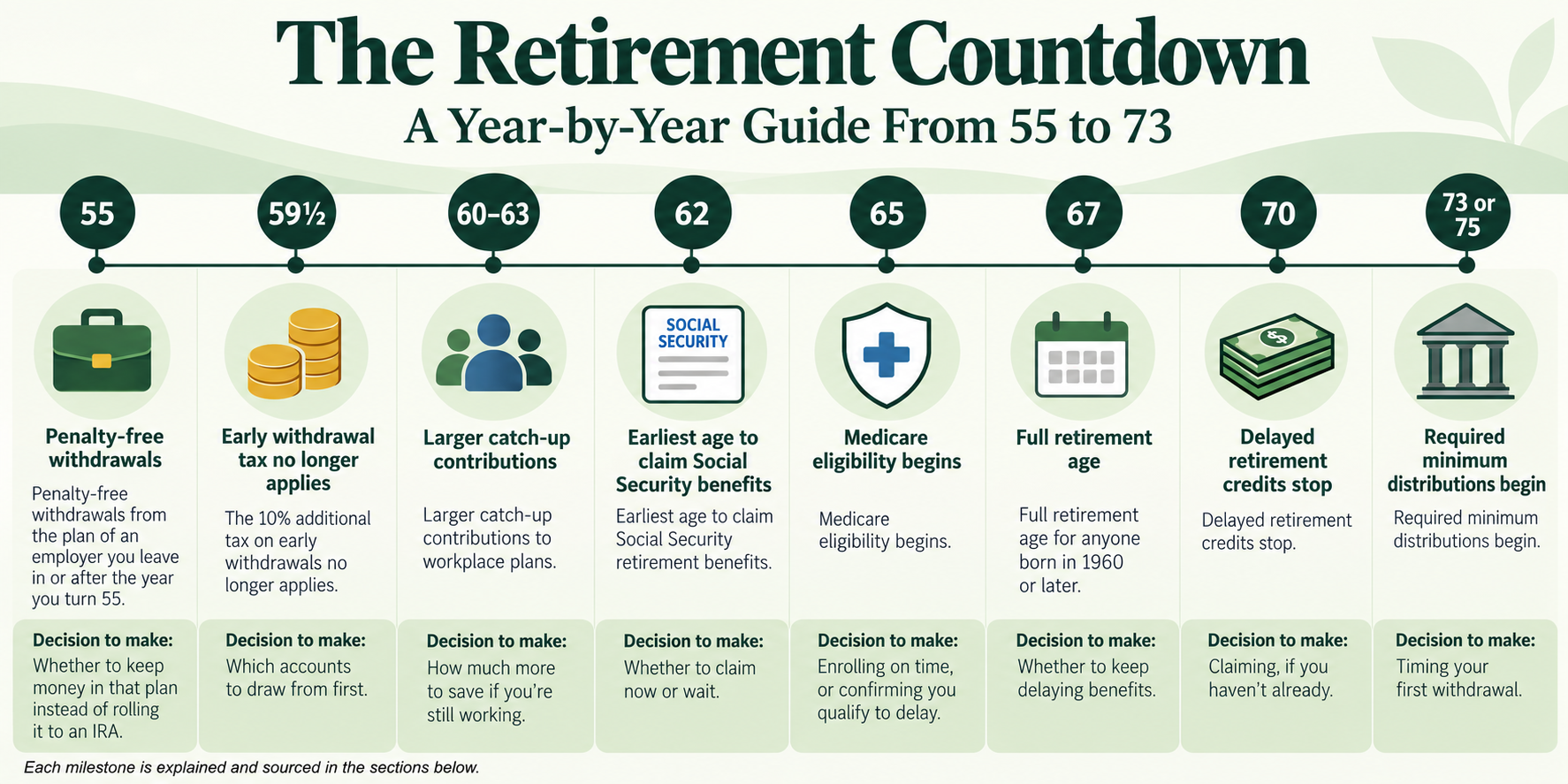
Here's the full sequence at a glance, followed by a closer look at each age:
What changes at 55?
The first milestone is one many people never hear about until it's too late to use. Money withdrawn from an IRA or retirement plan before age 59½ generally carries a 10% additional tax on top of regular income tax. But if you leave your job during or after the calendar year you turn 55, withdrawals from that employer's plan are exempt from the 10% tax, and for public safety employees in certain governmental plans the age drops to 50. This exception doesn't apply to IRAs(1).
That last detail is where the trouble usually starts. Suppose, hypothetically, you leave your job at 56 with $400,000 in your 401(k) and plan to withdraw $40,000 a year to cover the years before you claim Social Security. Taken from that 401(k), each $40,000 withdrawal owes income tax but no additional penalty. If you'd rolled the whole balance into an IRA on your way out the door, the same withdrawal would carry an extra $4,000 tax every year until you turned 59½.
The exception is tied to the year you separate from the employer, not the year you start taking money out. Someone who left a job at 53 doesn't qualify for that plan's exception after turning 55, because the separation happened too early(1).
If an early exit is on your horizon, the timing of your last day is worth discussing with your plan administrator and a tax professional before you set it.
What changes at 59½?
At 59½, the 10% additional tax on early distributions stops applying to IRAs and workplace plans alike(1). Ordinary income tax still applies to pre-tax money, but the penalty that has shaped your choices for decades falls away, and your traditional accounts become available on the same terms.
Roth accounts follow a slightly different rule.
A withdrawal of contributions and earnings from a Roth IRA or a designated Roth 401(k) is tax-free as a qualified distribution when the account has been held for at least five years and the withdrawal is made on or after age 59½, or because of disability or death(2). If you open your first Roth IRA at 58, you'd generally need to wait about five years, until around 63, before the earnings come out tax-free, even though you've already passed 59½.
The years between 59½ and the start of required withdrawals also give you the most control over your taxable income, because nothing forces withdrawals from tax-deferred accounts yet and nothing penalizes them either.
Why do 60 through 63 bring a bigger catch-up?
If you're still working, these four years offer the largest contribution limits of your career, because you can invest more as catch-up contributions. For 2026, the standard limit on employee deferrals to a 401(k) or similar plan is $24,500, and workers 50 and older can add an $8,000 catch-up contribution. Workers who turn 60, 61, 62, or 63 during the year can add $11,250 instead, while IRA limits are lower, at $7,500 plus a $1,100 catch-up for those 50 and older(3).
In dollar terms, a hypothetical 61-year-old could defer up to $35,750 into a 401(k) for 2026, compared with $32,500 for someone who is 58 or 64. Higher earners should check one more detail with their plan. If your 2025 wages exceeded $150,000, your 2026 catch-up contributions must be designated as Roth contributions, which are made with after-tax dollars instead of reducing this year's taxable income(2)(3).
What happens if you claim Social Security at 62?
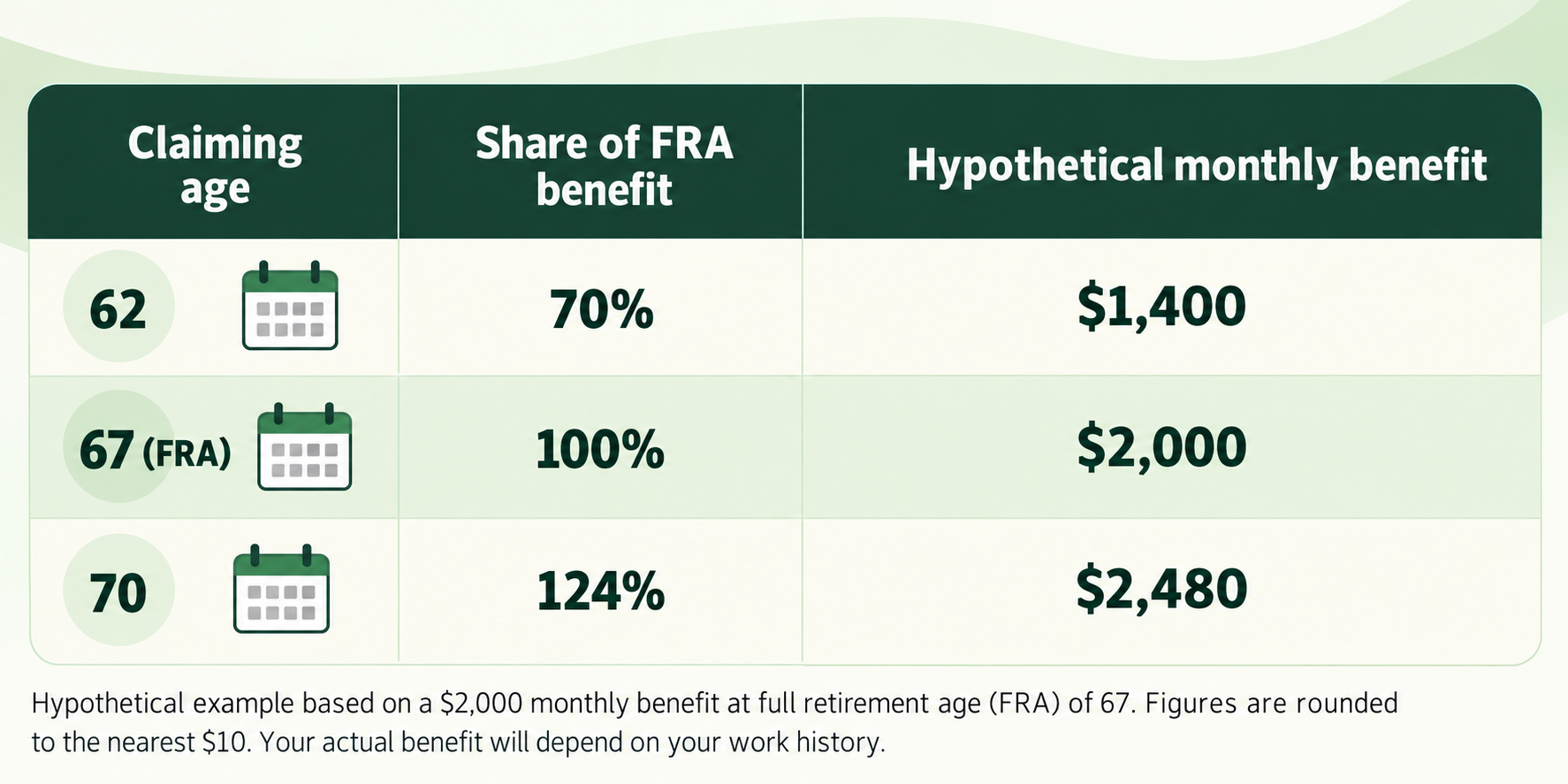
Sixty-two is the earliest age you can start Social Security retirement benefits, and it's also the age with the smallest monthly check. Your full benefit is available only at your full retirement age (FRA), which is 67 for anyone born in 1960 or later, and claiming at 62 with an FRA of 67 reduces the benefit by 30%, so a $1,000 benefit becomes $700. Spousal benefits shrink further when claimed early, with a $500 spouse's benefit dropping to $325 at 62(4).
Here's how the trade-off looks across the full claiming range, using a hypothetical $2,000 monthly benefit at an FRA of 67.
Claiming early while you're still working adds another layer. If you're under FRA for the entire year, Social Security withholds $1 in benefits for every $2 you earn above an annual limit, which is $24,480 for 2026. In the year you reach FRA, the limit rises to $65,160 and the withholding drops to $1 for every $3, counting only earnings before the month you reach FRA(6). A hypothetical 62-year-old who claims benefits and earns $44,480 in wages would be $20,000 over the limit and have $10,000 in benefits withheld for the year.
Those withheld benefits aren't gone for good, because Social Security recalculates your benefit at FRA to credit you for the months it reduced or withheld benefits(6). In the meantime, though, much of an early benefit can be held back.
There's also a reason to watch your income at 63. Medicare Part B and prescription drug premiums include an income-related surcharge known as IRMAA (income-related monthly adjustment amount), which Social Security bases on the most recent federal tax return the IRS provides. For 2026 premiums, that was generally a return for tax year 2024. Individual filers with modified adjusted gross income (MAGI) above $109,000, or joint filers above $218,000, pay the surcharge, which starts at an extra $81.20 a month for Part B and $14.50 for drug coverage(7).
Put simply, the income on your tax return at 63 can set what you pay for Medicare at 65, which makes a large property sale or Roth conversion in that year worth timing with care. If your income drops later because you stopped working or reduced your hours, Form SSA-44 lets you ask Social Security to base the surcharge on your newer, lower income(7).
What decisions arrive at 65?
Your Initial Enrollment Period (IEP) for Medicare lasts seven months, starting three months before the month you turn 65 and ending three months after it. If you qualify for premium-free Part A, that coverage starts the month you turn 65. Signing up for Part B before your birthday month means Part B starts then too, while signing up during your birthday month or the three months after pushes the start to the following month(8).
Missing that window can cost you for years. Unless you qualify for a Special Enrollment Period, the Part B late enrollment penalty adds 10% to your premium for each full 12-month period you could have had Part B but didn't, and for most people it lasts for as long as they have Part B.
Waiting two full years, for example, means paying the $202.90 standard premium for 2026 plus a $40.58 monthly penalty(9).
If you or your spouse are still working and covered by a group health plan that's available to everyone at the company, you can usually wait to sign up for Part B without a penalty. Once that job or coverage ends, you get an eight-month Special Enrollment Period, which starts when you stop working even if you choose COBRA. Coverage that isn't employer group coverage, such as retiree coverage or some self-employed plans, may not qualify, and Medicare's guidance in that situation is to sign up at 65.
If you contribute to a health savings account (HSA), you and your employer should stop contributions six months before you retire or apply for Social Security, which helps you avoid a tax penalty(10).
That six-month cushion exists because premium-free Part A can be backdated. When you sign up for Part A after 65, coverage starts up to six months before you sign up or apply for Social Security, though never earlier than the month you turned 65(8).
Turning 65 can also start a second clock.
If you choose Original Medicare, you get a one-time, six-month Medigap Open Enrollment Period that begins the first month you have Part B and are 65 or older. During it, an insurer can't refuse to sell you a Medigap (Medicare Supplement Insurance) policy or charge you more because of pre-existing health problems, while after it closes you may pay more or be turned down based on medical underwriting(11).
What changes at full retirement age?
For anyone born in 1960 or later, 67 is full retirement age, the point at which you receive 100% of the benefit your work record has earned. If you were born between 1955 and 1959, your FRA falls between 66 and 2 months and 66 and 10 months(4).
Reaching full retirement age changes two things.
First, beginning with the month you reach FRA, your earnings no longer reduce your benefits regardless of how much you earn(6). Second, if you haven't claimed yet, waiting now raises your benefit instead of avoiding a reduction, because each year you delay past FRA adds 8% for anyone born in 1943 or later(5).
If you're married, keep the limits of spousal benefits in mind. A spouse's benefit tops out at 50% of what the worker would receive at FRA(4), so delaying past FRA raises your own monthly check but not the spousal benefit your husband or wife collects on your record while you're both alive.
What's left to decide at 70?
Seventy is the last birthday at which waiting can raise your Social Security benefit, because the delayed retirement credit increase stops at 70(5). In the hypothetical example above, the age-70 benefit of $2,480 a month is $1,080 more than the age-62 amount, or roughly $12,960 more each year.
For married couples, the higher earner's claiming age carries extra weight. A widow or widower is entitled to the same delayed retirement credit increase the deceased spouse had received or was eligible for at the time of death(12). Waiting can therefore raise not only your own benefit but also the survivor benefit your spouse may rely on after you're gone.
Six months later, at 70½, a new option opens for IRA owners who give to charity. A qualified charitable distribution (QCD) sends money directly from your IRA to an eligible charity, and it's generally not included in your taxable income. You must be at least 70½ when the distribution is made, and a QCD counts toward your required minimum distribution once those begin(13). For 2026, the annual QCD limit is $111,000(3).
When do required minimum distributions begin?
Required minimum distributions (RMDs) are the withdrawals the IRS requires you to take from tax-deferred accounts each year once you reach a set age. For many people approaching that age now, it's 73. RMDs apply to traditional IRAs, SEP and SIMPLE IRAs, and workplace plans such as 401(k)s and 403(b)s, while Roth IRAs and designated Roth accounts in workplace plans don't require withdrawals while the owner is alive(14).
If you're reading this at 55 or 60, your starting age is likely later. Under the IRS's final regulations, the applicable age is 73 for people born from 1951 through 1958 and 75 for anyone born on or after January 1, 1960, with 1959 birth years handled under separate proposed rules(15).
Each year's RMD is your account balance at the end of the prior year divided by a distribution period from the IRS Uniform Lifetime Table, and that period is 26.5 at age 73(13)(14). On a hypothetical $500,000 IRA balance, a first RMD at 73 would be about $18,868.
Your first RMD comes with its own deadline. For IRAs, it's due by April 1 of the year after you reach your RMD age, and each later RMD is due by December 31. Waiting until April for the first one means taking two RMDs in the same tax year, so you can take the first by December 31 of the year you reach the age instead and keep the income in separate tax years. If you're still working, your current employer's plan may let you delay RMDs from that plan until you retire, unless you own more than 5% of the business, but the IRA deadline stays tied to your age(14).
Missing an RMD triggers a 25% excise tax on the amount you should have withdrawn, reduced to 10% if you correct it within two years(14). On the hypothetical $18,868 RMD above, that's $4,717, or about $1,887 if corrected in time.
Mistakes worth avoiding:
Rolling your 401(k) into an IRA the week you retire. If you leave a job at 55 or later and may need money before 59½, moving everything into an IRA gives up the age-55 exception, which applies only to employer plans(1).
Counting on COBRA or retiree coverage to delay Medicare. COBRA isn't considered group health plan coverage, and the end of COBRA or retiree coverage doesn't open a Special Enrollment Period on its own(8). Waiting for that coverage to run out can leave you without Part B for months and add a penalty you'd pay for as long as you have Part B(9).
Treating 62 as the default claiming age. For someone with an FRA of 67, the age-70 benefit is about 77% higher than the age-62 benefit on the same work record(4)(5), and the earnings test can hold back much of an early benefit if you're still working(6).
Planning around 73 when your RMD age is 75. If you were born in 1960 or later, your required withdrawals start at 75(15). Building a plan around 73 can mean taking taxable income two years before you have to.
Where to go from here
The decisions behind these birthdays are connected, and the right order of moves depends on your savings, your health, your spouse, and the day you'd like to stop working. If you've read this far and realized a few of these birthdays are closer than they seemed, you don't have to sort out the sequence alone. A professional who can see your whole picture can help you line up each move before the first deadline arrives.
To get matched with a financial advisor, answer a few questions below:
References
1. Internal Revenue Service. "Retirement Topics: Exceptions to Tax on Early Distributions." https://www.irs.gov/retirement-plans/plan-participant-employee/retirement-topics-exceptions-to-tax-on-early-distributions
2. Internal Revenue Service. "Roth Comparison Chart." https://www.irs.gov/retirement-plans/roth-comparison-chart
3. Internal Revenue Service. Notice 2025-67, "2026 Amounts Relating to Retirement Plans and IRAs, as Adjusted for Changes in Cost-of-Living." https://www.irs.gov/pub/irs-drop/n-25-67.pdf
4. Social Security Administration. "Starting Your Retirement Benefits Early." https://www.ssa.gov/benefits/retirement/planner/agereduction.html
5. Social Security Administration. "Delayed Retirement Credits." https://www.ssa.gov/benefits/retirement/planner/delayret.html
6. Social Security Administration. "Receiving Benefits While Working." https://www.ssa.gov/benefits/retirement/planner/whileworking.html
7. Social Security Administration. "Premiums: Rules for Higher-Income Beneficiaries." https://www.ssa.gov/benefits/medicare/medicare-premiums.html
8. Medicare.gov. "When Does Medicare Coverage Start?" https://www.medicare.gov/basics/get-started-with-medicare/sign-up/when-does-medicare-coverage-start
9. Medicare.gov. "Avoid Late Enrollment Penalties." https://www.medicare.gov/basics/costs/medicare-costs/avoid-penalties
10. Medicare.gov. "Working Past 65." https://www.medicare.gov/basics/get-started-with-medicare/medicare-basics/working-past-65
11. Medicare.gov. "Get Ready to Buy" (Medigap Open Enrollment Period). https://www.medicare.gov/health-drug-plans/medigap/ready-to-buy
12. Social Security Administration. Social Security Handbook, Section 720, "Delayed Retirement Credit." https://www.ssa.gov/OP_Home/handbook/handbook.07/handbook-0720.html
13. Internal Revenue Service. "Publication 590-B (2025), Distributions from Individual Retirement Arrangements (IRAs)." https://www.irs.gov/publications/p590b
14. Internal Revenue Service. "Retirement Topics: Required Minimum Distributions (RMDs)." https://www.irs.gov/retirement-plans/plan-participant-employee/retirement-topics-required-minimum-distributions-rmds
15. Department of the Treasury, Internal Revenue Service. "Required Minimum Distributions," Final Regulations, T.D. 10001. Federal Register, Vol. 89, No. 139, July 19, 2024. https://www.govinfo.gov/content/pkg/FR-2024-07-19/html/2024-14542.htm
Contribution limits, catch-up amounts, the Roth catch-up wage threshold, the QCD limit, Social Security earnings test limits, Medicare premiums, penalties, and IRMAA thresholds reflect 2026 figures and adjust annually. Examples labeled hypothetical are illustrations only and don't account for state taxes or individual circumstances. All sources were verified against their live pages on October 12, 2026.
General information: This article is for general educational purposes only and isn't legal, tax, investment, or insurance advice. Retirement account, Social Security, and Medicare rules depend on your birth year, employer plan terms, filing status, and other personal factors, and they can change. Before acting on any of the milestones described here, consider speaking with a qualified financial professional or tax advisor about your specific situation. For free, unbiased help with Medicare decisions, contact your State Health Insurance Assistance Program (SHIP) at shiphelp.org, or call 1-800-MEDICARE (1-800-633-4227; TTY 1-877-486-2048). For questions about your Social Security benefits, contact the Social Security Administration at 1-800-772-1213.
Investment disclaimer: Nothing on this site constitutes investment advice. All investors are encouraged to conduct their own research before making any investment decision. Past performance is not a guarantee of future results.
Medicare/Insurance disclaimer: Medicare plan availability and costs vary by location. Contact a licensed Medicare advisor or visit Medicare.gov to compare plans available in your area.
Editorial independence: Greensprout's editorial team writes on behalf of the reader. Our goal is to provide clear, useful information to help you make better financial decisions. Our editorial content is not influenced by advertiser relationships.
Affiliate disclosure: Greensprout is an independent, advertising-supported publisher and comparison resource. We may earn compensation when you click on links to products from our partners. This does not affect our editorial standards or recommendations.