

Key takeaways
- Some retirees can sell long-held investments and owe no federal tax on the profit.
- Whether you qualify depends on your total taxable income for the year, not on the size of the sale alone.
- Selling and buying back the same investment in a low-income year can shrink the tax bill your future sales would carry.
- A larger gain can still raise other costs, including future Medicare premiums and Marketplace health insurance premiums.
- Going a little over the limit taxes only the amount over the line, so a small miss is far less costly than many retirees fear.
If you've held a brokerage account for twenty or thirty years, you probably own a few funds or stocks you'd happily sell, rebalance, or spend, except for one thing. The profit on paper has grown so large that selling feels like handing a big check to the IRS, so the shares may stay put year after year, even when they no longer fit your plan.
For some retirees, that big check may actually be zero, because federal law taxes some long-term investment profits at 0%, and the years after a paycheck stops can be the years when a household's taxable income falls low enough to use it. Married couples and single filers who plan their withdrawals around this rate can sell appreciated investments, pay no federal income tax on the gain, and in many cases buy the same investments right back with a higher cost on record.
Using the 0% rate well depends on who qualifies, how your other income limits the amount you can sell, what selling and rebuying (called gain harvesting) accomplishes, and which side effects on Social Security, Medicare, and health insurance to check before you place the trade. The dollar thresholds below are for tax year 2026, and the IRS adjusts them for inflation each year.
Why does a low-income year in retirement open this opportunity?
While a salary fills the 0% range on its own because it’s not considered capital gains, any investment profit you take sits on top of that paycheck and is taxed at 15% or more, because it is.
But retirement can change your income.
If you spend a few years living on savings, a pension, or part-time work before Social Security begins and before larger withdrawals from traditional IRAs start, your taxable income in those years can fall well below what it was while you were working.
The tax code rewards that kind of year. Long-term capital gains, which are profits on investments held more than one year, are taxed at 0%, 15%, or 20% depending on your overall taxable income, and some or all net capital gain may be taxed at 0%(1).
Short-term gains on investments held one year or less are taxed as ordinary income at the regular graduated rates.
Taxable income is your income after the standard deduction or your itemized deductions, which is why the 0% rate reaches further than the threshold numbers suggest at first glance. For tax year 2026, the 0% rate applies up to these amounts of taxable income(2).
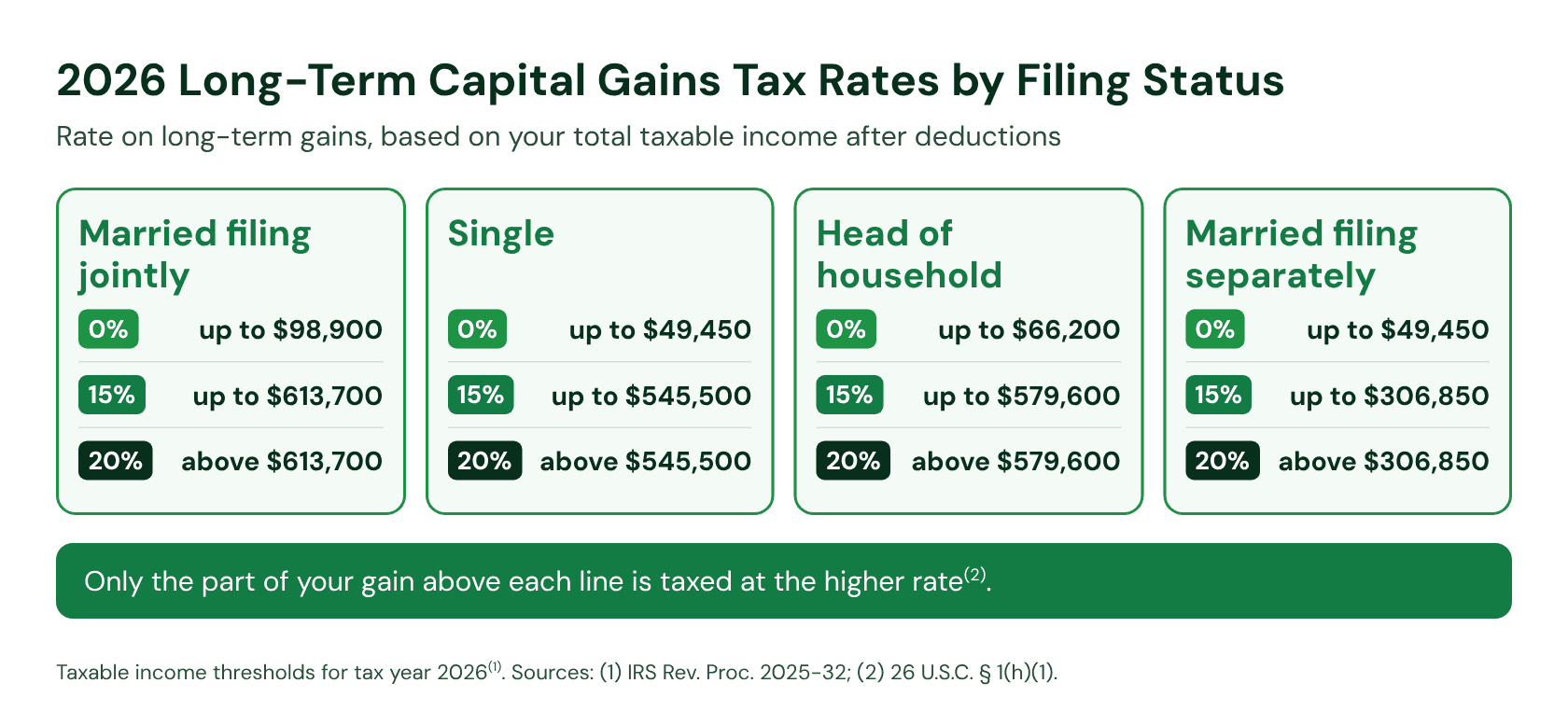
Taxable income thresholds for tax year 2026, from IRS Revenue Procedure 2025-32.
Gains above the 15% ceiling are taxed at 20%(1). For a retired household, the line that counts is the first one, because every dollar of long-term gain that fits under it carries no federal income tax at all.
How do your other income and deductions decide how much you can sell tax-free?
The 0% rate works like a container with a fixed size. Your ordinary income, such as pension payments, taxable IRA withdrawals, interest, and wages, goes into the container first, and your long-term gains and qualified dividends stack on top of it.
The 0% rate covers only the gains that still fit under the threshold after your ordinary taxable income is counted(3).
For example, a hypothetical married couple with $60,000 of taxable income before any gains has $38,900 of room left under the $98,900 threshold, so their first $38,900 of long-term gains is taxed at 0%.
Deductions enlarge the container because they come off before taxable income is measured. For tax year 2026, the standard deduction is $32,200 for married couples filing jointly and $16,100 for single filers. Taxpayers age 65 or older add an extra standard deduction of $1,650 each if married, or $2,050 if single(2).
A newer deduction adds more for older retirees.
From 2025 through 2028, each taxpayer who is 65 or older by the end of the year can deduct another $6,000, or $12,000 for a married couple when both spouses qualify. You can claim it whether or not you itemize, married couples must file jointly to take it, and it phases out once modified adjusted gross income (MAGI, your adjusted gross income with certain items added back) passes $75,000 for single filers or $150,000 for joint filers(4). Because this deduction is scheduled to end after 2028, years between now and then may offer more room than the years that follow.
Pension payments and traditional IRA withdrawals that aren't rolled over are generally taxable income, and they fill the container before any gain does(5, 6). The more of your spending you cover from savings you've already paid tax on, such as cash or the original amount you invested in a brokerage account, the more room is left for tax-free gains.
What does the 0% bracket look like for a retired couple and a single retiree?
Consider two hypothetical retirees in tax year 2026, each age 67 and not yet claiming Social Security. The first is a married couple filing jointly with $50,000 of pension and interest income. The second is a single retiree with $30,000 of pension and interest income. Both take the standard deduction, the extra standard deduction for age 65 and older, and the senior deduction.
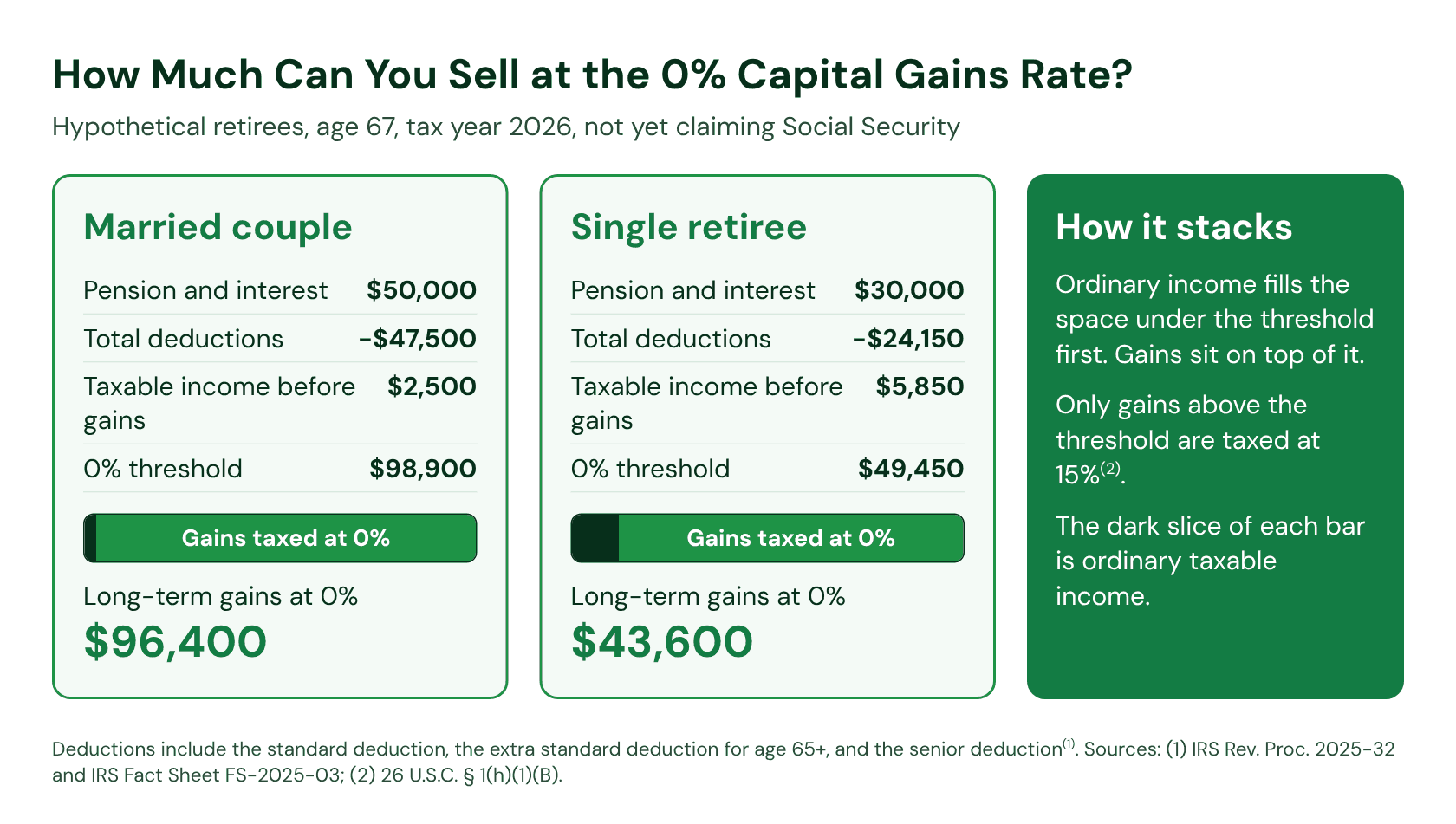
Hypothetical illustration using 2026 figures from IRS Revenue Procedure 2025-32 and the IRS senior deduction fact sheet.
In this hypothetical, after deductions the couple could realize $96,400 of long-term gains and owe no federal income tax on any of it. Taxed at 15% instead, the same gain would cost $14,460. The single retiree could realize $43,600 of gains at 0%, which would cost $6,540 at a 15% rate. Both examples stay under the senior deduction phase-out once the gains are added, with the couple's MAGI at $146,400 and the single retiree's at $73,600, so the full deduction holds.
The gain is only the profit, not the sale amount. If the couple's shares were bought for $60,000 and are now worth $156,400, selling all of them produces exactly $96,400 of gain, and the $60,000 they originally invested comes back to them without any tax.
What is gain harvesting, and why sell something you plan to keep?
Gain harvesting means selling an appreciated investment in a year when the gain is taxed at 0% and then buying it back, or buying something similar, so you keep the same portfolio while resetting its cost on record. Your basis in stock you buy is generally the purchase price plus any costs of purchase(7), so shares bought back at today's price carry today's price as their new basis. When you sell those shares in a future year, only the growth after the repurchase is taxable.
The wash sale rule is a federal tax rule for investments sold at a loss. If you sell a stock or fund at a loss and buy the same or a nearly identical one within 30 days before or after the sale, you can't deduct that loss, and the rule applies only to losses(8). Gain harvesting produces a gain, not a loss, so the rule doesn't come into play. A gain you harvest at 0% is taxed at 0% whether you buy the shares back the same day or a month later.
Going back to the hypothetical couple, suppose they sell $156,400 of an index fund with a $60,000 basis and repurchase it right away. Their account looks the same the next morning, but their basis has climbed from $60,000 to $156,400. If they later sell those shares in a year when their income is higher and gains are taxed at 15%, they've avoided tax on $96,400 of growth, which was worth $14,460 at that rate.
A household with several low-income years can repeat the harvest each year, using that year's room and leaving a little cushion for income that shows up late.
Which income can use up the room without your noticing?
Some investment income lands in the 0% container whether you sell anything or not.
Two kinds of investment payouts count here:
- Dividends are payments a company makes to shareholders out of its earnings, and the ones called qualified dividends are taxed at the same lower rates as long-term capital gains instead of as ordinary income.
- Mutual funds, exchange-traded funds and real estate investment trusts can also pay out capital gain distributions, which are always reported as long-term capital gains on Form 1099-DIV(9).
Both count toward the 0% threshold, so check what your funds expect to distribute before you harvest and leave a cushion for any payout that arrives after your sale.
Social Security benefits can also shrink how much room you have inside the tax-free container.
To figure out whether benefits are taxable, the IRS compares a base amount of $25,000 for single filers or $32,000 for joint filers with the total of half your benefits plus all your other income, including tax-exempt interest(10). A capital gain is part of that other income, so for a retiree already collecting benefits, a harvested gain can make more of the benefit taxable as ordinary income. That added ordinary income fills the container first and can push some of the gain out of the 0% range, so harvesting before Social Security begins can leave more room to work with.
The net investment income tax is an extra 3.8% federal tax on certain investment income for people whose income is above set limits, and it's rarely a factor at these income levels. It applies only when MAGI exceeds $200,000 for single filers or $250,000 for joint filers, and those threshold amounts are not indexed for inflation(11). Both hypothetical households above are well below those lines.
How can a gain this year raise Medicare or health insurance costs later?
A gain taxed at 0% still raises your adjusted gross income, and several programs set costs from that figure rather than from your tax bill. Medicare Part B and prescription drug premiums are one example. The Social Security Administration sets the income-related monthly adjustment amount (IRMAA, a surcharge on those premiums for higher-income beneficiaries) from the tax return the IRS provides, generally the one from two years earlier, and it measures income as adjusted gross income plus tax-exempt interest(12).
For 2026 premiums, the surcharge begins when MAGI exceeds $218,000 for married couples filing jointly or $109,000 for other filers, and the first tier adds $81.20 a month to the $202.90 standard Part B premium(12). Those lines are set for each year's premiums, so check the current thresholds when you plan a sale. The hypothetical couple above stays far under them, but a single filer who stacks a large harvest on top of IRA withdrawals or a pension can cross the single-filer line sooner than expected. If your income later falls because of a life-changing event, such as retiring, reducing work hours, or the death of a spouse, you can ask SSA to reduce the adjustment by filing Form SSA-44(12).
Retirees younger than 65 who buy coverage through the Health Insurance Marketplace face a more immediate tradeoff. A premium tax credit is a federal tax credit that lowers your monthly premium for a Marketplace health plan, and its size depends on the household size and estimated income you put on your Marketplace application(15). Capital gains count as income when the Marketplace sets that credit, and the estimate uses your expected household income for the year of coverage rather than last year's income(13). A large harvest in a year when you receive premium tax credits can shrink those credits, so compare the future tax you'd save with the higher premiums you'd pay this year before you sell.
When does gain harvesting make less sense?
Shares you expect to leave to your heirs may not need harvesting at all. Under federal law, the basis of property acquired from a decedent is generally its fair market value at the date of death(14), so heirs who inherit appreciated shares typically receive the higher basis anyway.
Harvesting those shares at 0% costs you nothing in federal income tax, but it still raises your income for the year, and the Social Security, Medicare, and Marketplace effects above may outweigh a basis increase your heirs would have received regardless.
Harvesting also makes less sense when your future tax rate on gains is likely to stay at 0%. If your income is expected to remain modest for life, gains you sell later may fall in the 0% range too, and there's little benefit in raising this year's income to reset a basis you'll never need. The move pays off most for households that expect higher income later, such as when Social Security starts, a spouse keeps working, or larger IRA withdrawals begin.
The 0% rate is a federal rule, so check how your state taxes capital gains before you assume the sale is tax-free.
Common mistakes retirees make with the 0% bracket
Measuring income instead of taxable income
Comparing gross income with the 0% threshold can make a retiree conclude they don't qualify. The threshold applies to taxable income after deductions, and for a married couple age 65 or older taking the standard deduction, the extra deduction for age, and the senior deduction, $47,500 of income in tax year 2026 is absorbed before any tax applies. Run your projected return with deductions included before ruling the strategy out.
Fearing that one extra dollar taxes the whole gain
Going over the threshold doesn't cost you the 0% rate on everything. Only the part of the gain above the line is taxed at 15%, because the rate applies in layers to the portion of gain that fits under each threshold(3). If the hypothetical couple realized $106,400 of gains instead of $96,400, the extra $10,000 would be taxed at 15%, or $1,500, and the first $96,400 would still be taxed at 0%. Their MAGI would also pass $150,000, which starts to shrink the senior deduction, so a small cushion below the line is still sensible.
Selling shares held one year or less
The 0% rate applies only to long-term gains on investments held more than one year(1). Shares bought eleven months ago produce short-term gains, which are taxed as ordinary income. Check the purchase dates on each lot before you sell, and sell the older lots first when your brokerage lets you choose.
Plan your withdrawals around the 0% bracket
Knowing how much taxable income you expect this year, and in the years before Social Security and larger IRA withdrawals begin, tells you how many dollars of gains you can move tax-free and which side effects to watch along the way.
Greensprout's editorial team writes on behalf of the reader. Our goal is to provide clear, useful information to help you make better financial decisions. Greensprout is an independent, advertising-supported publisher and comparison resource. We may earn compensation when you click on links to products from our partners. This does not affect our editorial standards or recommendations.
Nothing on this site constitutes investment advice. All investors are encouraged to conduct their own research before making any investment decision. Past performance is not a guarantee of future results.
This article is for general educational purposes and is not tax advice. Tax thresholds change each year with inflation, and tax law can change, so confirm current figures with the IRS or a tax professional before acting.
References
1. Internal Revenue Service. "Topic No. 409, Capital Gains and Losses." https://www.irs.gov/taxtopics/tc409
2. Internal Revenue Service. "Revenue Procedure 2025-32" (tax year 2026 inflation adjustments). https://www.irs.gov/pub/irs-drop/rp-25-32.pdf
3. 26 U.S. Code § 1, Tax Imposed, subsection (h)(1)(B) and (j)(5). Legal Information Institute, Cornell Law School. https://www.law.cornell.edu/uscode/text/26/1
4. Internal Revenue Service. "Tax Deductions for Working Americans and Seniors," Fact Sheet FS-2025-03. https://www.irs.gov/newsroom/one-big-beautiful-bill-act-tax-deductions-for-working-americans-and-seniors
5. Internal Revenue Service. "Topic No. 410, Pensions and Annuities." https://www.irs.gov/taxtopics/tc410
6. Internal Revenue Service. "Rollovers of Retirement Plan and IRA Distributions." https://www.irs.gov/retirement-plans/plan-participant-employee/rollovers-of-retirement-plan-and-ira-distributions
7. Internal Revenue Service. "Publication 551, Basis of Assets." https://www.irs.gov/publications/p551
8. 26 U.S. Code § 1091, Loss From Wash Sales of Stock or Securities. Legal Information Institute, Cornell Law School. https://www.law.cornell.edu/uscode/text/26/1091
9. Internal Revenue Service. "Topic No. 404, Dividends and Other Corporate Distributions." https://www.irs.gov/taxtopics/tc404
10. Internal Revenue Service. "Publication 915, Social Security and Equivalent Railroad Retirement Benefits." https://www.irs.gov/publications/p915
11. Internal Revenue Service. "Questions and Answers on the Net Investment Income Tax." https://www.irs.gov/newsroom/questions-and-answers-on-the-net-investment-income-tax
12. Social Security Administration. "Premiums: Rules for Higher-Income Beneficiaries." https://www.ssa.gov/benefits/medicare/medicare-premiums.html
13. HealthCare.gov. "What's Included as Income." https://www.healthcare.gov/income-and-household-information/income/
14. 26 U.S. Code § 1014, Basis of Property Acquired From a Decedent. Legal Information Institute, Cornell Law School. https://www.law.cornell.edu/uscode/text/26/1014
15. HealthCare.gov. "Save on Monthly Premiums." https://www.healthcare.gov/lower-costs/save-on-monthly-premiums/


