

Key takeaways
- A fiduciary is anyone legally responsible for managing money or property for someone else, and the core duties are loyalty and care.
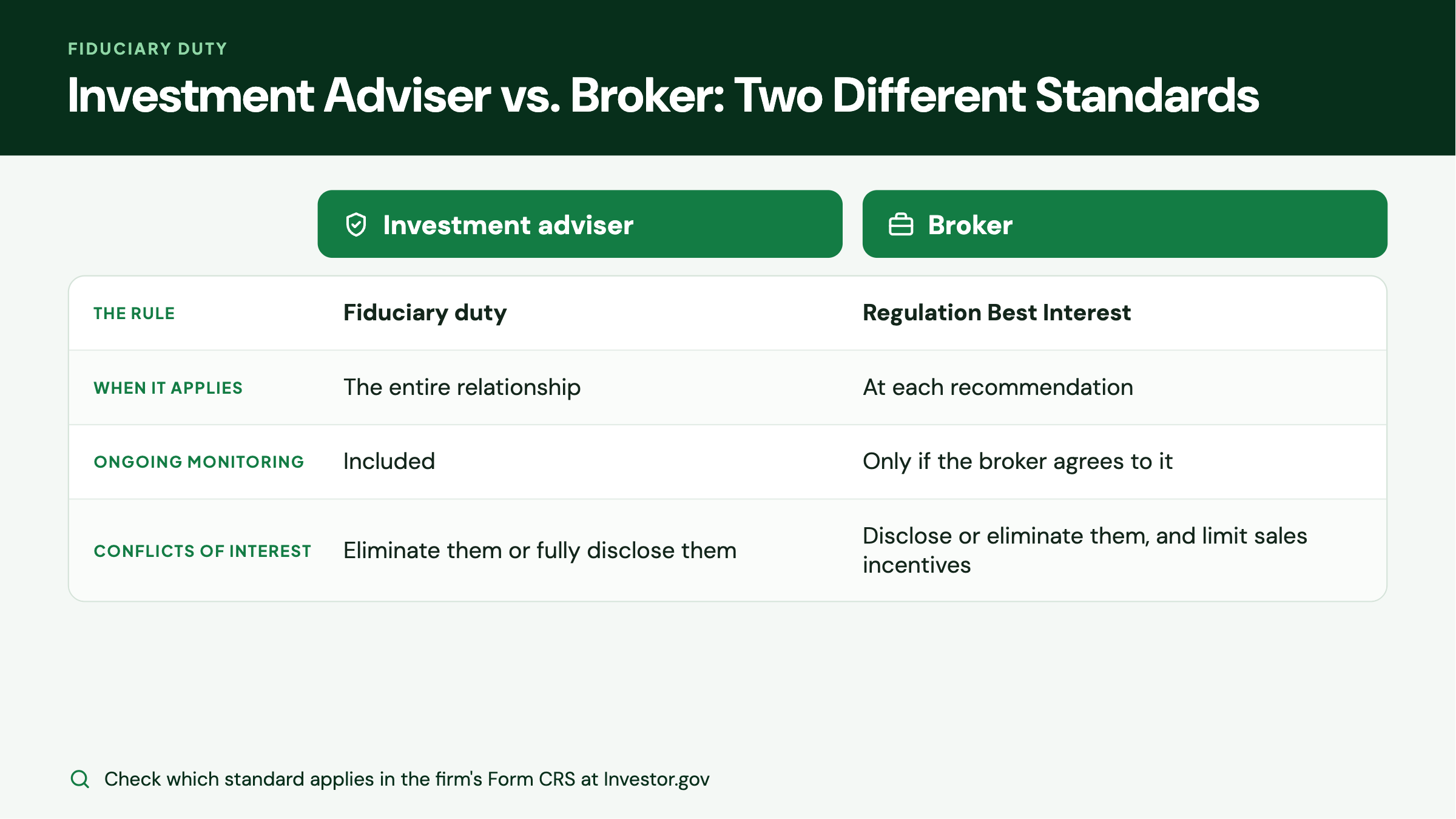
- Investment advisers owe clients a fiduciary duty that covers the entire relationship and can't be waived by contract.
- Brokers follow Regulation Best Interest, which applies at the time of each recommendation and doesn't require ongoing monitoring unless the broker agrees to provide it.
- Retirement plan fiduciaries who breach their duties are personally liable for plan losses and can owe a 20% Department of Labor penalty and prohibited-transaction excise taxes.
- Form CRS and the search tool on Investor.gov show which standard applies to the professional you're considering.
The word "fiduciary" appears in many of the financial documents you sign or receive, including advisory agreements, 401(k) plan documents, trusts and powers of attorney. While they all contain this word, these documents rarely explain what it means or what it requires of the person it describes.
The word carries legal weight. It decides whether the person handling your money is required by law to put your interests ahead of their own, what that person has to tell you about how they get paid, and what you can do if they fall short. If you've agreed to manage money for a parent or serve as trustee of a family trust, the word also describes legal duties you owe, and penalties apply if a person does not meet them.
In this article, you’ll learn what a fiduciary duty requires, which financial professionals owe one and which follow a different standard, what penalties apply when that duty is broken, and how to find out whether your financial professional is legally required to act as a fiduciary.
What does it mean to be a fiduciary?
The word comes from the Latin fīdūciārius, which meant “holding in trust” and described a trustee or property held on trust. Fīdūciārius comes from fīdūcia, the Latin word for trust, reliance or confidence, which also covered the transfer of property to someone on trust. Fīdūcia in turn comes from fīdere, “to trust.” The word first appeared in English in the 1630s(15). Its meaning hasn’t changed much since then. A fiduciary is anyone who has been trusted with another person’s money or property, and the law sets the rules for how they handle it.
Common examples include a trustee under a revocable living trust, an agent named in a durable power of attorney, a court-appointed conservator, and a representative payee who manages Social Security benefits on someone else’s behalf(1).
Every fiduciary has to manage that money for the other person’s benefit rather than their own, but which law sets the specific duties depends on the role.
State law governs trustees, agents and conservators, and their powers and duties vary from state to state(16).
Federal law governs other roles. A Social Security representative payee must use benefits only for the beneficiary’s use and benefit, in a way that serves the beneficiary’s best interests(17).
Fiduciary duties also apply to professionals. Under federal law, an investment adviser is a fiduciary to its clients(2). Under the federal law governing workplace retirement plans, a person is a fiduciary of a plan to the extent they exercise discretionary control over the plan's management or assets, or give investment advice to the plan for a fee(3).
Whatever the setting, the duty rests on two obligations. The first is loyalty, which means the fiduciary can't put their own interests ahead of yours. The second is care, which means decisions have to be made with the skill, prudence and diligence the role calls for(2,4). The specific rules differ depending on which law applies, which is why the same word can carry different consequences in an advisory contract, a 401(k) plan and a family trust.
What do the duties of loyalty and care require in practice?
A detailed description of these duties comes from the Securities and Exchange Commission (SEC), which in 2019 published a formal interpretation of the standard investment advisers must meet under the Investment Advisers Act of 1940. That interpretation describes an adviser's fiduciary duty as a combination of a duty of care and a duty of loyalty, and it states that the duty applies to the entire relationship between adviser and client(2).
What does the duty of loyalty ask of an adviser?
Under the duty of loyalty, an adviser cannot place its own interests ahead of yours. That doesn't mean an adviser can never have a conflict of interest, which is any situation where the adviser stands to benefit from steering you one way rather than another. It means the adviser has to either eliminate the conflict or disclose it fully and fairly, so that you can understand it and can give informed consent(2).
A disclosure saying an adviser "may" have a conflict is not adequate when the conflict already exists, and vague references to "conflicts" without further description don't count as full and fair disclosure. When a conflict is too complex to explain clearly enough for you to consent to it, the adviser should eliminate it or change its practices to reduce it until clear disclosure is possible(2).
What does the duty of care ask of an adviser?
The duty of care requires advice that is in your best interest based on your objectives. To meet it, an adviser working with an individual client should, at a minimum, make a reasonable inquiry into your financial situation, your level of financial sophistication, your investment experience and your financial goals. The duty of care also includes seeking the best execution of your trades when the adviser chooses the broker that places them, and providing advice and monitoring at a frequency that fits the relationship you agreed to(2).
Cost is one of many factors an adviser has to weigh, alongside an investment's objectives, risks, liquidity and likely performance in different market conditions. The fiduciary duty doesn't require an adviser to recommend the lowest-cost option, but an adviser also can't satisfy the duty simply by choosing the cheapest product without analyzing those other factors(2).
The duty can't be signed away, either.
An advisory contract can define which services the adviser provides, but a clause stating that the adviser will not act as a fiduciary, or a blanket waiver of all conflicts of interest, is inconsistent with the Advisers Act regardless of how sophisticated the client is(2).
Which financial professionals are legally required to act as fiduciaries?
The answer depends on how the professional is registered and what kind of account or plan is involved.
Are investment advisers fiduciaries?
Yes. Investment advisers owe each client a federal fiduciary duty whether they're registered with the SEC or with a state, and that duty covers all of the investment advice they give, including advice about investment strategy and about which type of account to use. Advice on whether to roll money out of a workplace retirement plan into an account the adviser manages counts as advice about account type, so it falls under the same duty(2).
What standard do brokers follow?
Brokers, also called broker-dealers, follow a different rule called Regulation Best Interest. When a broker recommends a securities transaction, an investment strategy or a type of account to a retail customer, the broker must act in that customer's best interest at the time of the recommendation, without placing the broker's own financial or other interests ahead of the customer's.
The rule is satisfied through four obligations covering disclosure, care, conflicts of interest and compliance(5).
The two standards overlap in many ways, but the timing differs. Regulation Best Interest attaches to each recommendation, and it does not impose a duty to monitor your account unless the broker agrees to provide monitoring(5). An adviser's fiduciary duty applies to the entire relationship and includes ongoing monitoring that fits the scope of the arrangement(2).
The SEC presumes that a broker who isn't also registered as an investment adviser violates Regulation Best Interest's disclosure requirement by using the word "adviser" or "advisor" in a name or title. Some professionals are registered as both a broker and an adviser, and for them, the standard that applies depends on the capacity in which they're acting when they make a given recommendation(5).
Who counts as a fiduciary for a 401(k) or other workplace retirement plan?
Workplace retirement plans are governed by the Employee Retirement Income Security Act of 1974 (ERISA). Under ERISA, a person is a fiduciary of a plan to the extent they exercise discretionary authority or control over the plan's management or its assets, give investment advice to the plan for a fee or other compensation, or have discretionary authority in running the plan.
Fiduciary status depends on what a person does with respect to the plan rather than on a job title(3).
A plan fiduciary must act solely in the interest of the plan's participants and beneficiaries, for the exclusive purpose of providing benefits and paying reasonable plan expenses. The fiduciary must also act with the care, skill, prudence and diligence that a prudent person familiar with the subject would use, diversify the plan's investments to minimize the risk of large losses unless it is clearly prudent not to, and follow the plan documents as long as they're consistent with the law(4).
When does retirement advice make someone an ERISA fiduciary?
For people who give advice rather than manage the plan, a Department of Labor (DOL) regulation sets out when that advice counts as fiduciary investment advice. The advice has to concern the value of securities or recommendations to buy or sell them, and the person must either have discretionary authority over the plan's purchases and sales, or give that advice on a regular basis under a mutual agreement that it will serve as a primary basis for investment decisions and will be individualized to the plan's needs(6).
Together with the statute's requirement that the advice be given for a fee, this framework is known as the five-part test(7).
A 2024 DOL rule would have extended ERISA fiduciary status to more securities brokers and insurance agents. Two federal courts in Texas stayed that rule before it took effect and later vacated it. In March 2026, the DOL removed the rule from the Code of Federal Regulations, restored the five-part test, and said it had no current plans to pursue new notice-and-comment rulemaking on the subject(7).
A registered investment adviser's recommendation to roll over a 401(k) is covered by the adviser's fiduciary duty(2), and a broker's recommendation to roll assets from a workplace plan into an IRA is covered by Regulation Best Interest(5).
Are Certified Financial Planners fiduciaries?
CFP® professionals take on a fiduciary duty through their certification. Under the CFP Board's Code of Ethics and Standards of Conduct, a CFP® professional must act as a fiduciary at all times when providing financial advice to a client, which includes a duty of loyalty, a duty of care and a duty to follow the client's instructions. The duty of loyalty requires the CFP® professional to place the client's interests above their own and their firm's, and to avoid conflicts of interest or fully disclose material conflicts, obtain the client's informed consent and manage the conflict properly(8).
The CFP Board enforces this standard itself, and violations of the Code and Standards can subject a CFP® professional to discipline(8).
What happens when a fiduciary breaks the duty?
The consequences depend on which law created the duty. They can include repaying losses, giving up profits, paying penalties, losing the right to work in the industry and, in serious cases, criminal prosecution and jail time.
What penalties can investment advisers face?
The SEC can enforce the securities laws in two venues. In federal court, it can ask for an injunction ordering the misconduct to stop, civil monetary penalties, and disgorgement, which is the return of illegal profits. In its own administrative proceedings, sanctions include cease-and-desist orders, suspension or revocation of an adviser's registration, censures, bars from association with the securities industry, civil monetary penalties and disgorgement(9).
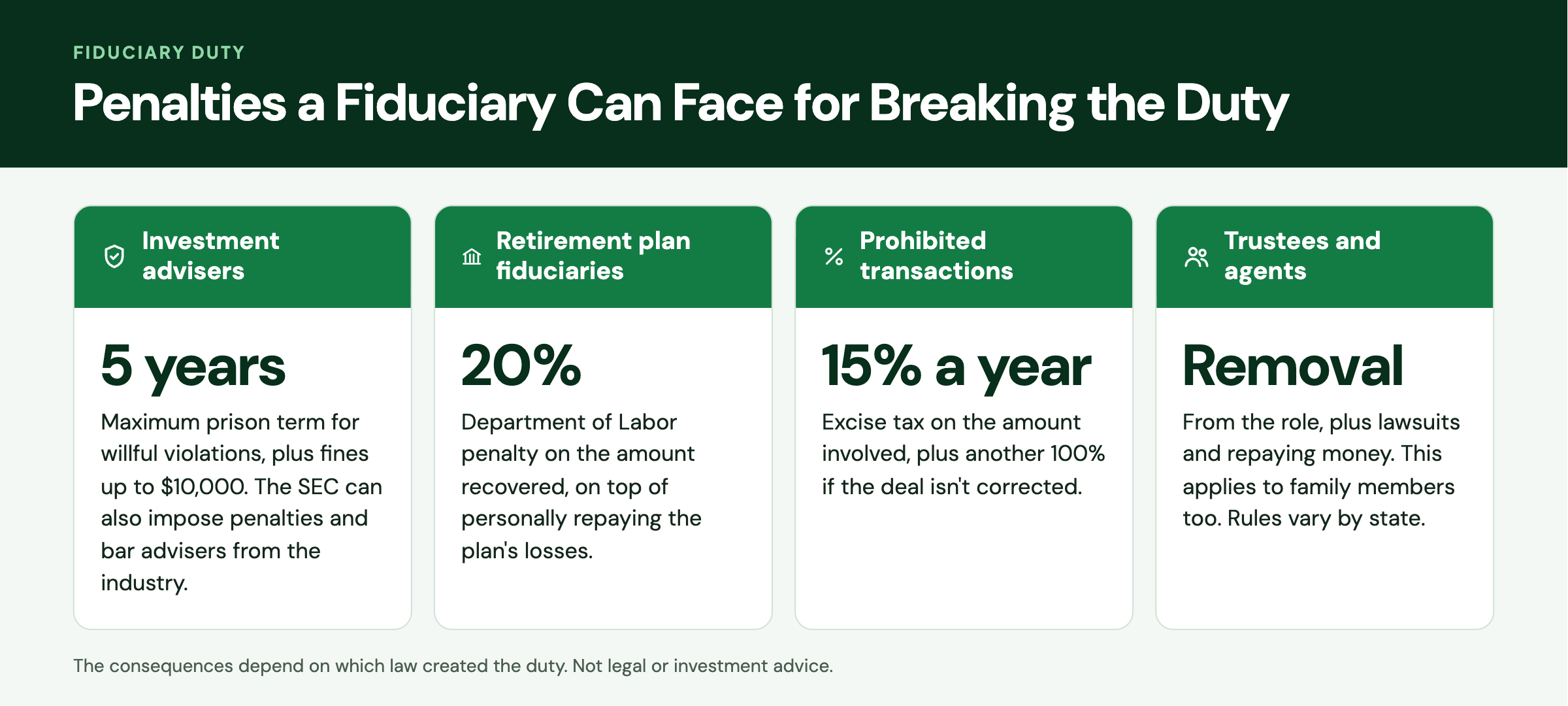
Willful violations can also be crimes. Anyone who willfully violates the Advisers Act, or a rule or order the SEC issues under it, faces a fine of up to $10,000, up to five years in prison, or both upon conviction(10).
The SEC's Division of Enforcement works with law enforcement agencies to bring criminal cases when appropriate(9).
What happens when a retirement plan fiduciary breaches the duty?
ERISA makes plan fiduciaries personally responsible. A fiduciary who breaches any of the duties ERISA imposes is personally liable to make good any losses the plan suffered from each breach, and to restore to the plan any profits the fiduciary made by using plan assets. A court can also order other relief, including removing the fiduciary from the role(11).
The DOL must assess a civil penalty equal to 20% of any amount recovered from a fiduciary through a settlement with the DOL or a court order in a case the DOL brings. The DOL may waive or reduce the penalty if it determines in writing that the fiduciary acted reasonably and in good faith, or that the fiduciary couldn't restore the losses without severe financial hardship, and the penalty is reduced by any tax imposed on the same transaction(12).
As a hypothetical example, if a plan fiduciary agreed in a DOL settlement to restore $200,000 to a plan, the 20% penalty would add $40,000, for a total of $240,000 before any waiver or reduction.
Some transactions are prohibited outright.
Federal tax law bars certain transactions between a retirement plan or IRA and a "disqualified person," a group that includes the plan's fiduciaries, people providing services to the plan and certain family members. Prohibited transactions include selling, exchanging or leasing property between the plan and a disqualified person, lending money between them, and a fiduciary dealing with the plan's income or assets in their own interest(13).
A disqualified person who takes part in a prohibited transaction, other than a fiduciary acting only in that role, owes an initial tax of 15% of the amount involved for each year, or part of a year, in the taxable period. If the transaction isn't corrected within that period, an additional tax of 100% of the amount involved applies(13). As a hypothetical example, a $50,000 prohibited transaction would trigger $7,500 in tax for each year in the taxable period, and failing to correct it would add a further $50,000.
What happens when a trustee or family member mismanages someone's money?
The duty applies just as firmly to family members. A person managing a relative's money in a role such as conservator has four basic duties, which are to act only in that person's best interest, manage the money and property carefully, keep it separate from their own, and keep good records. A fiduciary who doesn't meet these standards can be removed, sued or required to repay money, and in some cases can face a police investigation and jail(1). If you've been named to one of these roles and aren't sure what you're allowed to do, a lawyer can explain the specific rules that apply to you.
How can you tell whether your financial professional is a fiduciary?
Start with the relationship summary, also called Form CRS. Brokers and investment advisers must give retail investors this short, plain-English document, and it describes the services the firm offers, the fees and costs you'll pay, the firm's conflicts of interest, the standard of conduct that applies to its services, and whether the firm and its professionals have reportable legal or disciplinary history(14).
You can look up a firm's relationship summary, and confirm that a firm or individual is registered, using the free search tool on Investor.gov. Each summary also includes suggested questions to ask, such as how much of a $1,000 investment would go to fees and costs, how the professional's conflicts of interest might affect you, and whether your main contact is a representative of an investment adviser or a broker-dealer(14).
A few direct questions can fill in the rest:
- Will you act as a fiduciary for every recommendation you make to me, including rollovers and insurance products?
- How are you paid, and do you earn more if I choose one product over another?
- Will you put your answer to the first question in writing?
If someone tells you they hold the CFP® certification, you can confirm it with the verification tool on the CFP Board's website(8).
What do people commonly get wrong about fiduciaries?
Does disclosing a conflict make it acceptable?
Not by itself. Full disclosure and your informed consent mean the existence of the conflict doesn't violate the adviser's fiduciary duty, but they don't satisfy the adviser's separate obligation to act in your best interest(2). An adviser who has disclosed a conflict still has to give advice that fits your objectives.
Does "fee-based" mean the same thing as "fee-only"?
No. Under CFP Board standards, a CFP® professional may describe their compensation as "fee-only" only if neither they nor their firm receives sales-related compensation, such as commissions. A CFP® professional who uses "fee-based" or a similar term must clearly state that they or their firm earn both fees and commissions, or that they are not fee-only(8).
Does a fiduciary guarantee good results?
No. ERISA measures a plan fiduciary's conduct against what a prudent person would do under the circumstances prevailing at the time(4). The SEC requires an adviser to have a reasonable belief that its advice is in your best interest based on your objectives(2). For brokers, the SEC states that compliance with Regulation Best Interest's care obligation is evaluated as of the time of the recommendation, not in hindsight(5). None of these standards promises that an investment will make money.
Find a professional who will put your interests first
If you're comparing financial professionals, the questions above give you a consistent way to see which standard each one follows before you hand over your savings.
Nothing on this site constitutes investment advice. All investors are encouraged to conduct their own research before making any investment decision. Past performance is not a guarantee of future results.
Greensprout is an independent, advertising-supported publisher and comparison resource. We may earn compensation when you click on links to products from our partners. This does not affect our editorial standards or recommendations.
References
1. Consumer Financial Protection Bureau. "Managing Someone Else's Money: Help for Court-Appointed Conservators in Arizona." https://files.consumerfinance.gov/f/documents/cfpb_help-for-court-appointed-guardians_arizona.pdf
2. U.S. Securities and Exchange Commission. "Commission Interpretation Regarding Standard of Conduct for Investment Advisers," Release No. IA-5248. https://www.sec.gov/files/rules/interp/2019/ia-5248.pdf
3. 29 U.S.C. § 1002(21)(A), Definitions (Employee Retirement Income Security Act of 1974). https://www.govinfo.gov/content/pkg/USCODE-2021-title29/html/USCODE-2021-title29-chap18-subchapI-subtitleA-sec1002.htm
4. 29 U.S.C. § 1104, Fiduciary duties. https://www.law.cornell.edu/uscode/text/29/1104
5. U.S. Securities and Exchange Commission. "Regulation Best Interest: A Small Entity Compliance Guide." https://www.sec.gov/resources-small-businesses/small-business-compliance-guides/regulation-best-interest
6. 29 CFR § 2510.3-21, Definition of "Fiduciary." https://www.ecfr.gov/current/title-29/subtitle-B/chapter-XXV/subchapter-B/part-2510/section-2510.3-21
7. U.S. Department of Labor, Employee Benefits Security Administration. "US Department of Labor restores long-standing investment advice rule after pair of court decisions vacate 2024 retirement security rule." https://www.dol.gov/newsroom/releases/ebsa/ebsa20260318
8. CFP Board. "Code of Ethics and Standards of Conduct." https://www.cfp.net/ethics/code-of-ethics-and-standards-of-conduct
9. U.S. Securities and Exchange Commission. "How Investigations Work." https://www.sec.gov/enforce/how-investigations-work
10. 15 U.S.C. § 80b-17, Penalties. https://www.law.cornell.edu/uscode/text/15/80b-17
11. 29 U.S.C. § 1109, Liability for breach of fiduciary duty. https://www.law.cornell.edu/uscode/text/29/1109
12. 29 U.S.C. § 1132(l), Civil penalties on violations by fiduciaries. https://www.law.cornell.edu/uscode/text/29/1132
13. 26 U.S.C. § 4975, Tax on prohibited transactions. https://www.law.cornell.edu/uscode/text/26/4975
14. U.S. Securities and Exchange Commission, Investor.gov. "Relationship Summaries (Form CRS or Form ADV Part 3): Investor Bulletin." https://www.investor.gov/introduction-investing/general-resources/news-alerts/alerts-bulletins/investor-bulletins/relationship-summaries-form-crs-or-form-adv-part-3-investor-bulletin
15. Merriam-Webster. “Fiduciary.” https://www.merriam-webster.com/dictionary/fiduciary
16. Consumer Financial Protection Bureau. “Managing Someone Else’s Money: Help for Agents Under a Durable Power of Attorney.” https://files.consumerfinance.gov/f/documents/cfpb_msem_national_agents_guide.pdf
17. 20 CFR § 404.2035, What are the responsibilities of your representative payee? https://www.ssa.gov/OP_Home/cfr20/404/404-2035.htm