

Key takeaways
- The average retired worker received $2,087.52 a month as of August 2026, which comes to about $1,885 after the standard $202.90 Part B premium.
- Households headed by someone 65 or older put about 36% of spending toward housing and roughly 13% each toward food and health care, which makes housing the line with the most influence on whether a single check works.
- State-run Medicare Savings Programs can cover the Part B premium and more, and federal income limits aren't the final word, so applying is the only way to know.
- Social Security alone usually stays under the federal tax thresholds, but other income can push part of your benefits into taxable territory.
- Couples should test their budget against one benefit, because survivor and retirement benefits aren't added together.
Maybe the savings never grew the way you hoped, or a divorce, a layoff, or a stretch of medical bills used up what you'd set aside. Maybe there was never a pension to begin with. Whatever the route, a lot of people reach their 60s and realize that the monthly Social Security deposit isn't going to be one piece of their retirement income, it's going to be nearly all of it. For many people, that realization tends to arrive with one uneasy question, which is whether it’s going to be enough every month.
For many people it can, but only with a plan that starts from the check you'll receive and works outward, rather than from the life you'd like and works backward. Living on one fixed income means every category of spending has to earn its share of the same deposit, and small decisions about housing, health coverage, and taxes carry more weight than they would for someone drawing on savings.
This article walks through what the average benefit looks like once Medicare takes its cut, how retirees typically divide their spending, and the programs and timing choices that help a single check stretch further.
How many retirees depend mostly on Social Security?
39% of men and 44% of women Social Security beneficiaries 65 and older get at least half of their income from Social Security, with 12% of men and 15% of women rely on it for 90% or more of their income. Those reliance figures come from SSA research released in 2024 using 2015 data, which is the most recent breakdown the agency has published(1).
The size of the check you'd be living on depends on your work record and when you claimed, but the averages give a useful starting point. As of August 2026, the average monthly benefit for a retired worker was $2,087.52, which works out to about $25,050 a year(2). SSA's estimate for a couple where both spouses receive benefits was $3,208 a month after the 2026 cost-of-living adjustment (COLA, the annual inflation increase applied to benefits), and its estimate for a widow or widower living alone was $1,919(3).
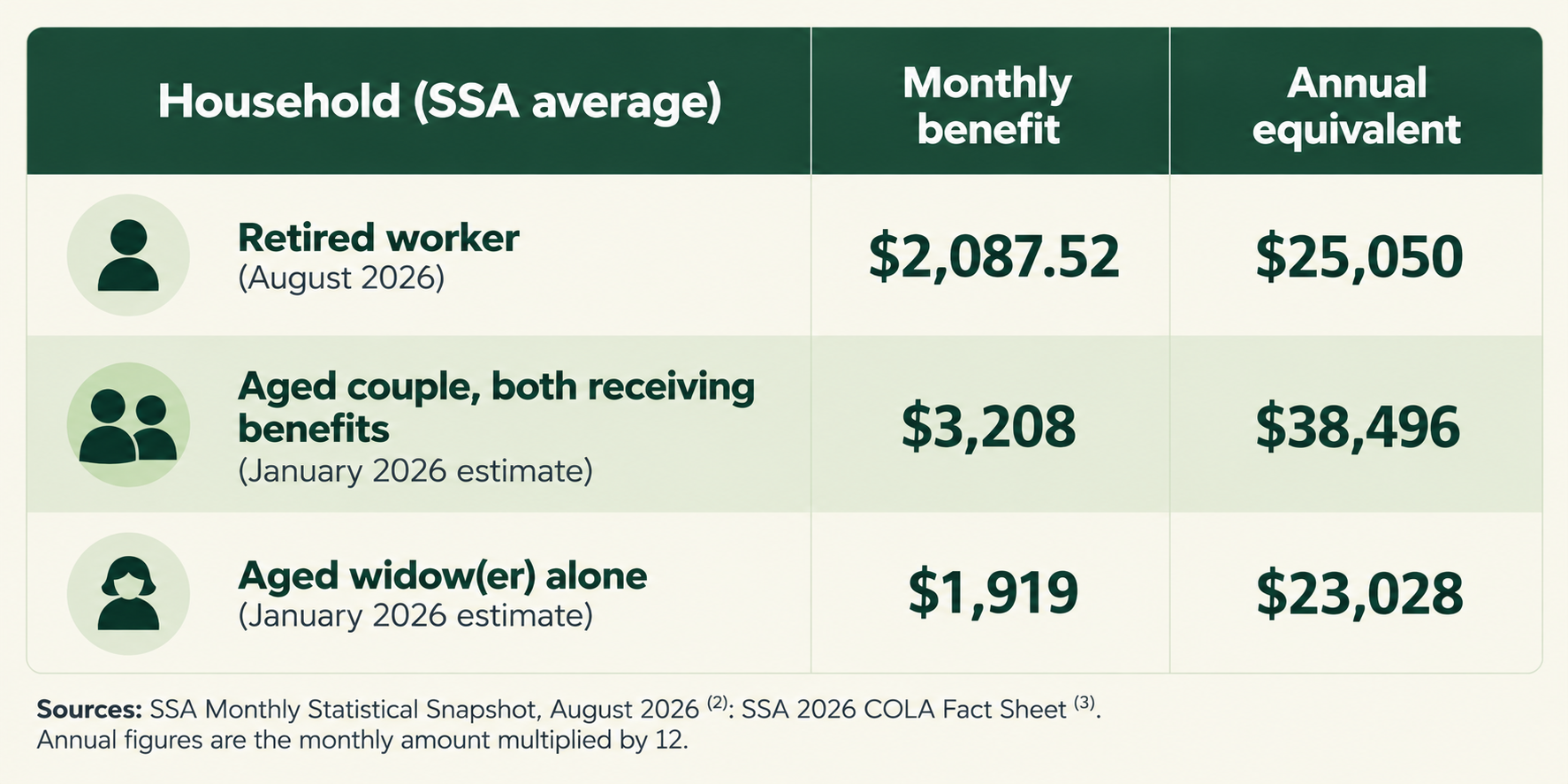
Your own figure is printed on your Social Security Statement or benefit letter, and it's the number every budget decision below should start from.
What's left of the check after Medicare takes its share?
The amount SSA announces isn't the amount that lands in your bank account. The standard Medicare Part B premium (the monthly charge for Medicare's medical insurance) is $202.90 for 2026, up $17.90 from 2025, and the Part B deductible is $283 for the year(4). Most people with Medicare have that premium deducted automatically from their Social Security payment, so it comes out before you ever see the money(5).
Here's what that does to the averages above, assuming everyone in the household pays the standard premium and has no other deductions.
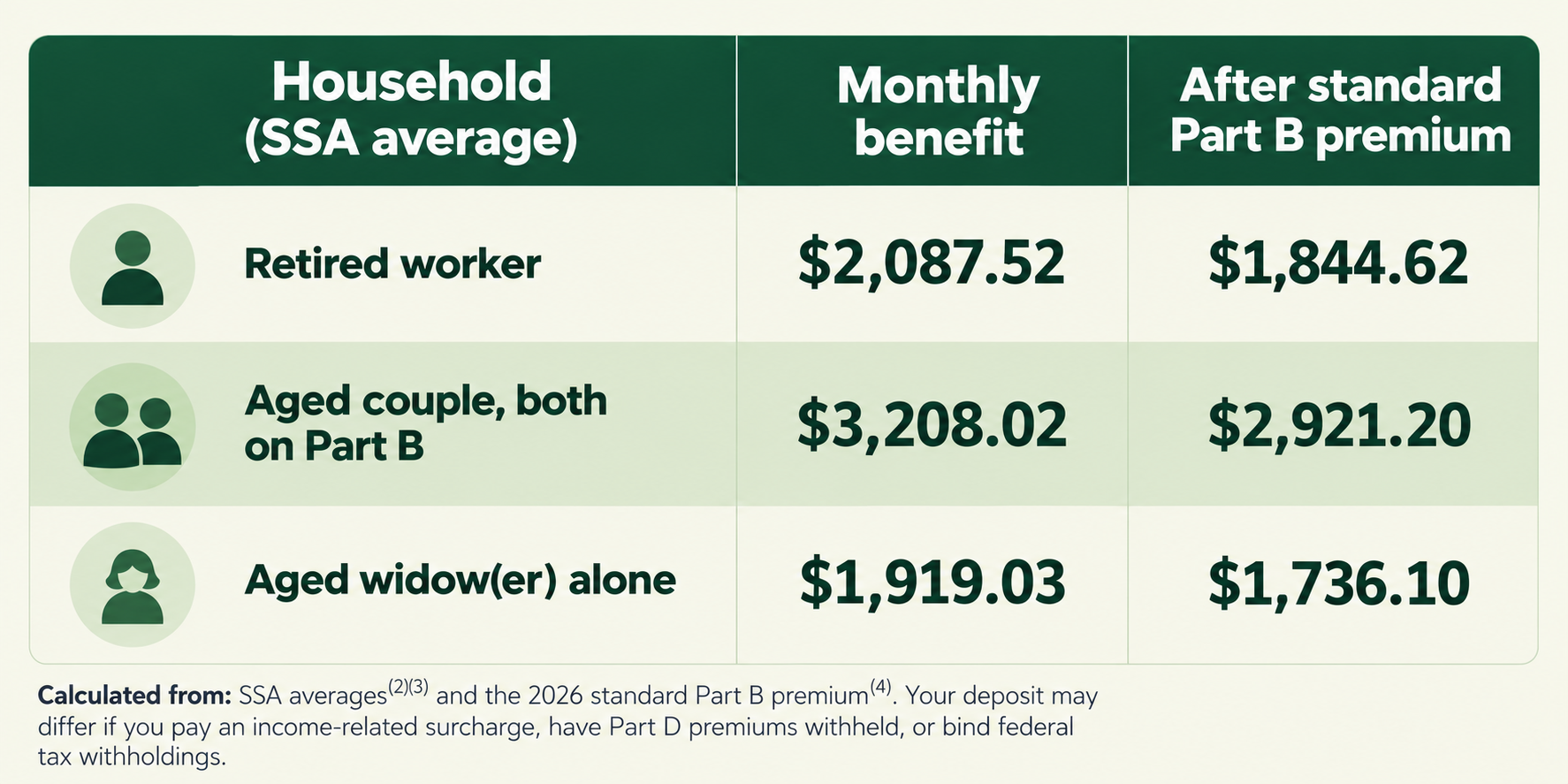
That net figure is the real budget. For the average retired worker, about $1,885 a month, or roughly $22,615 a year, has to cover housing, food, transportation, and every out-of-pocket health cost that Part B doesn't pay.
How does a typical retiree budget compare with Social Security alone?
The Bureau of Labor Statistics (BLS) tracks how households spend their money through its Consumer Expenditure Survey. In 2024, households headed by someone 65 or older spent an average of $61,432 for the year, on income before taxes of $67,462, with an average of 1.8 people per household(6).
That's about $5,119 a month in spending, close to two and a half times the average retired worker's benefit, which tells you the "average" retiree household is usually drawing on more than Social Security.
The proportions are more useful than the dollar totals. Those same households put 36.1% of their spending toward housing, 15.5% toward transportation, 12.9% toward food, and 12.7% toward health care, with everything else, including entertainment, clothing, personal care, and cash contributions to charities and family, making up the remaining 22.8%(6).
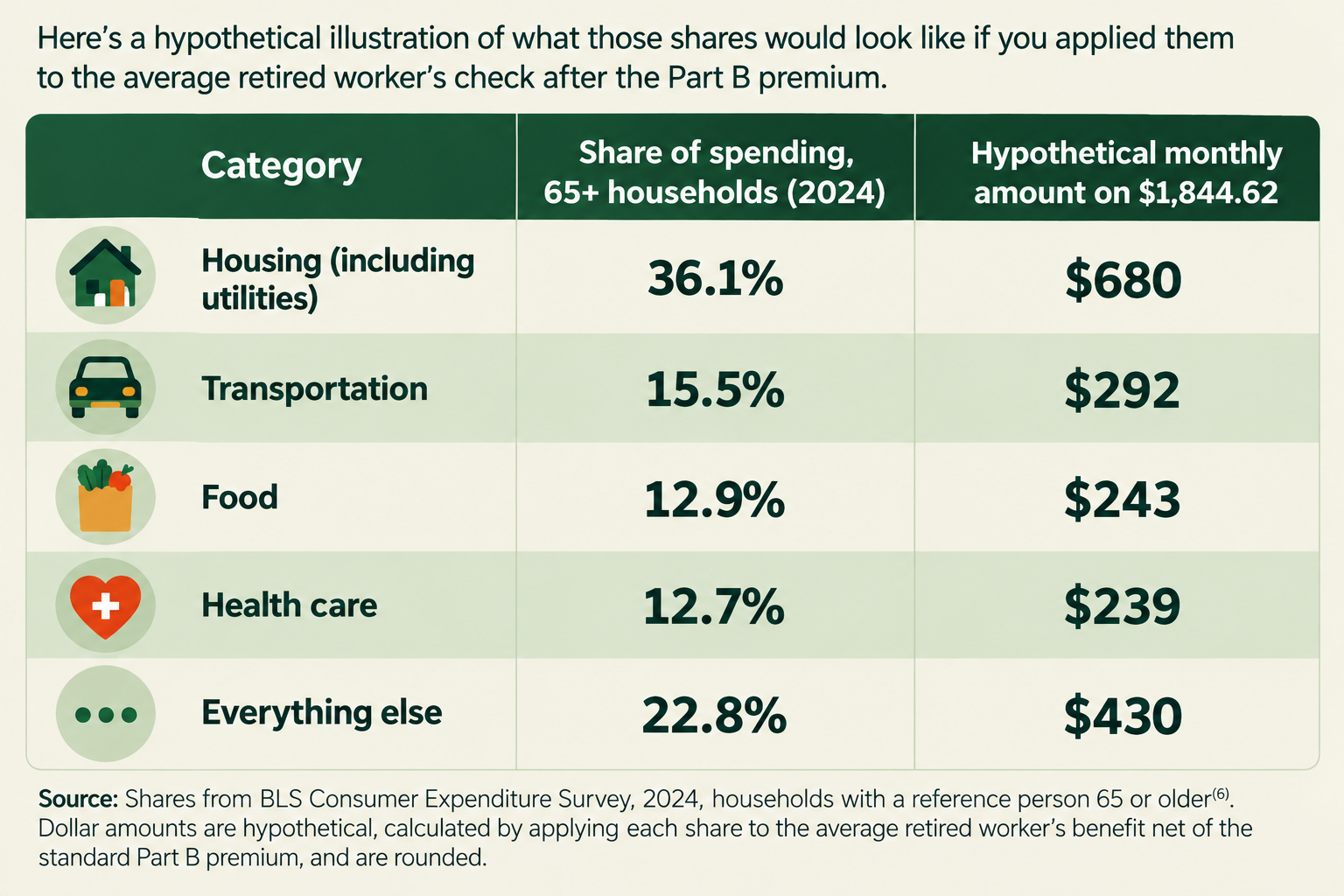
Few budgets will match those proportions exactly, and that's the reason to see them laid out. If your rent alone is $1,100, housing isn't taking 36% of your check, it's taking closer to 58%, and every other line has to shrink to make room. Seeing your own percentages next to the typical ones shows you quickly which category is under the most pressure and where any change will do the most good.
Where does housing fit when it's the largest line in the budget?
Housing deserves the closest look in a Social Security-only budget, because it's the biggest expense and the hardest to change month to month. Among households headed by someone 65 or older, 78% own their home and 22% rent, and utilities, fuels, and public services alone took 7.3% of their spending in 2024(6).
On the average net benefit in the table above, that utility share would be about $138 a month before rent, a mortgage, insurance, or property taxes enter the picture.
That's why a paid-off home changes the budget so dramatically for people living on one check. Without a mortgage or rent, the housing line shrinks to taxes, insurance, utilities, and upkeep, and the money that would have gone to a lender can cover food and health costs instead. Renters face a different challenge, because a lease renewal can raise the largest bill in the budget by more than the year's benefit increase, and that's why a smaller unit, shared housing, or a move to a lower-cost area is easier to weigh before it becomes urgent.
If you own, check which property tax relief or homestead programs your state and county offer older homeowners, since these programs vary by location and target the cost that keeps rising on a home you've already paid off.
How do you budget for health care on a fixed check?
Health care is the category where people on a single income are most likely to be surprised, because Part B's premium is only the starting cost. Households headed by someone 65 or older spent $7,799 on health care in 2024, including $5,107 on health insurance, $1,449 on medical services, and $898 on drugs(6).
For someone living on about $25,000 a year in benefits, that level of spending would take up close to a third of their income.
The programs that help most here are run by your state. Medicare Savings Programs can pay your Part B premium, and in some cases your deductibles, coinsurance, and copayments as well. Qualifying for the QMB, SLMB, or QI program also gets you Extra Help with prescription drugs, which caps what you pay at no more than $12.65 per covered drug in 2026(7).
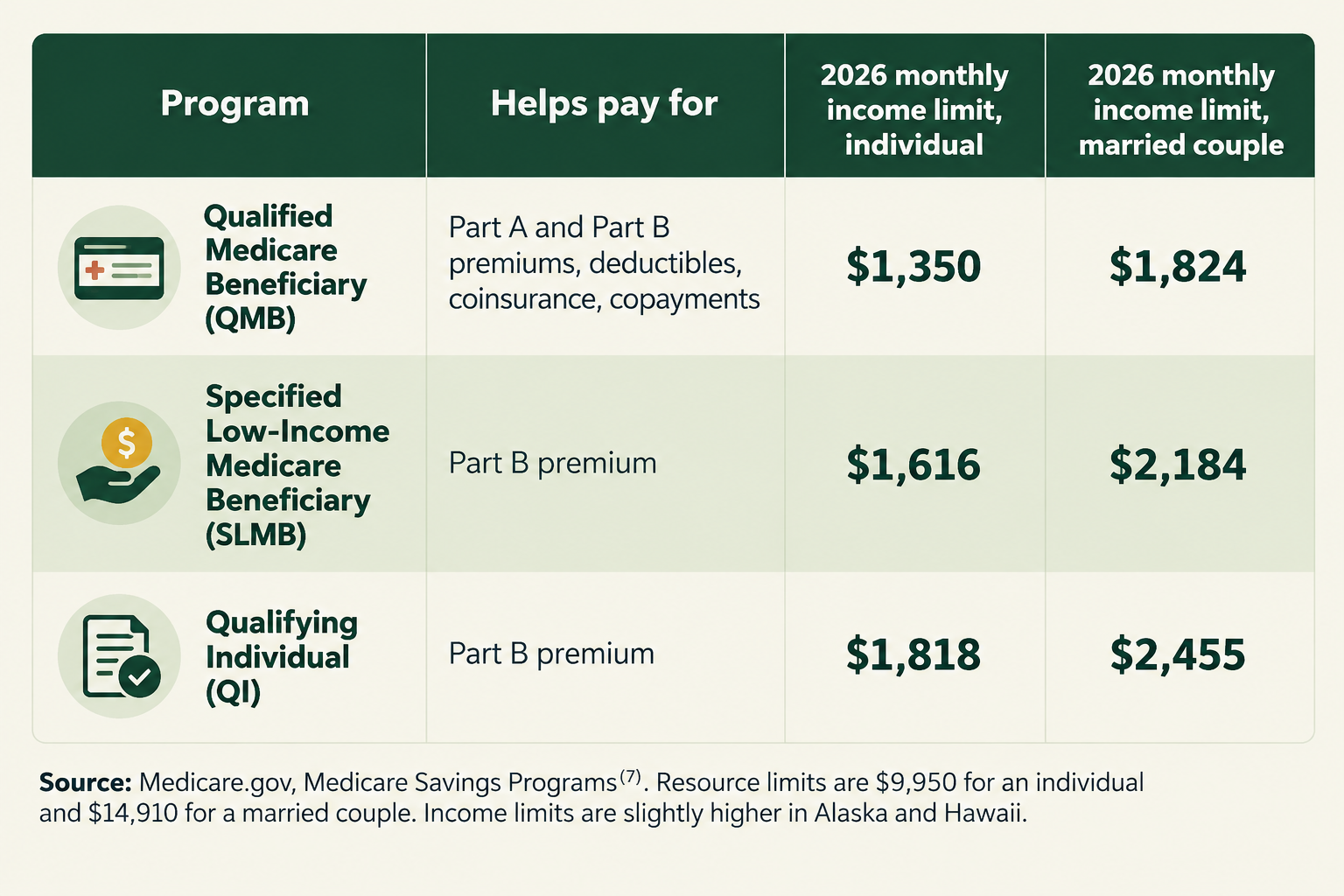
Those are federal limits, and Medicare notes that you may still qualify in your state even if your income or resources are higher, because some states don't count certain types or amounts of income. Medicare's guidance is to apply even if you don't think you'll qualify, and QI applicants have to reapply every year(7).
If you qualify for help with the Part B premium, the $202.90 that would have come out of your check stays in your budget, which adds up to $2,434.80 over a year.
Will you owe federal income tax on your benefits?
For many people living on Social Security alone, the answer is no, but the rules are worth understanding before you add any other income. The IRS looks at your modified adjusted gross income plus half of your benefits for the year, and if Social Security is the only income you received, your benefits may not be taxable and you may not need to file a return(8). SSA states that you'll pay federal income tax on your benefits once that combined income exceeds $25,000 a year if you file individually, or $32,000 if you file jointly(9).
Using the averages above, a retired worker's combined income would be about $12,525 (half of $25,050), and a couple's would be about $19,248 (half of $38,496), both well under those thresholds. The picture changes when a small pension, part-time job, or IRA withdrawal enters the mix. In a hypothetical example, a single retiree with the average benefit who also withdraws $19,000 from a traditional IRA would have combined income of about $31,525, which puts part of their benefits above the $25,000 threshold and into taxable territory.
Two other details help here.
For tax years 2025 through 2028, people 65 and older can claim an additional $6,000 deduction ($12,000 for a married couple where both qualify) on top of the existing extra standard deduction for seniors, with the deduction phasing out above $75,000 of modified adjusted gross income ($150,000 for joint filers)(10). And if some of your benefits will be taxable, you can ask SSA to withhold 7%, 10%, 12%, or 22% of each monthly payment so you aren't facing a single large bill in April(9).
How do food and everyday costs fit into the plan?
Food took 12.9% of spending among households headed by someone 65 or older in 2024, which on the average net benefit would be about $243 a month(6). Because food is one of the few categories that can increase weekly, it's also where people living on one check often feel the squeeze first, especially in months when a medical bill or car repair lands at the same time.
The Supplemental Nutrition Assistance Program (SNAP) has rules for older households that many retirees don't know about. Federal regulations define an elderly household member as someone 60 or older(11). Households that include an elderly member only have to meet SNAP's net income standard rather than both the gross and net standards, and they can deduct medical expenses above $35 a month for that member when their eligibility and benefit are calculated(12).
A retiree paying several hundred dollars a month in out-of-pocket medical costs may find that their countable income comes in lower than their benefit amount suggests, which is why it's worth checking eligibility through your state's SNAP office rather than ruling it out based on the size of your check.
What happens to a couple's budget when one spouse dies?
For couples living on Social Security alone, this is the planning step that shapes the surviving spouse's budget more than any other. When you're eligible for both a survivor benefit and another benefit, such as your own retirement benefit, SSA pays the one that works out best for you, and the two payments aren't added together(13). A household that was living on two checks is suddenly living on one.
The SSA averages show the scale of that change. The estimated average for an aged couple both receiving benefits was $3,208 a month in January 2026, while the estimate for an aged widow or widower living alone was $1,919(3). That's a drop of $1,289 a month, or about 40%, while many of the costs (property taxes, insurance, utilities, the car) stay the same or fall only slightly.
Couples can soften that drop by building the budget around the smaller of the two possible survivor incomes years before they need to, keeping housing costs at a level one benefit could support, and talking through which spouse's claiming decision affects the survivor benefit most. If the higher earner hasn't claimed yet, the section on claiming age below explains how that decision carries over to the survivor.
Can you organize your budget around when the money arrives?
Living on one deposit is easier when your bills line up with it. If you started benefits after April 30, 1997, your payment date depends on the birthday of the person whose record you're paid on, with the 1st through 10th paid on the second Wednesday of the month, the 11th through 20th on the third Wednesday, and the 21st through 31st on the fourth Wednesday. People who began benefits on or before April 30, 1997, or who receive both Social Security and Supplemental Security Income (SSI), are paid on the 3rd(14).
Knowing your date lets you schedule rent, utilities, and insurance autopays for the days just after your deposit, so the largest bills are covered before any discretionary spending happens. Keeping a one-month cushion in checking adds a second layer of protection, so a late or unusually large bill doesn't push you into overdraft fees or a high-interest card.
It also helps to budget for the January adjustment realistically. For 2026, the COLA was 2.8%, which raised SSA's estimated average retired-worker benefit from $2,015 to $2,071, an increase of $56(3). The Part B premium rose $17.90 over the same period(4), so roughly a third of that average increase went straight back out to Medicare before it reached the bank account.
What choices can still raise the check itself?
If you haven't claimed yet, your claiming age is the single biggest lever you control. For anyone born in 1960 or later, full retirement age (FRA) is 67, and claiming at 62 permanently reduces the benefit by 30%(15). Waiting past FRA adds 8% a year for anyone born in 1943 or later, and those increases stop at age 70(16). In a hypothetical example using the average retired worker's benefit as an FRA amount, waiting from 67 to 70 would raise $2,087.52 to about $2,588.52 a month, an increase of roughly $500 a month that lasts for life.
That increase also carries over to a surviving spouse, because a widow or widower is entitled to the same delayed retirement credit increase the deceased spouse had received or was eligible for(17).
Part-time work can also bridge the years before claiming or supplement a check that's already started. If you're under FRA for the full year and collecting benefits, SSA withholds $1 for every $2 you earn above $24,480 in 2026, and the earnings limit rises to $65,160 in the year you reach FRA, with $1 withheld for every $3 above it(3). Earnings below those limits don't reduce your benefit at all, and the limit disappears entirely once you reach FRA.
Here are a few mistakes worth avoiding
Budgeting from the gross benefit instead of the deposit. The benefit SSA quotes is the amount before the Part B premium and any other withholding. Building a budget from $2,087 instead of about $1,885 leaves a $200-a-month shortfall baked into the plan from the first month(4).
Assuming you earn too much for help. The federal Medicare Savings Program limits are lower than many people's benefits, but states can count income more generously, and Medicare's own guidance is to apply even if you don't think you'll qualify(7). The same logic applies to SNAP, where medical expenses above $35 a month can reduce countable income for anyone 60 or older(12).
Planning for two checks forever. Couples who build their spending around both benefits face the sharpest adjustment when one spouse dies, because the survivor keeps only the larger check(13). Testing your budget against a single benefit now shows whether the household could hold together on its own.
Where to go from here
If Social Security is going to cover most or all of your retirement, the margin for error is thin, and that's exactly why a second set of eyes on your claiming date, housing plan, and health coverage can make each dollar of that deposit go further. You don't need a large portfolio to get help seeing where your budget stands and which programs you might be leaving unclaimed.
References
1. Social Security Administration. "Fact Sheet: Social Security." https://www.ssa.gov/news/assets/materials/press/factsheets/basicfact-alt.pdf
2. Social Security Administration. "Monthly Statistical Snapshot, August 2026." Released September 2026. https://www.ssa.gov/policy/docs/quickfacts/stat_snapshot/
3. Social Security Administration. "2026 Cost-of-Living Adjustment (COLA) Fact Sheet." https://www.ssa.gov/news/en/cola/factsheets/2026.html
4. Centers for Medicare & Medicaid Services. "2026 Medicare Parts A & B Premiums and Deductibles." https://www.cms.gov/newsroom/fact-sheets/2026-medicare-parts-b-premiums-deductibles
5. Medicare.gov. "How to Pay Part A & Part B Premiums." https://www.medicare.gov/basics/costs/pay-premiums
6. U.S. Bureau of Labor Statistics. "Table 1300. Age of Reference Person: Annual Expenditure Means, Shares, Standard Errors, and Relative Standard Errors, Consumer Expenditure Surveys, 2024." https://www.bls.gov/cex/tables/calendar-year/mean-item-share-average-standard-error/reference-person-age-ranges-2024.xlsx
7. Medicare.gov. "Medicare Savings Programs." https://www.medicare.gov/basics/costs/help/medicare-savings-programs
8. Internal Revenue Service. "Topic No. 423, Social Security and Equivalent Railroad Retirement Benefits." https://www.irs.gov/taxtopics/tc423
9. Social Security Administration. "Request to Withhold Taxes." https://www.ssa.gov/manage-benefits/request-withhold-taxes
10. Internal Revenue Service. "Working Families Tax Cuts: Tax Deductions for Working Americans and Seniors." https://www.irs.gov/newsroom/working-families-tax-cuts-tax-deductions-for-working-americans-and-seniors
11. Electronic Code of Federal Regulations. 7 CFR 271.2, "Definitions." https://www.ecfr.gov/current/title-7/subtitle-B/chapter-II/subchapter-C/part-271/section-271.2
12. Electronic Code of Federal Regulations. 7 CFR 273.9, "Income and Deductions." https://www.ecfr.gov/current/title-7/subtitle-B/chapter-II/subchapter-C/part-273/subpart-D/section-273.9
13. Social Security Administration. "What You Could Get From Survivor Benefits." https://www.ssa.gov/survivor/amount
14. Social Security Administration. "Can I Change the Date I Receive My Benefits?" FAQ KA-01957. https://www.ssa.gov/faqs/en/questions/KA-01957.html
15. Social Security Administration. "Retirement Age and Benefit Reduction." https://www.ssa.gov/benefits/retirement/planner/agereduction.html
16. Social Security Administration. "Delayed Retirement Credits." https://www.ssa.gov/benefits/retirement/planner/delayret.html
17. Social Security Administration. Social Security Handbook, Section 720, "Delayed Retirement Credit." https://www.ssa.gov/OP_Home/handbook/handbook.07/handbook-0720.html
Average benefit figures reflect SSA's Monthly Statistical Snapshot for August 2026 and SSA's estimated averages for January 2026 after the 2.8% COLA. Medicare premium, deductible, and Medicare Savings Program limits reflect 2026 figures. Spending shares reflect the 2024 Consumer Expenditure Survey, the most recent published by BLS. Reliance statistics reflect SSA research released in 2024 using 2015 data. Examples labeled hypothetical are illustrations only. All sources were verified against their live pages on October 13, 2026. This article should be updated when SSA announces the 2027 COLA and CMS publishes 2027 Medicare amounts.
General information: This article is for general educational purposes only and isn't legal, tax, investment, or insurance advice. Social Security, Medicare, tax, and public benefit rules depend on your work record, birth year, household, income, state of residence, and other personal factors, and they can change. Before making claiming, budgeting, or enrollment decisions, consider speaking with a qualified financial professional or tax advisor about your specific situation. For free, unbiased help with Medicare costs and savings programs, contact your State Health Insurance Assistance Program (SHIP) at shiphelp.org, or call 1-800-MEDICARE (1-800-633-4227; TTY 1-877-486-2048). For questions about your Social Security benefits, contact the Social Security Administration at 1-800-772-1213.
Investment disclaimer: Nothing on this site constitutes investment advice. All investors are encouraged to conduct their own research before making any investment decision. Past performance is not a guarantee of future results.
Medicare/Insurance disclaimer: Medicare plan availability and costs vary by location. Contact a licensed Medicare advisor or visit Medicare.gov to compare plans available in your area.
Editorial independence: Greensprout's editorial team writes on behalf of the reader. Our goal is to provide clear, useful information to help you make better financial decisions. Our editorial content is not influenced by advertiser relationships.
Affiliate disclosure: Greensprout is an independent, advertising-supported publisher and comparison resource. We may earn compensation when you click on links to products from our partners. This does not affect our editorial standards or recommendations.