As costs continue to climb at the pump, the grocery store and across the economy as a whole, Buy Now, Pay Later (BNPL) plans offer a way to finance everyday purchases.
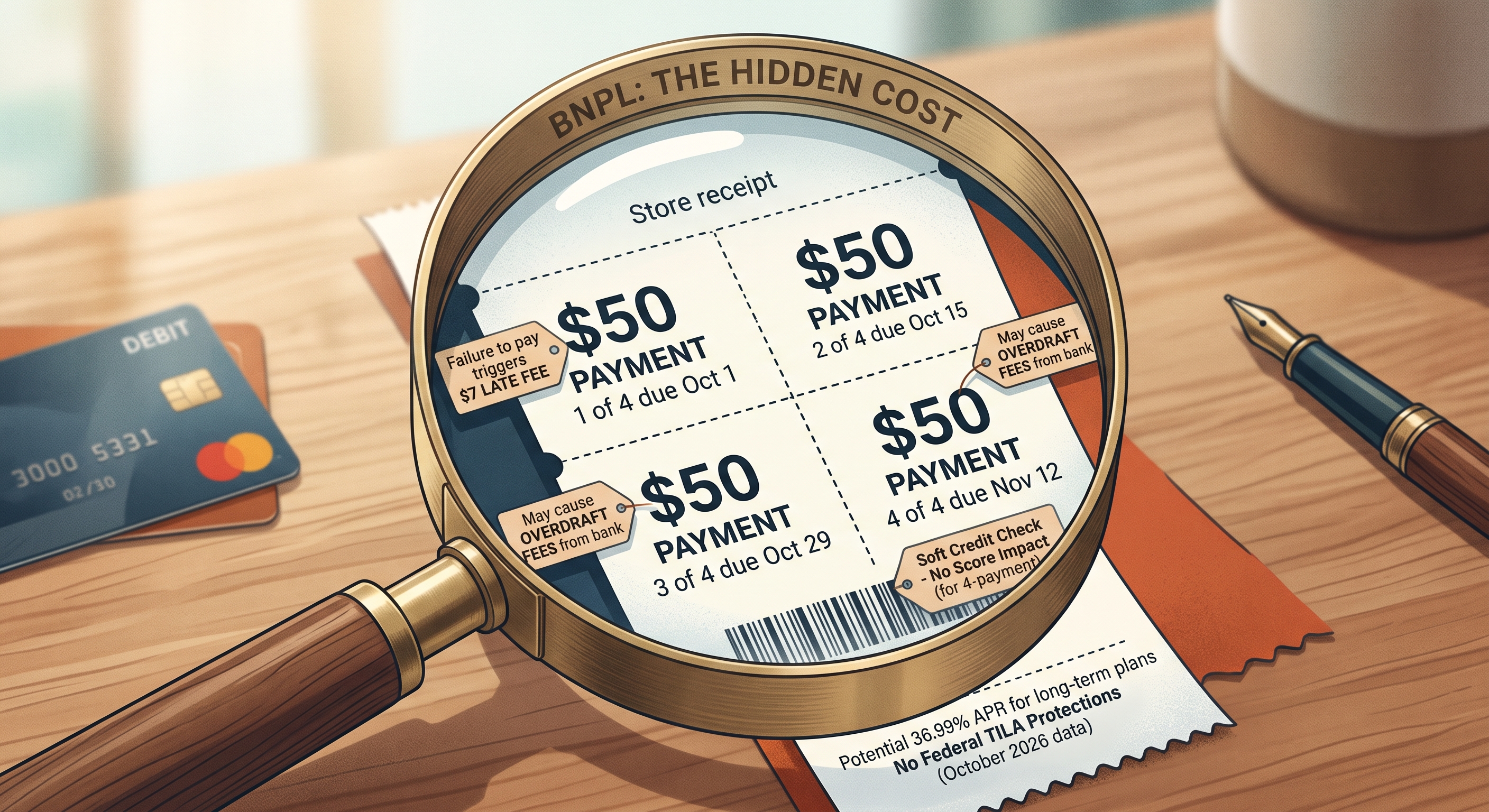
At the checkout, BNPL offers can turn a $200 purchase into four equal payments of $50, free of interest. According to Gallup's May 2026 survey data, approximately one in four Americans frequently (10%) or occasionally (17%) uses installment plans for online purchases.1
While these plans can make immediate expenses feel manageable, BNPL carries hidden costs and risks that can be easy to overlook.
Here’s a breakdown of how BNPL works, the costs and risks involved, the protections afforded to consumers, and how it affects your credit score.
How BNPL Works: Standard Plans vs. Long-Term Installments
At its core, BNPL is a form of short-term financing for retail purchases that breaks them down into smaller installments. The service generally splits into two distinct products:
- Standard "Pay-in-Four" plans: You pay 25% of the total purchase price upfront at checkout. The remaining 75% is divided into three equal installments due every two weeks over six weeks. These short-term loans typically carry no interest if paid on time.2
- Longer-term installment plans: For larger purchases—such as furniture, home appliances or electronics—providers offer monthly payment terms stretching from three to 36 months. Unlike pay-in-four plans, these longer BNPL plans frequently carry interest rates, with Annual Percentage Rates (APRs) reaching up to 36.99% depending on your credit profile.3
Repayment is designed to be automatic for BNPL plans. During checkout, you’re required to link a repayment method, such as a debit card, credit card or directly linked checking account. Once configured, payments are automatically deducted on scheduled due dates without requiring further action from you.
Hidden Costs of BNPL: From Late Fees to Loan Stacking
While pay-in-four plans are advertised as interest-free, the financial risks often show up in indirect fees, behavioral traps and cashflow issues.
Here are the main risks involved with using BNPL services.
Late Fees, Overdraft Fees and NSF Charges
If an automatic payment attempt fails due to insufficient funds, BNPL providers may charge you late fees. Fee structures vary by provider, with some charging fixed penalties while others cap fees at a percentage of the loan amount.
According to data from the Consumer Financial Protection Bureau (CFPB), the average borrower is charged $7 in late fees per missed payment for an average loan of $135.4
Similarly, if a payment fails due to insufficient funds, you may be charged a non-sufficient funds (NSF) fee or an overdraft fee by your bank, depending on its policy. The average NSF fee is $16.82 and the average overdraft fee is $26.77, according to recent survey data from Bankrate.5
Overextension and Loan Stacking
One of the best things about BNPL plans is also what makes them risky: it’s quick and generally easy to get approved.
Because BNPL providers perform only a soft credit inquiry and consider a range of factors during the application process, it’s usually easy enough to get approved for an installment plan.
If you’re already running on a tight budget or dealing with cashflow issues, it can be tempting to take out multiple BNPL plans, known as “loan stacking”.6 While you might be able to pay back each BNPL loan individually, the total sum of your debts could cause severe financial distress.
Similarly, loan stacking can cause you to default on other types of debt with less forgiving terms, such as credit card debt, auto financing loans and mortgage payments.
Overspending
BNPL offers tap into consumer psychology, breaking large payments down into smaller-looking chunks. Combine this with fast approval and frictionless checkout experiences, and it’s easy to see how BNPL loans can lead you down a slippery slope.
Often, BNPL financing can encourage you to make purchases you’d otherwise not be able to afford.
According to CFPB data, consumers with deep subprime credit scores accounted for 45% of BNPL originations between 2021 and 2022, while 63% of total borrowers engaged in loan stacking.7
Those who are already financially vulnerable are often the most susceptible to the risks of BNPL financing. For example, data from LendingTree’s 2026 Buy Now, Pay Later Report showed that 47% of BNPL users paid late on at least one loan in the past year.8
Generally speaking, BNPL should be used for essential item purchases only, and with a clear, realistic payment plan in place before taking out the loan.
What BNPL Costs Mean for Fixed-Income Households
For households living on fixed incomes, such as retirees relying on Social Security, pensions or structured investment withdrawals, BNPL creates specific budget vulnerabilities, including the following:
- Biweekly cadence vs. monthly income: Social Security benefits and retirement annuities arrive on a fixed monthly schedule. Pay-in-four plans operate on a strict 14-day cycle. Over time, biweekly due dates may drift across the calendar, causing withdrawal attempts to land days before retirement funds deposit.
- Cashflow bottlenecks: When a fixed income is tightly allocated toward utilities, housing and groceries, unexpected automated debits can trigger bank overdrafts or force households to delay essential purchases.
If you rely on fixed-income payouts, it’s essential to ensure you have enough cash flow before taking out BNPL loans, especially on long-term installment payments with interest.
BNPL Consumer Protections: What You Are (and Aren't) Guaranteed
A common misconception among consumers is that BNPL loans carry the same legal protections as standard credit cards. Under federal law, consumer protections for BNPL users remain limited and unstandardized.
In May 2024, the CFPB issued an interpretive rule attempting to classify BNPL providers as “card issuers” under Regulation Z and the Truth in Lending Act (TILA). That rule would have guaranteed consumers credit-card-style rights, such as mandatory written billing statements, standardized dispute procedures and explicit refund credits during merchant disputes.
However, as of May 2025, the CFPB officially withdrew the May 2024 interpretive rule and signaled that it wouldn’t prioritize enforcement or issue a replacement rule.9
That means as of October 2026, consumers don’t have guaranteed federal credit-card-style dispute or chargeback rights on BNPL transactions.
For example, if an item arrives damaged, defective or never ships at all, you cannot automatically withhold payment under federal TILA rules as you would with a credit card.
Similarly, when returning an item to a merchant, you generally must continue making scheduled biweekly payments to the BNPL provider until the merchant completes processing and refunds the lender. If the merchant delays processing the credit, stopping payments prematurely can result in late fees or negative account flags.
How BNPL Affects Your Credit Score
BNPL loans can affect your credit score, but the effects remain inconsistent and vary by loan type and provider.
As of 2026, the major credit bureaus have developed specialized frameworks to receive point-of-sale loan data, but participation among BNPL lenders is far from universal.10 Some major providers supply data regularly, while others don’t report standard short-term pay-in-four loans to avoid skewing consumer credit profiles.
Opening a standard pay-in-four loan almost always involves a soft credit check, which doesn’t impact your credit score. However, applying for longer-term financing (12 months or longer) typically requires a hard credit inquiry, which can temporarily lower your credit score by a few points.11
Where BNPL loans are reported, they are categorized as installment loans rather than revolving credit. This distinction carries important implications:
- Credit utilization: BNPL balances don’t count toward your credit card utilization ratio.
- Average age of accounts: Opening several short-term BNPL accounts over a brief period can lower the overall average age of your credit accounts, which may temporarily dip your credit score depending on the scoring model used.
To BNPL or Not?
Buy Now, Pay Later is neither an inherently predatory debt trap nor a completely harmless payment method.
Compared to traditional credit cards, which charge high ongoing interest rates on carried balances but offer guaranteed federal dispute protections and monthly billing cycles, BNPL provides zero-interest short-term financing at the expense of rigid biweekly schedules and weaker legal safety nets.
Using BNPL can be a practical, cost-effective choice when replacing high-interest credit card debt for a necessary, budgeted purchase, provided every upcoming biweekly payment can be made.
Conversely, the financing model tends to create financial strain when used to justify impulse purchases, when applied on a fixed monthly income with non-negotiable cashflow dates or when used as a substitute for depleted cash reserves and maxed-out credit limits.
Ultimately, BNPL works best as a deliberate cash management strategy for planned expenses rather than an ongoing way to stretch a budget beyond its natural limits.
Sources
1. Gallup. “Buy Now, Pay Later in U.S. Shopping” https://news.gallup.com/poll/709937/buy-pay-later-shopping.aspx
2. CFPB. “The Buy Now, Pay Later Market” https://files.consumerfinance.gov/f/documents/cfpb_bnpl-market-report_2025-12.pdf
3. CBS News. “"Buy now, pay later" plans can rack up steep interest charges. Here's what shoppers should know.” https://www.cbsnews.com/news/buy-now-pay-later-loans-interest-rate-fees-tips-what-to-know/
4. CFPB. “Buy Now, Pay Later: Market trends and consumer impacts” https://files.consumerfinance.gov/f/documents/cfpb_buy-now-pay-later-market-trends-consumer-impacts_report_2022-09.pdf
5. Bankrate. “Overdraft fees vs. NSF fees: How they differ” https://www.bankrate.com/banking/checking/overdraft-fees-vs-nsf-fees/#key-difference
6. CFPB. “Buy Now, Pay Later: Market trends and consumer impacts” https://files.consumerfinance.gov/f/documents/cfpb_buy-now-pay-later-market-trends-consumer-impacts_report_2022-09.pdf
7. CFPB. “Consumer Use of Buy Now, Pay Later and Other Unsecured Debt” https://files.consumerfinance.gov/f/documents/cfpb_BNPL_Report_2025_01.pdf
8. LendingTree. “BNPL Tracker: Nearly Half of BNPL Users Have Paid Late in the Past Year, Up for a Second Straight Year” https://www.lendingtree.com/personal/buy-now-pay-later-loan-statistics/
9. CFPB. "Buy Now, Pay Later (BNPL) products" (documents the May 12, 2025 withdrawal of the 2024 interpretive rule) https://www.consumerfinance.gov/compliance/compliance-resources/consumer-cards-resources/buy-now-pay-later-bnpl-products/ and CFPB. "CFPB Announcement Regarding Enforcement Actions Related to Buy Now, Pay Later Loans" https://www.consumerfinance.gov/about-us/newsroom/cfpb-announcement-regarding-enforcement-actions-related-to-buy-now-pay-later-loans/
10. TransUnion. “BNPL and Point-of-Sale Lending: Insights for Lenders and Furnishers” https://www.transunion.com/blog/bnpl-and-point-of-sale-lending
11. CFPB. “Will a Buy Now, Pay Later (BNPL) loan impact my credit scores?” https://www.consumerfinance.gov/ask-cfpb/will-a-buy-now-pay-later-bnpl-loan-impact-my-credit-scores-en-2117/