

Key takeaways
- An annuity's guarantees are only as strong as the insurer behind them, and guaranty association protection is limited by state law.
- Fixed and fixed indexed annuities generally protect you from market losses, while RILAs and variable annuities can lose value, and RILA floors and buffers behave very differently in a steep decline.
- Indexed annuity returns are reduced by caps, participation rates, spreads, and excluded dividends, which work like fees even when none are listed.
- Variable annuity costs stack, and surrender periods often run six to ten years or longer.
- Nonqualified withdrawals come out as taxable earnings first, and an annuity inside an IRA adds no extra tax deferral.
Ask a handful of people what they think of annuities and you’ll rarely get a shrug. Some will call theirs the smartest money move they ever made, and others will tell you to walk out of any meeting where the word comes up. What you won’t usually get from either side is a plain explanation of what you’d be buying, what it would cost you each year, and what you’d be giving up in exchange.
That’s a real problem when the decision involves handing a large share of your savings to an insurance company under a contract that can run for decades. The pitch usually leads with the guarantee and the protection from market losses, while the fee schedule and the withdrawal limits sit in a contract or prospectus you’re expected to read on your own.
This guide covers how annuities work, the main types, each common layer of cost, how the Internal Revenue Service (IRS) taxes the money coming out, and where an annuity can and can’t fit in your plan. There are no product recommendations or company names here, only the mechanics, so you can read any offer with a clear eye and decide for yourself.
What are you agreeing to when you buy an annuity?
An annuity is a contract between you and an insurance company. You pay the insurer a single lump sum or a series of payments, and in return the insurer agrees to pay you income on a regular schedule, beginning right away or at a future date. You can also take your contract’s value as a lump sum instead, although that can trigger surrender charges (fees for pulling money out during the contract’s early years), taxes, and tax penalties.
Every promise in the contract depends on the insurer’s financial strength and claims-paying ability, meaning its capacity to pay what it owes policyholders, so a company in serious financial trouble may not be able to pay you. Before you buy, do your due diligence to make sure the insurer has a solid reputation and the ability to fulfill its financial obligations to you over the long term(1).
That gives every annuity decision two halves, the product and the institution standing behind it. If an insurer fails, state guaranty associations protect policyholders in their state, but only up to limits set by state law. For annuities, those limits apply to the present value of your annuity benefits, meaning what your future payments are worth in today’s dollars. The limits differ from state to state, and the National Organization of Life & Health Insurance Guaranty Associations lists each state’s coverage on its website(2).
Checking an insurer’s financial strength is something you can do before you sign. You can review the company’s rating from an independent rating agency, look at the insurer’s own website, or ask the salesperson for more information, and your state insurance department may have more information about the company. You can find your state insurance department’s contact information through the National Association of Insurance Commissioners (NAIC) website(3).
When do the payments start?
Annuities fall into two broad groups based on when the income starts. An immediate annuity is one that begins paying you soon after you buy it, typically within one year of a single lump-sum payment. A deferred annuity is one that begins paying at a later date you choose, so you pay in once or over time and your money grows tax-deferred in the meantime (you don’t owe tax on the growth until you take money out), during a stretch called the accumulation phase. For both types, the period when income payments begin is called the payout phase(1,3). Deferred annuities are where the product types, fees, and withdrawal rules multiply, so that’s where this guide spends its time.
When you convert a contract into a stream of payments (a step called annuitizing), common choices include payments for your lifetime, for the longer of your lifetime or your spouse’s, for a set number of years, or for the longer of your lifetime or a set period. Once payments begin, you generally can’t take other money out or change the payment amount. If you die after annuitizing, your survivors may receive nothing unless the contract guarantees to return at least what you paid in or your payout option keeps paying after your death. Before you annuitize, a basic death benefit usually pays your beneficiaries the greater of the account value or the minimum guaranteed surrender value, which is the least the contract promises you could cash it in for(3).
What are the four main types of deferred annuities?
Deferred annuities come in four main types, listed here in order of increasing risk, and some contracts combine features from more than one(1).
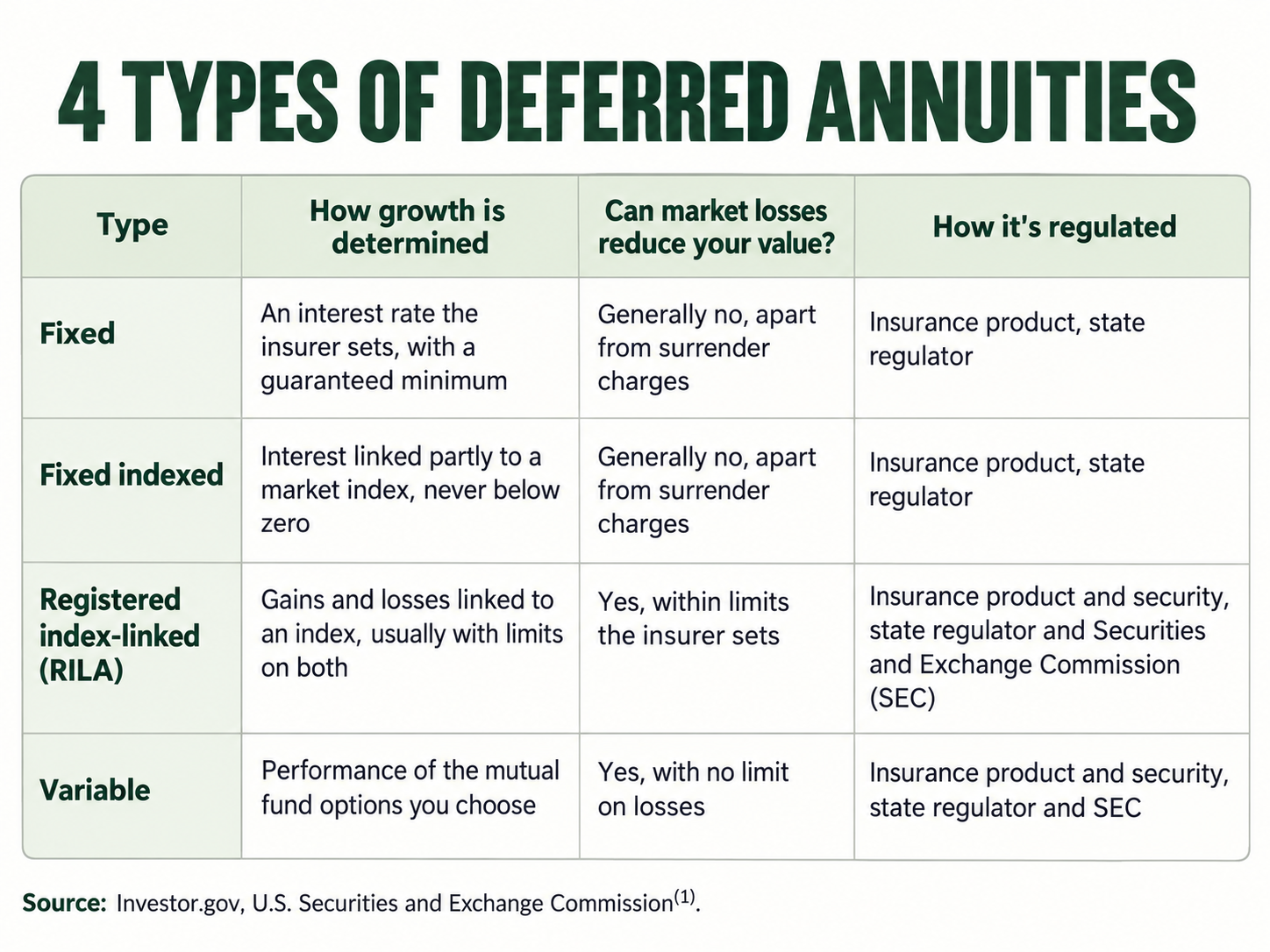
Being registered as a security means a RILA or variable annuity is also subject to federal securities laws and comes with a prospectus, a detailed document describing the contract that you should read carefully before buying(1).
Fixed annuities
A fixed deferred annuity earns interest at a rate the insurer sets, usually for a period such as a year. When that period ends, the insurer sets a new rate that could be higher or lower, but the guaranteed minimum rate stated in your contract can’t change for as long as you own it(3).
Fixed indexed annuities
A fixed indexed annuity earns interest based in part on how a market index (a measure of how the market or part of it performs, such as the S&P 500 Index) does over a set term, such as one year. The insurer credits that interest at the end of the term, so you don’t know the rate in advance, but the credited rate is guaranteed never to fall below zero even in a down market(1). You aren’t investing directly in the index, and if you take money out before a term ends, the insurer may not credit all of the index-linked interest for that term(3).
Registered index-linked annuities
A registered index-linked annuity, often shortened to RILA, also ties your results to an index, but your contract value can go down when the index performs poorly. The insurer generally sets parameters that limit both your gains and your losses(1).
Those loss limits come in two common forms that behave very differently in a bad year. A floor caps your total loss, so with a 10% floor and a 12% index decline, you’d lose 10%. A buffer (sometimes called a shield) has the insurer absorb the first losses, so with a 10% buffer and the same 12% decline, you’d lose only 2%(4).
Hypothetical illustration: On a $100,000 contract with a 12% index decline, the 10% floor costs you $10,000 and the 10% buffer costs you $2,000. In a steeper hypothetical decline of 30%, the order flips, because the floor still limits your loss to $10,000 while the buffer absorbs only the first 10% and leaves you with a $20,000 loss.
Variable annuities
A variable annuity lets you direct your money to a menu of investment options, typically mutual funds, and your contract value rises and falls with those funds. The insurer can change the options it offers, and you can lose money, including the money you originally put in(5).
How does an indexed annuity decide what you earn?
The word “indexed” suggests you’ll earn what the index earns, but the formula the insurer uses to calculate the return it credits to your account each term usually hands you less than the full move, and these limits show up in both fixed indexed annuities and RILAs(1,4).
- Dividends are usually left out. If an index returns 7% in a year and 2.5% of that came from dividends, many indexed annuities would treat 4.5% as the index’s return.
- A participation rate gives you a share of the gain. With a 75% participation rate and a 10% index return, the annuity would credit 7.5%.
- A cap sets a ceiling. With a 7% cap and a 12% index return, only 7% would be credited.
- A spread subtracts a set amount. With a 3% spread and a 9% index return, the annuity would credit 6%.
These features can be stacked, so a 75% participation rate plus a 3% spread on a 10% index return credits 4.5%. Contracts commonly let the insurer change features such as the cap from period to period, and these limits can reduce your return the same way a direct fee would, even on an annuity marketed as having no fees(4).
Hypothetical illustration: On $100,000, that stacked example credits $4,500 for a year in which the index rose 10%. What you get for accepting that limit is the other side of the formula, which in a fixed indexed annuity means a year credited at zero rather than a loss when the index falls(1).
What does an annuity cost?
Fees reduce your annuity’s value regardless of how you pay them. Some are explicit fees the insurer subtracts from your contract’s value, and others are implicit costs that are harder to spot but reduce your value just the same(1).
Explicit fees in variable annuities
Variable annuities charge several ongoing and transaction-based fees, and they stack on top of each other(1,3,5).
- Base contract fee. Often called the mortality and expense (M&E) risk charge, this pays the insurer for the insurance risk it takes on under the contract. It’s a percentage of your contract value, such as 1.25% a year, and part of it may go toward your financial professional’s compensation.
- Administration fees. These run either as a flat charge (perhaps $25 or $50 a year) or as a percentage of your account value, typically around 0.15% a year.
- Underlying fund fees. You indirectly pay the expenses of the mutual funds you choose, on top of the insurer’s charges.
- Optional benefit fees. Riders (optional add-on features, covered in more detail below) carry their own charges. Examples include enhanced death benefits, which can raise what your beneficiaries receive, and living benefits, which guarantee income or value while you’re alive. Some contracts also add sales loads (a charge deducted from each payment you make into the contract) or fees for moving money between investment options.
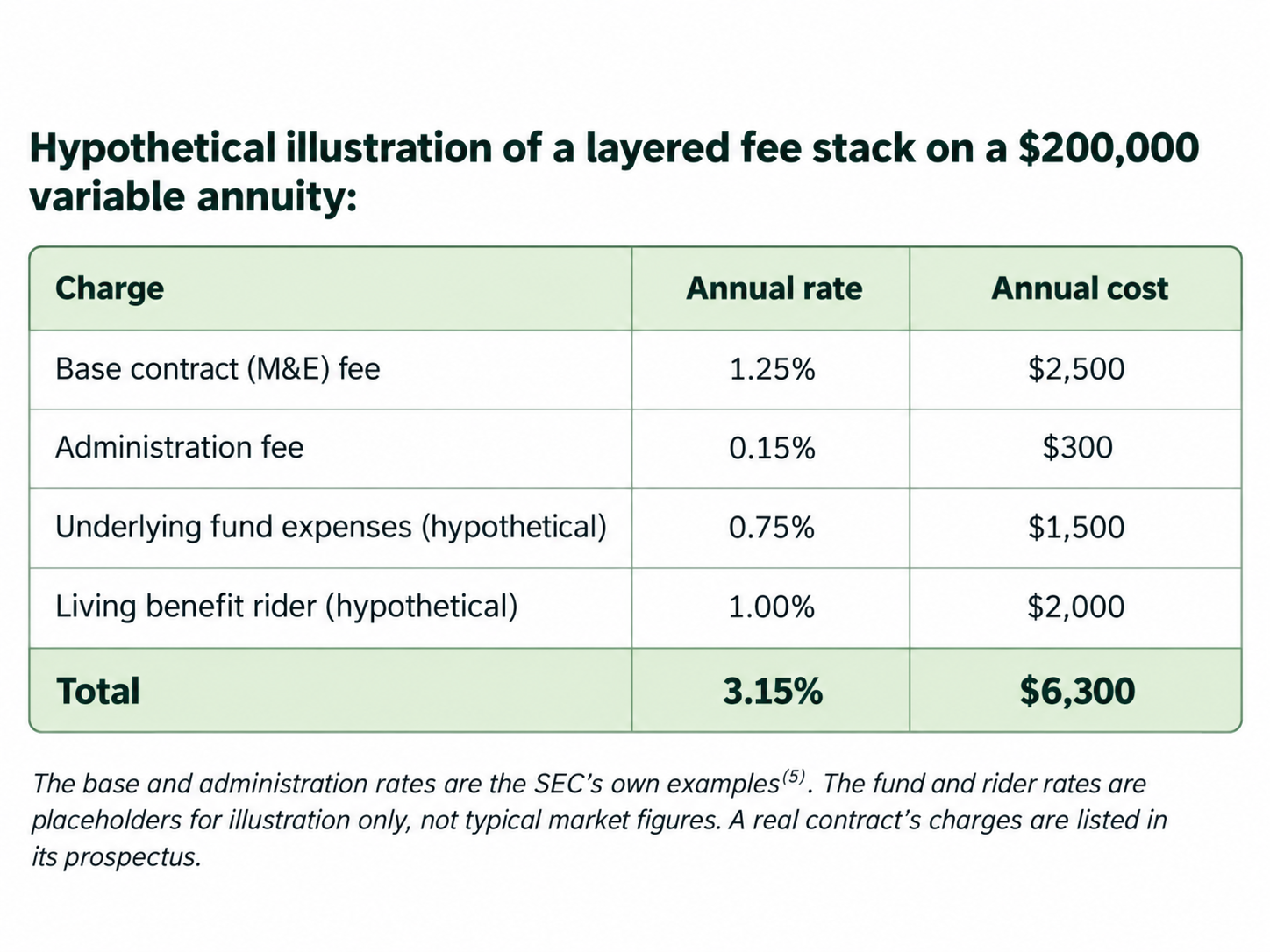
The base and administration rates are the SEC's own examples(5). The fund and rider rates are placeholders for illustration only, not typical market figures. A real contract's charges are listed in its prospectus.
Implicit costs in fixed, fixed indexed, and registered index-linked annuities
Many fixed annuities, fixed indexed annuities, and RILAs don’t charge explicit ongoing fees, but that doesn’t make them free. The insurer may credit you less interest than it earns on your money (for example, crediting 3% while it earns 4%), or it may cap your gains in exchange for the downside protection it provides(1).
Surrender charges and contract adjustments
Many annuities charge a surrender charges if you take out money within a certain number of years after buying or adding to the contract, and the charge generally shrinks over time(1). That surrender period typically lasts six to ten years, or even longer(4). Many contracts with surrender charges let you withdraw a set amount each year, usually up to 10% of the value, without the charge(3).
Hypothetical illustration: Say you own a $150,000 annuity in a year when its surrender charge is 6%, and you need $40,000 for a new roof. If the contract allows 10% a year without a charge, the first $15,000 comes out free and the charge applies to the remaining $25,000, which costs you $1,500 before any taxes. Contracts calculate surrender charges in different ways, so your actual figure depends on your contract’s terms.
Some annuities also apply a market value adjustment or interim value adjustment, which raises or lowers your contract’s value, when you withdraw or transfer money before the end of a specified period. With a market value adjustment, if interest rates are higher than when you bought the annuity, the adjustment could reduce what you can take out, and if rates are lower, it could increase it. These adjustments are often negative, can significantly lower your value, and come on top of any surrender charge, and withdrawals can shrink benefits such as death benefits by more than the amount you took out(1,3).
Bonus credits
Some annuities advertise a bonus, an extra amount the insurer adds based on a percentage of your purchase payments (the money you pay into the contract), typically between 1% and 5%. On a $100,000 purchase with a 3% bonus, the insurer adds $3,000, but annuities offering bonuses may charge higher fees than those that don’t, and those fees can outweigh the bonus(5).
What do optional riders promise, and what do they cost?
Riders are optional add-on features that cost extra, and they may carry investment restrictions. Their value can be sharply reduced if you withdraw more than a set amount or before a certain age, so before paying for one, consider whether you need it and whether you could buy the same protection more cheaply on its own, such as through a separate long-term care policy. Some riders charge a fee to add them and others charge an ongoing fee for as long as you keep them, and you’ll find the charges in your contract or, for a variable annuity, its prospectus(1,3,5).
Living benefits guarantee income or value while you’re alive, and two common versions work like this(3,5).
- Guaranteed lifetime withdrawal benefit. You can withdraw up to a set amount each year for life regardless of market performance, such as 6% of your purchase payments a year even if your contract value falls to zero. On $200,000 of purchase payments, that example works out to $12,000 a year.
- Guaranteed minimum income benefit. This sets a minimum value you can convert into income payments, for example your initial purchase payments growing at 5% a year.
Withdrawals under a lifetime withdrawal benefit reduce your own contract value, and the guarantee is what keeps the payments coming if that value reaches zero. An income benefit usually has to be chosen when you buy the annuity and generally requires you to annuitize to use it(3). Many of these guarantees are contingent, meaning they protect you from unlikely events such as severe market losses or an unusually long life, so you may pay for a benefit that never provides a financial return(1).
How does the IRS tax the money coming out?
Annuities grow tax-deferred, so you owe no federal tax on gains until you withdraw money, start income payments, or a death benefit is paid. When gains do come out, they’re taxed as ordinary income rather than at the lower capital gains rates(1,3,5).
Withdrawals before income begins
For an annuity you bought directly from an insurer rather than through a retirement plan (a nonqualified annuity), a withdrawal before payments begin is treated as coming from earnings first, which is the taxable part, and only then from your cost (generally the after-tax money you paid in, which the IRS calls your investment in the contract), which comes back tax-free. Contracts bought before August 14, 1982, follow a different order for money invested before that date. If you’re under 59½, the taxable part generally also faces a 10% additional federal tax, with exceptions that include death, total and permanent disability, a terminal illness certification, a series of substantially equal periodic payments (regular payments taken at least once a year over your life expectancy), and payments from an immediate annuity that begin within one year of purchase(6).
Hypothetical illustration: You paid $100,000 into a nonqualified annuity that’s now worth $140,000, and at age 57 you withdraw $30,000. Because earnings come out first and you have $40,000 of earnings, the entire $30,000 is taxable as ordinary income, and the 10% additional tax adds $3,000 on top of your regular income tax.
Income payments after you annuitize
Once you annuitize a nonqualified annuity, each payment is split into a tax-free return of your cost and a taxable portion. Under the method the IRS calls the General Rule, the tax-free share comes from the ratio of your cost to your total expected return (the total you can expect to receive under the contract), figured with IRS life expectancy tables. For annuities starting after 1986, the total you can exclude can’t exceed your cost, and any cost you haven’t recovered by death can be deducted on your final tax return(6).
Hypothetical illustration: If you paid $100,000 and the IRS tables put your expected return at $160,000, then 62.5% of each payment would be tax-free until you’ve recovered the full $100,000, and payments after that point are generally fully taxable.
Exchanges and retirement accounts
You can exchange one annuity for another without owing tax on the gain at the time of the exchange, as long as the annuitant (the person whose life the contract’s payments are based on) stays the same(1). Taxes are only part of that decision, though, since an exchange can trigger a surrender charge on the old contract and start a new surrender period on the new one, and the person suggesting it may have a financial incentive to do so. Holding an annuity inside a traditional individual retirement account (IRA) or 401(k) adds no extra tax deferral, because the account already provides it(1).
Where can an annuity fit in a retirement plan?
Annuities can do a few specific jobs, each with a price, so the first question is how one would fit your broader plan, including your goals, risk tolerance, cash needs, and the other investments you already own(1).
Turning savings into income you can’t outlive. Annuitizing provides protection against the possibility of outliving your assets, and you may be able to choose between payments fixed in amount and payments that vary with investment performance(5). A fixed payment stays the same dollar amount for as long as it lasts, so it’s fair to ask how that income would hold up as your living costs rise over a long retirement.
Extra tax deferral after other accounts are full. Before buying an annuity for tax deferral, it’s fair to ask whether you’re already taking full advantage of 401(k)s, 403(b)s, and IRAs(3). For variable annuities, the benefit of tax deferral generally outweighs the costs only if you hold the contract for the long term(5).
A deferred income start inside a retirement account. A qualifying longevity annuity contract (QLAC) is a special annuity you can buy inside a traditional IRA or certain workplace plans, though not a Roth IRA. Its payments must begin no later than the first day of the month after you turn 85, the IRS caps how much you can put into one, and before payments begin its value is left out of the balance used to calculate your required minimum distributions, which are the withdrawals the IRS requires you to take from these accounts each year once you reach a certain age(7).
Where annuities don’t fit is just as clear. Annuities are only appropriate for investors with a long-term time horizon(1). Money you might need for a home repair, a medical bill, or a family emergency in the next several years runs straight into surrender charges, contract adjustments, and possible tax penalties if it’s locked inside a contract.
What should you ask before you sign anything?
A salesperson recommending an annuity is expected to base it on your full financial picture, including your age, assets, debts, income, tax status, risk tolerance, goals, and how you plan to use the annuity. Anyone selling you an annuity must be licensed by your state insurance department, anyone selling a variable annuity must also be registered with the Financial Industry Regulatory Authority (FINRA), an independent self-regulatory organization that oversees the securities industry, and you can ask directly how they earn money from the sale. Once you receive the contract, many states give you a free look period, usually 10 to 30 days, to return it and get back either all of your money or your current account value, depending on your state(3,4).
You can also look up a broker or investment adviser with the SEC’s Check Out Your Investment Professional tool on Investor.gov to see whether they’re registered and whether they have any disciplinary history(5).
Which assumptions about annuities tend to trip people up?
“No fees” means no cost. An indexed annuity marketed as fee-free still limits your return through caps, participation rates, and spreads, and those limits reduce your return the same way a direct fee would(4).
An annuity in an IRA adds a tax advantage. It doesn’t, because the IRA already defers taxes(1). Any case for one there has to rest on other features, such as guaranteed income.
The guarantee is backed by the government. Annuity guarantees depend on the issuing insurer’s financial strength and claims-paying ability(1). State guaranty associations offer a backstop if an insurer fails, but that protection is capped by state law(2), which is why the insurer’s financial health deserves as much attention as the product’s features.
Getting a second opinion before you commit
If an annuity proposal is sitting on your kitchen table right now, the hard part isn’t understanding the brochure. It’s knowing whether this contract, at this cost, does a job your plan needs done, or whether you’d be paying for guarantees you’ll never use while locking up money you might need. A fiduciary financial advisor, meaning one who’s obligated to act in your best interest, can test the proposal against your Social Security timing, your other accounts, and your cash needs before anything is signed.
Important disclosures
Annuity disclosure: Annuities are long-term insurance contracts, not bank deposits. All guarantees are subject to the financial strength and claims-paying ability of the issuing insurance company. Variable annuities and registered index-linked annuities are securities offered by prospectus, which you should read carefully before investing. Features, fees, and availability vary by contract and by state. This article describes annuity types in general and does not recommend any product, insurer, or strategy.
Tax disclosure: This article describes federal tax rules in general terms and is not tax advice. Tax laws change, and state rules may differ. Consult a qualified tax professional about your situation before buying, exchanging, or withdrawing from an annuity.
Investment disclaimer: Nothing on this site constitutes investment advice. All investors are encouraged to conduct their own research before making any investment decision. Past performance is not a guarantee of future results.
Editorial independence: Greensprout's editorial team writes on behalf of the reader. Our goal is to provide clear, useful information to help you make better financial decisions. Our editorial content is not influenced by advertiser relationships.
Affiliate disclosure: Greensprout is an independent, advertising-supported publisher and comparison resource. We may earn compensation when you click on links to products from our partners. This does not affect our editorial standards or recommendations.
References
1. U.S. Securities and Exchange Commission, Investor.gov. "Annuities." https://www.investor.gov/introduction-investing/investing-basics/investment-products/annuities
2. National Organization of Life & Health Insurance Guaranty Associations (NOLHGA). "How You're Protected." https://nolhga.com/policyholders/how-youre-protected/
3. National Association of Insurance Commissioners. "Buyer's Guide for Deferred Annuities" (2013 revision, as hosted by the Maine Bureau of Insurance). https://www.maine.gov/pfr/insurance/themes/insurance/pdf/consumer-guides/pdf/buyers_guide_deferred_annuities.pdf
4. U.S. Securities and Exchange Commission, Investor.gov. "Updated Investor Bulletin: Indexed Annuities." https://www.investor.gov/introduction-investing/general-resources/news-alerts/alerts-bulletins/investor-bulletins/updated-investor-bulletin-indexed-annuities
5. U.S. Securities and Exchange Commission, Investor.gov. "Variable Annuities." https://www.investor.gov/introduction-investing/investing-basics/investment-products/annuities/variable-annuities
6. Internal Revenue Service. "Publication 575, Pension and Annuity Income." https://www.irs.gov/publications/p575
7. Internal Revenue Service. "Instructions for Form 1098-Q." https://www.irs.gov/instructions/i1098q