
Key takeaways
- Sellers over 60 in 2025 downsized by only about 100 square feet on average, and their new home's median price was close to their old home's sale price, so downsizing doesn't automatically mean a big cash windfall(1).
- Staying in a paid-off home still costs over $21,000 a year on average once maintenance, taxes, insurance, and utilities are included(5).
- Selling costs, including agent commission, escrow, and title fees, typically run 6% to 8% of the sale price before you've spent anything on the next move(7,8).
- The $250,000/$500,000 capital gains exclusion covers most home sales, but long-time owners in high-appreciation markets should calculate their actual gain before assuming it's fully tax-free(9).
- Home equity lines, home equity loans, and reverse mortgages offer ways to access equity while staying in place, each with different costs and tradeoffs worth comparing carefully.
You've probably thought about it more than once. The house is paid off or close to it, the kids are gone, and the idea of a smaller place with less upkeep sounds appealing. But selling the home you've lived in for decades is one of the biggest financial moves you'll make in retirement, and getting the decision wrong in either direction can cost you tens of thousands of dollars, whether that's from selling too soon and giving up ground you didn't need to, or holding on too long and paying for space and maintenance you don't need.
If you’re weighing the pros and cons of downsizing, you might be surprised to learn that sellers over 60 who moved in 2025 only gave up an average of just 100 square feet, and paid a median of $409,000 for the smaller home after selling their old one for a median of $433,000(1).
That's not the dramatic cash-out people picture when they imagine downsizing. It's a modest trade, and it comes with its own selling costs, moving costs, and tax questions attached.
But staying put comes with its own hidden costs. Three out of four adults 50 and older say they want to remain in their current home as they age, but 44% also expect they'll eventually have to move, most often because of rising costs tied to the mortgage or rent, property maintenance, and taxes(2). Neither path is free, and neither is automatically the smarter one. Here's how to think about your own situation, rather than relying on a general assumption about which option saves more.
Why this decision is harder than it looks
More than 70 million Americans are now 65 or older, and baby boomers have become the largest share of both home buyers and sellers in the country(3). Decades of home price growth have left many of them equity rich. Median home equity among homeowners 65 and older reached $250,000 in 2025, and more than 78% of that age group owns their home outright or with a mortgage(4).
That equity is exactly why the downsizing decision feels so consequential. For most people over 65, the home is the single largest asset on the balance sheet, often larger than retirement accounts combined. Selling it converts that equity into cash you can spend, invest, or use to cover long-term care. Keeping it preserves a paid-off or low-cost place to live, along with the property tax protections and familiarity that come with staying somewhere for years.
The reasons people expect to move are almost entirely financial, with 71% citing rising housing costs, 60% citing property maintenance, and 55% citing property taxes(2). Those are the same three categories worth pricing out before deciding anything.
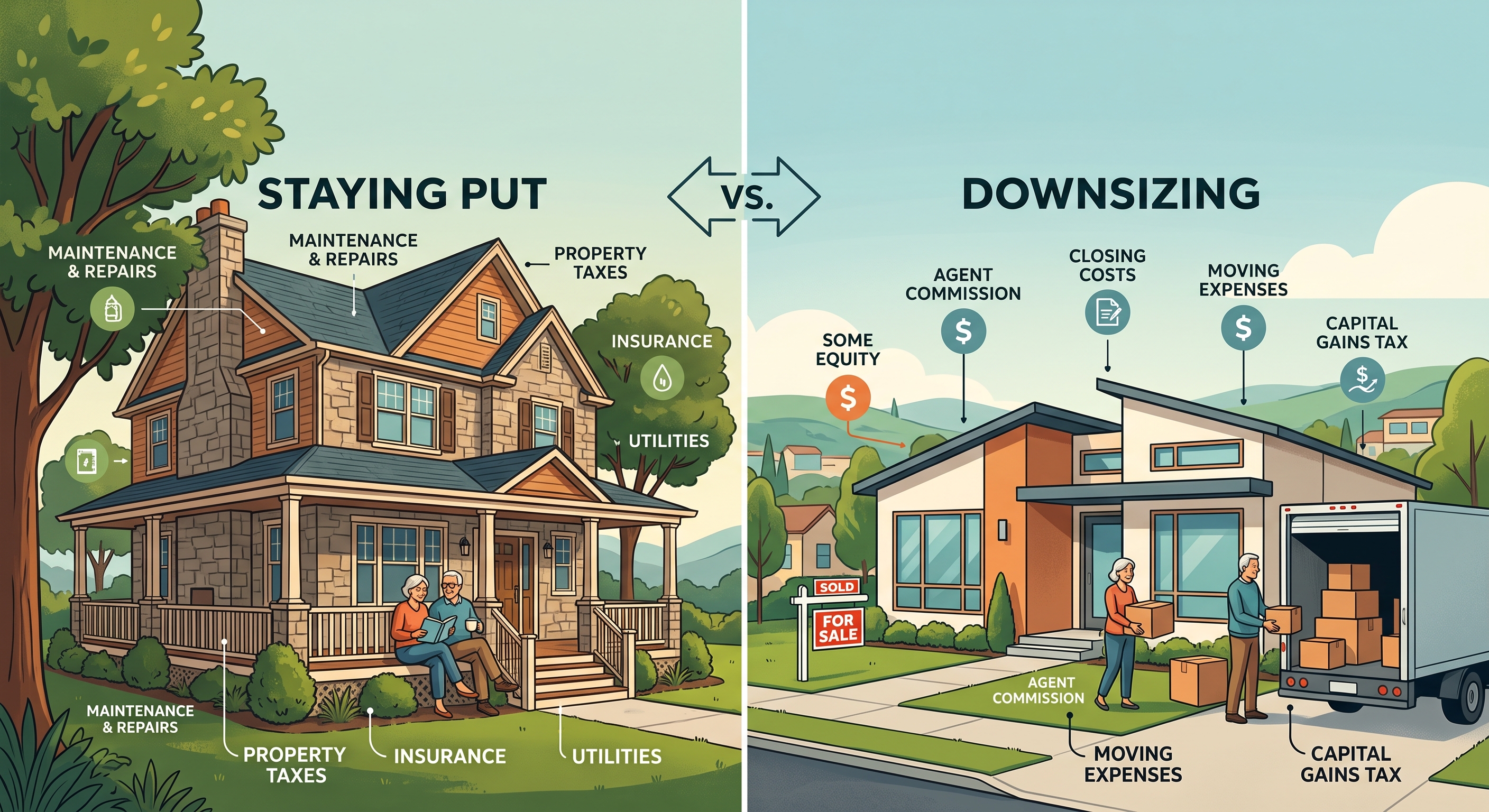
What staying put really costs
Staying in a paid-off or nearly paid-off home feels like the free option, but it isn't. Bankrate's 2025 study on home maintenance costs found that the typical single-family home costs over $21,000 a year to maintain and operate, once property taxes, insurance, maintenance, and utilities are added together(5). Home maintenance alone averages $8,808 a year nationally, and that's before property taxes, insurance, or utilities are factored in(5). None of those costs disappear once the mortgage is gone.
Here is a breakdown of some of the most common expenses:
Maintenance and repairs. Bankrate recommends budgeting up to 4% of your home's value annually for upkeep and repairs combined, split roughly into 1% for routine maintenance and 1% to 3% set aside for repairs(5). On a $400,000 home, that's a $4,000 routine maintenance budget plus another $4,000 to $12,000 held in reserve for the larger, less predictable repairs. Older homes with aging roofs, HVAC systems, and plumbing tend to land at the higher end of that range.
Property taxes. These rarely go down, and in many markets they climb even after a home is paid off. Some states offset this for older homeowners through homestead exemptions, assessment freezes, or tax ceilings tied to age. Florida's Save Our Homes program, for example, caps annual increases in assessed value for homesteaded property at 3% or the rate of inflation, whichever is lower, and lets homeowners carry up to $500,000 of that accumulated savings, called portability, to a new Florida home if they move(6). Programs like this vary significantly by state, so it's worth checking with your county assessor before assuming your current tax break would or wouldn't transfer.
Accessibility modifications. Over half of adults 50 and older say they'll need a home that supports independent aging, and grab bars, entryway changes, and kitchen modifications are the most commonly anticipated upgrades(2). These costs are typically in the thousands, not the tens of thousands, but they're easy to underestimate if you're planning to stay for decades.
What downsizing really costs
Downsizing isn't a clean cash-out either. Selling a home involves several layers of cost that reduce what lands in your account.
Here is a breakdown of some of the most common expenses:
Agent commissions. Real estate commissions typically run 5% to 6% of the sale price combined between the listing agent and buyer's agent, though this is negotiable and has shifted somewhat since 2024 industry rule changes(7). On a $400,000 home, that's $20,000 to $24,000 before anything else is subtracted.
Closing costs. Separate from commission, sellers cover a mix of transfer taxes, title-related fees, and escrow fees, which vary by state and transaction. Title-related fees average around $1,600, and escrow fees commonly run 1% to 2% of the sale price(8). These add up to a real, if smaller, cost on top of the mortgage payoff and commission.
Moving expenses. A professional local move commonly can run upwards of a couple thousand dollars, and a long-distance move can run several thousand more depending on the size of your household and the distance involved. Get quotes early since prices vary widely by season and region.
Buying the smaller place. This is where the NAR numbers are most revealing. Sellers over 60 downsized their square footage by only about 100 square feet on average, and yet their new home's median price, $409,000, wasn't dramatically lower than the $433,000 median they sold for. So downsizing in size doesn't automatically mean downsizing in price, especially if the move is to a more expensive area, a newer property, or a community with amenities and services built in. In fact, 17% of buyers over 60 purchased in senior-related housing specifically, which often carries a premium over a standard single-family resale(1).
Capital gains tax. This is the one many people overlook entirely. If you've owned and lived in your home for at least two of the last five years, you can exclude up to $250,000 of the gain from taxable income as a single filer, or $500,000 if you're married filing jointly(9). For most sellers, that exclusion covers the entire gain and no federal tax is owed. But if you bought decades ago in a market that's appreciated sharply, and your gain exceeds those thresholds, the excess is taxed at capital gains rates, generally 0%, 15%, or 20% depending on your income(9). It's worth calculating your actual gain, not just your sale price, before assuming the whole amount is yours to keep.
The side-by-side comparison
Cost category | Staying put | Downsizing |
|---|---|---|
Ongoing maintenance | Up to ~4% of home value per year (routine upkeep plus repairs) | Resets with a newer or smaller property, but not eliminated |
Property taxes | Continues, though senior exemptions or freezes may apply | May reset to current market value in the new location |
Upfront transaction costs | None | Roughly 6% to 8% of sale price in commission, escrow, and title fees |
Moving costs | None | Several thousand dollars, more for long distance |
Tax exposure | None triggered | Capital gains tax possible above the $250,000/$500,000 exclusion |
Access to cash | Equity stays illiquid unless you borrow against it | Converts equity to cash, minus transaction costs |
Where the equity goes if you sell
Let’s say you sell a home for $433,000 (the NAR median for sellers over 60) with a $150,000 mortgage balance remaining. A 5.5% commission plus escrow and title fees together take roughly $30,000. Paying off the mortgage removes another $150,000. That leaves about $253,000 in proceeds before you've spent a dollar on the next home or the move itself.
If you then buy a $409,000 replacement home using the cash (the median purchase price for buyers over 60) you're short by roughly $156,000 and would need to finance the difference or draw from other savings. Either way, the "free up cash by downsizing" plan depends heavily on how much smaller, and how much cheaper, your next home turns out to be, not just how many fewer square feet it has.
If staying put is the better fit
For homeowners who want to remain in place, there are a few ways to make that more financially sustainable without selling.
A home equity line of credit or home equity loan lets you access equity while keeping the home, useful for funding accessibility modifications or covering an unexpected stretch of expenses. A home equity conversion mortgage (HECM), the most common type of reverse mortgage, allows homeowners 62 and older to convert home equity into loan proceeds without a required monthly payment, though the loan balance grows over time and must eventually be repaid, typically when the home is sold.
Nearly 1.4 million older homeowners have used HECM loans since the program began in 1990(4). It's not the right fit for everyone, and the fees and long-term cost structure deserve a close look before signing anything.
Checking whether your state offers a senior property tax freeze, exemption, or deferral program is also worth the hour it takes. These programs can significantly reduce the ongoing cost of staying, particularly in states with fast-rising home values.
Common mistakes worth avoiding
Assuming downsizing means downsizing in price. As the NAR data shows, buyers over 60 barely reduced their square footage in 2025, and their new home's price was close to what they sold their old one for. A genuine reduction in cost usually requires a real shift in location, home type, or market, not just a smaller floor plan in the same area.
Forgetting the capital gains exclusion has limits. The $250,000/$500,000 exclusion covers most home sales, but not all of them, especially for long-time owners in high-appreciation markets. Calculate your actual gain before assuming your full sale price is tax-free.
Underestimating what staying costs. A paid-off home still costs thousands a year in maintenance, taxes, insurance, and utilities. Treating "no mortgage" as "no cost" leads to underfunded retirement budgets.
Not checking property tax portability before moving. In states with assessment caps or senior freezes, moving can reset your tax bill to full market value unless the state has a portability provision like Florida's. Confirm the rules in both your current state and any state you're considering before you list your home.
This decision comes down to understanding your own finances rather than assuming a national average applies to you. Specifics such as what your specific home would sell for, what a comparable home costs where you'd move, and what your state's tax rules do to your bill are all things a financial advisor can help you model against your broader retirement picture.
Find the right financial advisor for your situation to walk through the full comparison before you decide.
Investment disclaimer: Nothing on this site constitutes investment advice. All investors are encouraged to conduct their own research before making any investment decision. Past performance is not a guarantee of future results.
Editorial independence: Greensprout's editorial team writes on behalf of the reader. Our goal is to provide clear, useful information to help you make better financial decisions. Our editorial content is not influenced by advertiser relationships.
Affiliate disclosure: Greensprout is an independent, advertising-supported publisher and comparison resource. We may earn compensation when you click on links to products from our partners. This does not affect our editorial standards or recommendations.
References
1. National Association of REALTORS®. "Settling In, Not Slowing Down: Buyers 60+ by the Numbers." https://www.nar.realtor/news/economists-outlook/settling-in-not-slowing-down-buyers-60-by-the-numbers
2. AARP. "New AARP Report: Majority of Adults 50-plus Want to Age in Place, But Policies and Communities Must Catch Up." December 10, 2024. https://www.aarp.org/press/releases/2024-12-10-new-aarp-report-majority-adults-50-plus-age-place-policies-communities-catch-up.html
3. National Association of REALTORS®. "The 'Silver Tsunami' in Real Estate Is Here: Are You Ready?" https://www.nar.realtor/news/real-estate-news/the-silver-tsunami-in-real-estate-is-here-are-you-ready
4. National Council on Aging. "Get the Facts on Home Equity and Seniors." https://www.ncoa.org/article/get-the-facts-on-home-equity-and-seniors/
5. Bankrate. "What Are the Most Expensive Home Maintenance Costs?" 2025 study. https://www.bankrate.com/home-equity/most-expensive-home-maintenance-costs/
6. Martin County (Florida) Property Appraiser. "Save Our Homes / Portability." https://www.pamartinfl.gov/homestead-exemption/save-our-homes-portability
7. Bankrate. "Real Estate Commissions: How Much Do Agents Make?" https://www.bankrate.com/mortgages/agent-fees-commissions/
8. Bankrate. "Closing Costs When Selling a House." https://www.bankrate.com/mortgages/closing-costs-for-sellers/
9. Internal Revenue Service. "Topic no. 701, Sale of your home." https://www.irs.gov/taxtopics/tc701
Figures reflect the most recently published data as of mid-2026, drawing on NAR's 2025 Profile of Home Buyers and Sellers data, AARP's 2024 Home and Community Preferences Survey, and Bankrate's 2025 Hidden Costs of Homeownership study. Home equity, tax, and cost figures will vary by state, market, and individual circumstances. Consult a tax professional before making decisions based on the capital gains exclusion figures above.