
Key takeaways
- You give up flexibility, and often some growth, in exchange for guaranteed interest or income you can't outlive.
- The "cash grab" reputation is mostly earned by variable and indexed annuities, where layered fees, caps, and long surrender periods can eat into returns.
- Simple fixed and immediate annuities are a different product, and they can make sense if Social Security and any pension won't cover your essential expenses.
- Before you sign, check the insurer's rating, your state's guaranty association limits, the full fee schedule, and your free look period.
If you've ever sat across the table from someone pitching an annuity, you may have walked away with the same uneasy feeling a lot of people do. After all, handing an insurance company a large check, letting it hold your money for years, and then paying a penalty to get some of it back early can feel like a trade written in the insurer’s favor. It's fair to wonder who that arrangement is really designed to benefit.
That suspicion is valid, but it isn't the whole story either. Some annuities stack fees and restrictions in ways that work far better for the company and the person selling the contract than for you. Other types of annuities do one specific job that few other financial products can do, which is turning savings into a paycheck you can't outlive.
This article explains how insurers make money on annuities, where the ‘cash grab’ reputation comes from, which types tend to cost the most, and the narrower set of situations where an annuity can earn a place in a retirement plan. The goal is to give you enough clarity to judge any annuity offer on its own terms before you sign anything.
How do insurance companies make money on an annuity?
An annuity is a contract between you and an insurance company. You pay in, either as a single lump sum or as a series of payments, and in return the insurer agrees to make regular income payments to you, starting right away or at a future date you choose(1).
Once you pay your premium, the insurer puts it to work, and one way the company gets paid is by crediting you less than it earns on your money. The U.S. Securities and Exchange Commission (SEC) gives the example of a fixed indexed annuity where the insurer credits you 3% interest while it earns 4% on your investment.
Regulators call these implicit costs, and they reduce your return in the same way a direct fee would, even though you'll never see a bill for them(1).
Surrender charges are the other half of the concern.
If you pull money out of an annuity within a set number of years after buying it or adding to it, you can owe a surrender charge, which is a fee calculated as a percentage of the amount you take out that usually shrinks each year until the surrender period ends.
Withdrawals before age 59½ can also trigger a 10% federal tax penalty on top of the ordinary income tax you owe on the earnings(1).
Sales compensation adds another layer.
The SEC notes that profit from an annuity's base contract fee is sometimes used to pay a commission to the professional who sold it, and it warns that some financial professionals have a financial incentive to offer you a new annuity in place of the one you own(1).
So why does anyone buy them?
Because an annuity can do something a brokerage account can't, which is promise income for as long as you live. A pension that pays a lifetime annuity protects you against longevity risk, the risk of outliving your assets, but employers have been moving away from traditional pensions and toward 401(k)-style plans, and those plans typically don't offer an annuity option. That shift puts more of the job of making savings last through retirement on your shoulders(3).
The useful question, then, isn't whether annuities are good or bad. It's whether the specific contract in front of you charges a fair price for the protection you'd be buying, and whether you need that protection in the first place.
What types of annuities can you buy?
Every annuity falls into one of two groups, depending on when the payments start. With an immediate annuity, you make a single payment and typically start receiving income within one year. With a deferred annuity, you pay in once or over time, and your money grows tax-deferred during a stretch called the accumulation phase before income payments begin(1).
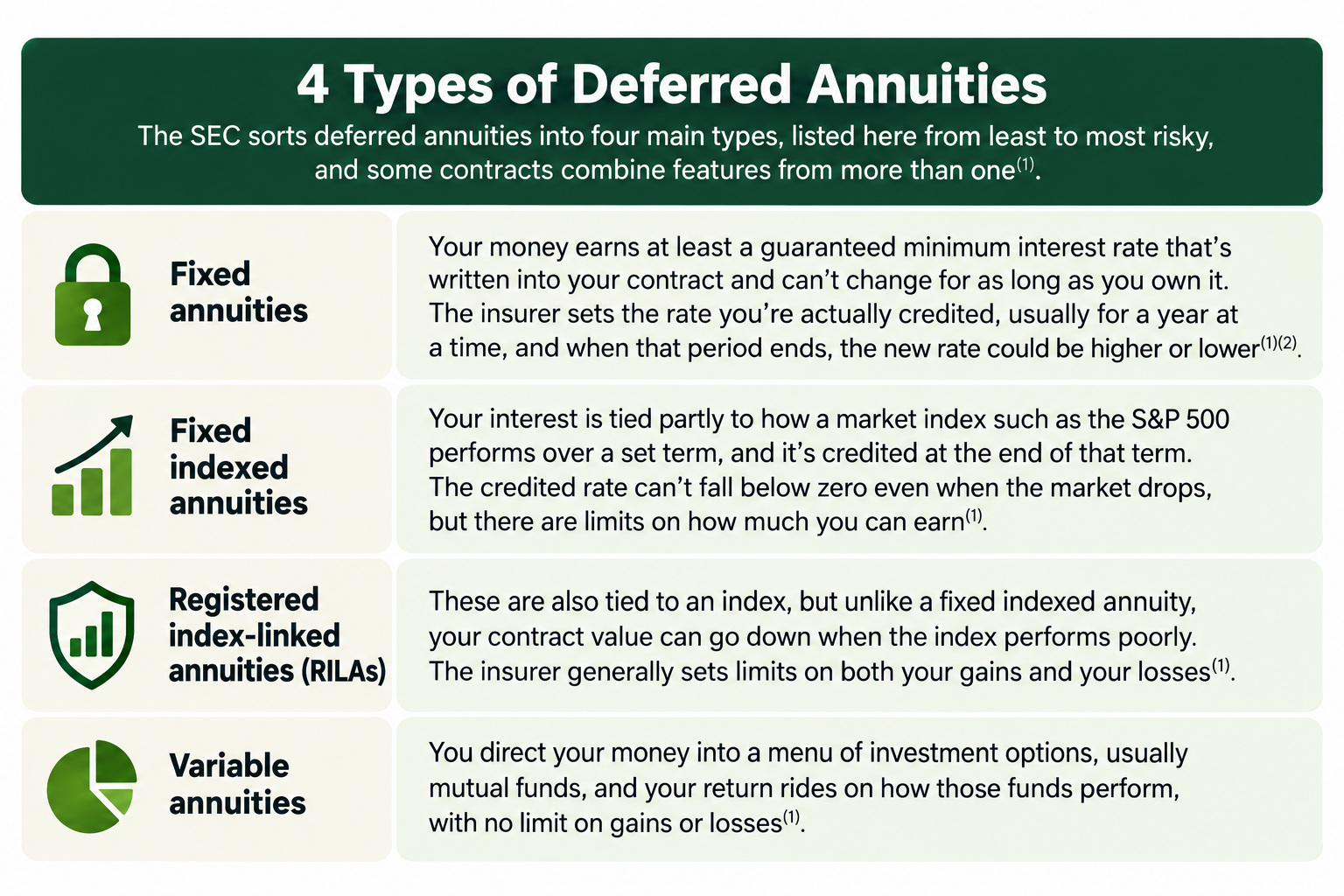
How these products are regulated tells you something too. Fixed and fixed indexed annuities are insurance products overseen by your state’s insurance regulator. RILAs and variable annuities are both insurance products and securities, so they must also register with the SEC and come with a prospectus you can read before you buy(1).
What are you trading away when you buy an annuity?
Every annuity is a trade between control and certainty. Here's how a simple fixed or income annuity compares with investing the same money yourself in low-cost index funds.
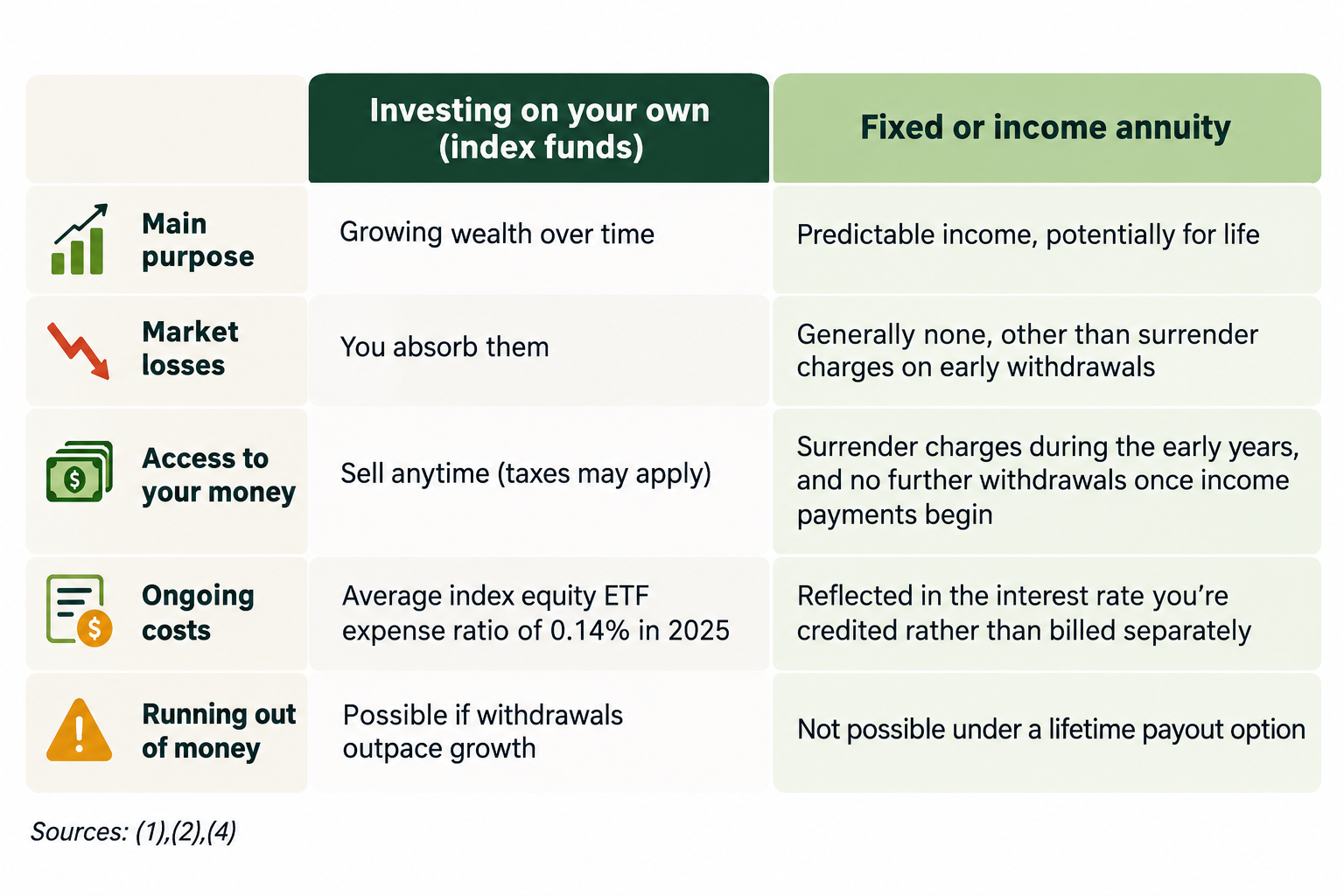
An exchange-traded fund (ETF) that tracks an index is about as cheap as investing gets, and you can sell it on any trading day. A fixed annuity gives up that flexibility in exchange for a guaranteed minimum interest rate set by the insurer, while a lifetime payout gives up access to the money entirely in exchange for checks that keep coming no matter how long you live. Neither is explicitly better than the other, the right one depends on which risk keeps you up at night, a market crash or outliving your money(1)(2).
Which annuities earn the "cash grab" reputation?
Two product types, variable annuities and fixed indexed annuities, carry far more moving parts than a plain fixed annuity, and some of their costs are harder to see. Both are deferred annuities, meaning your money grows for a period of years before income payments begin(1).
Why do variable annuities cost so much more?
A variable annuity works like an investment account wrapped inside an insurance contract. You choose from a menu of investment options, usually mutual funds, and your balance rises or falls with their performance, which means you can lose money, including the money you originally put in(5). The fee structure is where the reputation comes from.
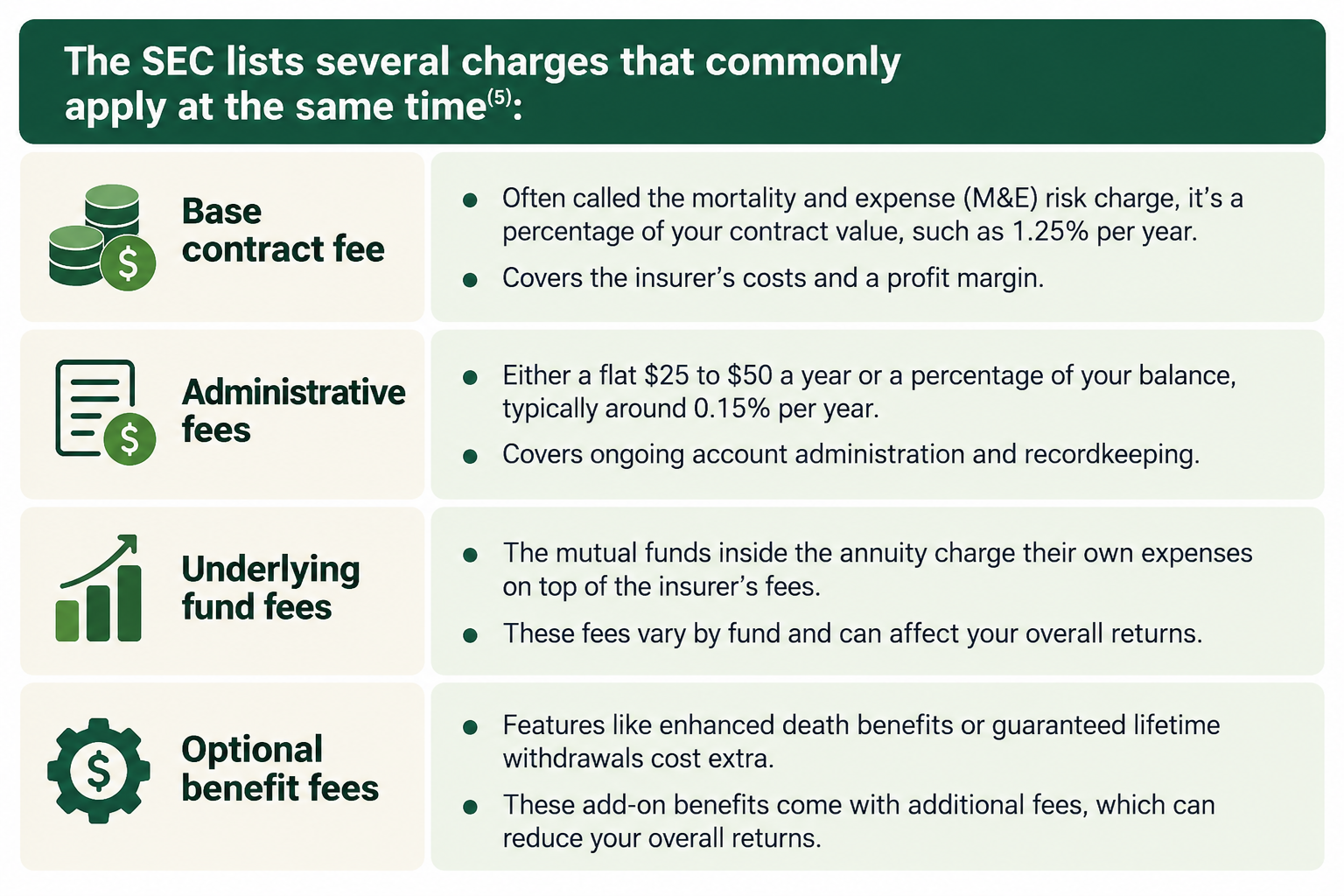
To see what that looks like in dollars, take a hypothetical $300,000 variable annuity using the SEC's example figures. A 1.25% base contract fee costs $3,750 a year, and a 0.15% administrative fee adds another $450, for $4,200 a year before a single dollar goes to fund expenses or optional riders. The same $300,000 in an index equity ETF charging the 2025 average expense ratio of 0.14% would cost about $420 a year(1)(4)(5).
Taxes are another factor.
Gains in a variable annuity are taxed at ordinary income rates when you withdraw them, rather than at lower capital gains rates. The SEC's own guidance is that the benefits of tax deferral generally outweigh a variable annuity's costs only if you hold it for the long term(5).
Some variable annuities promise to add a percentage of your purchase payment to your account, typically 1% to 5%, so a 3% bonus on $100,000 would add $3,000. The SEC cautions that annuities with ‘bonus credits’ may charge higher fees than those without, and that those fees can outweigh the bonus(5).
How do caps and participation rates limit an indexed annuity's growth?
A fixed indexed annuity credits interest based partly on how a market index such as the S&P 500 performs over a set term, often one year, and the credited rate is guaranteed never to fall below zero even when the market drops. That floor is the selling point. The tradeoff is that you rarely receive the index's full gain(1).
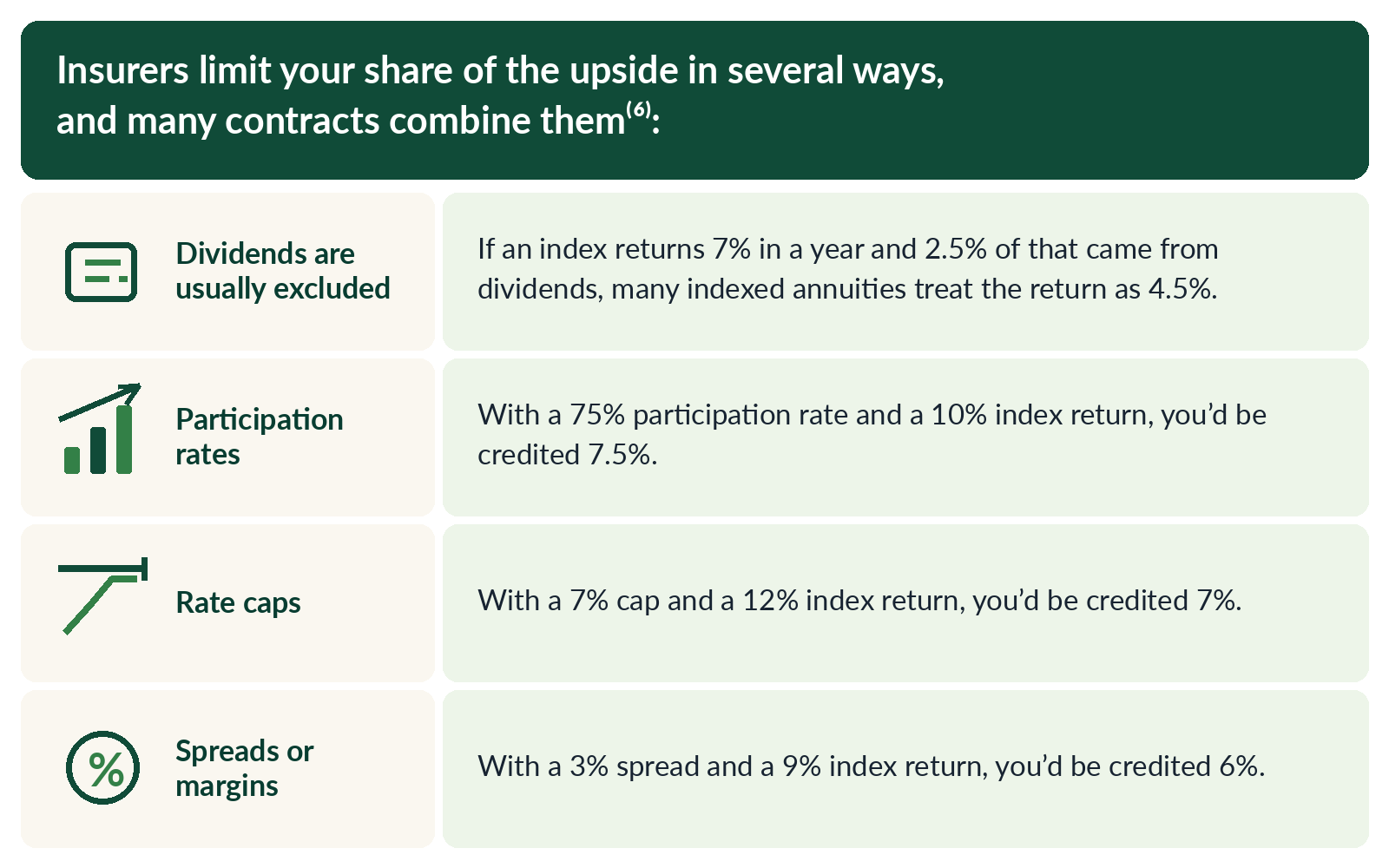
The SEC points out that these features can reduce your return just as a direct fee would, even when the product is marketed as having no fees. Many contracts also let the insurer change caps, participation rates, and spreads from time to time, which means the terms you buy may not be the terms you keep over the long-term(6).
Getting out early can be expensive.
Surrender periods on indexed annuities typically run six to ten years or longer, and under some contracts, withdrawing money means forfeiting interest that's already been credited. The Financial Industry Regulatory Authority (FINRA) also notes that the variety and complexity of crediting methods can make it hard to compare one indexed annuity with another, which is a real disadvantage when you're trying to judge whether you're getting a fair deal(6)(7).
There's also a newer cousin, the registered index-linked annuity (RILA). Unlike a fixed indexed annuity, a RILA can lose money when the index falls, with losses limited by a "buffer" or "floor" you select in exchange for capped gains(1)(7).
When does an annuity make sense?
Strip away the complex products and you're left with the simplest form of annuity, the kind that does one job and does it predictably.
What does an income annuity do that your portfolio can't?
With an immediate annuity, you make a single payment and typically start receiving income within one year. Depending on the contract, you can choose to receive payments for your lifetime, for the longer of your life or your spouse's life, for a set number of years, or for the longer of your lifetime or a set period(1)(2).
The lifetime options are where an annuity does something your portfolio can't. Social Security puts life expectancy for someone turning 65 in the mid-80s, and the agency specifically warns that if you come from a long-lived family, you may need extra money in your later years and could outlive pensions or annuities that only pay for a limited time(8). A lifetime payout removes that uncertainty for the portion of savings you put into it.
One practical way to think about it is to separate your expenses into two groups. Essential costs like housing, food, utilities, and insurance premiums need to be paid every month no matter what the market does, while travel and gifts can flex. If Social Security and any pension already cover your essentials, you may not need an annuity at all. If they don't, converting part of your savings into lifetime income can close that shortfall and leave the rest of your portfolio free to stay invested.
The SEC's own profile of a typical fixed annuity buyer is someone with a long time horizon and a very low to low tolerance for risk, who wants to protect assets and is looking for a guaranteed, set return. If that description sounds like you, a simple, low-cost fixed or immediate annuity is a very different product from the fee-heavy contracts that earned the industry its reputation(1).
How safe is the insurer's guarantee?
An annuity's guarantees are only as strong as the company behind them. The insurer's obligations depend on its financial strength and claims-paying ability, which is why the National Association of Insurance Commissioners (NAIC) recommends checking an insurer's rating from independent agencies such as A.M. Best, Standard & Poor's, Moody's Investors Service, and Fitch before you buy(1)(2).
There is a backstop if an insurer fails. State life and health insurance guaranty associations operate in all 50 states, Puerto Rico, and Washington, D.C., and they continue coverage for policyholders up to limits set by state law.
Those limits have exclusions. Coverage generally doesn't extend to portions of a contract the insurer doesn't guarantee or where the contract owner bears the risk, which includes the investment portion of a variable annuity. If you're placing a large sum, it's smart to contact your state's guaranty association to confirm exactly how its limits would apply to you(9).
What should you check before signing?
If you're seriously weighing an annuity, these steps protect you from the worst outcomes:
- Get the full fee picture in writing. Ask about upfront, surrender, ongoing, and implicit costs, and how long you'd need to hold the contract to avoid surrender charges and contract adjustments(1).
- Ask how the salesperson gets paid. The NAIC notes that insurers usually pay the salesperson after the sale and encourages buyers to ask directly how they earn money from it(2).
- Know your free look period. State law typically gives you 10 to 30 days after you receive the contract to change your mind and return it(1).
- Check the seller's record. Anyone selling a variable annuity must be registered with FINRA, and you can look up a professional's registration and disciplinary history through the SEC's Investor.gov search tool(1)(2).
What do people get wrong about annuities?
Buying an annuity inside an IRA for the tax break
Tax-deferred growth is one of the main features annuity salespeople highlight, but if the annuity sits inside a traditional individual retirement account (IRA) or 401(k), the account already provides that deferral. The SEC is explicit that you get no additional tax advantage from holding an annuity inside a tax-deferred retirement plan, so you'd be paying for a feature you already have(1).
Assuming "no fee" means free
Many fixed and fixed indexed annuities don't charge explicit ongoing fees, which can make them sound cheaper than they are. Their costs show up instead as lower credited interest, caps, participation rates, and spreads, and the SEC notes these can cut your return the same way a direct fee would. The right question isn't whether there's a fee, but how much of the index's gain you'd give up(1)(6).
Forgetting what happens to the money when you die
Once you annuitize, meaning you convert your balance into a stream of income payments, your beneficiaries may receive nothing after your death unless the annuity guarantees to pay out at least what you paid in or you chose a payout option that continues after you're gone. The payout period you choose also affects the size of each check, so if leaving something behind is important to you, compare the joint-life and set-period options against a lifetime-only payout before you commit(2)(5).
Get a second opinion before you commit
An annuity is one of the few financial decisions that can be hard to undo once the free look window closes, and the person selling it may be paid on the sale. If you're weighing an offer, having an advisor review the contract alongside the rest of your retirement picture can tell you whether you'd be paying a fair price for the income you want, or whether the same goal is within reach for less.
References
1. U.S. Securities and Exchange Commission, Investor.gov. "Annuities." https://www.investor.gov/introduction-investing/investing-basics/investment-products/annuities
2. National Association of Insurance Commissioners. "Buyer's Guide for Deferred Annuities." https://content.naic.org/sites/default/files/publication-anb-lp-consumer-annuities.pdf
3. U.S. Securities and Exchange Commission, Investor.gov. "Managing Lifetime Income." https://www.investor.gov/additional-resources/retirement-toolkit/managing-lifetime-income
4. Investment Company Institute. "Mutual Fund and ETF Fees Remained Near Historic Lows in 2025." March 25, 2026. https://www.ici.org/news-release/mutual-fund-and-etf-fees-remained-near-historic-lows-in-2025
5. U.S. Securities and Exchange Commission, Investor.gov. "Variable Annuities." https://www.investor.gov/introduction-investing/investing-basics/investment-products/annuities/variable-annuities
6. U.S. Securities and Exchange Commission, Investor.gov. "Updated Investor Bulletin: Indexed Annuities." July 31, 2020. https://www.investor.gov/introduction-investing/general-resources/news-alerts/alerts-bulletins/investor-bulletins/updated-investor-bulletin-indexed-annuities
7. Financial Industry Regulatory Authority. "The Complicated Risks and Rewards of Indexed Annuities." July 14, 2022. https://www.finra.org/investors/insights/complicated-risks-and-rewards-indexed-annuities
8. Social Security Administration. "What Important Things To Consider When Planning for Retirement." https://www.ssa.gov/benefits/retirement/planner/otherthings.html
9. National Organization of Life & Health Insurance Guaranty Associations. "How You're Protected." https://nolhga.com/policyholders/how-youre-protected/